Most people who plan a helicopter tour in the Khumbu region think of Everest Base Camp as the destination. And that makes sense, EBC is the most famous point in the Himalaya, and landing near it is genuinely extraordinary. But there is a tour that goes beyond EBC, covers more terrain, and for many passengers delivers a more complete picture of the Khumbu than the EBC stop alone. The Gokyo Lakes helicopter tour, combining the turquoise glacial lakes of Gokyo Valley with the Everest Base Camp landing, covers ground that takes trekkers 12 to 16 days to reach, in a single morning flight.
Here is what you need: everything about the Gokyo Lakes helicopter tour: the route, what Gokyo actually is, why it matters, what it costs, when to go, and how it compares to doing EBC alone. It is a longer flight, a more expensive tour, and for the right type of traveller, it is the most memorable morning available anywhere in Nepal.
What Are the Gokyo Lakes?
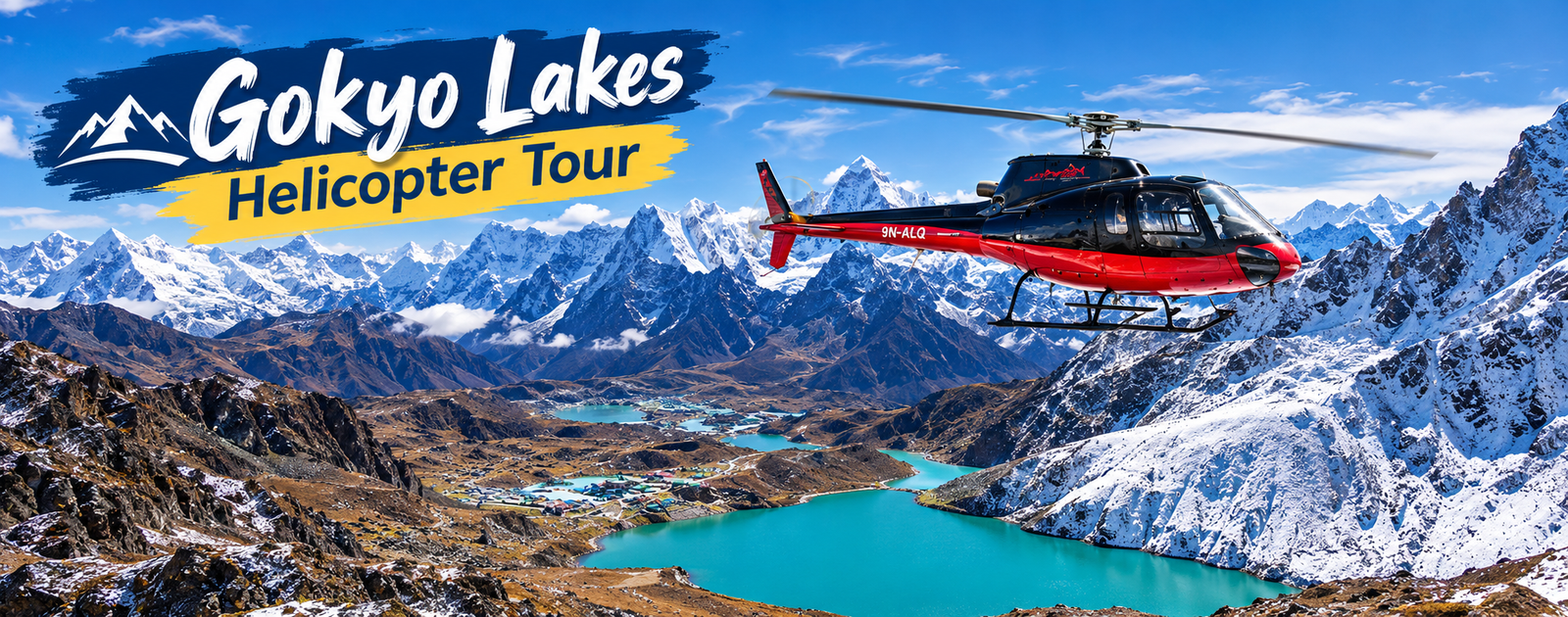
The Gokyo Lakes are a chain of six high altitude glacial lakes in the Gokyo Valley, northwest of Everest Base Camp. The main lakes, Longponga, Taujung, Gokyo (or Dudh Pokhari), Thonak, Ngojumba, and Gyazumpa, sit at altitudes between 4,700 and 5,000 metres. They are fed by glacial melt and snowpack and are among the highest freshwater lakes in the world.
What makes these lakes visually extraordinary is their colour. At altitude, with no suspended sediment and the deep blue of a clear Himalayan sky reflected in still water, the Gokyo Lakes appear an intense, almost artificial turquoise, the same colour as the most photographed mountain lakes in Patagonia or the Swiss Alps, but set against a backdrop of glaciers and 8,000-metre peaks rather than forested hills. The contrast between the ice-blue water and the white glaciers above is unlike anything else in the Khumbu.
The Gokyo Valley sits alongside the Ngozumpa Glacier, at approximately 36 kilometres in length, the longest glacier in the Himalaya. Flying over the Ngozumpa gives you an aerial perspective on scale that ground photography cannot convey: a river of ice and debris extending from the high peaks to the valley below, fractured and crevassed, with meltwater streams cutting through its surface.
Gokyo Ri: The View That Beats Everything
Trekkers who reach Gokyo Village typically spend a morning climbing Gokyo Ri, a rocky summit at 5,357 metres immediately above the third Gokyo Lake. The 360-degree panorama from Gokyo Ri is widely considered the single best non-technical mountain viewpoint in all of Nepal. From here, you can see four 8,000-metre peaks simultaneously: Everest (8,849m), Lhotse (8,516m), Makalu (8,485m), and Cho Oyu (8,188m). No other viewpoint in Nepal puts four of the world’s 14 highest peaks in a single frame.
The helicopter tour does not land on Gokyo Ri itself, the summit is too narrow and exposed for a safe helicopter approach. But the flight over and around Gokyo Ri in a helicopter gives you views of this panorama from the air that, in many ways, surpass what you see on foot, because you see the peaks and the lake simultaneously, from angles that ground walkers cannot access.
The EBC + Gokyo Route: What the Tour Actually Covers
The combined EBC and Gokyo helicopter tour varies between operators in sequence and emphasis, but the standard route from Kathmandu typically works like this:
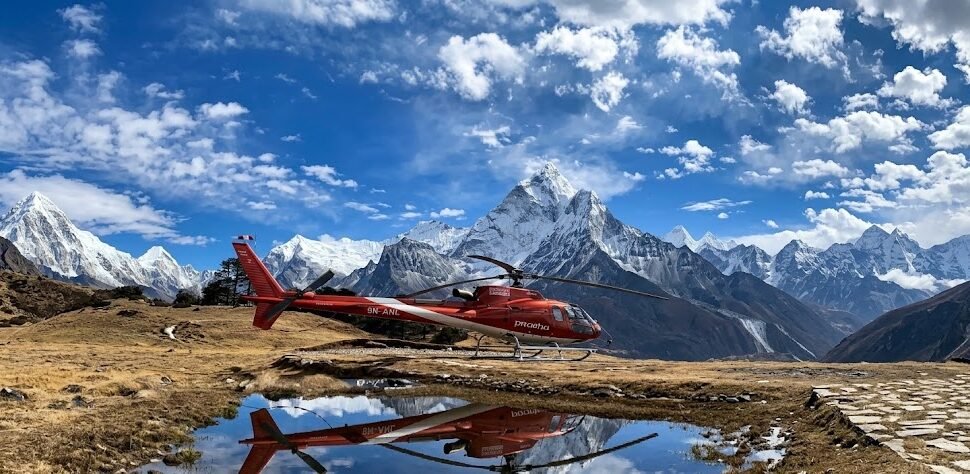
Departure from Kathmandu at approximately 6:00 to 6:30 AM. The flight heads east into the Khumbu, the same approach as the standard EBC tour, with the first high altitude landing at Kala Patthar (5,545 metres) or near Everest Base Camp (5,364 metres). Passengers have 10 to 15 minutes on the ground for the EBC stop.
The helicopter then departs EBC/Kala Patthar and flies northwest over the lateral moraine of the Khumbu Glacier, crosses the ridge between the Khumbu and Gokyo valleys, and descends into the Gokyo Valley. The Ngozumpa Glacier passes beneath, from the air, its scale is staggering. The flight then follows the Gokyo Valley south past the chain of lakes, giving a complete aerial view of all the major lake bodies and the Gokyo Ri summit ridge. The helicopter may do one or two passes over the main lake (Gokyo/Dudh Pokhari) for photography before heading south through the Dudh Koshi drainage back to Kathmandu. Some itineraries include a brief landing at Gokyo teahouse settlement for an additional ground stop.
Total flight time: approximately 5 to 6 hours from hotel pickup to return.
Gokyo Lakes Tour Cost (2026)
| Tour Type | Price Per Person (Shared) | Private Charter (Total) | Duration |
|---|---|---|---|
| EBC + Gokyo Fly-Over (no Gokyo landing) | $1,150, $1,350 | $4,500, $5,500 | 5 hours |
| EBC + Gokyo with Gokyo Landing | $1,350, $1,600 | $5,500, $7,000 | 5.5 6 hours |
| Gokyo Only (no EBC stop) | $1,000, $1,200 | $4,000, $5,000 | 4 5 hours |
The premium over a standard EBC tour reflects additional flight time and fuel for the Gokyo extension. At the per-person level, the EBC + Gokyo tour typically costs $200 to $400 more than the standard EBC tour. For a private charter, the premium is $800 to $1,500 for the full combined tour over the EBC-only charter. Price comparison with standard EBC tour: Everest Helicopter Tour Cost 2026.
Book our Gokyo combination tour directly: EBC with Gokyo Heli Tour.
Best Time for the Gokyo Lakes Helicopter Tour
The same seasonal logic applies to the Gokyo tour as to the EBC tour, with a few nuances specific to the Gokyo Valley.
October and November, Best
The Gokyo Lakes are most photogenic when the water is clear and unfrozen, reflecting maximum sky colour. October delivers this perfectly. The lakes reach their most intense turquoise in October before winter temperatures begin to freeze the edges. November is also excellent, though the lakes begin to develop ice around their margins by late November, which is its own striking visual.
March to May, Excellent
The lakes thaw from April onwards as temperatures rise. By late April and through May, they have returned to full turquoise. Spring cloudiness can build more quickly than in autumn in the Gokyo Valley, departures before 7:00 AM are important in May to complete the Gokyo circuit before afternoon build-up.
December to February, Possible, with Cautions
In winter, the Gokyo Lakes are typically partially or fully frozen. A frozen Gokyo Lake is striking in its own right, brilliant white ice against dark rock, the surrounding peaks in winter clarity. But the turquoise colour that makes Gokyo distinctive is largely absent in deep winter. February is the best of the winter months, with conditions improving toward spring. If winter is your only option, expect ice-covered lakes and plan accordingly for photography.
Monsoon, Avoid
The Gokyo Valley receives significant monsoon precipitation. The lakes are typically grey and clouded in appearance during monsoon, and the valley approach clouds over almost daily. The Gokyo extension is not worth attempting during June through September for most visitors.
Gokyo Lakes vs EBC: Which Adds More?
If you have already done or are planning the standard EBC helicopter tour, the question is whether the Gokyo extension justifies the additional cost. Here is the honest assessment.
The EBC stop gives you the world’s most famous mountain at close range. The Khumbu Icefall, the route of Everest expeditions, the stark high altitude terrain, all from 5,364 to 5,545 metres. It is extraordinary.
The Gokyo addition gives you the following that the EBC-only tour does not:
- Aerial views of the Ngozumpa Glacier, the longest glacier in the Himalaya
- The turquoise lakes, a visual element completely different from the grey-brown Khumbu terrain
- The Gokyo Ri panorama, four 8,000-metre peaks simultaneously from the air
- The Gokyo Valley’s greener, slightly softer terrain compared to the stark Khumbu
- Significantly more total terrain covered, giving you a much broader picture of the Khumbu region
For first time visitors choosing between the standard EBC tour and the EBC + Gokyo tour: if budget allows and time permits, the combined tour is the more complete Khumbu experience. The lakes add a visual element, the intense blue-green water against glaciers and peaks, that the EBC stop alone cannot provide. For travellers who have already done the EBC stop and want to see more of the Khumbu on a return visit, the Gokyo extension is the natural progression.
What to Expect at the Gokyo Landing (If Your Tour Includes One)
If your tour includes a ground stop at Gokyo teahouse settlement (near the main lake at approximately 4,790 metres), the experience is different from the EBC stop. The terrain here is less stark, stone-built teahouses, the lake immediately beside the landing area, yaks grazing on the moraines. The altitude is slightly lower than EBC (4,790 metres vs 5,364 metres), which means the physiological experience is somewhat gentler for most passengers.
The visual composition from the ground at Gokyo is exceptional: the lake in the foreground, Cho Oyu (8,188 metres) and Gyachung Kang (7,952 metres) framing the valley head, and the Ngozumpa Glacier’s lateral moraine rising immediately to the east. Photography from the ground at Gokyo is more compositionally varied than at the EBC landing zone, where the terrain is more uniformly rocky with fewer distinct foreground elements.
Photography on the Gokyo Tour
The Gokyo Lakes tour is specifically outstanding for aerial photography because the colour contrast between the lakes and the surrounding terrain is dramatic from altitude. The standard EBC tour is excellent for close range mountain photography at the landing zone; the Gokyo extension adds colour and landscape variety that the EBC terrain lacks.
Practical photography advice specific to the Gokyo extension:
- Shoot during the Gokyo Valley fly-over with your lens toward the lake side of the aircraft, typically the left side on the northwest approach. Ask your operator which side of the aircraft faces the lakes on your specific route before boarding.
- The Ngozumpa Glacier is best photographed from directly above or at a shallow angle, the texture and scale of crevassing is only evident when you can see the full glacier body. Shoot during the approach rather than waiting for the best angle to pass.
- The four-peak Gokyo Ri panorama is most effective with a wide angle lens, the peaks span more than 180 degrees of the horizon. A zoom lens will capture each peak individually but misses the impression of being surrounded by them.
Full packing and camera guide: What to Pack for an Everest Helicopter Tour.
Altitude on the Gokyo Tour
The altitude profile of the EBC + Gokyo tour is similar to the standard EBC tour, the Kala Patthar or EBC landing is still the highest point, at 5,364 to 5,545 metres. The Gokyo flight path and landing (if included) are at 4,790 metres, moderately high but below the EBC stop altitude. Most of the additional Gokyo circuit is flown at between 5,000 and 5,500 metres in the aircraft, not at ground level.
The longer total flight time (5 to 6 hours versus 4 to 5 hours for the standard EBC tour) means the pilot and aircraft are airborne for longer, a consideration for fuel management and pilot scheduling, but not an additional altitude risk for passengers. Full altitude guide: Altitude Sickness on the Everest Helicopter Tour.
Gokyo in the Context of the Full Khumbu: Why It Matters
The Khumbu region is not just Everest. It is an entire mountain landscape, glaciers, valleys, lakes, passes, and peaks, that extends far beyond the EBC moraine. The Gokyo Lakes, the Cho La pass connecting Gokyo to the EBC trail, the Renjo La pass above the upper Gokyo Lakes, and the perspective of Everest from the Gokyo Ri ridgeline, all of these are part of a complete picture of the Khumbu that EBC alone does not provide.
Trekkers who walk the Gokyo route, rather than or in addition to the EBC route, consistently describe it as the more scenic of the two options, with greater variety, less foot traffic, and the memorable lakes as the centrepiece. The helicopter tour captures this extended landscape in a single flight, giving you both the fame of EBC and the extraordinary variety of the Gokyo Valley in one morning.
How to Book the Gokyo Lakes Helicopter Tour
Our dedicated EBC + Gokyo combination tour: EBC with Gokyo Heli Tour. This is our most complete Khumbu helicopter tour and the one we recommend for visitors who want the most complete Everest region experience available in a single morning.
Booking guidance, including how to choose the right operator, what questions to ask, and how weather cancellations work: How to Book an Everest Helicopter Tour.
Our other Khumbu packages for comparison:
- Standard EBC Helicopter Tour, the EBC experience without the Gokyo extension
- EBC with Kala Patthar Landing, the highest available landing, direct Everest South Face view
- Group Charter, private helicopter for your group on any route
Frequently Asked Questions: Gokyo Lakes Helicopter Tour
How long does the Gokyo lakes tour take compared to the standard EBC tour?
The EBC + Gokyo combination adds approximately 60 to 90 minutes of flight time over the standard EBC tour. Total tour time from hotel pickup to return: 5 to 6 hours versus 4 to 5 hours for EBC-only. You are still back in Kathmandu by noon or early afternoon on a normal day.
Can I see the Gokyo Lakes from the EBC landing zone?
No, the EBC/Kala Patthar landing zone and the Gokyo Lakes are in separate valleys separated by a ridge. They are not visible from each other at ground level. The Gokyo extension requires flying over that ridge into the Gokyo Valley, it is a genuinely different location, not just a different viewing angle of the same terrain.
Are the Gokyo Lakes always accessible by helicopter?
No, the Gokyo Valley can develop cloud more quickly than the Khumbu in some weather conditions, particularly in spring afternoons. Some EBC + Gokyo tours complete the EBC stop and then cannot proceed to Gokyo due to cloud in the connecting ridge or the Gokyo Valley. In this case, the tour returns to Kathmandu after EBC. Your operator should have a clear policy on pricing if the Gokyo portion is weather-prevented, confirm this before booking.
Is the Gokyo extension worth the extra cost?
For photography-motivated visitors, almost certainly yes, the lakes add a colour and landscape element that the EBC terrain does not have. For visitors whose primary goal is the Everest close up and who have a tighter budget, the standard EBC tour may be sufficient. For first time visitors to the Khumbu who want the most complete experience available in one flight, yes, the Gokyo extension is worth it.
What is Ngozumpa Glacier and why does it matter?
Ngozumpa is the largest glacier in the Himalaya by area, approximately 36 kilometres long and up to 3 kilometres wide. It descends from the peaks around Cho Oyu and Gyachung Kang, filling the valley floor of the Gokyo region. Flying over it in a helicopter reveals its scale, it is an extraordinary natural feature that is impossible to appreciate fully from the ground. The Gokyo Lakes exist precisely because Ngozumpa’s lateral moraines have dammed the valley floor to create lake basins. Understanding the glacier explains the lakes.
Can I do the Gokyo tour on its own without the EBC stop?
Yes, some operators offer Gokyo-only tours that fly directly from Kathmandu to the Gokyo Valley without the EBC detour. These are slightly shorter and slightly less expensive than the combined tour. If your primary interest is the lakes rather than EBC, a Gokyo-only tour is a legitimate option, ask your operator about this variant.
The Bottom Line on the Gokyo Lakes Helicopter Tour
The Gokyo Lakes helicopter tour is, in terms of visual variety, the most complete Khumbu experience available by air. It covers the world’s most famous mountain at close range AND one of the most striking lake landscapes in the Himalaya, in a single morning flight from Kathmandu.
For first time visitors to Nepal with the budget and the interest, the EBC + Gokyo combination is the tour we most often recommend over the EBC-only option. It delivers more terrain, more visual variety, and a fundamentally different element (water, colour, glacier scale) that the EBC stop alone cannot provide.
The lakes are waiting. They will not look the way a photograph suggests until you are above them in a helicopter at 5,000 metres, looking down at that extraordinary turquoise against the white of the Ngozumpa and the grey moraines. It is the kind of view that, if you have been to the Swiss Alps or Patagonia and seen the lakes there, recalibrates your sense of what mountain scenery can be.
Book the tour: EBC with Gokyo Heli Tour.
The Six Gokyo Lakes: Each One Named and Described
The Gokyo Lakes are a chain of six glacial lakes in the Gokyo Valley, each at a different elevation and with its own character. Flying in from the south, you encounter them in this order:
Longponga (Trochog Tso), 4,660 metres: The southernmost and largest lake by surface area. The most accessible on foot from the main trail. In autumn the water is a muted green-blue. In winter it freezes from the edges inward, leaving a rim of white ice around a dark centre.
Taujung (Taboche Tsho), 4,670 metres: A smaller, rounder lake immediately north of Longponga. It sits in a bowl flanked by moraine ridges and catches light differently depending on the time of morning. Less photographed than the others but quietly beautiful.
Gokyo (Dudh Pokhari), 4,750 metres: The third and most famous lake. Dudh Pokhari means milk lake in Nepali, though the water is anything but milky, being an intensely clear turquoise. The teahouse settlement of Gokyo Village sits on its eastern shore. This is the lake in most Gokyo photographs. The one that you fly over and immediately understand why people walk ten days to see it.
Thonak (Thonak Tsho), 4,830 metres: The fourth lake, the most remote from the village and least visited on foot. It is elongated in shape. The way it reflects the flanking ridges on calm mornings makes it photogenic from altitude in a way its modest reputation among trekkers does not suggest.
Ngojumba (Ngojumba Tsho), 4,980 metres: Named after the glacier that terminates immediately to its north. Glacial meltwater carries suspended sediment into this lake, giving it a colder grey-green colour rather than the clear turquoise of the lower lakes. Flying over it puts you directly above the terminus of the longest glacier in the Himalaya.
Gyazumpa (Gyazumba Tsho), 5,000 metres: The highest and most remote of the six. Only properly acclimatised trekkers reach it on foot. From the helicopter, it appears as a sheet of water at the base of high glacial terrain, surrounded entirely by rock and ice with no vegetation. The silence implied by the view is absolute.
The Cho La Pass: What Connects Gokyo and EBC on Foot
One of the things that makes the Gokyo region particularly interesting in the context of Everest is what connects them on the ground. The Cho La is a glaciated mountain pass at 5,420 metres that crosses the ridge between the Gokyo Valley and the Khumbu Valley. Experienced trekkers cross the Cho La to link both valleys in what is called the Three Passes Trek, one of the most demanding routes in Nepal.
The Cho La crossing is serious. The eastern approach involves a steep descent on ground that can be icy depending on the season, requiring trekking poles and, in some conditions, crampons. The ascent from the Gokyo side involves a rocky glacier crossing with crevasse risk. It is not a route for casual walkers regardless of fitness level.
In the combined EBC and Gokyo helicopter tour, you fly over the ridge that contains the Cho La in approximately 8 to 10 minutes. What takes a fit, well equipped trekker a full hard day of demanding mountain travel takes the helicopter slightly longer than it takes to drink a cup of tea. The aerial view of that ridge makes the scale of what trekkers accomplish on the Three Passes route immediately and viscerally clear. Many passengers who have completed both the trek and the helicopter tour describe the ridge crossing moment in the helicopter as the one that gave them the clearest understanding of what their trekking companions went through. The helicopter does not diminish that understanding. It creates it.
Related reading: Everest Helicopter Tour Cost 2026 | Kala Patthar Helicopter Landing | Best Time to Visit | How to Book | Private vs Group