People ask us this question every single day: How much does an Everest helicopter tour actually cost? And the honest answer is, it depends on more factors than most travel sites bother to explain. The price you see on one website might be $800. Another shows $3,500. A third quotes something in between. No wonder people are confused.
Here is every cost involved in an Everest Base Camp helicopter tour, explains why prices vary so dramatically, and tells you exactly what you should expect to pay in 2026. We have been running these tours for years, and we know where operators cut corners and where the real value lies. Read this before you book anything.
Everest Helicopter Tour Cost in 2026: The Short Answer
If you want the numbers upfront, here they are. A shared Everest Base Camp helicopter tour, where you join four or five other passengers in one helicopter, costs between $1,000 and $1,250 per person in 2026. A private charter, where you book the entire helicopter for your group, runs between $3,500 and $5,500 depending on the route, helicopter model, and season.
Those are the honest 2026 figures. Everything below explains what drives those numbers and how to make sure you get genuine value for your money.
Why Everest Helicopter Tour Prices Vary So Much
Before we dive into the price breakdown, you need to understand the three biggest factors that move the needle on cost. Ignore these and you will almost certainly end up comparing prices that are not actually comparable.
Factor 1, Shared vs Private Charter
This is the single biggest price driver. A shared tour means the operator sells individual seats on one helicopter. Typically five or six passengers fly together, split the cost, and you end up paying somewhere around $1,000 to $1,200 per seat. A private charter means you book the entire helicopter, usually a five or six seater, for one flat fee. You decide who comes, you set the schedule, and you do not wait for a stranger’s group to fill up.
Private charters give you flexibility that shared tours cannot match. You can spend longer at high altitude. You can request a second circuit around Everest. You can land at multiple points. If you are traveling as a family or a group of four or more, a private charter often works out to roughly the same per person cost as a shared tour, sometimes less, since you negotiate the whole aircraft price.
Factor 2, Route and Landing Points
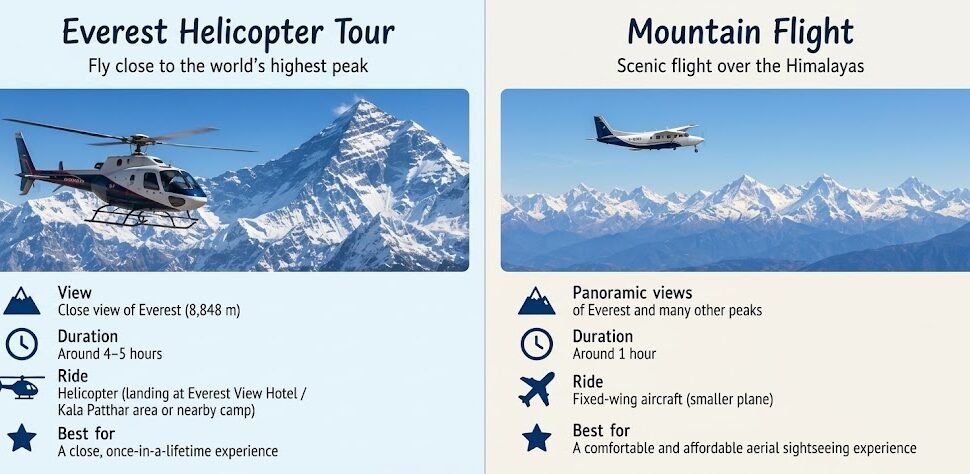
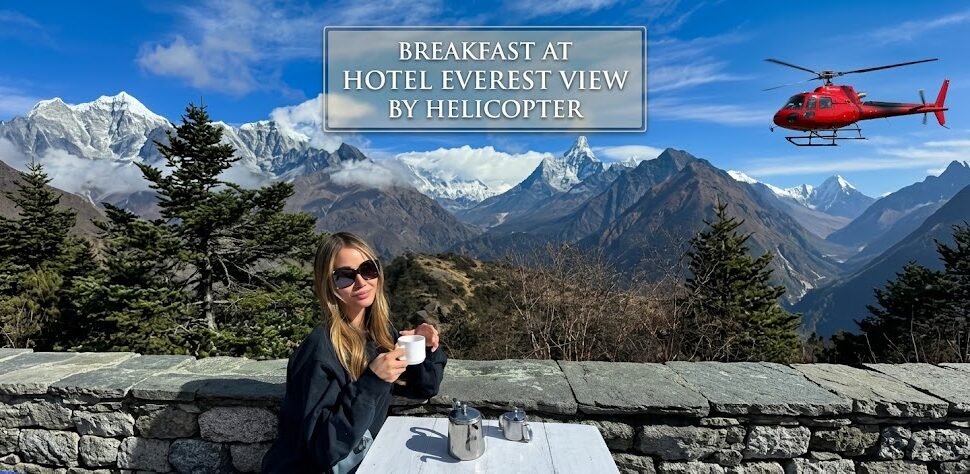
The standard shared tour lands at Kala Patthar (5,545 metres) or at the ridge near Everest Base Camp (around 5,364 metres) for a brief stop of 10 to 15 minutes. Some operators add a landing at Hotel Everest View (3,962 metres) for a champagne or tea breakfast with unobstructed Himalayan views. Others offer a Gokyo Lakes extension that adds the turquoise glacial lakes and Gokyo Ri to the flight path.
Each additional landing adds cost. The Gokyo extension adds roughly $200 to $350 per person on a shared tour. The Hotel Everest View breakfast stop adds $50 to $150 depending on what is included. Make sure you know exactly which route you are buying before you compare prices across operators.
Factor 3, Helicopter Type and Age
Not all helicopters are the same. Most Everest helicopter tours in Nepal use one of three aircraft: the AS350 B3e (Airbus H125), the Bell 407, or the older Ecureuil series. The AS350 B3e is the gold standard for high altitude flying in Nepal. It has the most powerful engine for its class, excellent single engine safety margins, and a proven record in extreme altitude conditions. The Bell 407 is slightly larger and quieter. Older models cost less to operate but have higher maintenance requirements and, honestly, should give you pause.
Reputable operators fly modern, properly maintained aircraft. If a quote is significantly below the market rate, the first question to ask is: what helicopter? How old? When was the last engine overhaul?
Everest Helicopter Tour Prices by Package Type (2026)
| Package | Type | Price Per Person | Duration | What’s Included |
|---|---|---|---|---|
| Standard EBC Tour | Shared (5-6 pax) | $1,000, $1,200 | 4 5 hours | EBC/Kala Patthar landing, Kathmandu pickup |
| EBC with Hotel Everest View Breakfast | Shared | $1,100, $1,350 | 5 6 hours | EBC landing + breakfast at 3,962m |
| EBC with Kala Patthar Landing | Shared | $1,150, $1,400 | 5 hours | Kala Patthar landing, highest point in the tour |
| Gokyo + EBC Combo | Shared | $1,350, $1,600 | 5 6 hours | Gokyo Lakes, EBC, Kala Patthar |
| Honeymoon / Romantic Package | semi private (2 pax) | $1,500, $1,900 per person | 5 hours | Champagne, private seating, hotel pickup |
| Private EBC Charter (full helicopter) | Private (up to 5 pax) | $3,500, $4,500 total | Custom | Flexible landing, custom route, any group size |
| Private Deluxe Charter | Private premium | $4,500, $5,500 total | Custom | Premium aircraft, multi-stop, champagne breakfast |
Prices are in US dollars and reflect 2026 rates. They can fluctuate by 5 10% between operators. All legitimate operators charge roughly similar rates because their operating costs, fuel, landing fees, CAA Nepal permits, are fixed.
What Is Actually Included in the Price
This is where operators differ most and where cheap quotes often hide the full cost. Here is what a reputable full service operator should include at no extra charge.
Airport Transfers
Hotel pickup and drop in Kathmandu is standard. You should not be paying extra for a car to Tribhuvan International Airport or to the helicopter terminal at Shyambhu. If an operator asks you to arrange your own transport, that is a red flag, or at minimum, factor in that cost when comparing prices.
Government Permits and Landing Fees
Flying into the Khumbu region and landing near Everest Base Camp requires permits from the Civil Aviation Authority of Nepal (CAAN) and Sagarmatha National Park entry fees. These should be baked into your tour price. Some budget operators list a lower headline price and then add these fees at booking or worse, at the helipad. Confirm explicitly: are park entry fees included?
Insurance for the Flight
Your operator’s aircraft must carry aviation insurance. This is not optional under Nepali law, it is a CAAN requirement. What is optional, and what you should seriously consider, is your own travel insurance with helicopter evacuation coverage. Your tour price does not cover your personal travel insurance, but the operator’s insurance covers the aircraft itself.
Refreshments and Meals
On a standard shared tour, refreshments are not always included. On the Hotel Everest View breakfast package, a sit-down breakfast at 3,962 metres is part of the deal. On honeymoon or deluxe packages, champagne or sparkling wine is usually included. Clarify this before you book, it matters, especially if you are combining the tour with a significant personal occasion.
What Is Not Included, Hidden Costs to Watch For
Let us be direct here. Some costs are genuinely not part of any operator’s standard package. Others are costs that unscrupulous operators sneak in after booking. Here is how to tell the difference.
Costs That Are Legitimately Separate
Personal travel insurance: non negotiable for Nepal. A helicopter evacuation in an emergency can cost $5,000 to $20,000 without coverage. Buy insurance that explicitly covers helicopter rescue and evacuation at high altitude before you travel.
Photography gear and tips: You are responsible for your own camera, memory cards, and the kind of tips you want to leave for your guide and crew. A reasonable tip for a half day shared tour is $20 to $50 per person for the crew.
Nepal visa: Most nationalities pay $30 to $125 on arrival at Kathmandu airport. This is not part of your helicopter tour cost.
Your hotel in Kathmandu: The tour picks you up from your hotel, but the hotel itself is your expense. Kathmandu has options from $30 budget guesthouses to $300-plus luxury hotels. Where you stay before and after the tour is up to you.
Costs That Should Not Be Extra But Sometimes Are
Sagarmatha National Park entry fee: This was $30 per person as of 2025 and is consistently included in legitimate tour packages. If an operator charges this separately at the time of the tour, they either forgot to include it in the quote or are hoping you will not notice.
TIMS card: The Trekkers’ Information Management System card is technically required for the Khumbu region. Most helicopter tour operators include it. Confirm.
Oxygen: Standard shared tours do not include supplemental oxygen. Most passengers do not need it for a brief 10-15 minute high altitude landing when they ascend and descend the same day. But if you have any cardiac or respiratory concerns, discuss this with your operator before booking.
Seasonal Price Variations: When Costs Go Up and Down
Timing your tour affects price more than most people expect. Here is how the year breaks down.
Peak Seasons, October to November and March to May
These are the best months to fly the Everest route: stable weather, clear visibility, calm morning air. Demand is highest, and so are prices. Expect to pay at the upper end of the ranges quoted above. More importantly, expect to wait, many operators are booked weeks in advance during October and April. Book at least three to four weeks ahead for these months, ideally longer for private charters.
Shoulder Seasons, February and September
February is cold at altitude but often beautifully clear. September marks the end of monsoon, weather improves dramatically in the second half of the month, and prices are softer than peak season. Some operators offer discounts of 5 to 10 percent in February and late September. If you are flexible on dates, these months offer genuine value.
Low Season, June to August (Monsoon)
The monsoon season runs roughly mid-June through early September. Cloud cover is persistent and heavy over the Himalaya. Flights are frequently cancelled and rescheduled, sometimes multiple times. Most reputable operators reduce pricing during monsoon and offer full refunds for weather cancellations, but you should expect delays. If you have a fixed departure date from Nepal, a monsoon-season helicopter tour is a gamble that may not pay off.
Winter, December and January
December and January are cold, very cold at altitude. Visibility can be dramatic on clear days, and the mountains are sharp and white with fresh snow. Prices are similar to shoulder season, sometimes slightly lower. The main risk is wind. high altitude landings above 5,000 metres are more frequently cancelled in winter due to strong jet-stream winds. Morning departures mitigate this, but cancellations are more common than in spring or autumn.
| Season | Months | Price Range (Shared Tour) | Cancellation Risk |
|---|---|---|---|
| Peak (Autumn) | October, November | $1,150, $1,250 | Low |
| Peak (Spring) | March, May | $1,100, $1,250 | Low |
| Shoulder | February, September | $1,000, $1,100 | Moderate |
| Winter | December, January | $1,000, $1,150 | Moderate, High |
| Monsoon | June, August | $900, $1,050 | Very High |
How Private Charter Pricing Works
If you are traveling with three or more people, a private charter deserves serious consideration. The math often surprises people.
Say you have a group of five. A shared tour costs $1,100 per person, totalling $5,500 for your group. A private charter costs $4,200 for the helicopter, so $840 per person for your group of five. You get more flexibility, a longer landing time, and a custom route, and you each pay less than on a shared tour. The math only works when you have a full group, but when it does, private charter is the obvious choice.
Private charter pricing is quoted per helicopter, not per person. Factors that affect the private rate include the helicopter model (B3e commands a premium over older Ecureuil models), the specific route (Gokyo extension adds fuel cost), landing duration at altitude (longer ground time means more idling fuel consumption), and the time of year.
When negotiating a private charter, ask specifically: is there a maximum landing time at each point? What happens if weather forces an early return, is there a partial refund? Can you add a Hotel Everest View stop for breakfast? Most operators are flexible on these questions, but you need to ask upfront.
Everest Helicopter Tour Cost vs Everest Trekking Cost
People frequently ask whether the helicopter tour is worth the price compared to trekking to EBC on foot. It is a fair question, but it is the wrong comparison for most visitors.
A standard EBC trek takes 12 to 16 days including acclimatization days. It costs $1,500 to $3,000 per person when you factor in a guide, porter, teahouse accommodation, food, permits, and flights to Lukla. Add to that two weeks away from work, physical preparation, and the real possibility of altitude related illness forcing a descent before you reach EBC.
The helicopter tour costs $1,000 to $1,250 and takes five hours. It lands you at or above EBC on the same morning you leave Kathmandu. You are back in time for lunch. The comparison is not really about cost, it is about time, physical condition, and what kind of Himalayan experience you are looking for.
If you want the journey, the villages, the teahouses, the gradual altitude gain, the ache in your legs and the satisfaction of arriving on foot, trek. If you want to stand above 5,000 metres and look Everest in the face, without the two weeks, the helicopter tour is exceptional value for what it delivers. We have a full comparison guide here: Everest Helicopter Tour vs Trekking: Complete Comparison.
Is Cheap Always a Red Flag?
Not automatically. But below a certain floor, yes, something is wrong with the quote. Here is why.
Operating a helicopter in Nepal is expensive. Fuel for the Everest route costs around $400 to $600 per flight. Aircraft maintenance under CAAN regulations is strict and expensive. Landing fees, park permits, crew salaries, insurance premiums, and Kathmandu helipad fees add up fast. A shared helicopter with five passengers at $600 per person generates $3,000 in revenue. After operating costs of $2,000 to $2,500, the margin for a legitimate operator is $500 to $1,000 per flight.
If you see a quote below $800 per person for a shared EBC tour, the operator is either subsidizing a loss leader to build market share, occasionally legitimate for new entrants, or they are cutting costs somewhere that matters. The most common corners cut by budget operators are: older, less powerful aircraft; insufficient maintenance intervals; less experienced pilots; exclusion of permits; and no compensation offered for cancellations.
The risk is not just inconvenience. A helicopter at 5,500 metres with insufficient engine power in a sudden weather change has almost no margin for error. This is not a boat tour on a lake. The consequences of an under-powered aircraft at altitude are serious.
How to Get the Best Price Without Compromising Safety
Here are the practical steps to get fair value on your Everest helicopter tour.
Book Directly with a Reputable Nepal-Based Operator
third party booking platforms, travel aggregators, global OTAs, add 15 to 30 percent commission to the base price. They also have no control over which specific aircraft or crew is used on the day. Book directly with a Nepal-based operator that owns or has a direct contract with the helicopter company. Book our Everest Base Camp Helicopter Tour directly here for the most current pricing.
Travel in a Group
Even on shared tours, operators sometimes offer group discounts for families or groups of four or more who book together. Ask specifically. A group of four booking a shared helicopter together is essentially a private charter with one spare seat, and some operators will cut you a deal to fill that last seat.
Travel in Shoulder Season
As noted above, February and late September offer the best combination of acceptable weather and softer pricing. If your travel dates are flexible, these windows save you 10 to 15 percent without meaningful sacrifice in experience quality.
Book in Advance, Not at the Last Minute
last minute deals on Everest helicopter tours are rare. Unlike hotels, helicopter operators do not discount last minute inventory because a flight that goes up half-empty costs almost the same to operate as a full one. Book ahead, confirm your weather policy and cancellation terms, and you will not be scrambling for availability in Kathmandu.
Confirm What Is Included in Writing
Before transferring any deposit, get written confirmation of: the helicopter model and registration; the exact route and landing points; what happens in a weather cancellation (full refund? reschedule?); all fees included in the quoted price; pickup location and time. Any legitimate operator will provide this without hesitation.
What Happens If the Tour Is Cancelled Due to Weather?
Weather cancellations are the most important financial question people overlook when booking. Kathmandu airport is frequently fogged in. The Khumbu can have sudden cloud build-up even on otherwise clear days. Any helicopter operator who guarantees no cancellations is not being honest with you.
The standard policy among reputable operators: if the tour cannot depart due to weather or is turned back before landing at altitude, you get either a full refund or a rescheduled flight at no extra cost. Confirm this explicitly. Some operators, particularly those selling through third party platforms, have opaque cancellation terms that leave you covering hotel costs for an extra night in Kathmandu while waiting for weather.
Budget for one or two extra nights in Kathmandu in case of weather delays. The cost is small. The alternative, racing to catch an international connection after a cancelled flight, is stressful and expensive.
2026 Price Comparison: Top Operators
We monitor competitor pricing regularly. Without naming specific operators (competitive pricing changes frequently), here is the general 2026 price landscape for shared EBC tours among the five most established helicopter tour companies operating in Nepal:
| Operator Tier | Shared Tour Price Range | Aircraft Type | Includes Park Fee? | Cancellation Policy |
|---|---|---|---|---|
| Premium / Established | $1,100, $1,250 | AS350 B3e / Bell 407 | Yes | Full refund or reschedule |
| mid tier | $950, $1,100 | AS350 B3 / B3e mix | Usually yes | Reschedule only |
| Budget | $750, $950 | Older Ecureuil models | Sometimes separate | Credit only |
We sit firmly in the premium tier. Our aircraft are modern, our pilots have thousands of hours of high altitude Nepal experience, and our cancellation policy is straightforward: weather cancellation means a full refund or a rescheduled flight, your choice. View our Kala Patthar landing package for detailed pricing.
Understanding What Your Money Actually Pays For
When you pay $1,150 for an Everest helicopter tour, here is roughly how that money is spent:
- Fuel cost: $80 to $120 per passenger (the helicopter burns 180 to 220 litres for the full Everest route)
- Aircraft maintenance reserve: $100 to $150 per flight hour, helicopters require far more maintenance per hour than fixed wing aircraft
- Pilot and crew: $50 to $80 per passenger share
- Permits and fees: $40 to $60 per passenger (CAAN, park fees, helipad)
- Insurance: $30 to $50 per passenger share
- Ground operations, hotel pickup, admin: $50 to $80 per passenger
- Operator margin: $150 to $300 per passenger on a legitimate operation
That breakdown makes the $1,000 to $1,250 range make complete sense. It also explains why anything significantly below $800 per person starts to strain credibility unless one of those cost lines has been cut, and the ones that get cut first are usually maintenance reserves and insurance.
Children and Senior Pricing
Children under 12 often receive discounts of 20 to 30 percent on shared tours, provided they can safely occupy a seat independently. Infants who sit on a parent’s lap may fly free on some private charters. Seniors receive no automatic discount, but the option to book a semi private arrangement with a dedicated seat and more space is available.
If you are traveling with children or elderly passengers, a private charter is worth the premium. The ability to customize the landing duration and keep the group together throughout the flight is valuable and reduces the pressure that can come with a five-seat shared cabin.
For detailed guidance on health conditions and age considerations, read our complete guide: Everest Helicopter Tour for Families.
Group and Corporate Booking Rates
For groups of 10 or more, dedicated corporate or incentive travel groups, or tour operators looking to block book helicopter capacity for the season, contact us directly. We offer custom pricing for bulk bookings, dedicated aircraft allocation, and co-branded ground arrangements. These rates are not published because they depend on the size of the group, the dates, and the services required, but they are consistently below the standard per-person rate.
Deposits and Payment Terms
Most operators require a deposit of 20 to 30 percent at booking, with the balance due before departure or on the day itself. Some accept credit cards; many strongly prefer bank transfer for international bookings because credit card processing fees in Nepal are high. If an operator insists on 100 percent payment by wire transfer before you have received a written confirmation with all terms, be cautious, verify the operator’s legitimacy first through Nepal Tourism Board listings or established review platforms.
Frequently Asked Questions About Everest Helicopter Tour Cost
Is the Everest helicopter tour price negotiable?
For shared tours with fixed per-seat pricing, generally no, not meaningfully. For private charters, especially for large groups or extended routes, yes, there is usually some room. The worst they can say is no.
Why do some websites show much lower prices?
Some sites show outdated pricing from years past. Others show prices that exclude park fees or airport transfers. A few are showing prices for shorter or older-helicopter tours that look like EBC tours but land at lower altitude. Always read exactly what is included before comparing.
Are there any extra charges on the day of the tour?
With a reputable operator, no. The only on-the-day cost should be the tip you choose to leave for the crew, which is discretionary but appreciated. Park fees, permits, and transfers should all be pre-arranged and pre-paid.
What currency should I pay in?
Most operators quote and accept US dollars. Nepali rupees are accepted for payments in Kathmandu, and some operators accept euros or British pounds. Payment by card typically adds a 2 to 3 percent fee. Confirm the accepted currency and any surcharges before sending a deposit.
Is there a price difference for solo travellers?
Solo travellers on shared tours pay the same per-person rate as everyone else. If you are a solo traveller wanting a private tour, you pay the full charter rate for the whole helicopter, which makes private charters expensive for solo travellers. Some operators can match solo travellers with a compatible group for a semi private arrangement; ask if this is available.
Our Recommended Packages for 2026
Based on value, experience quality, and the feedback we receive consistently from our guests, here are the packages we most often recommend:
Best for first timers: Standard EBC Helicopter Tour, the full experience at the most accessible price.
Best for photography and views: EBC with Kala Patthar Landing, the higher landing point gives views that the base camp landing alone cannot match.
Best for honeymooners and couples: Everest Honeymoon Helicopter Package, semi private, champagne, the most romantic morning you can have in Nepal.
Best for groups: Everest Group Helicopter Tour, dedicated aircraft, flexible schedule, the best per-person value for four or more.
Best for the adventurous: EBC with Gokyo Heli Tour, the lakes, the glacier, EBC, and Kala Patthar in one morning. Nothing else compares.
Final Word on Everest Helicopter Tour Pricing
The honest truth about Everest helicopter tour pricing is this: it is not expensive for what it delivers. Standing above 5,000 metres with the world’s highest mountain filling your window, reaching a place that takes two weeks on foot, in five hours from your Kathmandu hotel, is a remarkable thing. The price you pay goes directly into the aircraft, the fuel, the crew, and the permits that make it possible safely.
Spending an extra $100 to $200 to fly with an operator who uses modern aircraft, pays their pilots properly, and treats weather cancellations honestly is not extravagance. It is the sensible decision when the alternative is a helicopter at 5,500 metres operated by someone who has cut costs you cannot see.
Compare prices. Ask questions. Read the cancellation terms. And then book with whoever gives you honest, clear answers, because in Nepal’s high Himalaya, the quality of the operation behind your flight matters every bit as much as the price of the ticket.
Ready to book? View our current 2026 Everest helicopter tour packages or contact us directly for a custom quote on a private charter.
What Does the Everest Helicopter Tour Cost in Nepali Rupees?
If you are paying from a Nepali bank account, drawing cash from ATMs in Kathmandu, or simply want a local currency reference, here are the 2026 prices in Nepali rupees. The rate has held between 132 and 136 NPR per US dollar through most of 2025 and early 2026.
| Tour Type | USD | Approx NPR |
|---|---|---|
| Shared EBC Tour (standard) | $1,000 to $1,250 | NPR 132,000 to 170,000 |
| EBC with Kala Patthar Landing | $1,150 to $1,400 | NPR 152,000 to 190,000 |
| EBC with Hotel Everest View Breakfast | $1,100 to $1,350 | NPR 145,000 to 183,000 |
| Gokyo Lakes Combo | $1,350 to $1,600 | NPR 178,000 to 217,000 |
| Private Charter (full helicopter) | $3,500 to $5,500 | NPR 462,000 to 748,000 |
When paying in Nepali rupees, operators use the rate of the day. There is no NPR surcharge if you pay the equivalent of the agreed USD amount. Always confirm which exchange rate the operator is using before handing over cash, especially if rates have moved in the days since you booked.
Month by Month Price Calendar for 2026
Prices shift predictably across the year. Here is what to expect for each month, based on current operator pricing.
| Month | Shared Tour Price | Weather Quality | Booking Lead Time Needed |
|---|---|---|---|
| January | $1,000 to $1,100 | Cold, possible wind at altitude | 1 week |
| February | $1,000 to $1,150 | Improving, cold mornings | 1 to 2 weeks |
| March | $1,050 to $1,200 | Excellent | 2 to 3 weeks |
| April | $1,100 to $1,250 | Peak season, excellent | 4 to 6 weeks |
| May | $1,100 to $1,250 | Good, cloud builds by late morning | 3 to 4 weeks |
| June | $900 to $1,050 | Monsoon begins, high cancellation rate | Last minute possible |
| July | $900 to $1,000 | Peak monsoon, very high cancellation rate | Last minute possible |
| August | $900 to $1,000 | Monsoon, high cancellation rate | Last minute possible |
| September | $950 to $1,100 | Improving from mid month | 1 to 2 weeks |
| October | $1,100 to $1,250 | Best of the year | 4 to 6 weeks |
| November | $1,100 to $1,250 | Excellent | 3 to 4 weeks |
| December | $1,000 to $1,150 | Cold, possible altitude wind | 1 week |
When a Low Quote Is a Genuine Deal and When It Is a Warning Sign
Not all low quotes are dangerous. A new operator building market share may genuinely price below the average for a period while using quality aircraft. A group that fills a helicopter directly may negotiate a meaningful reduction. An operator with low occupancy in shoulder season may offer a genuine discount for quick booking.
But below certain floors, something is missing from the quote or from the operation. Here is the floor:
A shared EBC tour quoted below $750 per person almost always means one of the following: an older aircraft with a weaker engine and less performance margin at altitude; a Kathmandu agent reselling a smaller helicopter that will not actually land at EBC or Kala Patthar, but at a much lower and less demanding point; a quote that excludes national park entry fees and landing permits that will appear as extra charges at the helipad; or a tour packaged with a monsoon departure date where weather cancellation is highly probable and terms are deliberately vague.
Ask three specific questions when a price seems surprisingly low: What helicopter model and registration number? What is the exact landing point and its elevation? Are Sagarmatha National Park entry fees included in this price? Clear, specific answers to all three suggest a legitimate deal. Vague or deflecting answers on any of them confirm the caution your instinct is already giving you.
Related reading: Best Time for an Everest Helicopter Tour | Private vs Group Tours: Which Is Right for You?