When visitors to Kathmandu want to see Mount Everest from the air, they typically encounter two options: the Everest Mountain Flight and the Everest Helicopter Tour. Both are marketed under the broad banner of “see Everest from above.” Both sound similar. They cost dramatically different amounts and deliver dramatically different experiences. The mistake people make is assuming they are comparing the same product at different price points when they are actually comparing two completely different things.
Here is every meaningful difference between the two options, honestly, with real price data, real duration information, and a genuine recommendation for which is right for which type of traveller. No marketing vagueness. Just a clear comparison.
What Is the Everest Mountain Flight?
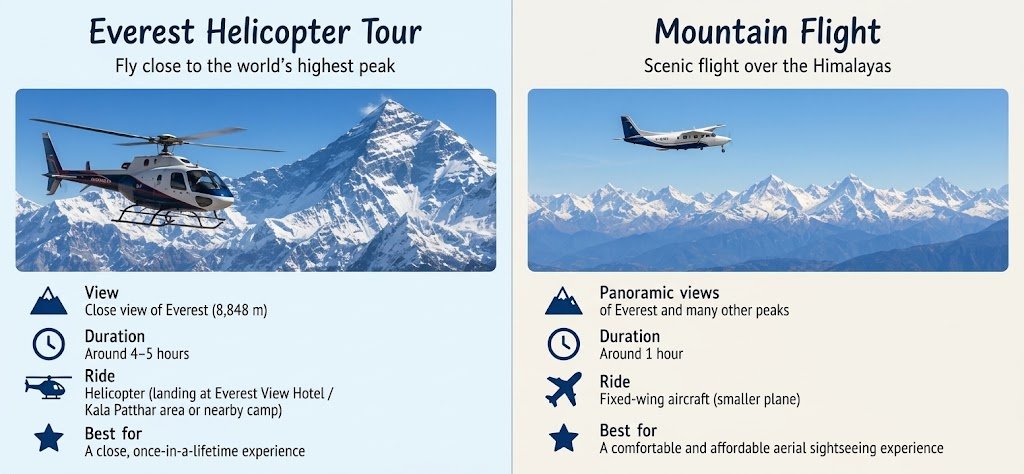
The Everest Mountain Flight is a fixed wing aircraft sightseeing flight operated daily from Kathmandu’s Tribhuvan International Airport. Several airlines run these, Buddha Air, Yeti Airlines, and Sita Air among the most established operators. The flight takes off, flies east along the Himalayan range to a viewing altitude of approximately 8,500 to 9,000 metres, and then orbits or does a series of passes beside the mountains for 45 to 60 minutes before returning to Kathmandu. Total flight time: 60 to 75 minutes including departure and return.
During the flight, each passenger gets a turn sitting beside a window seat (aircraft are typically configured so all passengers rotate to window positions during the mountain portion of the flight) to see the Himalayan peaks. The pilot provides commentary. On a clear morning, you can see Everest’s distinctive pyramid summit, along with Lhotse, Makalu, Cho Oyu, Ama Dablam, and other major peaks along the range.
The aircraft does not approach or land near the mountains. The viewing distance from the aircraft to Everest at altitude is typically 20 to 40 kilometres. You are looking at the mountain from a fast-moving aircraft through a small window at a significant distance.
What Is the Everest Helicopter Tour?
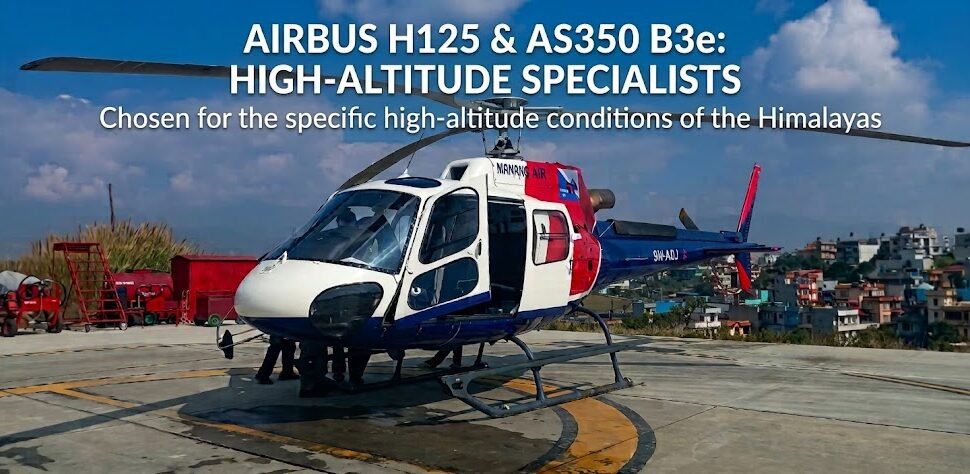
The Everest helicopter tour flies passengers from Kathmandu by helicopter to a landing point near Everest Base Camp (approximately 5,364 metres) or at Kala Patthar (5,545 metres). The helicopter, typically an AS350 B3e or Bell 407, flies at low altitude through the Khumbu Valley, lands, allows passengers 10 to 15 minutes on the ground, and returns to Kathmandu. Total time from hotel pickup to return: 4 to 5 hours.
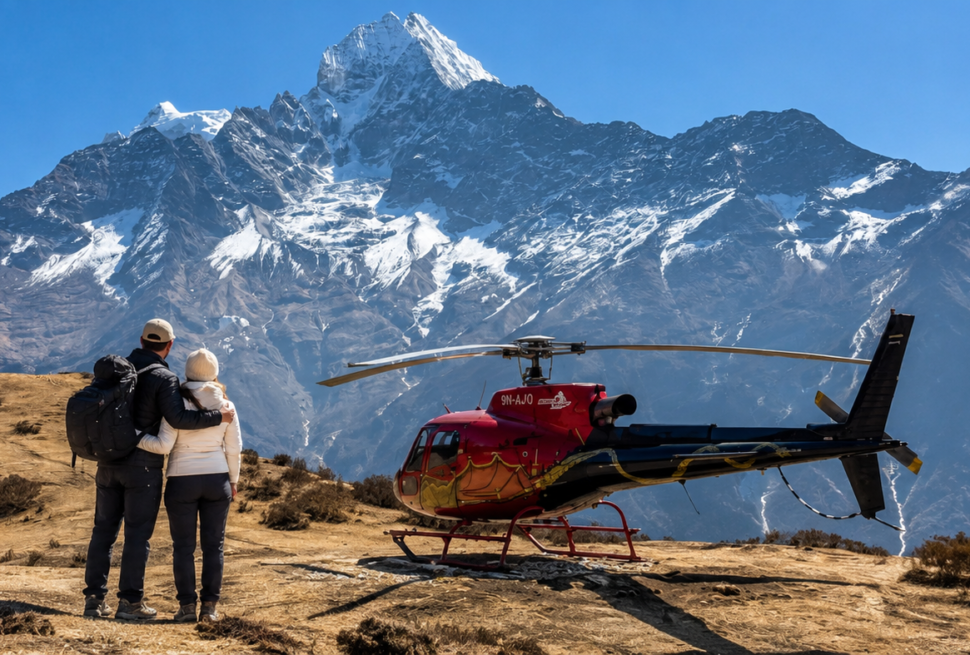
During the helicopter tour, you fly through the same mountain valleys that trekkers walk through. You land at an altitude above the base of the world’s highest mountain. You stand on the ground at over 5,000 metres with Everest’s South Face filling the view in front of you and the Khumbu Glacier below your feet. Then you fly back to Kathmandu.
Side-by-Side Comparison: Every Factor That Matters
| Factor | Mountain Flight | Helicopter Tour |
|---|---|---|
| Departure from | Kathmandu Airport | Kathmandu helipad or airport |
| Aircraft type | fixed wing turboprop (18 72 seats) | Helicopter (5 6 seats) |
| Flight duration | 60 75 minutes total | 45 50 minutes each way (90 100 min flight total) |
| Total tour time | About 1.5 hours including transfer | 4 5 hours including hotel pickup and return |
| Do you land near Everest? | No, overfly only | Yes, land at EBC (5,364m) or Kala Patthar (5,545m) |
| Closest approach to Everest | 20 40 km distance at flight altitude | Approximately 5 8 km at landing point |
| Altitude reached | 8,500 9,000 metres (above Everest summit level) | 5,364 5,545 metres (ground level, near EBC) |
| Window access | Rotate by turns, 10 15 mins per passenger at window | Full window view throughout the flight |
| Group size | 18 72 other passengers | 4 5 other passengers (shared) or private |
| Cost per person | $180 $280 | $1,000 $1,250 (shared) |
| Weather cancellation risk | Lower, flies above cloud level | Higher, requires visual approach to valley |
| Physical limitation | None | Weight limit; altitude consideration |
| Cultural immersion | None | Khumbu Valley, Sherpa homeland flyover |
| Photography conditions | Window only, distance, glare | In-flight + ground level, close up |
The Experience Gap Is Bigger Than the Price Gap
The price difference between the mountain flight ($180 $280) and the helicopter tour ($1,000 $1,250 shared) seems enormous, roughly a 5x premium. But the experience difference is even larger. Here is a concrete illustration of what that means in practice.
On the mountain flight: you are in a seat among 18 to 72 other tourists. The flight takes off, gains altitude, and when you are “at the window”, your allotted 10 to 15 minutes in the rotation, you see Everest’s summit pyramid from roughly 30 kilometres away, at around the same altitude as the mountain’s summit, through a 35cm aircraft window. The summit is unmistakably Everest. The view is genuinely impressive on a clear day. You photograph it through the window, get a certificate saying you have “seen Everest by air,” and return to Kathmandu in time for breakfast.
On the helicopter tour: you fly at low altitude through the Khumbu Valley, over the forests and teahouses of Namche Bazaar, over the lateral moraines of the Khumbu Glacier, past the ice pinnacles of the Khumbu Icefall, and land on rocky ground at Kala Patthar. Everest’s full South Face and the Southeast Ridge, the classic climbing route, are directly in front of you, unobstructed, from approximately 6 to 8 kilometres. The Khumbu Icefall is below you. You can see the fixed rope lines used by climbers on the lower slopes. You have 10 to 15 minutes on the ground, and then you board the helicopter and fly back through the valley. You are home for lunch.
These are not variations of the same experience. The mountain flight is seeing Everest the way you might see a cityscape from a commercial airliner, notable, photographable, and real, but distant. The helicopter tour is being in the Khumbu.
When the Mountain Flight Is the Right Choice
The mountain flight deserves a fair case made for it, because for specific travellers in specific situations, it is genuinely the right option.
Budget Is the Primary Constraint
If your Nepal travel budget is limited and the mountain flight or helicopter tour is one choice among many expenses, $200 versus $1,200 is a meaningful difference. The mountain flight delivers a genuine Himalayan aerial experience at a price accessible to budget travellers. There is no shame in choosing it for this reason, it is a reasonable choice, not a compromise.
Very Limited Time in Kathmandu
The mountain flight operates daily and is typically completed by 9:00 AM. If you have one morning in Kathmandu with a noon flight out, literally no more time available, the mountain flight can be done without a hotel pickup, directly from the airport, in under 90 minutes. The helicopter tour’s five-hour duration (including hotel pickup, check-in, flight, return) is not possible in that window.
Severe Physical Limitations
The helicopter tour involves a high altitude landing, briefly, 10 to 15 minutes, at over 5,000 metres. For passengers with serious cardiovascular conditions or severe respiratory illness, even this brief exposure may not be medically appropriate. The mountain flight, which flies above 8,500 metres in a pressurised cabin with regulated oxygen, carries a different physiological profile. Passengers who cannot safely experience the rapid altitude change of the helicopter tour may be able to do the mountain flight safely.
Fear of Small Aircraft or Enclosed Spaces
The helicopter is a five or six passenger aircraft with large windows but a physically small, enclosed cabin. For passengers with claustrophobia or significant anxiety about small aircraft, the large fixed wing turboprop of the mountain flight, with dozens of other passengers, an aisle to stand in, and the structural reassurance of a conventional aircraft, is a more comfortable environment. Read our full safety guide: Is Everest Helicopter Tour Safe?
When the Helicopter Tour Is the Right Choice
You Want an Actual Himalayan Experience
If your goal is to genuinely be in the Khumbu, to land in the valley, to breathe the air, to look at Everest from the ground rather than from a passing aircraft, there is no substitute for the helicopter tour. The mountain flight, however good, cannot replicate what it feels like to stand at Kala Patthar with the South Face directly in front of you. If that is your goal, the helicopter tour is the only product that delivers it.
You Have a Group and Want Privacy
The mountain flight is a shared experience with dozens of strangers. The window rotation means your “Everest moment” is brief and potentially interrupted by passenger logistics. On a shared helicopter tour, you are with four or five other people for the entire flight and landing. On a private charter, you are with your own group only. If the experience of being at Everest is something you want to share with family or a specific group rather than with 50 strangers, the helicopter tour gives you that.
Photography Is a Priority
The mountain flight produces photographs of Everest’s summit from a distance through a window. They are recognisable, impressive, and real, but they are the same photographs that thousands of other mountain flight passengers take every month. The helicopter tour produces photographs from the valley floor, from the landing zone, at a distance that allows the full mountain structure to fill the frame without optical compression. For serious photography, the helicopter tour is incomparable. Full guide: What to Pack, camera section.
You Have Already Done the Mountain Flight
Many repeat visitors to Nepal do the mountain flight on a first trip and the helicopter tour on a second. If you have already seen Everest from the mountain flight and want to actually get to the Khumbu on your next visit, the helicopter tour is the natural progression.
The Certificate Question
The Everest mountain flight operators issue certificates to every passenger confirming they have “viewed Mount Everest by air.” This is part of the product’s value proposition and is included in the ticket price. The helicopter tour does not issue certificates, landing at the base of Everest tends to be self-evidently memorable without paperwork. We mention this only because some people specifically want the certificate for a collection or for children’s educational purposes, in which case the mountain flight has that going for it.
Photography Comparison: What Each Product Actually Produces
For travellers for whom photography matters, here is an honest comparison of what each experience produces in terms of images.
Mountain Flight Photography
You are shooting through an aircraft window (clean glass, but with some distortion, potential for glare). Your subject, Everest’s summit, is 20 to 40 kilometres away. At that distance, even with a 200mm telephoto, the mountain occupies a modest portion of the frame. The background is sky, no foreground elements to provide scale or context. The images are identifiable as Everest and can be technically excellent on a clear day, but they look like aircraft window mountain photography because that is what they are.
Helicopter Tour Photography
During the flight, you shoot through large helicopter windows with a much shorter focal length because you are physically closer to the terrain. The valley itself, the glacier, the moraines, the icefall, fills the frame at low altitude with extraordinary texture. At the landing zone, you shoot from the ground with Everest’s full South Face 6 to 8 kilometres away and thousands of metres of vertical relief in the frame. Foreground elements, the rocky terrain of Kala Patthar, other passengers for scale, the helicopter itself, give the mountain context that aerial-only shots cannot. These photographs look like what they are: close range images of the world’s highest mountain from a dramatic ground level vantage point.
The Practical Decision Framework
Here is a simple framework for deciding between the two options:
Choose the mountain flight if: You have a budget under $300 for this experience; you have less than two hours available; you have medical conditions that make a high altitude helicopter landing inadvisable; or the mountain flight is part of a broader Nepal experience and a helicopter tour is not in the plan for this trip.
Choose the helicopter tour if: Your primary goal is to be in the Khumbu rather than just see it from above; you are travelling with a family or group who deserve a private or semi-private experience; photography is a serious priority; you have done the mountain flight before; or you have the budget and want the experience that is actually close to what Everest is.
Do both if: You have multiple mornings in Kathmandu, want to compare them personally, or want the mountain flight’s certificate and the helicopter tour’s ground experience. Some visitors do exactly this, and it is not excessive, they genuinely complement each other.
Booking the Right Experience
Mountain flights can be booked directly with Buddha Air, Yeti Airlines, or Sita Air from Kathmandu, typically on the same morning at the airport. No advance booking is strictly necessary in low season, though peak season (October, April) fills up and advance booking is advisable.
Helicopter tours require advance booking. Our packages:
- Standard EBC Helicopter Tour, the complete experience at the most accessible price point
- EBC with Kala Patthar Landing, the highest landing, directly facing Everest’s South Face
- EBC with Gokyo Lakes Tour, the full Khumbu experience in one flight
- Honeymoon Package, semi-private, for couples
- Group Charter, private helicopter for your group
How to book intelligently: How to Book an Everest Helicopter Tour | Cost Guide 2026.
Frequently Asked Questions: Helicopter Tour vs Mountain Flight
Is the mountain flight worth it?
For the price, yes, it is a genuine Himalayan aerial experience at an accessible price point. It is not the same as the helicopter tour and should not be compared to it directly. Judge it against its own category: a one-hour fixed wing sightseeing flight over the world’s highest peaks for around $200. On those terms, it is reasonable value.
Can I see Everest better on the helicopter tour than the mountain flight?
In almost every measurable way, distance, duration, ground access, photography conditions, immersion. The mountain flight is a passing view from a commercial aircraft. The helicopter tour is being in the Khumbu.
Is the helicopter tour five times better than the mountain flight?
The price is five times higher. Whether the experience is five times better is genuinely subjective, it depends on what you value. The helicopter tour delivers things the mountain flight simply cannot: a ground landing, Khumbu valley immersion, proximity to the mountain. Whether that is worth five times the price is a personal decision.
What if weather cancels my helicopter tour, can I do the mountain flight instead?
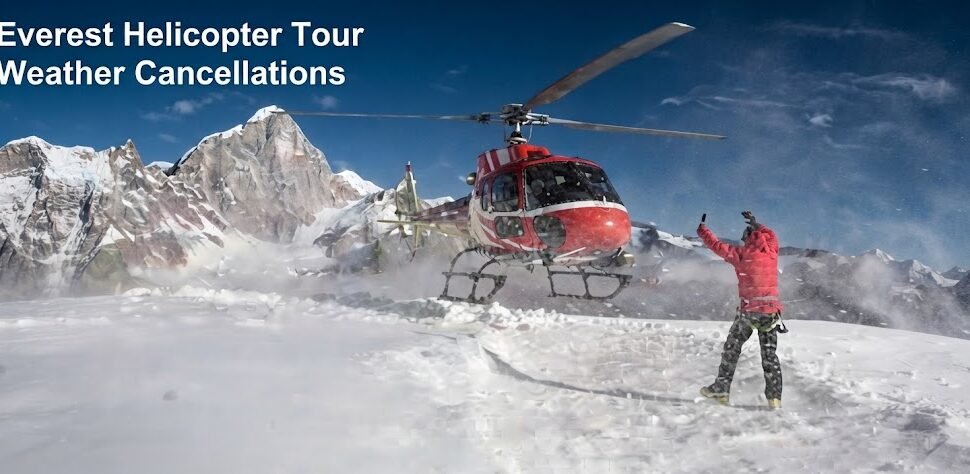
Mountain flights operate in weather conditions that would ground helicopter tours, they fly above cloud level in a pressurised aircraft, so low-level cloud in the Khumbu does not cancel them. If your helicopter tour is cancelled due to low-level cloud at the landing zone, the mountain flight on the same morning might actually have good visibility at altitude. This is an unusual situation but has happened. Ask your helicopter operator if this is relevant to your circumstances.
Which option can elderly passengers do?
Both, in most cases. The mountain flight has no physical requirement beyond being able to board a standard fixed wing aircraft. The helicopter tour involves a brief high altitude landing, most healthy elderly passengers are completely fine, but those with significant cardiovascular conditions should discuss this with their doctor first. Full guide: Everest Helicopter Tour for Families.
The Final Word
The Everest Mountain Flight is a good product for what it is. The Everest Helicopter Tour is a different product entirely. Choosing between them is not a matter of budget compromise, it is a matter of what experience you are actually looking for.
If you want to see Everest from the air at an accessible price and be done in 90 minutes, the mountain flight. If you want to go to the Khumbu, land near the base of the world’s highest mountain, and have the kind of morning that passengers describe for years afterwards, the helicopter tour. Both are worth doing. If you only do one, be honest with yourself about what “seeing Everest” means to you, and choose accordingly.
Inside a Mountain Flight: Aircraft, Seating, and How the Rotation Works
Most Everest mountain flights use one of two aircraft types: the ATR 42 operated by Buddha Air (48 seats) or the Beechcraft 1900 operated by Sita Air (19 seats). Yeti Airlines typically flies the ATR 72 with greater capacity. The aircraft type matters because it determines how many passengers compete for window time.
On the ATR 42 and ATR 72, the mountains appear only on the left side of the aircraft when flying east from Kathmandu toward Everest. The right side faces south over the valley and the Terai plains. The rotation applies only to left side windows.
The rotation process: passengers in left side window seats view the mountains first. Cabin crew then manage a systematic exchange, bringing right side and aisle passengers to the left side window positions. Each passenger gets roughly 10 to 15 minutes at the window. On the smaller 19-seat Beechcraft 1900, the cabin is narrower, seats sit closer to the glass, and with fewer passengers the wait between rotations is shorter.
Practical tip: request a left side window seat when booking. On Buddha Air’s ATR 42, left side window seats are generally the A-position seats (1A, 2A, 3A and so on). Arrive at check-in early enough to confirm your seat assignment. Start the flight at the window and you get uninterrupted viewing from the first mountain sighting rather than waiting in the aisle for the rotation to reach you.
Mountain Flight Airlines: Which One to Choose
Three airlines run the majority of Everest mountain flights in 2026. Here is an honest comparison.
| Airline | Aircraft | Seats | Approx Price | Best For |
|---|---|---|---|---|
| Buddha Air | ATR 42 / ATR 72 | 48 to 72 | $185 to $220 | Most departures, most reliable scheduling, strong safety record |
| Yeti Airlines | ATR 72 | 72 | $180 to $215 | Very similar to Buddha Air in quality and frequency |
| Sita Air | Beechcraft 1900 | 19 | $200 to $250 | Fewer passengers per window, more intimate, slightly higher price |
For the best window experience, the 19-seat Beechcraft 1900 gives each passenger proportionally more window time with fewer people in the rotation. The larger ATR flights run more frequently and are easier to reschedule when a morning is cancelled due to weather, which matters in peak season when availability is tight. All three have acceptable safety records on this specific route.
Mountain flights can be booked directly at Tribhuvan Airport on the morning of the flight in low season. In October and April, book two to three days ahead. Same-morning walk-up seats are scarce during those peak months. Booking directly through the airline website or your hotel concierge avoids the commission markup that street-level ticket agents charge.
Related reading: Everest Helicopter Tour Cost 2026 | Best Time for Everest Tour | Is It Safe? | Helicopter Tour vs Trekking