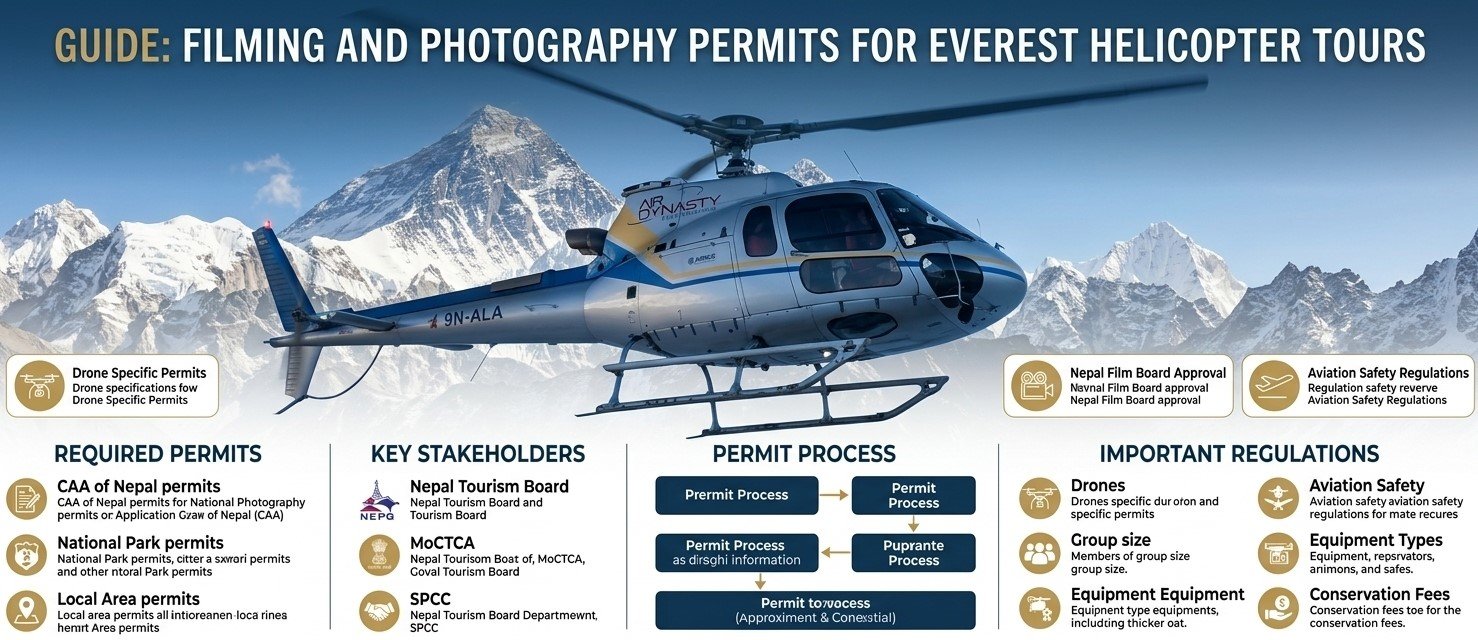
Every week, our booking inbox gets a request that looks a little different from the usual honeymoon inquiry or bucket list traveler. It comes from a documentary producer, a travel brand’s content team, a journalist working on a piece about climate change in the Khumbu, or a freelance filmmaker who has been dreaming about a shot of Everest Base Camp from the air for years. They all ask some version of the same question: what do we actually need to arrange before we show up with cameras, gimbals, and a drone case?
The honest answer is that filming in Nepal, and especially filming from a helicopter in one of the most tightly controlled pieces of airspace in the country, involves more moving parts than a standard tourist flight. There are national permits to think about, park regulations that apply specifically to the Everest region, aviation rules that govern what can and cannot share airspace with a manned aircraft, and practical limits on what gear actually fits and functions inside a helicopter cabin at high altitude. None of this is meant to discourage serious crews. Professional teams fly this route successfully every season. It simply means the planning has to start earlier and with more specific questions than a typical booking.
This guide walks through what we know, from research into Nepal’s current rules and from years of flying photographers, filmmakers, and content teams over the Khumbu Valley, about permits, drone restrictions, cabin logistics, and how to plan a shoot that actually works. Rules in Nepal change, sometimes with little public notice, and the authorities involved are not always the same for every type of production. Treat this as a starting point for your planning conversation, not as a final word. We say this throughout the article, and we mean it: confirm current requirements with the relevant Nepali government offices and with us directly before you commit a production schedule to this flight.
Why an Everest Helicopter Shoot Is Different From a Standard Tour Booking
A typical guest on the Everest Base Camp helicopter tour needs a passport, a seat, and a sense of anticipation. A professional crew needs all of that plus a plan for equipment, an understanding of what airspace and ground authorities are involved, and often a conversation with us weeks in advance about what the shoot actually requires. The difference comes down to three things: legal permissions, physical constraints, and coordination.
On the legal side, casual photography and video taken by a paying passenger for personal use is generally treated very differently from commercial production, journalism, or any filming intended for broadcast, advertising, or wide distribution. The moment a shoot becomes commercial in nature, whether that means a branded content piece, a documentary, a news segment, or footage destined for a client’s marketing campaign, it can trigger a different set of Nepali regulatory requirements than a family taking photos on their honeymoon flight.
On the physical side, an AS350 B3e helicopter cabin, which is the aircraft type we operate for this route, is a compact space shared with other passengers, safety equipment, and the pilot. A tripod, a boom arm, a large gimbal rig, or a second or third camera body with long lenses simply will not fit the way they would in a studio or even in a car. Weight matters too, because this aircraft is flying to genuinely extreme altitudes and every kilogram affects performance margins.
On the coordination side, a standard tour follows a fixed route and a fixed schedule because that is what works for a cabin full of travelers who are there for the experience, not for specific footage. A production team usually needs something different: a particular orbit around Ama Dablam, an extra pass near the Khumbu Icefall, a slower approach to Hotel Everest View for a establishing shot, or specific timing tied to light. None of that happens by showing up and hoping. It happens because the production team told us in advance, in detail, what they were trying to capture.
Nepal’s Permit System for Professional Filming and Commercial Photography
Nepal does not have a single office that issues one universal filming permit for every type of production. Instead, the requirements depend on what kind of content is being made, who is making it, and where. Understanding the rough categories helps a production team figure out which conversations to start early.
Feature Films, Documentaries, and Broadcast Productions
Larger productions, meaning feature films, television projects, and documentaries intended for broadcast or wide commercial release, generally fall under the oversight of Nepal’s national film authorities and the government ministry responsible for information and communication (historically referred to as the Department of Information, and now organized under Nepal’s Ministry of Communication and Information Technology, alongside the Nepal Film Development Board for cinema specific matters). Foreign productions working at this scale typically need to submit a formal application well before filming, including details like a script or shot outline, a full crew and cast list with nationalities, an equipment inventory, a shooting schedule, and information about where filming will take place. Heritage sites and protected areas layer on their own additional approvals from the relevant department, such as the Department of Archaeology for cultural and religious sites, or the national park authorities for protected wilderness areas like the Everest region.
Because this process involves multiple ministries and can take real time to move through, productions of this scale should expect the permitting process to be measured in weeks, not days, and should build that lead time into their production calendar rather than treating it as a formality to sort out after arrival.
Commercial Photography, Content Creation, and Smaller Production Teams
Not every professional shoot is a feature film. A brand content team shooting a marketing campaign, a travel journalist on assignment, a small crew making a promotional video, or a serious photographer shooting stock or editorial work for commercial use occupies a somewhat different category than a full cinema production, but that does not mean no permission is required. Commercial use of photography and video, meaning anything beyond a traveler’s personal memories, generally still needs to be disclosed and, depending on scope and location, may still require specific approval, particularly once a shoot moves into a protected area like Sagarmatha National Park or involves any aerial equipment.
The safest approach for this middle category, which covers most of the professional and prosumer crews who contact us, is to tell us exactly what the production involves as early as possible: who is filming, for what purpose, what gear is coming, whether a drone is involved, and what the final content will be used for. We have handled this conversation many times and can tell you which approvals are likely to apply to your specific case and route you toward the right office, rather than you guessing at a general framework that may not match your actual shoot.
The Nepal Tourism Board’s Role
The Nepal Tourism Board plays an important role for productions connected to tourism promotion, familiarization trips, and certain categories of travel content, and it can be a useful point of contact for content creators whose work will promote travel to Nepal. It is not, however, a substitute for aviation permissions through Nepal’s Civil Aviation Authority or for park level approvals when a shoot enters a protected area. Treat the Tourism Board as one part of a larger picture rather than a single office that clears every requirement at once.
Journalists and Press Crews
Working journalists covering Nepal, particularly news crews and anyone identifying as press, often have a distinct accreditation pathway separate from commercial or cinema production, generally coordinated through Nepal’s information ministry and, for foreign press specifically, sometimes involving the Department of Immigration or the relevant diplomatic channel depending on visa status. If your shoot is journalistic in nature rather than commercial or narrative, say so clearly when you contact us, because the paperwork path can differ from a branded content shoot even though both are professional productions.
| Production type | Likely authorities involved | General lead time to plan for |
|---|---|---|
| Personal photography or video by a paying passenger, not for commercial use | None beyond your standard booking | None, covered by normal booking process |
| Commercial content, branded video, marketing photography | Relevant ministry for information and communication, Nepal Tourism Board where applicable, park authority if entering Sagarmatha National Park | Several weeks |
| Documentary film | Nepal Film Development Board and information ministry, plus park and heritage authorities depending on location | Several weeks to a couple of months |
| Feature film or large broadcast production | Nepal Film Development Board, information ministry, park and archaeology authorities as relevant, often a local production liaison | A couple of months or more |
| Press or news journalism | Information ministry press accreditation channel, immigration where relevant to visa status | Several weeks, can be faster for breaking coverage with the right accreditation already in place |
| Any drone use, in any category above | Civil Aviation Authority of Nepal, plus Department of National Park and Wildlife Conservation and local district administration if inside Sagarmatha National Park | Several weeks, often longer inside the park |
Fees for these permits vary by production type, scale, and current government schedules, and we deliberately are not quoting specific numbers here because they change and because misquoting a fee is worse than not quoting one. What we can tell you with confidence is that commercial and cinema level productions should expect meaningful government fees and processing time, while personal photography by ordinary passengers costs nothing beyond your ticket. For an accurate, current figure for your specific production, ask us directly or contact the relevant ministry, and treat any number you read on a general travel blog, including implicitly this one, as a starting estimate rather than a quote.
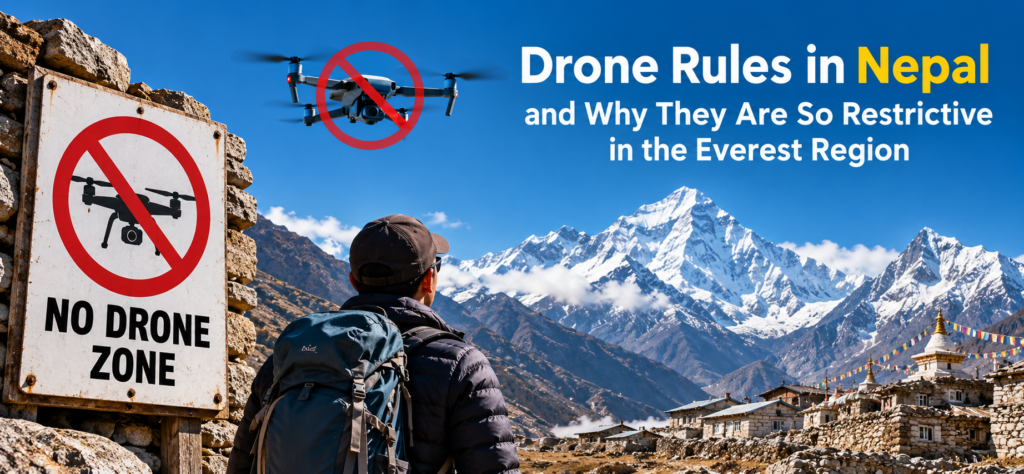
Drone Rules in Nepal and Why They Are So Restrictive in the Everest Region
If there is one area where we see well intentioned crews run into trouble, it is drones. Nepal’s rules around unmanned aircraft are genuinely strict, and the Everest region in particular layers several separate sets of restrictions on top of each other. This is not a case of an operator being cautious for its own sake. It reflects real aviation safety concerns, real conservation concerns, and a regulatory system that treats the Khumbu as one of the more sensitive pieces of airspace in the country.
Nepal’s General Drone Framework
Nepal’s Civil Aviation Authority (CAAN) is the primary body governing drone operation nationally. Drones are registered by weight category, and operators, including foreign visitors, are generally required to register their aircraft and obtain flight authorization before operating, rather than simply showing up and flying. Typical rules that apply broadly across Nepal include a maximum altitude limit of around one hundred twenty meters above the ground, a requirement to keep the drone within visual line of sight of the operator, minimum distances from people and buildings, restrictions on flying near airports and international borders, an outright ban near military installations and many religious and heritage sites, and a prohibition on night flying. None of these numbers are exotic by global drone regulation standards, but Nepal enforces them with real consequences, including confiscation of equipment and fines, so treating them as optional is a genuine risk to a production’s gear and budget, not just a theoretical rule.
Sagarmatha National Park: A Separate, Stricter Layer of Approval
The Everest region sits inside Sagarmatha National Park, a UNESCO listed protected area with its own drone procedure that operates independently of, and in addition to, CAAN’s general national rules. Based on the park’s own published procedure, flying a drone inside Sagarmatha National Park requires, in sequence, registration with CAAN, a formal approval letter from Nepal’s Department of National Park and Wildlife Conservation, a separate approval letter from the District Administration Office covering Solukhumbu district, and finally specific permission issued by the park itself once those other approvals are in hand. That is not a single form. It is a multi step chain of approvals across at least three different government offices, and each step depends on the one before it. Crews sometimes assume that because they registered a drone with CAAN before their trip, they are cleared to fly anywhere in Nepal including inside the park. That assumption is incorrect, and it is one of the most common and costly misunderstandings we see from visiting production teams.
Realistically, this means drone use inside Sagarmatha National Park, including anywhere along the trekking routes to Everest Base Camp, near Namche, or around Syangboche and Hotel Everest View, should be treated as something that needs advance, written permission from park and district authorities, not something a crew can improvise on arrival day. Given how the approval chain works, this is not a same week process.
Controlled Airspace Near Lukla and the Everest Corridor
Separately from the park’s own wildlife and land use rules, the airspace above the Khumbu Valley is genuinely busy and genuinely controlled. Tenzing Hillary Airport at Lukla is one of the more demanding airports in the world to operate into, and the approach corridor sees a steady flow of fixed wing aircraft and helicopters throughout the flying season, often in tight formation with limited margin for error given the surrounding terrain. Airspace near any operating airport in Nepal is restricted for drones as a matter of general aviation rule, and the Everest corridor adds mountain terrain, changeable weather, and a high volume of manned traffic on top of that. A drone sharing that airspace, even briefly, is not a minor technical infraction. It is a real collision risk for aircraft that are already operating close to their performance limits at altitude.
If your production plan includes aerial footage anywhere near this route, whether from a drone launched from the ground near Lukla, Namche, or Syangboche, or anywhere along the Khumbu Valley, this is precisely the kind of detail to raise with us and with the relevant authorities before your trip, not something to sort out with a quick flight once you have landed. For a wider look at how Everest helicopter flights are permitted and regulated more generally, our article on Everest helicopter tour permits and fees covers what is already built into a standard tour, which is a useful baseline before layering a production specific plan on top of it.
Why You Cannot Fly a Drone From or Near the Helicopter Itself
We get this question often enough that it is worth addressing directly. Some crews picture a shot where a drone launches from inside or alongside the helicopter to capture the aircraft itself against the mountains, or flies in formation nearby for a few seconds of footage. This is not something we can support, and it is not really a Nepal specific restriction so much as a basic rule of aviation safety that applies almost everywhere manned and unmanned aircraft might otherwise share space.
A helicopter in flight, particularly at the altitudes this route operates at, has very little tolerance for an unpredictable object nearby. Rotor downwash from an AS350 is powerful and can destabilize a small aircraft, and a drone’s own turbulence or a sudden control input can send it into the main or tail rotor with essentially no warning. Radio frequency interference is a separate and real concern, since a helicopter’s communication and navigation systems and a drone’s control link both use radio spectrum, and a malfunction or interference event at altitude is not something anyone wants to discover mid flight. There is also a simple visibility problem: from the cockpit, a small drone at any distance is extremely hard to see against sky, cloud, or a bright snow background until it is far too close to react to.
On top of the physical safety issue, launching or flying a drone from or near an aircraft in flight runs directly into the airspace and line of sight rules described above, since a drone operator on the ground cannot maintain visual line of sight with a drone that is following a moving helicopter, and a drone cannot legally operate inside the same controlled airspace as manned traffic without specific coordination that is not something a tourism operator can arrange for a single flight. This is one of the few areas where the answer is close to a flat no rather than a matter of degree, and it applies whether the request comes from a hobbyist or a well resourced production company. What we can help with instead is planning the shot from inside the cabin itself, choosing the aircraft’s actual flight path and timing to give you the angle you want, and, where a ground based drone shot near the helicopter is genuinely important to a production, treating that as an entirely separate, independently permitted ground operation that does not happen while our aircraft and passengers are airborne nearby.
What Camera Equipment Actually Works Inside the Helicopter Cabin
Once the permitting questions are sorted, the next practical issue is what to actually bring. The AS350 B3e is an excellent aircraft for aerial filming because of its visibility and stability, but it is still a shared cabin, not a studio, and weight and space constraints are real, particularly at the altitudes this tour reaches. Our companion article on camera settings and the best seats for photography on this tour is a good starting point for general shooting advice, and it applies to professional crews too, but a few points deserve more detail for teams bringing serious gear.
What Tends to Work Well
Mirrorless and DSLR bodies with a couple of lens options, handheld gimbals sized for a single camera rather than a full cinema rig, action cameras mounted securely to approved points, and a second body as backup all travel well in the cabin. Fast prime or moderate zoom lenses tend to be more practical than very long telephoto glass, both because of the vibration and shake involved in helicopter shooting and because much of what you want at this altitude, the scale of Everest, Lhotse, Nuptse, Makalu, and Ama Dablam against the sky, actually reads better on wider to moderate focal lengths than on a long lens that narrows the frame down to a small slice of ridge line.
What Generally Does Not Work
Full sized tripods, sliders, jib arms, boom microphones on long poles, large three axis gimbal stabilizers built for a cinema camera, and anything that needs to be bolted, clamped, or rigged to the aircraft’s structure are not realistic for this platform. The cabin does not have the floor space, the aircraft’s certification does not allow ad hoc mounting hardware attached to the airframe, and weight allocated to a passenger seat is meant for a person and reasonable hand carried gear, not a rig designed for ground based or studio production. Our article on the Everest helicopter tour weight limits and baggage rules explains the general baggage allowance, and professional gear needs to be planned against those same limits, with the reality that a private charter, discussed below, gives you meaningfully more flexibility than a shared seat does.
| Equipment category | Generally practical in cabin | Generally not practical |
|---|---|---|
| Camera bodies | Mirrorless or DSLR, one primary and one backup | Large format or cinema bodies with separate monitor rigs |
| Lenses | Wide to moderate zoom or prime lenses | Very long telephoto lenses needing support |
| Stabilization | Handheld single camera gimbal | Multi axis rigs, sliders, jib arms |
| Audio | Small on camera or body worn recorders | Boom poles, external mounted microphones on the airframe |
| Support | None needed, shooting is handheld from the seat or window | Tripods, monopods, clamps attached to aircraft structure |
| Aerial capture beyond the cabin | Footage shot through the window during the flight itself | Any drone launched from or flown near the aircraft in flight |
One more practical point worth planning around: this flight reaches genuinely high, cold, thin air altitudes, up to and above five thousand meters near Everest Base Camp. Battery performance drops in the cold, condensation can be an issue moving between a warm hotel and the cold cabin air, and altitude itself affects both people and, in edge cases, some electronics. Bring more batteries than you think you need, keep them warm before the flight, and test your gear at altitude before the trip if you can, rather than for the first time on the day of the shoot.
How a Professional Charter Differs From a Standard Tourist Booking
Most guests on this route book a seat on a shared flight, and for sightseeing that works well. For a production, it usually does not, and this is the single biggest piece of advice we give professional crews: book the whole aircraft.
A private charter, which puts the entire helicopter, roughly five seats, at your production’s disposal for about four thousand eight hundred dollars total, removes the constraints that come with sharing a cabin with other paying passengers who are not part of your shoot. On a shared group flight, at around one thousand two hundred fifty dollars per person for a group of five or more, or eleven hundred dollars per person under our group package pricing, you are one of several travelers on a fixed itinerary, and the pilot’s priority is delivering a consistent experience to everyone aboard, not accommodating one passenger’s specific framing request. That is completely reasonable for a group of friends celebrating a trip, but it does not give a director of photography room to ask for a particular bank angle near Ama Dablam or a slightly longer hold near the Khumbu Icefall.
On a private charter, your crew is the only production in the cabin, which means the conversation with the pilot beforehand can actually shape the flight. You can discuss, in advance, which side of the aircraft you want positioned toward the mountains for key shots, whether you want a slightly different approach angle near Everest Base Camp for a wider establishing shot, how much time you would like at Hotel Everest View in Syangboche for ground based coverage during the breakfast stop, and how many people beyond camera operators, such as a director, a sound person, or a producer, need seats. None of this overrides the pilot’s authority over the flight, which always comes first, particularly given the terrain, weather, and altitude involved, but within those safety limits a private charter gives a production far more room to plan a specific shot list than a shared seat ever will. Our article comparing private versus group Everest helicopter tour packages goes into more detail on how the two options differ for any traveler, and the same logic applies even more strongly for a production that needs control over timing and positioning.
If your shoot specifically wants the highest tourist accessible landing point in Nepal as a location, our Kala Patthar landing upgrade, which reaches five thousand five hundred forty five meters, is worth discussing as part of your charter planning, since it changes the flight profile and the time available at each stop.
Planning a Professional Shoot: Practical Advice for Production Companies and Serious Content Creators
Start the Permitting Conversation Early
Because Nepal’s permit process for commercial and cinema production can genuinely take weeks, and because Sagarmatha National Park’s drone approval chain involves multiple offices working in sequence, the single most common mistake we see is a production team reaching out two or three weeks before travel expecting everything to be arranged on arrival. Depending on scope, that can work for personal photography, but it rarely works for commercial filming, and it essentially never works for drone use inside the park. Reach out to us as soon as you have a rough shoot date, even before every creative detail is locked, so we can flag what lead time your specific plan will need.
Tell Us Exactly What You Are Making and Why
The permit path for a travel brand’s Instagram content is different from a broadcast documentary, which is different again from news journalism. Being specific and upfront about the purpose of your footage, where it will appear, and who is producing it lets us point you toward the right process rather than a generic one that may not actually match your requirements. Vague answers slow this down far more than specific ones.
Plan Around Weather, Not Just a Calendar Date
Everest area flying is weather dependent, and mountain weather in the Khumbu can change quickly regardless of season. A production booking a single flight day with no flexibility is taking on real risk of a weather delay affecting a shoot with a fixed crew schedule and return flights already booked. Where your budget allows, build a buffer day or two into the Kathmandu portion of your schedule specifically to absorb a weather related reschedule, rather than treating the helicopter day as a fixed point that the rest of the trip cannot move around.
Coordinate Cabin Logistics Before You Arrive
Tell us your full crew count, your gear list, and your priority shots before the flight, not on the morning of departure. This lets us confirm seat and weight allocation on your charter, flag anything that will not be practical inside the cabin, and make sure the pilot understands your priorities before engines start. Our guide on how to book an Everest helicopter tour step by step covers the general booking process, and for a professional shoot we simply add a more detailed pre flight conversation on top of that same process.
Understand That Safety Always Comes First
Every request from a production team, whether it involves a specific flight path, extra time at a stop, or a particular shot angle, is accommodated within the limits our pilots set based on weather, aircraft performance, and standard operating procedure. Our approach to safety, aircraft maintenance, and pilot standards is covered in detail in our article on Everest helicopter tour safety, pilots, and aircraft maintenance standards, and it applies exactly the same way to a private charter carrying a production crew as it does to any other flight we operate. No shot is worth compromising on that.
Budget for Both the Charter and the Permits Separately
The private charter cost covers the aircraft, the pilot, and the flight itself. It does not cover government filming or drone permits, which are separate processes with their own fees and timelines, generally handled either directly by your production or through a local production service or fixer if your team does not have one already. Treat these as two separate line items in your production budget, planned in parallel rather than assuming one covers the other.
A Direct Note on Accuracy and Confirmation
We have researched the information in this guide carefully and grounded it in what we currently understand about Nepal’s aviation, filming, and national park regulations. But rules in Nepal, like rules in most countries, are subject to change, sometimes with limited advance public notice, and different offices can interpret overlapping requirements differently depending on the specifics of a shoot. This article is meant to help a production team ask the right questions early, not to serve as a final legal authority on what is currently required. Before you commit a production schedule or a budget to filming permits or drone use in Nepal, confirm current requirements directly with Nepal’s Civil Aviation Authority, the relevant ministry for information and communication, the Nepal Film Development Board if your project is a documentary or feature film, Sagarmatha National Park and the Department of National Park and Wildlife Conservation if you are entering the park, and with us directly about anything specific to the helicopter flight itself. We would rather tell you to double check something than have your production discover a gap in permits on location.
Frequently Asked Questions
Can we fly a drone from inside the helicopter during the Everest flight?
No. This is not something we can accommodate, for both aviation safety reasons and because a drone operator cannot maintain the required control and visual line of sight over a drone launched from a moving aircraft. If aerial drone footage of the helicopter itself is important to your production, it would need to be arranged as a completely separate, independently permitted ground based operation, not something attempted during the actual flight.
Do we need a permit just to bring a professional camera on board as a paying passenger?
Personal, noncommercial photography and video by a paying passenger generally does not require a special permit beyond your standard booking. The moment the footage is intended for commercial use, broadcast, journalism, or wide distribution, it moves into a different category that likely does require formal permission, so tell us upfront if that describes your shoot.
How far in advance should a production team contact you before a shoot?
As early as possible, ideally as soon as you have a rough travel window, since Nepal’s permitting process for commercial or cinema production, and especially any drone approval inside Sagarmatha National Park, can take several weeks to a couple of months depending on scope. Reaching out early costs nothing and gives everyone more room to work within realistic timelines.
Is a private charter required for a professional shoot, or can we book a group seat?
A group seat is technically possible for personal footage, but for any production with specific shots in mind, a private charter is strongly recommended. It removes other passengers from the equation, gives your crew the full aircraft, and allows the kind of advance conversation with the pilot about flight path and timing that a shared flight simply cannot accommodate.
Can we land somewhere in the Khumbu other than Hotel Everest View to get specific footage?
Landing points are determined by what is operationally approved and safe, which for our standard route means Syangboche for the breakfast stop, with the Kala Patthar landing available as a specific upgrade for crews who want that higher altitude location. Additional or nonstandard landing requests would need to be discussed with us directly well before your flight, and are subject to weather, aircraft performance, and any relevant local approvals.
What happens if weather delays our shoot day?
Like any Everest area flight, this route is weather dependent, and delays happen. We recommend production teams build at least one buffer day into their Kathmandu schedule specifically to absorb a possible reschedule, rather than treating the flight date as fixed with no flexibility on either side of it.
Do journalists need a different type of permission than a commercial content creator?
Often yes. Working press generally follows an accreditation path connected to Nepal’s information ministry that is distinct from a commercial production permit, and foreign journalists may also need to consider visa and immigration factors specific to press work. If your shoot is journalistic, tell us that specifically so we can point you toward the correct process rather than a general commercial filming pathway.
Can we bring a second camera operator or a producer along on the charter at no extra cost?
The private charter price covers the aircraft as a whole, for roughly five seats, so additional crew beyond a single photographer can generally be accommodated within that same charter without booking extra seats separately, as long as total headcount and gear weight stay within the aircraft’s limits. Tell us your full crew count in advance so we can confirm this fits your specific plan.
Ready to Plan Your Shoot
Filming the Everest region from the air is a genuinely rare opportunity, and doing it properly, with the right permissions in place and a flight plan built around your actual shot list rather than a generic tourist itinerary, makes the difference between footage that looks like everyone else’s and footage that reflects real planning. If you are a production company, a documentary team, a journalist, or a serious content creator considering this shoot, reach out to us with your dates, your crew size, and what you are trying to capture, and we will help you understand what applies to your specific production before you lock a schedule. When you are ready to move forward, our Everest Base Camp helicopter tour page is the place to start, and a private charter booked through that page remains the most practical way to give your crew the room, the flexibility, and the direct pilot coordination that a professional shoot over Everest deserves.