Two Ways to Fly to Everest: Understanding Your Options
When you book an Everest Base Camp helicopter tour, one of the most fundamental decisions you will make is whether to book a group sharing seat or a private charter. This choice affects the cost, the flexibility, the intimacy, and the overall character of your morning over the Khumbu, and it deserves careful consideration rather than a reflexive default to whichever option looks cheapest or most convenient at first glance.
The distinction seems simple on the surface: group sharing means you share the helicopter with other passengers (typically four to five people per aircraft on a standard tour configuration), while private charter means the aircraft is exclusively yours for the duration of the tour. But the practical implications of this difference go well beyond the number of people in the cabin, and understanding those implications is the purpose of this guide.
This article covers every dimension of the group vs private decision: cost, flexibility, timing, intimacy, photography, weight considerations, family and couple dynamics, corporate use, and the specific occasions for which each option is best suited. By the end, you will know with confidence which option is right for your particular group, occasion, and budget.
Group Sharing Helicopter Tours: Everything You Need to Know
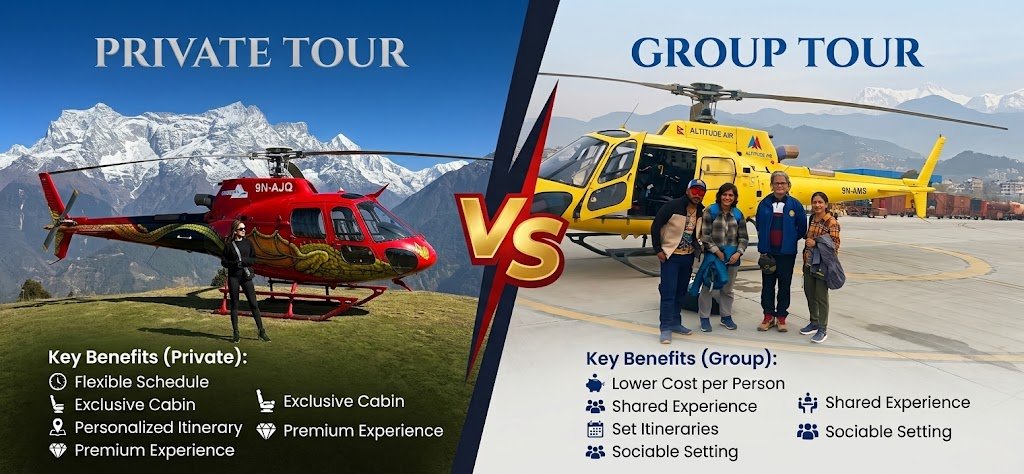
The group sharing helicopter tour is the most popular way to experience the Khumbu by helicopter, and for good reason: it makes the extraordinary aerial journey over Everest financially accessible to a much wider range of travellers than a private charter alone could serve. On a group sharing flight, your seat in the helicopter is sold alongside seats for other individually booked passengers, typically up to four or five total passengers on a standard single engine helicopter. The cost per person is significantly lower than a private charter because the operational costs of the flight are shared across multiple bookings.
Our Everest Helicopter Tour Group is priced at $1,100 per person, making it one of the most cost effective ways to access the Khumbu from the air. This price includes hotel pickup and drop-off, the full Khumbu flight route, the Kala Patthar landing or EBC aerial pass depending on package selection, and all applicable permits and fees. There are no hidden costs payable on the day.
Who shares the helicopter with you on a group tour? Passengers are typically from different booking parties, solo travellers, couples, small friend groups, or family members who have individually booked seats. The shared cabin creates an informal community for the morning: strangers who have nothing in common except the decision to fly over Everest together, and who typically find themselves united by the shared intensity of the experience. Many group tour passengers report forming genuine connections during the flight, exchanging camera recommendations at the Kala Patthar landing, sharing breathless reactions to the views, or simply sitting in companionable silence in the face of something too large for words.
The main limitation of the group sharing tour is scheduling flexibility. Because seats must be combined across different bookings to fill the aircraft efficiently, departure times are fixed and the route is standardised. You cannot request additional time at a specific location, adjust the landing sequence, or extend the ground stop at Kala Patthar beyond the standard 20 to 30 minutes. The tour operates according to a planned schedule that balances the needs and preferences of all passengers in the aircraft, and individual customisation is not possible within the group sharing format.
Private Charter Helicopter Tours: The Exclusive Experience
The private charter helicopter tour gives you and your group exclusive use of the aircraft for the entire duration of the tour. No other passengers share your cabin, the helicopter is entirely yours, from the moment it lifts off in Kathmandu to the moment it returns you to the city. This exclusivity has several practical and experiential implications that make the private charter genuinely different from the group sharing tour, not simply more expensive.
Our private charter options include the Everest Base Camp Helicopter Tour Private at $4,800 per group and the various private configurations of our other tours. The price covers the entire aircraft, so if you are travelling as a couple, a family of four, or a small group, the per-person cost drops as you add passengers to fill the aircraft capacity. A private charter for four people at $4,800 works out to $1,200 per person, only slightly more than the group sharing rate, with the significant advantages of exclusive use and scheduling flexibility.
The scheduling advantage of the private charter is significant. Because the aircraft is exclusively yours, departure can be timed to your preference (within the early morning operational window), the route can be adjusted within operational constraints, ground stop durations can be discussed with the pilot, and additional stops or aerial passes can be incorporated if time and conditions permit. This flexibility is particularly valuable for photographers who want to time the Kala Patthar arrival at a specific light quality, for couples who want a more leisurely breakfast stop at Hotel Everest View, or for groups who want to hover over a specific Khumbu feature longer than the standard routing allows.
Cost Comparison: Group vs Private
The cost difference between group and private depends heavily on group size, and the comparison changes significantly depending on how many people are travelling together.
| Group Size | Group Sharing Cost (total) | Private Charter Cost (total) | Private per Person | Difference per Person |
|---|---|---|---|---|
| 1 person (solo) | $1,100 | $4,800 | $4,800 | +$3,700 |
| 2 people (couple) | $2,200 | $4,800 | $2,400 | +$200 |
| 3 people | $3,300 | $4,800 | $1,600 | +$500 |
| 4 people | $4,400 | $4,800 | $1,200 | +$100 per person |
| 5 people (full aircraft) | $5,500 | $4,800 | $960 | Private is cheaper |
This table reveals something important: for couples (2 people), the price difference between group sharing and private charter is only $200 per person, the additional cost of $400 for the entire couple to have a private aircraft rather than sharing with three strangers. For many couples, particularly those on a special occasion such as a honeymoon or anniversary, this modest premium for exclusivity and scheduling flexibility is easily justifiable. For groups of four or five, the private charter is actually competitive with or cheaper than booking individual group sharing seats.
The cost analysis strongly suggests that the group sharing tour makes most financial sense for solo travellers, where the private charter premium is substantial. For couples and groups of three or more, the per-person price difference shrinks to the point where the decision should be driven primarily by preference and occasion rather than cost alone.
The Photography Question: Group vs Private
For serious photographers, the group vs private question has specific implications that non-photographers may not consider. Helicopter photography in mountain terrain is sensitive to cabin position, window condition, and passenger movement, factors that the group sharing format makes less controllable.
On a group sharing tour, window seats are allocated and the aircraft configuration determines which passengers sit next to windows with the best views on any given part of the route. Depending on the flight path and the position of the sun, some windows may offer better photographic angles than others, and these are not always predictable in advance. In a full aircraft of five passengers, not all will have equally good window positions for photography throughout the entire route.
On a private charter, you have complete control over seating and can rearrange during the flight to access the best windows for specific sections of the route. If the mountain views are better on the left side of the aircraft on the outbound leg and the right side on the return, you can move accordingly. If you want to hover over a specific feature, the Khumbu Icefall or the Gokyo Lakes, for a few extra seconds, the pilot can accommodate this more easily when the cabin is yours alone.
For photographers with a specific shot list or who are travelling to produce professional-quality Himalayan imagery, the private charter’s flexibility is valuable enough to justify the premium on its own. For casual photographers who simply want great holiday photos, the group sharing tour provides perfectly good photographic access to the views and the Kala Patthar landing site.
Special Occasions: When Private Is the Clear Choice
Certain occasions make the private charter the obvious choice regardless of the cost calculation. These include:
Honeymoon and romantic travel: Our Everest Helicopter Tour Honeymoon Package is specifically designed for couples who want a private, intimate experience of the Khumbu without strangers in the cabin. The intimacy of being alone in a helicopter over Everest, with no other passengers competing for window space, no unfamiliar faces sharing the emotional intensity of the Kala Patthar landing, and the ability to take as long at the breakfast table as the couple wants, is a qualitatively different experience from the group sharing tour. The morning becomes genuinely yours: a private encounter with one of the world’s great landscapes that you share only with each other and the pilot. For couples celebrating a milestone, the private charter honeymoon package is worth every rupee of the premium.
Family groups with elderly or young members: When travelling with elderly grandparents or young children who may need more attention, support, or flexibility than a mixed-group shared flight provides, the private charter is strongly preferable. With an elderly passenger who needs supplemental oxygen or extra time at the Kala Patthar landing, or a child who becomes cold quickly and needs to return to the helicopter earlier than other passengers, the private charter allows the pilot and crew to respond specifically to your family’s needs without consideration of other passengers’ schedules and comfort.
VIP and corporate travel: For high-profile individuals, corporate executives, or groups where exclusivity is part of the brand of the experience, the private charter is the appropriate option. The private flight allows for complete confidentiality, flexible departure timing to accommodate schedules, and the ability to tailor the route and stops to the group’s specific interests.
Groups who know each other well: When travelling as an established friend group or family where the shared experience is specifically about the connections between the people in the group, the private charter make sures that the morning’s conversation, reactions, and shared emotions are contained within the group rather than shared with strangers. Some of the most meaningful group travel memories come from the conversations that happen in close quarters during intense shared experiences, and having those conversations in a private cabin rather than a shared one makes them more free and more intimate.
Weight Limits and Their Effect on Group vs Private Options
Helicopter operations at extreme altitude are subject to strict payload limits, and passenger weight is a significant operational variable. At 5,545 metres, reduced air density limits rotor lift capability, which means that aircraft payload, the total weight of passengers and luggage, must be carefully managed. Different aircraft types have different payload limits, and the weight of passengers directly affects the ability to land at high altitude points like Kala Patthar.
On a group sharing tour, passenger weights are checked at check-in and the flight is configured to remain within the operational payload limit. If a combination of passengers on a given flight is heavier than the limit for the specific route, the operator may need to adjust routing or the number of passengers per flight. Individual passengers who significantly exceed the standard weight guideline (typically around 80 to 85 kg per person for Khumbu operations) may be asked to purchase an additional seat to make sure the flight can operate safely, this is communicated at the time of booking rather than on the day, to avoid surprise.
On a private charter, the payload calculation is done for your specific group, and the weight management is entirely between your group and the operator. This is particularly relevant for families or groups where some members have higher body weight, as it removes the variable of unknown co-passengers and allows the operator to plan the flight configuration specifically for your group’s combined weight. We recommend contacting us in advance to discuss weight considerations if any member of your group is above the standard weight guideline, this allows us to advise on the best configuration for your specific situation without any surprises on the day.
Comparing the In-Cabin Experience: Group vs Private
Beyond the practical differences in cost and flexibility, the in-cabin experience has a different character in group sharing vs private flights that is worth honestly describing.
The group sharing cabin creates an interesting social dynamic. Strangers from potentially very different backgrounds and nationalities are suddenly together in a small space, sharing a profound experience. Some passengers love this dimension: the shared wonder creates an immediate connection, and many group tour passengers describe meeting fellow passengers as an unexpected highlight of the morning. Others find the presence of strangers slightly intrusive, they would prefer to process the emotional intensity of the experience with only their own companions or in private reflection.
The private charter cabin is quieter, more intimate, and more personally controlled. Reactions to the views can be expressed freely without reference to strangers. If you want to cry at the sight of Everest from Kala Patthar, and some people do, from sheer emotional overwhelm, you can do so without self-consciousness in a private charter. If your group wants to make noise, laugh, or have intense conversation during the flight, you can do so freely. The private cabin gives you the psychological freedom to fully inhabit your own emotional response to the experience without the social modulation that sharing space with strangers inevitably produces.
The Verdict: When to Choose Group, When to Choose Private
Here is a clear decision framework based on everything discussed above:
Choose group sharing if: You are travelling solo. You are on a tight budget and cost is the primary constraint. You are comfortable with and potentially enjoy the social dimension of shared experiences. You are a first time visitor who wants to meet fellow travellers. You are travelling as one of a pair or small group where the per-person cost difference with private is minimal but you’d still prefer the lower price point. Our Group Helicopter Tour at $1,100 per person is the ideal option in these cases.
Choose private charter if: You are on a special occasion, honeymoon, anniversary, milestone birthday, family celebration. You are travelling with elderly family members or young children who need specific attention. You are a professional photographer or filmmaker who needs cabin flexibility. You are a VIP or corporate group where exclusivity is part of the requirement. You are travelling as a couple where the total additional cost of the private charter is less than $500 over the group sharing option. You want complete schedule flexibility and the ability to customise the route. Explore our Private Charter tours and our Honeymoon Package for the exclusive experience.
How to Book: The Process for Both Options
Booking either the group sharing or private charter tour is straightforward. Contact us through the relevant tour page on this website, providing your preferred date (with backup dates for weather flexibility), group size, and any special requirements such as dietary needs for the breakfast stop, language preferences for the briefing, or specific interests for route customisation on a private charter.
We confirm availability, provide the exact pricing for your group size and chosen tour type, and issue a booking confirmation on payment of the deposit. Full payment is typically required seven to ten days before the tour date for peak season bookings. We reconfirm the tour approximately 48 hours before the scheduled date based on the weather forecast, and provide a final go/no-go notification by 4:00am on the morning of the tour.
Both group and private tours have the same weather rescheduling policy: cancellations due to weather are rescheduled at no charge to the earliest available suitable morning. If rescheduling is not possible within your Nepal travel dates, a full refund is provided. This policy applies identically to group sharing and private charter bookings, we do not differentiate between booking types on weather policy.
Frequently Asked Questions: Group vs Private
Can I upgrade from group sharing to private on the day? Subject to availability, upgrades from group to private can sometimes be arranged at the helipad on the morning of the tour. However, this is not guaranteed and should not be relied upon. We recommend deciding on your tour type at the time of booking to make sure the right experience.
Will my private charter wait for me if I am late? Within reasonable limits, yes. The advantage of the private charter is that the aircraft is yours, so minor delays on your side (traffic, late hotel checkout) can be accommodated without affecting other passengers. There is a maximum operational window within which flights must depart for safety reasons, and we cannot guarantee waiting beyond that point.
Can I request a specific pilot on a private charter? We can note pilot preferences and will do our best to accommodate, but pilot assignment is ultimately based on operational requirements and scheduling. All our pilots are CAAN-certified mountain aviation specialists with extensive Khumbu experience.
Does the route differ between group and private tours? The standard route is the same for both. The private charter gives you the ability to request route variations or additional stops, which we will accommodate where operationally feasible and within the time and fuel budget of the tour.
Can a group sharing flight be rebooked as private if not all seats fill? If a group sharing flight has fewer passengers than the maximum capacity, remaining seats are not automatically available for private purchase at the group sharing rate. Private charter pricing covers the full operational cost of exclusive aircraft use regardless of actual seat utilisation.
Ready to book? Explore our full range of options: the Group Helicopter Tour at $1,100 per person, the EBC Helicopter Tour with private options from $4,800, the Honeymoon Package for couples, and the EBC with Gokyo Heli Tour for the maximum Khumbu experience. The right option for your situation is here, and once you see Everest from a helicopter, you will understand why every person who has made this choice considers it one of the best decisions of their travel life.
The Aircraft: What You Are Actually Flying In
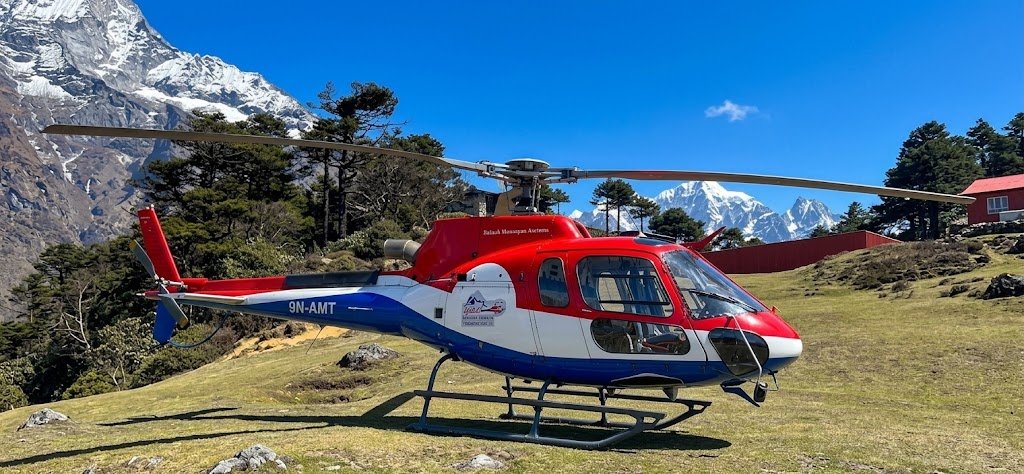
Understanding the aircraft used on Everest helicopter tours helps you understand the operational context of the group vs private decision. The standard aircraft for Khumbu helicopter tours is a single engine turbine helicopter, most commonly the Airbus H125 (formerly known as the Eurocopter AS350 B3) or the Bell 407. Both are high performance single engine helicopters specifically designed for high altitude mountain operations, and both have a maximum passenger capacity of five to six seats depending on configuration.
The Airbus H125 is the most widely used aircraft for high altitude helicopter operations in the world. It holds multiple world records for helicopter altitude performance and is the aircraft of choice for operations at extreme elevation precisely because its turbine engine and rotor system are optimised for low-density air. The Bell 407, also widely used in Nepal’s commercial helicopter sector, offers slightly more cabin space and good high altitude performance, making it a popular choice for tours where passenger comfort is a priority alongside altitude capability.
In practical terms for the group vs private decision, the aircraft type affects how many passengers can share the cabin on a group tour, how much luggage can be carried, and the comfort of the seating arrangement. On a full group sharing flight of five passengers in an H125, the cabin is genuinely compact, comfortable, but close quarters that some passengers find more intimate than they expected. The private charter’s exclusive use of the same aircraft feels significantly more spacious simply because there are fewer people in it.
All our aircraft are CAAN-certified and maintained to international airworthiness standards. Pilot certifications include mountain flying endorsements specific to the Khumbu region. We do not share detailed fleet information publicly for operational security reasons, but passengers can ask about the aircraft type when booking and we will confirm the expected configuration for their specific tour.
What Happens If Your Group Has Members Who Cannot Fly Together
Occasionally, groups encounter the situation where all members want to experience the Khumbu by helicopter but the group is too large for a single aircraft. A standard helicopter carries a maximum of five passengers (including a guide if one is assigned), so groups of six or more need to split across multiple flights.
For large groups on the group sharing tour, booking individual seats means the operator will attempt to schedule passengers from the same party on the same departure flight. However, if the aircraft fills with other bookings, some members of a large group may be assigned to a different departure. This is a limitation of the group sharing format that large groups should be aware of, if it is important for your entire group to fly together, the private charter (or multiple private charters booked for the same morning) is the only way to guarantee this.
For groups of six to ten people, we can arrange multiple private charter flights departing at the same time or in close succession, so that the group arrives at the Kala Patthar landing and Hotel Everest View simultaneously or within a few minutes of each other. This “convoy” approach allows large groups to share the ground experience together even though they cannot all be in the same aircraft simultaneously. Corporate incentive groups, wedding parties, and large family gatherings regularly use this multi-aircraft arrangement with great success.
Language and Communication on Group vs Private Tours
On group sharing tours, the briefing, safety instructions, and any in-flight communication are typically conducted in English, as the common language most likely to be understood by a mixed international group. If all passengers in a group sharing flight speak the same language (not always predictable in advance), the crew will try to accommodate it, but English is the operational standard.
On a private charter, language preferences can be discussed in advance and accommodated more readily. If your group is Chinese-speaking, Japanese-speaking, German-speaking, or in another language, a bilingual crew member or guide can sometimes be arranged on request for a private charter. This is particularly valuable for corporate groups where the debrief or commentary during the flight needs to be conducted in the group’s working language.
We recommend communicating any language preferences at the time of booking so we can advise on what is possible for your specific tour type and date. English-language operations are always available and form the default for all our tours regardless of group type.
The Return on Investment: How to Think About the Cost of Either Tour
One useful framework for evaluating the cost of either helicopter tour option is to think about it as a cost per life experience rather than a cost per hour or cost per kilometre. Travel experiences vary enormously in their return on emotional investment, and the Everest helicopter tour, whether group sharing or private charter, consistently ranks among the highest-return-per-dollar travel experiences that visitors to Nepal report.
Consider: a return economy flight from London to Kathmandu might cost $600 to $900 and delivers you across the world to a remarkable destination. The helicopter tour at $1,100 per person costs slightly more than that intercontinental flight and delivers you to the foot of the world’s highest mountain. Expressed for the ratio between cost and experiential intensity, the helicopter tour is arguably better value than the long haul flight, and the private charter at $4,800 for two people, placed next to the cost of two business class long haul tickets, is clearly the more experientially valuable expenditure.
This comparison is not just rhetorical. When experienced travellers are asked to name the single most memorable experience they have had for a given amount of money, the Everest helicopter tour appears with extraordinary frequency among those who have taken it. The combination of extreme altitude, extreme beauty, and the concentrated intensity of a single morning creates a memory density that most other travel experiences at comparable cost levels cannot match.
Seasonal Pricing Variations: Group vs Private
Pricing for both group sharing and private charter tours varies across the year, with peak season rates (April and October) typically higher than off-peak rates (January, February, November, December). Understanding these variations allows you to optimise the cost-versus-conditions trade-off for your specific travel dates.
During the peak months of April and October, both group sharing and private charter prices are at their highest due to demand. Booking well in advance, two to four weeks for April, three to four weeks for October, is recommended not just to secure your preferred date but also to lock in pricing before any peak-season rate adjustments. Our pricing is transparent and published on each tour page, with no hidden peak supplements applied after booking.
During the shoulder seasons (March, May, September, November), pricing for both options may be slightly lower and availability is significantly better. Travellers with flexibility in their Nepal schedule who can arrange their Kathmandu stay to fall in March rather than April, or November rather than October, will typically find easier booking and competitive pricing for both tour types. The shoulder seasons also offer excellent flying conditions, not quite at the statistical peak of April and October, but very close, and with the advantage of lower demand and better availability.
Monsoon season pricing (June to August) is at its lowest for both options, reflecting the reduced demand and higher weather-cancellation risk of these months. Travellers who can be flexible with multiple days available for weather rescheduling and are comfortable with the possibility of reduced visibility on their tour day can access the Khumbu experience at significantly lower prices during the monsoon shoulder. We recommend this approach only for travellers with genuine schedule flexibility and an adventurous attitude toward weather uncertainty.
Making Your Final Decision: A Summary
The private vs group helicopter tour decision comes down to four key variables: cost, occasion, flexibility, and intimacy. Work through these four factors to reach your decision:
Cost: If you are solo, the group sharing tour at $1,100 is the clear financial choice. If you are travelling as a couple or group of three or more, run the per-person comparison, the gap narrows rapidly, and the private charter often becomes cost-competitive at group sizes of four or more.
Occasion: Special occasions, honeymoons, anniversaries, milestone celebrations, family reunions, warrant the private charter. The exclusivity and intimacy of a private aircraft are part of what makes these occasions feel genuinely special rather than simply convenient.
Flexibility: If timing and route flexibility matter to you, if you want to adjust departure time, hover over specific features, or extend the ground time at any stop, the private charter is necessary. The group sharing tour cannot offer individual flexibility because it must balance multiple passengers’ needs.
Intimacy: If you want to share the morning’s emotional intensity only with people you know, your partner, your family, your close friends, the private charter provides this. If you are comfortable with and interested in sharing the experience with fellow travellers from around the world, the group tour’s social dimension can be a genuine enrichment rather than an intrusion.
Whatever you choose, the Khumbu awaits. The world’s greatest mountain range does not distinguish between the passengers in its private charters and those in its group tours, it shows everyone the same extraordinary panorama from above the clouds. The difference is in how you experience that encounter, and choosing the right format for your situation make sures that your morning over Everest is everything it deserves to be.
Book your tour today: Everest Group Tour ($1,100/person) | Honeymoon Package | Private Charter Tours | Kala Patthar Landing Tour | EBC with Gokyo Heli Tour.
Real Experiences: What Group and Private Passengers Say
To ground the abstract comparison in lived experience, it helps to consider what passengers who have taken both tour types actually report about their experiences. The patterns that emerge across different traveller profiles are consistent and reveal the key differentiators in practice rather than in theory.
Solo travellers on group sharing tours consistently highlight the social dimension as a positive surprise. Many arrive expecting to feel like they are sharing a taxi, and discover instead that the shared experience of seeing Everest together creates an immediate and genuine connection with strangers. Several solo travellers have described group tour co-passengers evolving into lasting travel friendships or providing local knowledge and recommendations that enriched the rest of their Nepal stay. The group sharing format is particularly well suited to solo travellers who are open to the social dimension of adventure travel and understand that shared extremity creates unusual closeness between people.
Couples on private charter tours uniformly describe the intimacy of the exclusive aircraft as one of the most valued aspects of the morning. The ability to react freely to the views, to hold hands at the Kala Patthar landing without self-consciousness, to speak quietly to each other during the flight without pitching your voice over background noise, to take photographs of each other with complete freedom of movement in the cabin, creates a qualitatively different emotional experience from the group tour. Many couples describe the private charter morning as more intimate and more emotionally intense than they had anticipated, with several describing it as more romantically powerful than any conventional honeymoon activity they had experienced.
Families with elderly members on private charters consistently highlight the flexibility as the decisive advantage. The ability to give an elderly grandparent more time at the landing site, to let younger children return to the warm helicopter ahead of the adults, and to make real-time decisions about pace and stops without reference to other passengers’ schedules is something that families with mixed physical abilities value enormously. Family groups on group tours sometimes feel constrained by the need to match the pace and schedule of other passengers, particularly if an elderly or child member needs special consideration that would require holding up or inconveniencing co-passengers.
Corporate groups on private charters describe the exclusive aircraft as essential to the professional character of the experience. For a company bringing a team to Nepal as a reward or incentive activity, having the helicopter exclusively for the group creates a coherent shared experience where all reactions, conversations, and shared moments happen within the team rather than being observed or interrupted by external parties. The private charter in this context is less about luxury than about professional coherence, the experience belongs completely to the group, without the variables that shared transportation introduces.
These patterns confirm what the cost and logistics analysis suggests: the group sharing tour excels for solo travellers and budget conscious smaller groups who value social connection and cost efficiency. The private charter excels for special occasions, mixed-ability groups requiring flexibility, and those for whom the emotional integrity and exclusivity of the experience is part of its value. Neither is universally superior, the right choice depends entirely on who you are and what you want from your morning over Everest.