Every week or so, somebody emails us the same question in a slightly different shape. “I already have travel insurance from my bank card, is that enough?” or “My agent said I need trekking insurance, but I’m not trekking, I’m just flying up and back in a day, do I still need it?” It’s a fair question, and it deserves a better answer than the generic one that gets copied and pasted around the internet. Most of what you find when you search for Nepal travel insurance was written for someone spending two or three weeks walking to Everest Base Camp and back through Namche, Dingboche, and Lobuche. That is a different trip with a different risk profile than a one-day Everest helicopter tour from Kathmandu, and the insurance advice that fits one doesn’t map cleanly onto the other.
We are a Kathmandu-based, CAAN-licensed helicopter operator running Everest Base Camp helicopter tours and Kala Patthar landing tours, and we’ve spent years watching how our passengers think about risk before they book, and how that thinking often doesn’t match what they actually need. Some people arrive worried about the wrong things and blow past the thing that actually matters. Others assume that because the trip is “only a few hours,” insurance is basically irrelevant. Neither is quite right. This post is our attempt to lay out, honestly and without the scare tactics some insurance-affiliate blogs use, what travel insurance actually does for you on a one-day helicopter tour, what it doesn’t do, and how to check whether the policy you already have (or are about to buy) will actually work if you need it.
We are not insurance brokers and this is not financial or legal advice. We are operators who fly this route regularly and talk to passengers, hospitals, and evacuation coordinators as part of running the business. Treat everything below as practical background to bring into a conversation with your own insurer, not as a substitute for reading your policy document or calling to confirm terms, which change from company to company and year to year.
Why a one-day helicopter tour is a genuinely different insurance question than a trek
Almost everything written about “Everest region travel insurance” online assumes you’re trekking. That makes sense, because historically most people who went anywhere near Everest Base Camp walked there, usually over ten to fourteen days, gaining altitude gradually, sleeping at increasing elevations, and accepting a real risk of altitude illness that builds cumulatively over multiple days without full acclimatisation. Insurance guidance for that trip correctly focuses on emergency helicopter rescue coverage, high medical limits, and multi-day high-altitude activity riders, because the exposure is prolonged and the risk of something going wrong on day seven of a trek is a real, well-documented thing that trekking insurers have priced for over decades.
An Everest helicopter tour is a different shape of trip entirely. You leave Kathmandu in the early morning, you’re in the aircraft for roughly three to four hours round trip depending on the specific package, and if you’re on our Everest Base Camp helicopter tour with a Kala Patthar landing, you touch down at Kala Patthar, around 5,545 metres, for roughly ten to twenty minutes before flying back down. On the standard flight without a ground landing, the helicopter passes near Everest Base Camp itself, at around 5,364 metres, without anyone getting out. Either way, you are back in Kathmandu, at about 1,400 metres, well before lunch. There is no multi-day acclimatisation schedule because there doesn’t need to be one in the way a trek needs one. You have not spent five nights slowly climbing through the Khumbu. You have spent minutes at extreme altitude, not days.
That difference matters, and it’s worth being honest about it rather than pretending the insurance conversation is identical to a trekker’s. But “different” is not the same as “irrelevant,” and that’s the part some travellers get wrong when they assume a day tour needs no real insurance thought at all. The exposure window is shorter, which changes the probability of altitude-related problems, but it does not zero it out, and it does not touch the other things insurance covers, like flight delays, illness before departure, or the cost of emergency treatment and evacuation if something does go wrong while you’re up there. We’ll walk through each of these pieces separately, because lumping “insurance” into one undifferentiated worry is exactly how people end up either overinsured for the wrong risk or underinsured for the risk that actually applies to them.
What actually happens to your body during the flight, and why it’s not zero risk
We want to be straightforward here because we think honesty serves our passengers better than either alarming them or waving the question away. Acute mountain sickness, the general term for altitude-related illness, is primarily a function of how high you go, how fast you get there, and individual physiology that varies a lot between people and isn’t fully predictable by fitness level or age alone. Trekkers get it because they’re sustaining moderate to high altitude for days on end, often sleeping at altitudes their bodies haven’t adjusted to yet. Helicopter passengers are exposed to a much shorter version of the same physics: less oxygen in the air at 5,500 metres than at sea level, arriving there almost instantly rather than gradually.
For most healthy adults, ten to twenty minutes on the ground at Kala Patthar, or a flyby near Base Camp without disembarking, is not long enough for classic acute mountain sickness to develop, since AMS typically takes some hours of exposure to manifest as headache, nausea, or fatigue. That’s the reason the tour is designed the way it is: short exposure, then descent. It is also why the vast majority of passengers who take this tour feel nothing more than being slightly out of breath if they walk around quickly at the landing site, similar to what you’d feel doing brisk exercise at altitude.
But “most people are fine” is not the same claim as “nobody has ever had a problem,” and we’d be doing you a disservice if we implied otherwise. A small number of people are unusually sensitive to sudden altitude exposure even briefly, and this is where honesty matters most: anyone with an existing cardiac condition, a respiratory condition like COPD or significant asthma, or certain other chronic health issues can have a meaningful physiological response even during a short stop at extreme altitude, because the drop in available oxygen is sudden rather than gradual and gives the body no time to compensate. This is a genuinely different mechanism of risk than classic multi-day AMS, and it’s the main reason our booking process, and most responsible operators’ booking processes, ask about relevant health conditions before confirming a Kala Patthar landing in particular. We go into this in more depth in our own altitude sickness guide for the Everest helicopter tour, which is worth reading in full if you have any relevant health history, and we’d rather you read that and talk to your doctor before booking than find out something matters mid-flight.
The practical takeaway for insurance purposes is this: the altitude risk on a helicopter tour is real but different in shape from a trekker’s risk, being lower in probability for most people but not absent, and concentrated specifically around cardiovascular and respiratory vulnerability rather than the classic slow-onset AMS trekkers worry about. Insurance that assumes you need coverage against a multi-day cumulative altitude illness scenario is solving a slightly different problem than the one you actually face. What you need is a policy that will still pay out if something happens during those brief minutes at extreme altitude, which is a narrower but no less important requirement.
Two different kinds of insurance that solve two different problems
This is probably the single most common point of confusion we see, and it’s worth being very clear about it before going further, because a lot of travellers assume “travel insurance” is one product that covers everything. It isn’t, and the two main components work completely differently.
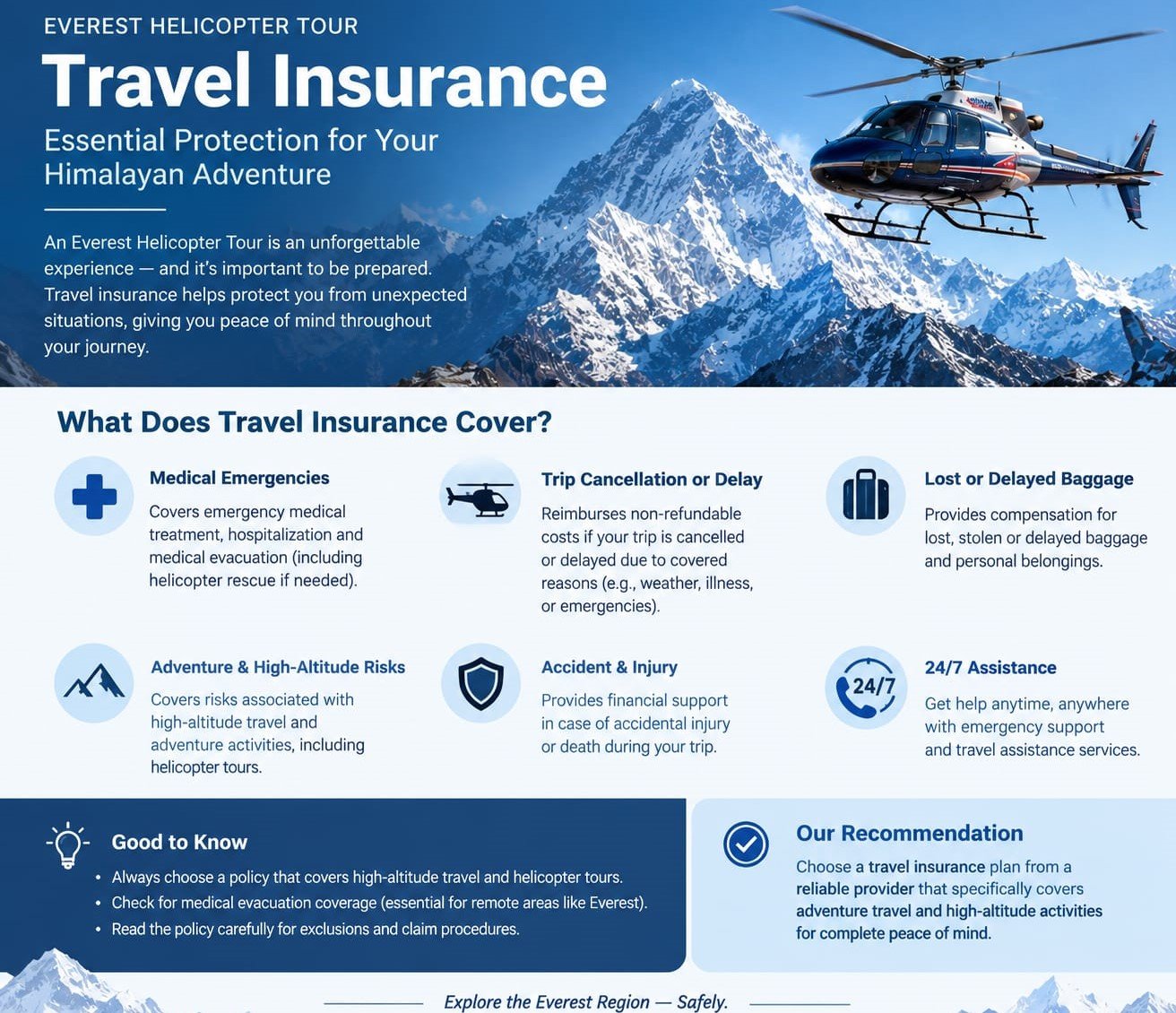
The first is trip cancellation and interruption insurance. This is the coverage that reimburses you if you personally have to cancel or cut short your trip: you get sick before departure, a family emergency comes up, your connecting flight into Kathmandu is cancelled and you miss your tour date, or something similar. It is triggered by things that happen to you or around your travel plans, not by decisions made by the operator. This is important to understand clearly: trip cancellation insurance generally does not cover a tour cancellation caused by the operator due to weather, which is an extremely common reason Everest helicopter flights get cancelled or rescheduled, since mountain weather changes fast and safety always comes before schedule. That situation is handled separately, by us, through our own published weather cancellation, refund, and rebooking policy, which spells out what happens to your booking and your money if we cancel or delay a flight for weather. Your trip cancellation insurance and our weather policy are two separate safety nets covering two separate scenarios, and you genuinely benefit from understanding both rather than assuming one covers the other.
The second kind is emergency medical and evacuation insurance. This is the coverage that pays for treatment and, if needed, helicopter rescue and transport to a hospital, if something goes wrong with your health during the trip itself, whether that’s during the flight, at the landing site, or afterward. This is the coverage most directly relevant to the physical risks of being briefly at extreme altitude that we described above, and it’s the one that matters most if you’re asking “what happens if I have a medical problem during the tour.” It typically also covers repatriation, meaning getting you home or to a hospital with appropriate facilities if the situation is serious enough to require that.
People often buy one and assume it covers the other, or buy neither because they’re thinking about the wrong scenario. A simple way to hold the distinction in your head: cancellation insurance protects your money if your plans get disrupted before or around the trip; medical and evacuation insurance protects your body and your wallet if something happens to your health during it. Here’s a short comparison that might help make the distinction concrete.
| Question | Trip cancellation / interruption insurance | Emergency medical / evacuation insurance |
|---|---|---|
| What triggers a claim | You cancel, get sick before the trip, miss a connection, family emergency, etc. | Illness or injury during the trip, including at altitude |
| Covers weather-caused tour cancellation by us | Usually not, this is a separate exclusion in most policies | Not applicable, different type of claim entirely |
| Covers helicopter rescue or hospital transfer | No | Yes, if the policy explicitly includes evacuation coverage |
| Altitude ceiling matters | Rarely relevant | Directly relevant, this is the coverage that needs to reach Kala Patthar altitude |
| Who handles the equivalent situation on our tours | Your insurer, plus our own weather policy for weather-related cancellations | Your insurer, plus emergency services and hospitals in Kathmandu |
If you only remember one thing from this section, remember that weather cancellation and medical emergency are handled by entirely different systems, and confusing them is how people end up frustrated when a claim gets denied for reasons that were actually spelled out in the policy the whole time.
The altitude ceiling problem: the gap most travellers never think to check
Here is the part of this whole topic that we think is genuinely underappreciated, and it’s specific to what we do, so we want to spend real time on it rather than rushing past it.
A lot of standard travel insurance policies, the kind bundled with a credit card, sold as an add-on when you book a flight, or purchased as a generic “worldwide travel insurance” product, cap emergency medical and evacuation coverage at a specific maximum altitude. This is a common and often invisible limitation. It’s frequently somewhere in the range of 2,000 to 4,000 metres, depending on the insurer, and it exists because most travel insurance is priced and written for general tourism, business travel, and beach holidays, not for high-altitude activity. If you never asked about it, there’s a decent chance your policy has one of these caps written into the fine print, in a section most people never read closely because most people never travel high enough for it to matter.
Kathmandu itself sits at roughly 1,400 metres, comfortably under any of these caps. That’s exactly the trap. If you booked a Nepal trip and bought travel insurance without thinking specifically about the helicopter tour, your policy might genuinely cover you for anything that happens in the city, in your hotel, on the drive to the airport, and then simply stop covering you the moment the helicopter climbs past whatever ceiling the policy specifies, which could be well below the roughly 5,500 to 5,600 metres you’ll reach near Kala Patthar or Base Camp. A policy that covers you up to 3,000 metres is, for the purposes of the actual high point of an Everest Base Camp helicopter tour, not covering the part of the trip where the altitude-specific risk actually exists.
This is the single most practical thing we want every reader of this post to walk away with: don’t just check whether your policy covers “Nepal” or “emergency medical treatment” in general terms. Check the specific maximum altitude stated in the policy document, and confirm it is comfortably above 5,600 metres. If a policy doesn’t state a maximum altitude anywhere, that’s not necessarily good news, since it can sometimes mean the exclusion is written differently, for example excluding “mountaineering” or “high-altitude activities” as a category rather than stating a number, and a support line will usually give you a straight answer if you ask directly, “is emergency medical and evacuation coverage valid up to at least 5,600 metres, including landing on the ground at that altitude, for a helicopter tour rather than a trek.” Ask it in exactly that specific way, because a vaguer question sometimes gets a vaguer answer, and this is one area where you want a specific answer in writing if possible, such as by email, before you fly.
Part of why this gap exists and persists is precisely because you are booking what feels like a day tour rather than a mountaineering expedition. Nobody buying a helicopter sightseeing flight thinks of themselves as doing “high-altitude activity” in the way a climber does, and insurers’ default policy wording sometimes hasn’t caught up with the fact that a few minutes at 5,500 metres in a helicopter carries some of the same altitude-ceiling considerations as being there on foot, even though the overall risk profile is different in the ways we described above. The activity classification in the policy cares about the altitude reached, not really about how you got there or how long you stayed, so don’t assume that because you’re not trekking, altitude exclusions don’t apply to you. They can, and checking is the only way to know for certain in your specific case.
What the words on the page should actually say
When you’re reading a policy document or a summary of benefits, insurance language is written by lawyers for lawyers, and it’s easy to skim past the parts that matter most. Here’s what we’d suggest looking for specifically, based on years of watching what turns out to matter when something actually goes wrong.
Look for the explicit words “helicopter evacuation” or “mountain rescue” somewhere in the policy, not just “emergency medical treatment” as a general category. General emergency medical coverage sometimes assumes evacuation by road ambulance, which obviously isn’t how anyone gets moved from the Khumbu region or from a helicopter landing site near Base Camp. If a helicopter rescue is genuinely needed, whether that’s because of a medical event during the tour itself or, in a different but related scenario, because a family member is separately trekking in the region and needs evacuation, you want a policy that names helicopter evacuation specifically as a covered benefit, not one where you’re hoping it falls under a broader phrase and finding out only when you file a claim.
Check the stated maximum altitude of coverage, as we described above, and make sure it’s comfortably above the altitude your specific tour reaches, whether that’s the roughly 5,364 metres of a Base Camp flyby or the roughly 5,545 metres of a Kala Patthar landing.
Check that Nepal, and specifically the Khumbu or Everest region, is not on an exclusion list. Some policies, especially budget ones, exclude countries or regions associated with mountaineering by default, or they exclude “mountaineering and climbing activities” as a category and require you to add a specific high-altitude rider or adventure sports add-on to reinstate coverage for anything above a stated altitude. This is worth asking about directly rather than assuming a general “worldwide” policy has no regional carve-outs, because some do.
Check whether pre-existing conditions relevant to cardiovascular or respiratory health are covered, or whether they’re excluded by default and require disclosure and a medical underwriting add-on. This is the category of condition most relevant to brief high-altitude exposure specifically, as we discussed above, so if you have a heart condition, a lung condition, or something adjacent, this is not a box to skip past. Many standard policies exclude pre-existing conditions completely unless you declare them at the time of purchase and, sometimes, pay a bit more for the coverage to apply. If you don’t declare something that turns out to be relevant, that can be exactly the kind of thing that gets a claim denied later, which defeats the entire purpose of having bought the policy.
Check the medical coverage limit itself. There isn’t one number that’s universally “correct,” and figures do vary by policy and by how conservative you want to be, but as general guidance commonly cited for high-altitude Nepal trips, travellers are often advised to look for something in the region of 100,000 US dollars or more in combined emergency medical and repatriation coverage. Evacuation and hospital treatment costs can add up faster than people expect once transport, specialist care, and international transfer get involved, so a policy with a very low medical limit, even if it technically covers “emergency medical treatment,” may not stretch far enough if something more serious happens.
None of this requires you to become an insurance expert. It requires reading the specific sections of your policy that touch on altitude, evacuation, and pre-existing conditions, and if the document doesn’t answer these questions clearly, calling or emailing the insurer and asking directly before you fly. A five-minute phone call answered clearly in writing is worth more than an assumption that turns out to be wrong when you’re standing in a hospital corridor in Kathmandu.
What it actually costs if something goes wrong, and why proof of coverage isn’t just paperwork
We want to talk plainly about cost, because this is the part that makes the rest of this post practical rather than theoretical. If a genuine emergency helicopter evacuation is needed somewhere in the mountains, whether that’s because of a medical event during the tour itself, or a more common scenario where a family member or travel companion is separately trekking in the region and needs rescue, the cost without insurance can run into five figures in US dollars once you account for the helicopter flight itself, hospital treatment, and any follow-on care or repatriation. These are not small, easily absorbed expenses. They are the kind of bill that changes a trip from a memorable adventure into a serious financial event if you’re paying entirely out of pocket.
There’s a practical dimension to this beyond the raw cost, and it’s one that surprises people who haven’t dealt with medical emergencies abroad before. Hospitals and evacuation providers in Kathmandu, like many private medical providers internationally, commonly want confirmation of insurance coverage or a guarantee of payment before releasing a patient or, in some cases, before proceeding with certain non-emergency-stabilising treatment. In a genuine life-threatening emergency, immediate stabilising care happens regardless. But once you’re past the immediate crisis, into ongoing treatment, discharge, or repatriation, having clear, quickly verifiable proof of coverage is often what determines how smoothly and quickly things move. This is exactly why we say proof of coverage matters practically, not just as a box to tick when you’re booking a trip. It’s the document that lets a hospital move forward with confidence that they’ll be paid, rather than a family scrambling to wire funds internationally while someone is still receiving care.
This is also a good moment to be clear about what our own coverage as an operator does and doesn’t do for you. We are CAAN-licensed, meaning we operate under Nepal’s Civil Aviation Authority regulatory framework, and as a responsible operator we carry our own liability insurance and work to ensure medical evacuation coverage is available as part of running flights safely and responsibly, which you can read more about on our About page. This operator-side coverage exists because it’s part of what it means to run a legitimate, safety-conscious helicopter operation in this industry, and we think you should expect any operator you fly with to have something equivalent. But we want to be completely clear about this, because a less careful operator might let you assume otherwise: our coverage as an operator is not a substitute for your own personal travel and medical insurance. It is not designed to, and does not, cover the full range of things your own policy covers, including anything unrelated to the flight itself, your own pre-existing conditions, costs incurred if you need care after leaving our direct operation, or the trip cancellation and interruption side of things entirely. A responsible operator tells you this plainly rather than letting a vague reference to “we’re insured” give you a false sense that you don’t need your own policy. We’d rather you hear this directly from us than assume it and find out otherwise at the wrong moment.
Specialist insurers versus generic travel insurance
Because of everything above, particularly the altitude ceiling issue, it’s worth knowing that specialist adventure and high-altitude travel insurers exist specifically because generic travel insurance often isn’t built for trips like this. Companies such as World Nomads or Global Rescue are examples of the kind of specialist insurer that people booking Everest region trips, whether trekking or flying, commonly consider, precisely because their policies are more likely to be written with high-altitude activity, helicopter evacuation, and mountain regions already accounted for rather than treated as an edge case requiring an add-on. We mention these as examples of the category, not as an endorsement or a guarantee of current pricing or terms, because insurance products, coverage limits, and exclusions change over time and vary by the country you’re purchasing from. If you look into any specialist insurer, including these two, verify current policy wording, altitude limits, and what counts as a covered activity directly with the insurer before you buy, rather than relying on what a blog post, including this one, says about them.
The broader point isn’t “buy this specific brand.” It’s that a policy built with high-altitude Nepal travel in mind is more likely to already have sensible altitude ceilings and explicit helicopter evacuation language than a generic policy built primarily for city breaks and beach holidays, so if you’re shopping for a policy from scratch specifically for this trip, that’s a reasonable place to start looking rather than defaulting to whatever your bank or airline offers as a bundled add-on.
If you already have insurance from somewhere else
Plenty of our passengers already have some form of travel insurance by the time they’re booking with us, often through work, a credit card benefit, an annual multi-trip policy from home, or a policy bought for a longer trip that includes this tour as one part of it. If that’s you, the advice above still applies, just applied to what you already hold rather than something you need to shop for from scratch. Pull out the actual policy document, not just the marketing summary, and look specifically for the altitude ceiling, the words “helicopter evacuation” or “mountain rescue,” any regional exclusions for Nepal or the Everest region, and the pre-existing condition terms if relevant to you. Annual multi-trip policies in particular are worth double-checking, because they’re often priced and written for a broad range of ordinary travel and may have altitude or activity exclusions that never mattered on your previous trips and that you’ve simply never had a reason to notice before.
If you find a gap, for instance an altitude cap that doesn’t reach 5,600 metres, or an activity exclusion that catches “mountaineering” in a way that arguably includes a helicopter landing at extreme altitude, you generally have two options: contact the insurer and ask whether a short-term add-on or rider is available to cover the specific dates and activity, or buy a separate short-term specialist policy just for the Nepal portion of your trip, layered alongside whatever you already have. Neither option is unusual, and insurers dealing with adventure travel are generally used to fielding this exact question, so don’t feel like you’re asking something strange by calling and asking specifically about a helicopter tour reaching over 5,500 metres.
Timing: buy before you fly, not after you land
This is a simple point but an important one, and it trips up more people than you’d expect. Buy your travel insurance before you leave for Nepal, not after you’ve arrived. Most policies, across most insurers, are structured so that they do not cover a trip that is already in progress, and they generally will not cover a condition or event that has already begun by the time the policy is purchased. If you land in Kathmandu, start feeling unwell, and only then think to buy travel insurance, in most cases that illness will already be excluded as a pre-existing condition relative to the policy’s start date, even though from your perspective it just happened.
This sounds obvious written down, but in practice we do occasionally hear from travellers who assumed insurance was something they could sort out once they arrived, treating it a bit like a local SIM card or a taxi, something to handle on the ground. It isn’t. Buy it as part of your pre-trip planning, at the same time you’re booking flights and accommodation, ideally as soon as you have firm dates, since some benefits, particularly around trip cancellation, work best or only apply if the policy was purchased reasonably close to when you first booked and paid for the trip. Check your specific insurer’s rules on timing, since these details vary, but as a general habit, treat travel insurance as a pre-departure task, not a Kathmandu-arrival task.
Who should pay particularly close attention to all of this
We don’t want to be alarmist here, because the overwhelming majority of people who fly with us have a completely uneventful, genuinely spectacular morning and land back in Kathmandu having seen something they’ll talk about for years. But a few groups of travellers benefit from taking the insurance conversation, and the broader health conversation around this tour, a bit more seriously than the average booking.
Older travellers are one such group, not because age alone is a disqualifying factor, since plenty of travellers in their seventies and beyond fly with us without any issue, but because age can correlate with underlying cardiovascular or respiratory factors that matter more at sudden altitude than they would at sea level. If this describes you or someone you’re booking for, our dedicated guide for senior travelers on the Everest helicopter tour goes into age and health considerations specifically, and it’s worth reading alongside this post rather than instead of it, since the two cover different ground.
Anyone with an existing cardiac or respiratory condition, whatever their age, is the group we’d most strongly encourage to talk to their own doctor before booking, specifically about whether a brief period at roughly 5,500 metres altitude is something their particular condition and current treatment can handle safely. This isn’t a formality. It’s a genuine medical question that we as an operator are not qualified to answer for you, and it’s exactly the kind of question a doctor familiar with your history can actually assess.
Anyone who is pregnant should also raise the trip specifically with their doctor beforehand, given the combination of altitude and the physical experience of a helicopter flight, rather than assuming that because the flight itself is short, it removes the need for that conversation.
For all three groups, and honestly for anyone booking this tour, it’s worth reading our altitude sickness guide and our safety guide in full before you fly, because they cover the physical and operational side of risk in more depth than an insurance-focused post like this one can. Insurance is what protects you financially and logistically if something goes wrong. Those two guides, plus an honest conversation with your doctor if any of the above applies to you, are what help you and us assess whether something is likely to go wrong in the first place. The two things work together, not as substitutes for each other.
Putting it together: a practical sequence before you book and fly
If we were advising a friend going through this process rather than writing a blog post about it, here’s roughly the order we’d suggest thinking about things in.
Start with your own health picture, honestly assessed, ideally with your doctor’s input if you have any cardiac, respiratory, or other relevant condition, or if you’re pregnant, or if age is a factor you want a second opinion on. This isn’t about disqualifying yourself, it’s about knowing what you’re working with before anything else.
Once you have a sense of your own health situation, look at your existing travel insurance, if you have any, whether through a bank, an employer, or a previous purchase, and check it specifically for the altitude ceiling, the explicit helicopter evacuation or mountain rescue wording, regional exclusions for Nepal, and pre-existing condition terms, as we described in detail above. If it checks out, you’re most of the way there. If it doesn’t, decide whether to add a rider through your existing insurer or buy a separate specialist policy for the Nepal portion of your trip.
Buy or confirm your insurance before you leave for Nepal, not after arrival, and keep a copy of the policy, the insurer’s emergency contact number, and your policy number somewhere accessible during the trip itself, not just filed away in an email you’d need good internet to find in an actual emergency. A printed copy or a saved screenshot on your phone is a small thing that makes a real difference if it’s ever needed.
Separately from your medical and evacuation coverage, understand our weather cancellation and refund terms so you know what happens to your booking and your payment if we have to reschedule or cancel for weather, which is common enough in mountain flying that it’s worth knowing in advance rather than being surprised by it. That’s covered fully in our weather cancellation, refund, and rebooking policy, and it operates independently of whatever your personal trip cancellation insurance does or doesn’t cover.
When you’re ready to book the flight itself, our step-by-step booking guide walks through the practical process, including the kind of health and readiness questions we ask before confirming a Kala Patthar landing specifically, since that’s the part of the tour where ground-level altitude exposure is most relevant.
None of this needs to feel heavy or bureaucratic. It’s maybe an hour of reading and a phone call or two, done once, well before your flight date, and it’s the kind of preparation that you’ll either never think about again because nothing went wrong, or that turns out to be the single most useful hour you spent preparing for the trip. We’d rather every passenger fall into the first category, and statistically almost all of them do, but the whole point of insurance is that it’s there for the ones who don’t.
A couple of things we’re publishing alongside this post
This post focuses specifically on insurance, but two related questions come up often enough that we’ve written separate, dedicated guides for them rather than trying to cram everything into one article. If you’re still deciding between the two main versions of this tour, we’ve put together a comparison of the EBC helicopter tour versus the Kala Patthar landing tour, which walks through the practical differences, including the altitude and ground-time differences that are relevant to some of what we discussed above. And if you’ve been wondering what’s actually included in the price versus what counts as a separate permit or park fee, our guide to Everest helicopter tour permits, fees, and what’s included breaks that down clearly, since it’s a different kind of “what am I actually paying for” question than the insurance one, but one we get almost as often.
Our honest bottom line
An Everest helicopter tour is a short, safety-conscious way to see Everest and the high Khumbu without committing to a multi-week trek, and for the great majority of passengers it is exactly the straightforward, well-run morning it’s designed to be. Choosing to fly rather than trek genuinely changes your altitude exposure and, with it, the shape of the risk you’re carrying, and we think that’s worth saying plainly rather than borrowing wholesale from trekking insurance advice that doesn’t quite fit your trip.
But different is not the same as absent. The altitude at Kala Patthar and near Base Camp is real altitude, with real physiological effects for a small number of people, and the financial exposure of an uninsured medical emergency or evacuation in Nepal is real money, five figures in US dollars in a genuine worst case. Good travel insurance, specifically insurance that names helicopter evacuation, states an altitude ceiling that actually reaches where this tour goes, and doesn’t quietly exclude Nepal or pre-existing cardiac and respiratory conditions, is inexpensive relative to what it protects against, and it’s the kind of thing that’s much better sorted out from your armchair at home with time to compare options than from a hospital waiting room in Kathmandu.
Our own CAAN license and our own liability and evacuation-related coverage as an operator are part of running this business responsibly, and we take that seriously. But that’s our responsibility to you as a passenger, not a replacement for your responsibility to yourself, which is your own policy, checked properly, bought before you fly, and understood well enough that you know exactly what it does and doesn’t do if you ever need it. Read the policy, ask the specific questions we’ve laid out here, confirm the details directly with your insurer since terms do change, and then go enjoy what is, for nearly everyone who takes this flight, one of the more remarkable few hours they’ll spend in Nepal.