Every week we get some version of the same phone call. Someone has spent an evening on our site comparing two packages that sit right next to each other on the homepage, cost exactly the same amount, and appear to fly the same mountains. One is called the Everest Base Camp Helicopter Tour. The other is called the Everest Base Camp Helicopter Tour with Kala Patthar Landing. Both are priced at $1,250 per person on a shared flight. Both mention Everest Base Camp in the title. Both include breakfast at Hotel Everest View. And the caller, quite reasonably, wants to know why anyone would pick the cheaper-sounding option (there isn’t one, they cost the same) or what they’re actually giving up by not paying more for the version with “landing” in the name, since it isn’t priced any higher at all.
This article exists because that question deserves a real answer, not a sales pitch toward whichever package happens to have better margins that month (for what it’s worth, the margins are similar; this isn’t an upsell piece). We fly both routes multiple times a week, we’ve stood on the tarmac at Tribhuvan Domestic Terminal explaining this exact distinction to confused couples, solo trekkers, retired doctors from Texas, and honeymooning couples from Mumbai, and we’ve watched people choose wrong for their own priorities simply because nobody laid out the decision clearly before they booked. So let’s lay it out clearly.
The short version, before we get into the detail
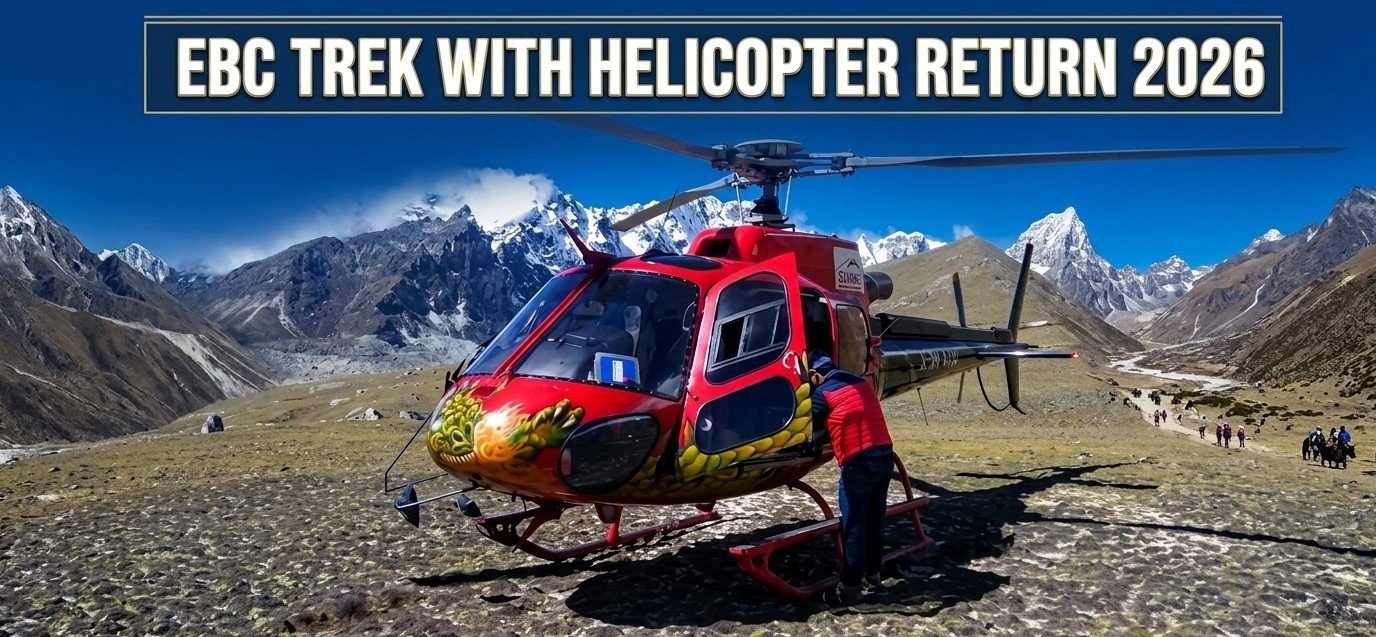
The standard Everest Base Camp helicopter tour flies you from Kathmandu up the Khumbu valley, past Lukla and Namche Bazaar, to an aerial pass directly above and around Everest Base Camp at 5,364 meters, without landing there. The helicopter circles at altitude, giving you a genuine, close aerial view of the base camp area, the Khumbu Icefall, and the summit pyramid of Everest itself alongside Lhotse, Nuptse and Ama Dablam, then descends to Hotel Everest View in Syangboche for a mountain-view breakfast on the terrace before returning to Kathmandu. Door to door, this typically runs four to five hours.
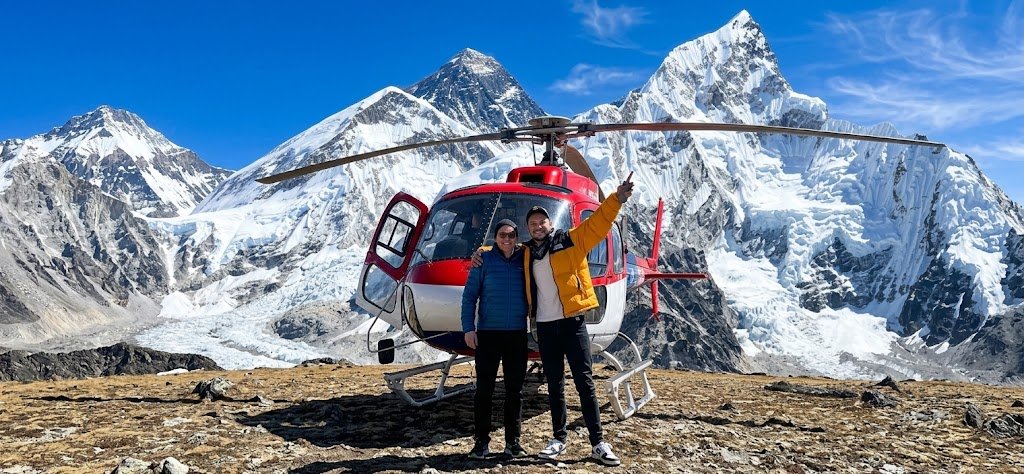
The Kala Patthar landing tour flies the same general route through the same valley and past the same peaks, but the flight plan is built around an additional stop: an attempt to land the helicopter at or very near Kala Patthar itself, at 5,545 meters on the shoulder of Pumori, directly across from Everest’s southwest face, for somewhere between five and fifteen minutes on the ground before continuing on to Hotel Everest View for the same breakfast and the same return leg. Because of that extra stop, and because Kala Patthar landings on shared flights sometimes involve a shuttle system we’ll explain further down, this version usually takes five to six hours door to door.
That is the structural difference. But the more important difference, and the one that actually determines which product you should book, is not structural at all. It’s about what each package is honestly promising you, and what it isn’t. We need to spend real time on that, because it’s the single most misunderstood part of booking an Everest helicopter tour from Kathmandu, and getting it wrong leads to disappointment that has nothing to do with our flying and everything to do with expectations that were never realistic in the first place.
What “with Kala Patthar Landing” in the name actually means
This is the part we want you to read slowly, because we’d rather lose a booking than have you show up at the airport believing something that isn’t true.
A helicopter landing at Kala Patthar is not a scheduled event the way boarding a bus is a scheduled event. It is an attempt, governed by a stack of real constraints that exist whether you fly with us or with any other CAAN-licensed operator running this route. Nepal’s civil aviation regulations and Sagarmatha National Park’s rules on helicopter operations in the high Khumbu have both tightened over recent years, for reasons that make sense once you understand the terrain: the noise impact on wildlife in a national park that exists specifically to protect snow leopard and Himalayan tahr habitat, and the sheer technical difficulty of setting a helicopter down at nearly 5,650 meters, where the air is thin enough that engine performance margins shrink dramatically and every landing decision has to account for exactly how much lift the aircraft has left to work with that day.
What that means in practice is this. On any given flight, whether the helicopter actually touches down at or very near Kala Patthar depends on a combination of factors that aren’t known until the day of the flight, sometimes not until the aircraft is already in the air approaching the site. The pilot in command makes the call based on aircraft performance calculations that account for the day’s passenger and baggage weight, current wind conditions at altitude (which change fast and unpredictably that high up), air traffic in the vicinity, and whatever the current regulatory posture happens to be. If everything lines up, the helicopter lands, the door opens, and you get five to fifteen minutes standing on the ridge with Everest’s southwest face across the valley from you. If conditions don’t line up, safety comes first every time, and the helicopter instead flies a close pass over the Kala Patthar area without touching down, and continues on to Hotel Everest View.
We are not saying this to hedge our own liability, and we are not saying it because our aircraft or our pilots are somehow less capable than the next operator’s. We are saying it because it is true for every single operator running helicopter tours out of Kathmandu to this specific site, and any company that tells you a Kala Patthar landing is guaranteed is either being careless with language or being dishonest with you. If you book the Kala Patthar landing package specifically because standing at 5,545 meters is the whole reason you’re spending $1,250, you need to go in understanding that a flyover instead of a landing remains a real possibility on any given day. It doesn’t happen often, and when conditions are good (clear skies, manageable wind, a passenger load the aircraft can comfortably handle at that altitude) the landing goes ahead the large majority of the time. But “large majority” is not “always,” and we won’t tell you it is.
Our job in that scenario, and it’s a real part of what you’re paying for even when things don’t go perfectly, is to be upfront about it before you fly, brief you honestly on what the conditions look like that morning, and explain clearly afterward exactly what happened and why, rather than quietly hoping you don’t ask. If you want more detail on how the landing itself actually feels and what past guests have experienced there, we’ve written a longer piece specifically on the Kala Patthar helicopter landing experience, and a separate guide to Kala Patthar as Nepal’s most famous viewpoint more broadly, covering both the trekking and flying routes up to it.
So what are you actually paying for, if it isn’t a guaranteed landing?
This is where we think most explanations of these two products, including our own trip page for the Kala Patthar tour, tend to move too fast. The honest way to think about the difference between these two packages is that you are not paying for an outcome, you are paying for a flight plan with a different priority built into it.
The standard EBC helicopter tour is designed, from the ground up, around the aerial pass. The route, the timing, the fuel planning, all of it assumes the helicopter stays airborne for the entire mountain segment of the flight and never budgets time or weight allowance for a ground stop above Base Camp altitude. There is no attempt at a landing on this package because the package was never built to include one. What you’re buying is a highly deliberate, close-in aerial circuit around Everest Base Camp, with the mountains visible through the windows (or through an open door on charter flights) from an altitude that puts you eye level with some of the most dramatic terrain on the planet, followed by a relaxed breakfast at a genuinely comfortable lodge with a terrace view of Everest itself.
The Kala Patthar landing tour is a different flight plan with a different priority. It is built around the landing attempt as the centerpiece of the route, with ground time budgeted into the schedule specifically for it, and the aircraft’s weight and fuel planning done with that stop in mind. When conditions cooperate, this is the package that gets you standing on solid rock at 5,545 meters, camera in hand, with the summit pyramid across the valley and no aircraft window between you and the view. When conditions don’t cooperate, you get a close pass over the same terrain instead, which is still a genuinely spectacular few minutes of flying, just not the ground stop you were hoping for.
So the fair way to describe the two products is not “one includes a bonus and one doesn’t.” It’s closer to saying that one flight plan is built around aerial proximity to Everest with zero landing ambition anywhere near it, and the other is built around attempting a landing at extreme altitude as its defining feature, with the understanding that attempts at nearly 5,650 meters don’t succeed on every single flight for reasons entirely outside anyone’s control. Both are legitimate, well-designed products. They’re just answering different questions about what you actually want out of your one shot at seeing Everest from a helicopter.
The altitude jump matters more than people expect
One thing that tends to get lost in the marketing copy on any Everest helicopter tour site, including plenty of pages on our own, is just how significant the altitude difference is between “staying in the aircraft above Base Camp” and “getting out and standing at Kala Patthar.” It sounds like a small technical detail. It isn’t.
Here’s a reference table we give to guests who ask, because seeing the numbers side by side tends to make the point better than we can in a sentence.
| Location | Altitude |
|---|---|
| Kathmandu | 1,400 m |
| Lukla | 2,860 m |
| Namche Bazaar | 3,440 m |
| Hotel Everest View / Syangboche | 3,780 to 3,880 m |
| Everest Base Camp (aerial pass altitude) | 5,364 m |
| Kala Patthar landing site | 5,545 m |
| Mont Blanc summit, for comparison | 4,808 m |
| Kilimanjaro summit, for comparison | 5,895 m |
On the standard EBC tour, the highest point of your flight is 5,364 meters, and you experience it seated, pressurized by nothing more than the cabin environment of the aircraft itself, without ever stepping out into that air. On the Kala Patthar tour, if the landing happens, you are standing, walking a few steps, and breathing unassisted at 5,545 meters, which is higher than the summit of Mont Blanc and closing in on Kilimanjaro’s summit altitude. The jump from sitting in a helicopter cabin to standing upright and moving around at that height is a meaningfully bigger physiological event than most people expect going in.
What that means practically: breathlessness within the first minute of standing, a mild headache, and a wave of dizziness on standing up too quickly are all common and expected reactions at that altitude for someone with zero acclimatisation, which describes essentially every helicopter passenger doing this as a day trip from Kathmandu. This isn’t altitude sickness in the dangerous sense, it resolves the moment you’re back in the aircraft and descending, but it is real and it happens to a lot of people, including younger, fit travellers who assume altitude only affects trekkers who’ve been walking uphill for days. We carry supplemental oxygen on every flight as a standard safety measure, and our pilots and ground staff are trained to recognize when someone needs to get back in the aircraft rather than push through those five or ten minutes on the ridge.
We mention all of this not to talk anyone out of the Kala Patthar package, most people who land there have a completely fine, often exhilarating few minutes and come back grinning, but because it’s a real factor that deserves a place in your decision, not an afterthought buried in a waiver you sign at the airport. If you’re older, if you have any cardiac or respiratory condition, or if you already know you get anxious about altitude exposure even in situations you know are safe, the standard aerial-only EBC tour genuinely might be the more comfortable choice for you, and there’s no shame in that being the deciding factor. Staying seated at 5,364 meters and never opening the door is, for a meaningful number of our guests, exactly the right amount of adventure.
What you’ll actually see and photograph on each flight
Because both packages fly essentially the same corridor up the Khumbu, via Lukla, Namche, Tengboche and the Dingboche and Pheriche area, using the same aircraft family (we and most operators on this route fly the Airbus H125, also known as the AS350 B3e, which is the standard workhorse for high-altitude helicopter operations in Nepal because of its power reserves at extreme elevation), the broad visual experience in the air is genuinely similar on both. You’ll see Everest, Lhotse, Nuptse, Makalu in the distance, and Ama Dablam’s distinctive spire on both packages. You’ll fly directly over or alongside the Khumbu Glacier and get a good look down into the Khumbu Icefall on both packages. If your main goal is simply seeing this part of the Himalaya from the air, you are not shortchanged by choosing the standard tour.
Where the two genuinely diverge is in the kind of photograph you come home with. On the standard EBC tour, your best images are aerial: Everest framed through the aircraft window or, on private charters where the door can be opened for photography at a safe moment, through an open door with the ridgelines and glacier spread out below you. These are dramatic photographs, and honestly, for a lot of our guests they’re more visually interesting than a ground-level shot, because you get the scale of the whole massif in one frame rather than a single peak from one angle.
On the Kala Patthar tour, assuming the landing happens, you get the shot that a huge number of people specifically come to Nepal hoping for: yourself standing on solid ground, at altitude, with Everest’s summit pyramid directly behind you across the valley, in a way that no window or open door can replicate. This is the single biggest reason we hear from guests who specifically choose the landing package over the aerial one. It’s not really about the flying experience, which is broadly comparable either way, it’s about wanting that specific ground-level photograph and the specific claim of having stood at 5,545 meters, not just flown near it. If that photograph and that claim matter to you more than almost anything else about the trip, that’s a completely valid reason to book the Kala Patthar package, as long as you’re doing it with clear eyes about the landing not being promised.
Relaxed morning versus adventurous morning
There’s a softer, less measurable difference between the two flights that we think deserves mention because it changes how the morning actually feels, independent of photography or altitude concerns.
The standard EBC tour has a rhythm to it that a lot of our guests, particularly older travellers, honeymooners who’d rather not spend their morning managing altitude symptoms, or anyone who just wants a beautiful, low-stress few hours in the air, tend to prefer. You board, you fly, you circle the base camp area at altitude without the adrenaline spike of an extreme-altitude landing, you descend to a lodge terrace for breakfast with a view that genuinely rivals anything you’d get from days of trekking, and you fly home. It’s a controlled, comfortable morning built around scenery and a nice breakfast, and there’s nothing lesser about wanting exactly that.
The Kala Patthar tour has a different energy, even when everything goes according to plan. There’s a stretch of real anticipation as the helicopter approaches the landing site, not knowing until fairly late in the approach whether conditions allow it, then the landing itself (if it happens), the disturbance of stepping out into thin, cold air at nearly 5,650 meters, the rush of the ten minutes you have up there, and then back into the aircraft for the descent to breakfast. Guests who choose this package tend to be the ones who came to Nepal specifically wanting an edge-of-comfort experience as part of their trip, not just a scenic flight. If you’re the kind of traveller who reads “the pilot won’t know until the approach whether the landing will happen” and feels a flicker of excitement rather than anxiety, that’s a good sign this package suits you. If that same sentence makes you nervous, that’s useful information too, and it points toward the standard tour.
Group logistics: why the Kala Patthar tour sometimes runs as a shuttle
This is a detail that rarely gets explained clearly anywhere, and it’s worth understanding before you book a shared seat rather than a private charter on the Kala Patthar package specifically.
Helicopter payload capacity drops sharply above roughly 4,000 meters, because thinner air means less lift for the same amount of power, and that effect compounds the higher you go. At Kala Patthar’s landing altitude of 5,545 meters, an aircraft that comfortably carries five passengers at sea level can carry a much smaller load, sometimes only two or three passengers plus the pilot, depending on fuel state and the day’s specific conditions. Because our shared group tours are typically sold in blocks of five seats to make efficient use of the aircraft, this creates a logistics problem specific to the landing package that simply doesn’t exist on the standard aerial tour, where the helicopter never needs to carry a reduced load for a landing it isn’t attempting.
The solution most operators use, including us, is a shuttle system through a staging point, most commonly Pheriche at 4,371 meters, which sits at a manageable altitude for the aircraft to operate from with a fuller load. On a shared Kala Patthar landing tour, the helicopter may fly the full group up to Pheriche together, then ferry passengers up to the Kala Patthar site in smaller batches of two or three at a time, cycling back down to Pheriche to collect the rest of the group before everyone continues on together to Hotel Everest View for breakfast. This is a completely normal, safe way of managing the weight math at extreme altitude, and it’s part of why the Kala Patthar package runs five to six hours rather than the standard tour’s four to five, since some of that extra time is genuinely spent shuttling rather than flying new terrain.
It also means that on a shared Kala Patthar flight, you may spend a portion of the morning waiting your turn at Pheriche while other passengers in your group take their turn at the landing site first. Some guests don’t mind this at all, Pheriche itself sits in dramatic terrain and the wait isn’t unpleasant, but if the idea of a staged, shared landing experience with waiting involved doesn’t appeal to you, a private charter removes the issue entirely, since the aircraft only needs to manage your party’s weight, not a full group’s. We go into the tradeoffs between shared and private bookings in much more depth in our private versus group Everest helicopter tour guide, which is worth reading alongside this one if budget allows for a private charter and you’re trying to decide whether it’s worth the difference.
A side by side look at the two packages
Here’s how the two products stack up when you put them next to each other directly.
| EBC Helicopter Tour | EBC Helicopter Tour with Kala Patthar Landing | |
|---|---|---|
| Price (shared flight) | $1,250 per person | $1,250 per person |
| Highest point reached | 5,364 m (aerial pass, no landing) | 5,545 m (landing attempted, not guaranteed) |
| Ground stop above Base Camp altitude | None | 5 to 15 minutes, weather and performance permitting |
| Typical total duration | 4 to 5 hours door to door | 5 to 6 hours door to door |
| Breakfast stop | Hotel Everest View, Syangboche | Hotel Everest View, Syangboche |
| Route and peaks seen | Everest, Lhotse, Nuptse, Makalu, Ama Dablam, Khumbu Icefall | Same peaks and terrain, plus ground-level view from Kala Patthar if landing occurs |
| Shared flight logistics | Standard single flight, no shuttle needed | May involve a shuttle through Pheriche for weight management |
| Best suited for | Relaxed morning, altitude caution, aerial photography priority | Ground-level photography priority, adventurous morning, wanting the story of having stood at extreme altitude |
A practical decision framework
If you’ve read this far and you’re still not sure which one fits you, here’s how we’d actually walk you through it if you called our office right now.
Start with what you want the photograph to be. If the image you’re picturing when you imagine this trip is yourself standing with Everest behind you, boots on the ground, that specific photograph only comes from a successful Kala Patthar landing, and no amount of aerial flying replicates it. If the image in your head is more about the mountain itself, seen from above, with the scale of the Khumbu Icefall and the base camp area spread out below the aircraft, the standard tour delivers that just as well as the landing package does, arguably with a cleaner, less obstructed view since you’re not managing a ground stop.
Next, think honestly about your tolerance for altitude exposure and unpredictability. If you’re travelling with an older parent, if anyone in your party has a heart or lung condition, or if the idea of stepping out at nearly 5,650 meters with no acclimatisation sounds stressful rather than exciting even in the abstract, the standard aerial tour removes that variable entirely while still delivering a genuinely spectacular flight. There is no requirement that a trip to see Everest by helicopter involve standing at extreme altitude, and plenty of our happiest guests never leave their seat above 3,880 meters.
Then think about your morning itself, not just the flying. Do you want something contained and predictable, a beautiful flight followed by a relaxed breakfast with a view, or do you want a morning with a real element of not-quite-knowing until you’re up there, weather permitting, whether the ground stop happens? Neither answer is wrong, but people tend to enjoy the trip more when they picked the version that matches their actual temperament rather than the version they felt they were supposed to pick.
Finally, and this is the part we most want you to sit with: if landing at Kala Patthar specifically is your entire reason for choosing the more involved package, make peace in advance with the fact that it may not happen on your particular day, for reasons entirely outside anyone’s control, exactly as it might not on any operator’s flight on any given morning. If you can accept that possibility calmly and still want to book the attempt, book it. If the idea of paying for an attempt that might not succeed bothers you more than it excites you, the standard EBC tour gives you a guaranteed, excellent aerial experience with none of that uncertainty built in.
What it costs, and why the price doesn’t tell you which to pick
Both packages sit at the same $1,250 headline price on a shared flight, which is exactly why this decision can’t be made on cost alone, unlike most travel decisions where price differences do a lot of the work for you. We’ve written a full breakdown of Everest Base Camp helicopter tour cost for 2026 if you want to understand how this pricing compares across shared versus private options, and where the money actually goes given fuel costs, permit fees, and the realities of operating aircraft at extreme altitude. The short version relevant here is that the Kala Patthar landing attempt doesn’t cost more to book specifically because the extra ground time, and the shuttle logistics on shared flights, are already factored into how both products are priced against each other, not layered on top as a premium add-on. You’re not getting a discount by choosing the standard tour and you’re not paying a surcharge by choosing the landing tour. They’re priced as equally weighted core products because, from our operational side, they represent roughly comparable aircraft time and complexity once you account for everything involved in each.
If you’re still working out whether an Everest helicopter tour is worth the expense at all, regardless of which of these two you’d choose, our separate honest assessment of whether an Everest helicopter tour is worth the money tackles that broader question directly, including how it compares to trekking to Base Camp on foot for those weighing both options.
How the season you fly in affects the landing odds
We get asked less often than we should about timing, and it genuinely matters if the Kala Patthar landing is the deciding factor for you. Nepal’s flying calendar for this route has a fairly well understood rhythm, and it’s worth lining your dates up with it if the landing attempt is the main reason you’re booking that package rather than the standard tour.
Late September through November, the post-monsoon autumn window, is generally the most reliable stretch of the year for this route. Skies tend to be clear in the early morning hours, winds at altitude are more settled than in other seasons, and visibility on the approach to Kala Patthar is usually good. This is also, unsurprisingly, the busiest season for both trekking and flying in the Khumbu, so if you’re booking a shared flight during peak autumn weeks, book earlier rather than later, since seats fill up well in advance of the actual date.
December through February brings cold, frequently very clear days, which sounds ideal, but wind at the landing site can be a bigger factor in winter, and cold air actually helps aircraft performance somewhat (colder, denser air gives the rotor more to work with), which is one of the few places where a Kathmandu winter genuinely works in your favor for a high-altitude landing attempt. Mornings are still the preferred flying window regardless of season, because thermal activity and cloud buildup over the mountains tend to increase as the day goes on, which is part of why virtually every helicopter tour on this route, ours included, departs Kathmandu early.
March through May, the pre-monsoon spring season, is generally good too, though visibility can be more variable day to day than autumn, with haze building up in the lower valleys as the season progresses toward the pre-monsoon heat. June through September, the monsoon months, are the most difficult window for this route on any package, standard or landing, because cloud cover and precipitation over the Khumbu make both the aerial pass and any landing attempt far less predictable, and flights are more likely to be delayed, rescheduled, or in some cases flown on a modified route. If your travel dates are flexible and the Kala Patthar landing specifically matters to you, autumn and winter mornings are where we’d point you first.
None of this changes the fundamental point made earlier in this article: even in the best season, on the clearest morning, the landing is still an assessment made on the day by the pilot based on that specific flight’s conditions and loading, not a guarantee tied to the calendar. Good timing improves your odds. It doesn’t remove the uncertainty entirely, and we’d rather you book with realistic expectations in October than disappointed ones in July.
Special occasions and where the Kala Patthar concept leads next
For couples, the Kala Patthar landing concept extends into two dedicated packages worth knowing about even if you’re currently only comparing the two core products. Our wedding photo shoot package builds directly on the landing experience, giving couples dedicated time at altitude specifically structured around photography, with a longer ground window planned into the itinerary than the standard landing tour allows for. The honeymoon package takes a similar approach for couples who want the Kala Patthar landing as part of a broader, more personal celebration rather than a standard shared flight. Both are worth a look if the ground-level Everest photograph is important to you and you’d rather have a package built entirely around that moment than one where it’s a stop along a shared group itinerary.
For travellers more interested in seeing a wider stretch of the Khumbu than either of these two products covers, rather than specifically wanting the Kala Patthar landing, our EBC with Gokyo helicopter tour extends the standard route westward toward the Gokyo lakes and Renjo La area, trading the landing attempt for a longer, geographically broader flight. If what’s actually pulling at you is wanting to see more of the Khumbu rather than wanting to stand at a specific altitude, that combination tour might answer the question better than either of the two products we’ve spent this article comparing.
What we tell people who genuinely can’t decide
Every so often, after all of this, a guest still can’t choose, and honestly that’s fine, because both are good products and we mean that. When someone is truly torn, we usually ask two questions and let the answers make the decision for them.
First: if you had to fly today and the pilot told you honestly that conditions looked borderline for a Kala Patthar landing, maybe a fifty-fifty chance of it happening, would you still rather book the landing package and take that chance, or would you rather book the standard tour and know exactly what you’re getting? People’s gut reaction to that question tends to be immediate and tells them more than an hour of reading comparison charts.
Second: five years from now, telling someone about this trip, which version of the story do you actually want to be telling? “We flew right up to Everest Base Camp and had breakfast looking at Everest” is a genuinely great story on its own, and it’s the true, honest description of the standard tour. “We landed at Kala Patthar at 5,545 meters and stood there looking at Everest’s southwest face” is a different, more specific story, and it’s the one the landing package is built to try to deliver, with the honest caveat we’ve repeated throughout this piece that it isn’t promised on any given day.
Neither story is better. They’re just different, and the right one for you is whichever answer came more naturally when you read those two questions.
A couple of things we’re publishing alongside this guide
Two related questions come up often enough after people book either of these packages that we’re covering them properly in their own posts rather than trying to squeeze them in here. If you’re wondering exactly what’s included in the price versus what counts as a separate permit or park fee on an Everest helicopter tour, we’ve laid that out in full in our guide to Everest helicopter tour permits, fees, and what’s included. And if you’re packing for either trip and want to know exactly what the weight allowances and baggage rules look like, particularly relevant if you’re booking the Kala Patthar landing where every kilogram affects the aircraft’s performance margin at altitude, our companion piece on Everest helicopter tour weight limits and baggage rules covers that in detail. And if the Kala Patthar landing tour is on your shortlist because you are planning something more specific than sightseeing, our guide to proposing at Kala Patthar walks through how that particular use of the landing attempt is usually planned.
Where we land, so to speak
If we had to compress this entire article into a single piece of advice, it would be this. Choose the standard Everest Base Camp helicopter tour if you want a relaxed, predictable, genuinely spectacular aerial experience with Everest and its neighboring giants, no altitude risk beyond sitting in a pressurized cabin at 5,364 meters, and a calm breakfast with a view to finish the morning. Choose the Kala Patthar landing tour if the ground-level photograph and the specific experience of standing at 5,545 meters matter enough to you that you’re willing to accept a real, honest chance that conditions on your particular day mean a close flyover instead of a touchdown, exactly as they might for any operator flying this route.
Both leave from the same terminal, fly the same valley, pass the same mountains, and land you back in Kathmandu by lunchtime with photographs you’ll look at for years. The only real question is which version of that morning actually matches what you’re hoping to feel when you’re up there, and we’d rather you answer that honestly before you book than find out the hard way at 5,364 meters with the door still closed, wishing you’d chosen differently. Call us, tell us what you’re picturing, and we’ll help you pick the one that actually fits.