Every year, thousands of travellers sit in Kathmandu hotel rooms doing the same calculation. The helicopter tour costs over a thousand dollars. That is a lot of money for a few hours. Is it actually worth it? This is the honest answer, not a marketing pitch from someone trying to sell you the tour.
The short version: for most people who take it, the Everest helicopter tour ranks among the two or three most powerful travel experiences of their life. For a small number of travellers, it meets but does not dramatically exceed their expectations. For almost none of them is it a disappointment. But whether it is worth it for you specifically depends on what you are comparing it to, what you are looking for, and what stage of life you are at when you go.
What Does Worth It Actually Mean?
The word “worth it” means different things depending on who is asking. For some travellers, worth it means getting measurably more value than the money paid. For others, it means an experience they will remember for the rest of their life. For others still, it means not regretting it when they look back. Each of those standards produces a different answer.
Let us be specific. The Everest helicopter tour at $1,100 to $1,400 per person delivers: a return flight from Kathmandu over the Himalayan foothills and into the Khumbu Valley, aerial views of Everest Base Camp, the Khumbu Icefall, and the surrounding 8,000 metre peaks, a landing at Kala Patthar at 5,545m, roughly 15 to 20 minutes on the ground at the highest accessible viewpoint in the world, supplemental oxygen, permits, and return to Kathmandu by midday. The total time from hotel pickup to hotel dropoff is around four hours. The time actually in the mountains is around two to three hours.
Is that worth $1,100? Against a hotel stay at the same price, no. Against a flight from Europe to Nepal at the same price, a more interesting comparison. Against a week at a European ski resort at the same price, the helicopter tour starts to look like very reasonable value. The frame of reference changes the answer dramatically.
What You Actually Get for the Money
Let us break down what the tour delivers in concrete terms, because the abstract description of “views of the world’s highest mountain” does not capture the actual experience.
The flight itself is extraordinary from the first few minutes. Leaving Kathmandu, the city drops away and within fifteen minutes you are flying over hills and river valleys that most tourists in Nepal never see. The transition from the Kathmandu Valley to the Himalayan foothills involves a visual shift that is hard to describe accurately. The scale increases continuously for 45 minutes until the Khumbu peaks appear around a ridge and you realise that what you thought were large mountains in Europe or the American West were, in comparative terms, hills.
The approach into the Khumbu puts you at eye level with peaks that trekkers see from below. Ama Dablam, which is considered one of the most beautiful mountains in the world by virtually everyone who sees it, appears at close range from the helicopter window. Nuptse’s south face, a wall of rock and ice nearly 2,500 metres high, fills the window on the approach. And then Everest itself appears, not from below as trekkers see it, but from roughly the same altitude as base camp, with the route visible on the mountain and the plume of snow streaming from the summit.
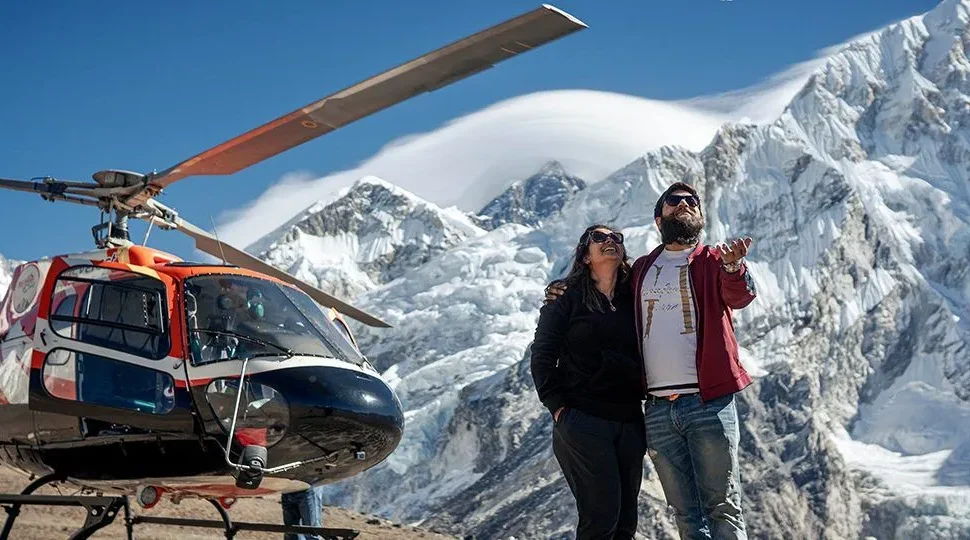
The Kala Patthar landing adds something the aerial views cannot provide: the physical sensation of being at 5,545m. The cold, the thin air, the sound of wind across the ridge, the feeling that the world is very far below you. Many travellers describe the landing stop as the moment the experience becomes real in a way that flight views through a window cannot match. Standing on the same ridge where some of the world’s best mountaineers have stood to photograph Everest from above, with the summit visible directly across the glacier, is a specific kind of experience that money can replicate in very few other ways.
Who Gets the Most Value from the Tour
The people who consistently report the highest satisfaction with the Everest helicopter tour share a few characteristics.
They have wanted to see Everest for a long time. The tour delivers the most profound experience for people who have carried some version of an Everest ambition for years, whether from mountaineering books they read as teenagers, a long held travel goal, or the specific aspiration to stand in the Khumbu that they have deferred for practical reasons. The emotional resonance of finally being there, in the mountain’s presence, with the whole range visible from Lhotse to Pumori, is much greater for people who have imagined the experience than for people who added it to their Nepal itinerary somewhat casually.
They have limited time or physical capacity for the trek. The full EBC trek takes 12 to 14 days and requires significant physical fitness. For travellers with only a week in Nepal, with health conditions that prevent multi week trekking, or with family or professional obligations that make a two week absence impossible, the helicopter tour is not a compromise version of the trekking experience. It is the only version that is realistically available. For these travellers, the question is not “helicopter or trek.” It is “helicopter or nothing.” In that framing, the helicopter tour is not just worth it. It is the whole experience.
They choose the right package. People who book the Kala Patthar landing tour consistently report higher satisfaction than those who book aerial only tours. The landing changes the nature of the experience from observation to participation. You are not watching the mountain. You are in it, at altitude, with cold air and thin oxygen and rock under your boots. That difference is significant for how people feel about the experience afterward.
Who Gets Less Value from the Tour
Being honest about this matters. The helicopter tour is not the ideal choice for every traveller, and acknowledging that is more useful than pretending otherwise.
Travellers who are primarily interested in the human experience of the Khumbu, the Sherpa villages, the teahouses, the culture of high altitude communities, and the gradual physical journey through the landscape, will find the helicopter tour shallow compared to trekking. The tour gives you views. It does not give you the relationship with the landscape that comes from walking through it over two weeks. If what you want is the cultural and human experience of the Khumbu, trek.
Travellers who are primarily motivated by the physical challenge of trekking will not find the helicopter tour satisfying. The achievement component of the EBC trek, the fitness it requires, the adaptation to altitude over days, and the earned perspective that comes from walking to base camp, is absent from the helicopter tour. The mountain is accessible and dramatic from the helicopter, but it has not been earned in the same way. For some travellers, that matters enormously. For others, not at all.
Travellers who need significant sensory preparation to appreciate experiences, who find it difficult to absorb the significance of what they are seeing in the moment, may find that the tour moves too quickly. The 15 to 20 minutes at Kala Patthar is enough for many people to be fully present and absorb the experience. For others, the brevity means they spend the time getting oriented and photographing rather than actually being there, and they feel afterward that they did not fully arrive before it was time to leave. If you know that you need more time than most people to settle into a new place and absorb it properly, factor that into your expectations for the landing stop.
The Real Cost Comparison: Helicopter vs Trek
The most common framing of the “is it worth it” question assumes that the helicopter tour and the EBC trek are alternatives to be compared in cost. They are not equivalents, but the comparison is still instructive.
| Item | EBC Trek (14 days) | Helicopter Tour (1 day) |
|---|---|---|
| Main activity | $1,800 to $3,500 | $1,100 to $1,400 |
| Guide | $350 to $600 | Included |
| Porter | $200 to $400 | Not needed |
| Permits | $65 to $80 | Included |
| Lukla flights | $200 to $350 | Included |
| Accommodation (14 nights) | $200 to $700 | Not needed |
| Food on trail | $350 to $550 | Not needed |
| Gear | $400 to $1,000 | Warm jacket only |
| Insurance | $150 to $350 | $30 to $80 |
| Total | $3,715 to $7,530 | $1,230 to $1,580 |
The trekking budget runs three to five times higher than the helicopter tour cost. If you have the time and fitness for the trek, it delivers a different and in many ways richer experience. But if your Nepal budget is fixed at around $1,500 for the mountain experience and you have a week in Kathmandu, the helicopter tour is not the expensive option. It is the only option that fits.
What the Tour Actually Looks Like: A Realistic Hour by Hour Account
Understanding what the tour is like from pickup to return helps set realistic expectations. Here is what a typical tour day actually looks like.
5:30 to 6:00am. Vehicle pickup from your Kathmandu hotel. Kathmandu in the early morning is quiet and slightly cold. The driver takes you through empty streets to the helipad area near the international airport or to one of the private helipad locations used by tour operators. The transfer takes 20 to 40 minutes depending on your hotel location.
6:15 to 6:30am. You arrive at the helipad. There is a small waiting area, a briefing from the operator about the route and what to expect, weight checks, and assignment to your seat. The crew does pre flight checks. You may wait 15 to 30 minutes at this stage depending on weather reports and ATC clearances.
6:45 to 7:00am. Departure. The helicopter lifts from the helipad and the city falls away immediately. Within three minutes you are above Kathmandu’s eastern suburbs and heading northeast toward the mountains. The flight into the hills takes about 20 minutes, then the valley narrows, the hills become ridges, the ridges become peaks, and after about 40 minutes you are in the Khumbu proper.
7:40 to 8:00am. Arrival in the Khumbu. The helicopter descends toward Lukla for a refuelling stop. Lukla (2,800m) is a brief pause, five to ten minutes on the ground at the famous mountain airport with its dramatic short runway. From here the helicopter climbs toward the Khumbu. The peaks get larger. Ama Dablam appears. Namche Bazaar passes below. The route continues up the valley past Tengboche, past Dingboche, into the upper Khumbu.
8:20 to 8:40am. Kala Patthar landing (5,545m). The helicopter descends onto the helipad on the ridge. The door opens. The cold hits you immediately. The air is thin enough that the first breath feels noticeably insufficient. You step out onto the rocky ground of the ridge. Everest is directly in front of you. Nuptse is to the left. Pumori is behind you. The Khumbu Glacier runs below you and Base Camp is visible as a collection of coloured dots on the moraine at the glacier’s edge. You have 15 to 20 minutes here. Use the oxygen provided.
8:50 to 9:10am. Departure from Kala Patthar. The return flight passes back through the Khumbu. Ama Dablam from above is arguably even more impressive than from below. Some tours stop at the Hotel Everest View (3,800m) for tea or breakfast before the return to Lukla for refuelling.
9:30 to 10:30am. Return to Kathmandu. You land at the helipad, transfer back to your hotel. Most travellers are back at their hotel by 10:30 to 11:00am with the entire rest of the day in Kathmandu ahead of them. Many describe the hours after the tour as quietly strange, sitting in a cafe or restaurant in Thamel with the knowledge that they were at 5,545m looking at Everest just four hours earlier.
Comparing to Other Extraordinary Travel Experiences by Price
The worth it question becomes clearer when you compare the helicopter tour to other travel experiences at similar price points.
A Serengeti safari day in Tanzania costs $400 to $800 per person per day for a mid range operator. Three days on safari runs $1,200 to $2,400. The Everest helicopter tour at $1,100 to $1,400 is competitive with three days in the Serengeti and delivers a single concentrated experience rather than an extended one.
A day’s helicopter skiing in the Canadian Rockies or New Zealand runs $900 to $2,000 per person depending on the number of runs. The Everest helicopter tour is comparable in price and arguably more visually dramatic, though helicopter skiing delivers a different physical experience.
A hot air balloon flight over Cappadocia in Turkey costs $150 to $350. It is a fraction of the Everest helicopter tour price. But the scale of what you see, the altitude you reach, and the proximity to extraordinary geography are very different. Cappadocia from a balloon is beautiful. Everest from 5,545m is in a different category.
A private boat charter in the Greek Islands for a day costs $600 to $2,000 depending on the vessel and number of passengers. The Everest helicopter tour is comparable in price and comparable in how people describe it afterward, as an extraordinary sensory experience in a remarkable natural setting.
None of these comparisons prove that the Everest helicopter tour is worth it. They do show that it sits in a reasonable price band for the category of significant, once in a lifetime travel experiences that people plan and save for deliberately.
What People Say After the Tour
The most useful data on whether the tour is worth it comes from people who have already taken it. Across thousands of reviews on TripAdvisor, Google, and direct feedback, several themes come through consistently.
Almost no one reports disappointment. This is notable. For a travel experience at $1,100 per person, the rate of genuine disappointment in reviews is very low. The most common negative comments are about weather related cancellations (which are operational facts of mountain flying, not reflections on the tour quality) and about tours that promised the Kala Patthar landing but delivered something less. Both of these concerns are resolved by booking with a reputable operator who uses capable aircraft and has a transparent rescheduling policy.
The most common positive theme is scale. Travellers consistently describe being unprepared for the actual size of the mountains seen from the helicopter. People who have seen mountains before, who have been to the Alps or the Rockies, describe the Himalayas from the Khumbu as being in a different category. The phrase “I did not understand what big meant until I saw this” appears in some version in a remarkably large number of reviews.
The second most common positive theme is the landing. The Kala Patthar stop is consistently described as the moment the experience becomes real. Standing on the ground at altitude changes the relationship to the mountains in a way that flight views through a window cannot. Many travellers say the landing was worth the full cost of the tour on its own.
The third consistent theme is regret avoidance. A significant number of travellers, particularly those who deliberated for a long time before booking, describe a relief response after the tour. The question of whether they should do it, which had occupied some mental space for weeks or months before the trip, is answered definitively. Yes, they should have done it. They are glad they did. The version of themselves who did not go would have regretted it.
The Regret Calculation
There is a specific way to think about this that cuts through the cost analysis. Ask yourself: if you go to Nepal and do not do the helicopter tour, how will you feel about that decision in ten years?
For most people, the answer is that they will regret it. Not dramatically, not with persistent sadness, but with the quiet awareness that they were in Nepal with Everest accessible by helicopter and they did not go. That kind of regret is worse than the temporary sting of spending money. Money is replaceable. The morning you could have spent on Kala Patthar is not.
The regret calculation flips the question. Instead of asking “is it worth the money,” ask “will I regret not going?” For the vast majority of travellers considering the tour, the answer to that second question is yes. Which makes the answer to the first question straightforward.
Making the Most of the Money You Spend
If you decide the tour is worth it, a few decisions determine how much value you actually get from the money.
Choose the Kala Patthar landing. The basic aerial tour is meaningful, but the landing at 5,545m is what distinguishes the experience from a scenic flight. Every review comparison between the aerial only and the landing tour favours the landing. The additional cost is modest relative to the total tour price and the difference in experience is significant.
Book directly with a licensed operator rather than through a booking platform. Booking platforms add 10 to 25 percent commission to the tour price. That money does not improve your experience. Booking direct means more of your money goes toward the aircraft, the pilot, and the operation itself.
Go in the right season. October and November, or March and April, give you the best probability of clear skies and successful completion on your first scheduled date. Booking in the peak window with a reputable operator who offers free weather rescheduling protects your investment and maximises the chance of getting the full experience rather than a weather limited version.
Be present at the landing site. Put the camera down for at least two minutes at Kala Patthar and just look at the mountain. Take the oxygen and breathe. Let the scale register before you start thinking about angles and composition. The photographs are evidence of the experience. The experience itself comes from being there without a screen between you and the mountain.
Our Honest Assessment
We operate Everest helicopter tours. That creates an obvious conflict of interest in answering whether the tour is worth the money. So let us be direct about the cases where it might not be the right choice for you specifically.
If you are physically fit, have three weeks available, and the trekking experience is what you actually want, trek. The helicopter tour cannot give you what the trek gives you, and the trek cannot give you what the helicopter tour gives you. They are not interchangeable, and if the trek is genuinely available to you, it is worth doing.
If your Nepal budget is very constrained and the helicopter tour would represent a genuinely painful financial sacrifice with real consequences, there are other meaningful things to do in Nepal at lower cost. The Nagarkot sunrise view of the Himalayas from the ridge east of Kathmandu gives extraordinary mountain views for around $50 including transport and accommodation. It is not the same as the helicopter tour, but it is not nothing either.
For everyone else, the honest answer is: yes. The Everest helicopter tour is worth it. Not because we sell it. Because the people who take it tell us, consistently and without significant exception, that it was one of the best mornings of their life.
Book the Kala Patthar Landing Tour for the full experience, or compare options between the Group Tour and the Private Couples Package depending on your group size.
Book the Everest Helicopter Tour
You’ve done the research. The Everest Base Camp helicopter tour is the fastest way to see the world’s highest mountain up close — and the most honest answer to whether it’s worth it is that most guests wish they had done it years earlier. No advance payment required to hold your seat. Check availability and book here →