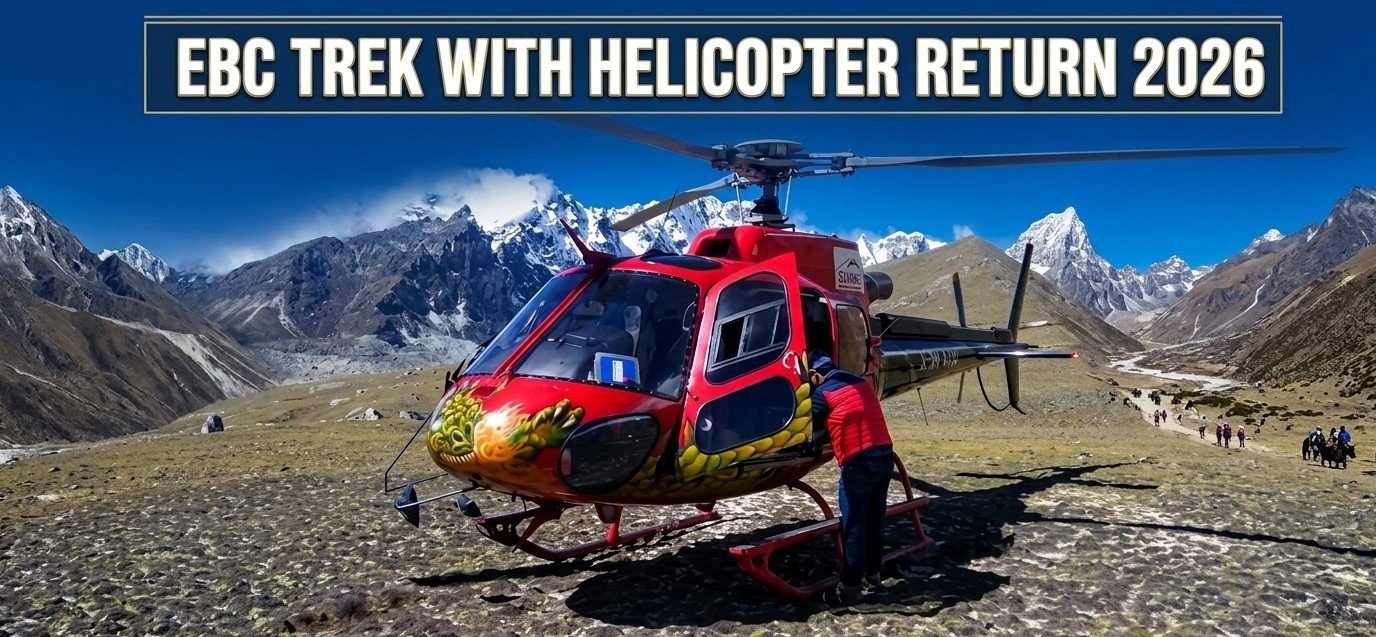
The most common question we get from serious trekkers planning their Nepal trip is some version of this: I want to do the EBC trek, but I do not have two full weeks to walk back down. Can I fly out by helicopter? The answer is yes, and the EBC trek with helicopter return has become one of the most popular Nepal itineraries for travellers who want the full trekking experience without spending half their trip retracing their steps on the descent.
Here is everything about the hybrid option: how it works logistically, what it costs, how to book both components, which direction works best, and how to plan the overall itinerary so the trek and the helicopter pickup connect smoothly. If you are trying to fit the EBC experience into a Nepal trip of eight to twelve days, this is very likely the right format for your trip.
How the EBC Trek with Helicopter Return Works
The standard format is straightforward. You fly to Lukla from Kathmandu on a scheduled mountain flight (20 to 30 minutes, $200 to $350 each way), trek the classic EBC route over eight to ten days to Everest Base Camp and Kala Patthar, and then instead of walking back to Lukla over four to five days, you board a helicopter at one of several pickup points in the Khumbu and fly back to Kathmandu in one morning.
The helicopter pickup can happen from several locations depending on your fitness, your schedule, and how far you want to walk before flying:
Gorak Shep (5,160m): The settlement closest to base camp, this is the highest helicopter pickup point and the most popular for trekkers who have completed both base camp and Kala Patthar. Flying out from Gorak Shep means you walk in, summit Kala Patthar, sleep at Gorak Shep, and fly the next morning without any descent walk at all.
Dingboche (4,410m): A lower pickup point that some trekkers choose after descending from Gorak Shep to Dingboche for a better night’s sleep at lower altitude before flying. The descent from Gorak Shep to Dingboche takes four to five hours and involves significant altitude reduction that most trekkers find comfortable and restorative before the flight.
Namche Bazaar (3,440m): The main Sherpa hub of the Khumbu and a lower altitude option for travellers who have descended further or who want a final night in Namche before flying out. Namche is well connected for helicopter pickups and is the most reliable weather window point for early morning departures.
The helicopter from any of these points to Kathmandu takes 40 to 60 minutes depending on the pickup location. Most operators schedule early morning departures (6:30 to 8:00am) to use the best weather window before midday cloud and wind build.
Why Trek In, Fly Out Works Better Than Fly In, Trek Out
Some travellers ask about the reverse option: fly to base camp by helicopter first, then walk back to Lukla. This is possible but almost never the right choice, for reasons that are physiologically straightforward.
Acclimatisation runs only in one direction: you must ascend gradually to allow your body to adapt to reduced oxygen. Flying to Gorak Shep at 5,160m on day one of your Nepal trip without any acclimatisation means arriving at an altitude where altitude sickness risk is high, with a body that has had no time to adapt. Even with supplemental oxygen provided by the helicopter operator, a brief exposure to 5,160m followed by a two week descent back to Lukla on foot would be physiologically strange and potentially counterproductive for trekking performance.
When you trek in and fly out, your body has acclimatised progressively over eight to ten days. By the time you reach Gorak Shep, you have spent several nights at increasing altitudes and your cardiovascular and respiratory systems have adapted substantially. The helicopter flight home from that point is easy on your body. You are flying down from high altitude, which presents no physiological risk. The whole approach is sensible.
The practical implication: always trek in and fly out, not the reverse. The trekking experience and the helicopter experience both work better in this order.
Sample Itinerary: 10 Days Trek Plus Helicopter Return
| Day | Route | Altitude | Approximate Walk Time |
|---|---|---|---|
| Day 1 | Kathmandu to Lukla (flight), Lukla to Phakding | 2,610m | 3 to 4 hours |
| Day 2 | Phakding to Namche Bazaar | 3,440m | 5 to 6 hours |
| Day 3 | Namche Bazaar acclimatisation day (hike to Everest View Hotel and back) | 3,440m to 3,880m | 3 to 4 hours round |
| Day 4 | Namche to Tengboche | 3,867m | 5 to 6 hours |
| Day 5 | Tengboche to Dingboche | 4,410m | 5 to 6 hours |
| Day 6 | Dingboche acclimatisation day | 4,410m | Short day hike |
| Day 7 | Dingboche to Lobuche | 4,940m | 4 to 5 hours |
| Day 8 | Lobuche to Gorak Shep, visit Everest Base Camp | 5,160m / 5,364m | 7 to 8 hours |
| Day 9 | Gorak Shep to Kala Patthar summit (pre dawn), helicopter pickup from Gorak Shep | 5,545m then back to 5,160m | 2 to 3 hours hike, then fly |
| Day 10 | Arrive Kathmandu by 10am, buffer/rest day | 1,400m |
This ten day structure is the most efficient format for the EBC trek with helicopter return for travellers who have around twelve days in Nepal total (two in Kathmandu before, two after). It saves five to six days compared to the full trek and return, which typically takes 14 to 16 days in total.
What the Helicopter Return Actually Costs
The helicopter pickup from the Khumbu back to Kathmandu is a separate booking from the EBC trek package itself. Most licensed Nepal helicopter operators offer this service, and the cost depends on the pickup location and whether you arrange a shared or private flight.
A shared helicopter return from Gorak Shep or Dingboche to Kathmandu costs around $500 to $700 per person. This means you are grouped with other trekkers from the same area who are also flying out, sharing the aircraft to reduce the per person cost. Most trekkers going out by helicopter from the Khumbu during peak season (April and October) have no difficulty finding shared seats at these prices, as demand for helicopter returns is high and operators routinely fill aircraft.
A private helicopter charter from the Khumbu to Kathmandu costs $1,800 to $2,500 for the whole aircraft. For a group of three to five trekkers flying together, this works out at $360 to $830 per person, which is comparable to or cheaper than shared seats. For solo trekkers or couples, private is more expensive per person but gives flexibility on departure time and pickup location.
Some trekkers book the helicopter return through their trekking agency as part of the overall package. Others book it independently after arriving in Kathmandu and confirming their trek is going to plan. Both approaches work. Booking in advance gives certainty. Booking in the Khumbu gives flexibility if your trek schedule shifts due to acclimatisation needs or weather on the route.
Total Cost of the EBC Trek with Helicopter Return
Here is a realistic budget breakdown for the full ten day itinerary including the helicopter return from Gorak Shep.
| Item | Budget Range |
|---|---|
| Kathmandu to Lukla flight (one way) | $200 to $350 |
| Trekking agency/guided package (8 to 10 days) | $900 to $2,500 |
| Permits (TIMS + Sagarmatha National Park) | $65 to $80 |
| Accommodation on trail (9 nights) | $120 to $450 |
| Food on trail (9 days) | $250 to $450 |
| Helicopter return (shared, Gorak Shep to KTM) | $500 to $700 |
| Travel insurance with helicopter evacuation | $100 to $300 |
| Gear (if purchasing) | $200 to $800 |
| Total realistic budget | $2,335 to $5,630 |
The saving compared to the full two week trek (which typically runs $3,500 to $7,500 with all costs) is modest in dollar terms once you account for the helicopter return cost. The real saving is in time: five to six days of walking replaced by one morning’s flight. For most people, time savings on a Nepal trip have more value than the direct dollar comparison suggests.
Booking the Helicopter Return: How and When
There are three main ways to book the helicopter return from the Khumbu.
Through your trekking agency as a package inclusion. Many Kathmandu based agencies offer EBC trek packages that include the helicopter return as a standard component. This simplifies logistics and means your agency coordinates the pickup on your behalf. The downside is that you pay the agency’s margin on the helicopter component, which may be 15 to 25 percent above the direct operator price.
Directly with a Kathmandu based helicopter operator before you leave the city. This is the most cost effective approach and the one we recommend. You confirm your trekking itinerary with the helicopter operator, agree on the pickup point and approximate date, and the operator monitors your scheduled arrival and arranges the pickup accordingly. Most reputable operators are flexible about adjusting the pickup date by one to two days if your trek runs slightly ahead or behind schedule.
On the mountain, through your guide or a teahouse in Namche or Dingboche. This is the most flexible option but also the most uncertain. In peak season, helicopter seats from the Khumbu fill quickly. Waiting until you are on the mountain to book risks finding no seats available on your preferred date, particularly in late April or early October when both trekking and helicopter demand peak simultaneously. If you plan to book on the mountain, start enquiring at Namche Bazaar rather than waiting until Gorak Shep.
The Experience of Flying Out from Gorak Shep
The helicopter pickup from Gorak Shep after completing Kala Patthar is genuinely extraordinary, and it is worth describing in detail because it is one of those rare moments where multiple significant experiences stack on top of each other.
You have just walked to Kala Patthar (5,545m) in the dark, watched the sun rise over the Himalayan range, seen Everest’s summit catch the first light of day in a glow that turns from pink to gold to white over about twenty minutes, and walked back down to Gorak Shep. You are at 5,160m, your body has been operating at high altitude for eight days, and you are physically tired in the specific way that comes from sustained effort at altitude. Your pack is on the helipad. And then the helicopter lands.
Within sixty seconds of boarding, you are lifting off from Gorak Shep. The base camp area falls away below. The route you walked over eight days passes under you in minutes. Gorak Shep, Lobuche, Dingboche, Tengboche, Namche. The flight that takes eight days on foot takes fifty minutes in the air. Most trekkers describe a complex emotional response to this. Pride in what they walked. Disbelief at how quickly it collapses back to Kathmandu. And, underneath both, a profound sense of having been somewhere rare and returned with something that does not fit easily into words.
Many trekkers say the helicopter return changed their relationship to the trek in retrospect. The compression of the route from above gives a spatial understanding of the Khumbu Valley that the ground level experience does not provide. Seeing the whole route you walked laid out below the helicopter, from Lukla to base camp in a single glance, makes the scale of what you did more apparent rather than less. The helicopter does not diminish the trek. For most trekkers, it reveals it.
Practical Logistics for the Helicopter Pickup Day
The morning of your helicopter pickup requires some organisation. Here is what typically happens.
The night before, confirm with your helicopter operator that the flight is scheduled. Weather in the Khumbu can require rescheduling at short notice. Most operators use WhatsApp to communicate with trekkers or their guides on the mountain. Have your guide maintain contact with the helicopter company the evening before and the morning of your departure.
On the morning, be at the designated helipad with your pack by the scheduled pickup time. Helicopter schedules in the mountains run on weather, not clocks, and the pilot will land when conditions allow, which may be slightly earlier or later than the planned time. Being at the helipad with everything ready means you board immediately when the helicopter arrives.
Luggage rules at high altitude helicopter landings are stricter than standard air travel. Maximum baggage weight per passenger is typically 10 to 15kg. If your trek pack is heavier than this, speak with your helicopter operator before arriving at the pickup point. Excess luggage may need to be sent back to Namche or Lukla by yak and collected or forwarded separately, which is entirely manageable with advance notice but creates problems if discovered on the morning of pickup.
Tip your guide and porter before the helicopter arrives. It is easy to forget this in the excitement and logistics of the departure morning, and once you are on the helicopter you will not have another opportunity. Your guide has carried both your experience and your wellbeing for eight to ten days. A meaningful tip, typically $100 to $200 for a ten day trek, reflects that appropriately.
Is the Helicopter Return Worth Adding to the Trek?
Almost universally, yes. The descent from Gorak Shep to Lukla on foot takes four to five days of walking on the same route you walked up. Much of that descent is physically demanding on the knees and less visually engaging than the approach, since you have already seen the landscape from the other direction. The trekking community is honest about this: most people who do the full two week trek find the descent somewhat anticlimactic compared to the ascent. The mountain views remain extraordinary, but the psychological arc of the experience peaks at base camp and Kala Patthar, and the walk down is completion rather than discovery.
The helicopter removes the anticlimactic portion and replaces it with one of the most extraordinary flights in commercial aviation. You lose the exercise and the additional time in the mountains. You gain the aerial perspective on the route you walked and an hour that compresses the entire Khumbu into a single visual experience from above. For almost all trekkers, this is a very good trade.
The additional cost of the helicopter return ($500 to $700 for a shared seat) adds roughly 15 to 25 percent to the total trek budget for most travellers. Against the value of five extra days available for other Nepal experiences, or simply returning home earlier without the physical wear of five more days of downhill walking, most trekkers consider it among the best money they spent on the trip.
Combining with the Everest Helicopter Tour
Some travellers want both: the full Everest helicopter tour from Kathmandu and the EBC trek with helicopter return. This is possible but requires careful scheduling to avoid duplication. One approach is to do the helicopter tour first as an orientation flight at the start of the Nepal trip, then trek EBC independently, and fly home by helicopter at the end. This gives three distinct Khumbu experiences: the aerial tour from above, the ground level trek over ten days, and the departure flight from Gorak Shep. Each delivers a genuinely different perspective on the same geography, and many serious Nepal travellers find this combination the most complete way to know the Khumbu.
For a Nepal trip combining all three components, allow a minimum of fifteen days in Nepal. The helicopter tour from Kathmandu takes one morning. The EBC trek with helicopter return takes ten to eleven days. Two to three days in Kathmandu at the start and end complete the trip.
Book Your Khumbu Helicopter Return
If you are planning an EBC trek and want to arrange the helicopter return from Gorak Shep, Dingboche, or Namche Bazaar, contact us at Mt Everest Helicopter Tour to discuss the options and pricing for your specific dates and group size. We operate helicopter services throughout the Khumbu Valley and can coordinate your pickup with whatever trekking schedule you are running.
If you are also interested in the standalone Everest helicopter tour from Kathmandu, explore our packages including the EBC and Gokyo combined tour for the widest aerial perspective on the Khumbu and Gokyo regions.
Book the Everest Helicopter Tour
Whether you’re trekking to base camp and flying back, or doing the full aerial experience from Kathmandu, the Everest Base Camp helicopter tour is the benchmark Khumbu experience. No advance payment required. Check availability and book here →