
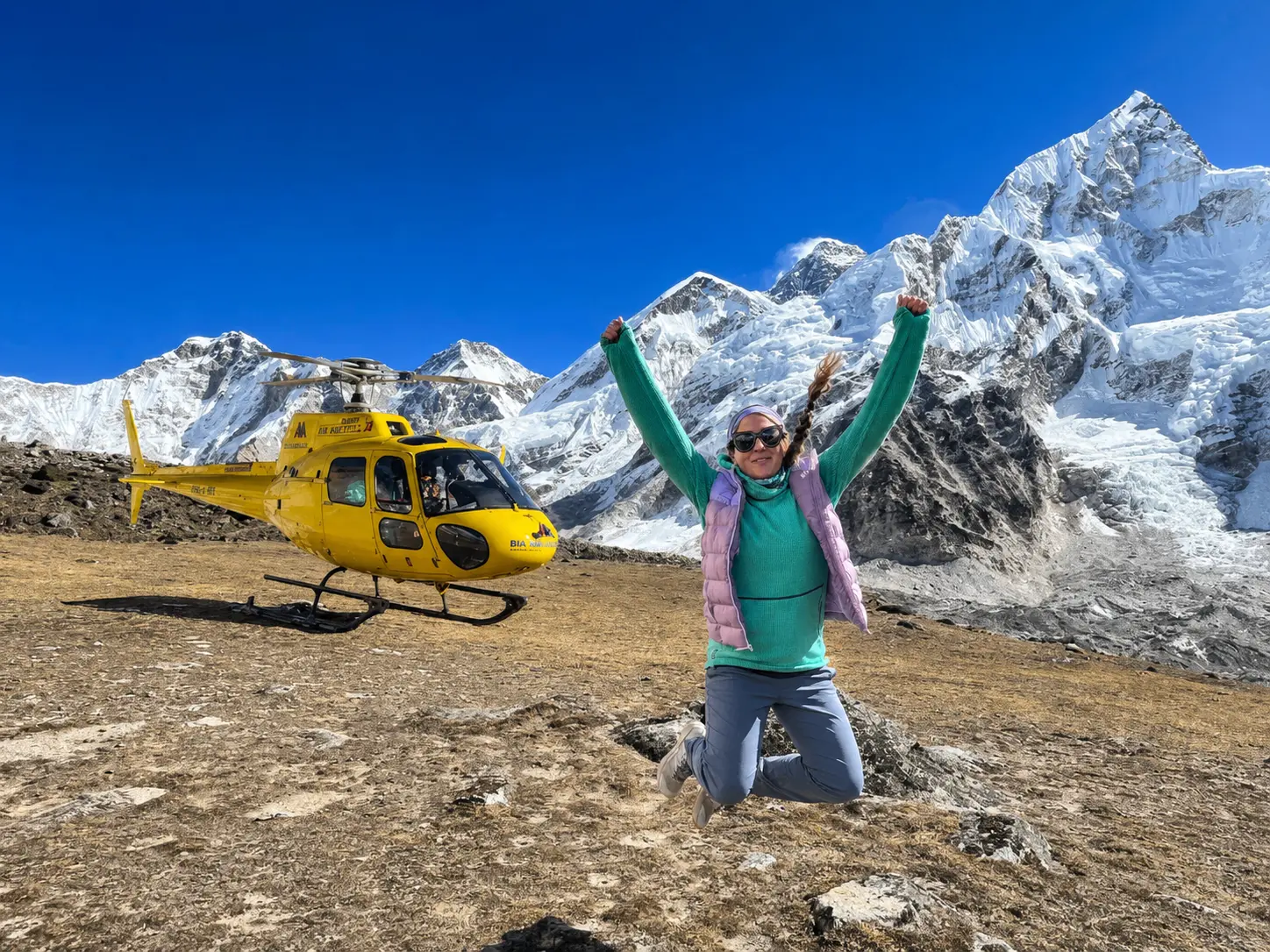
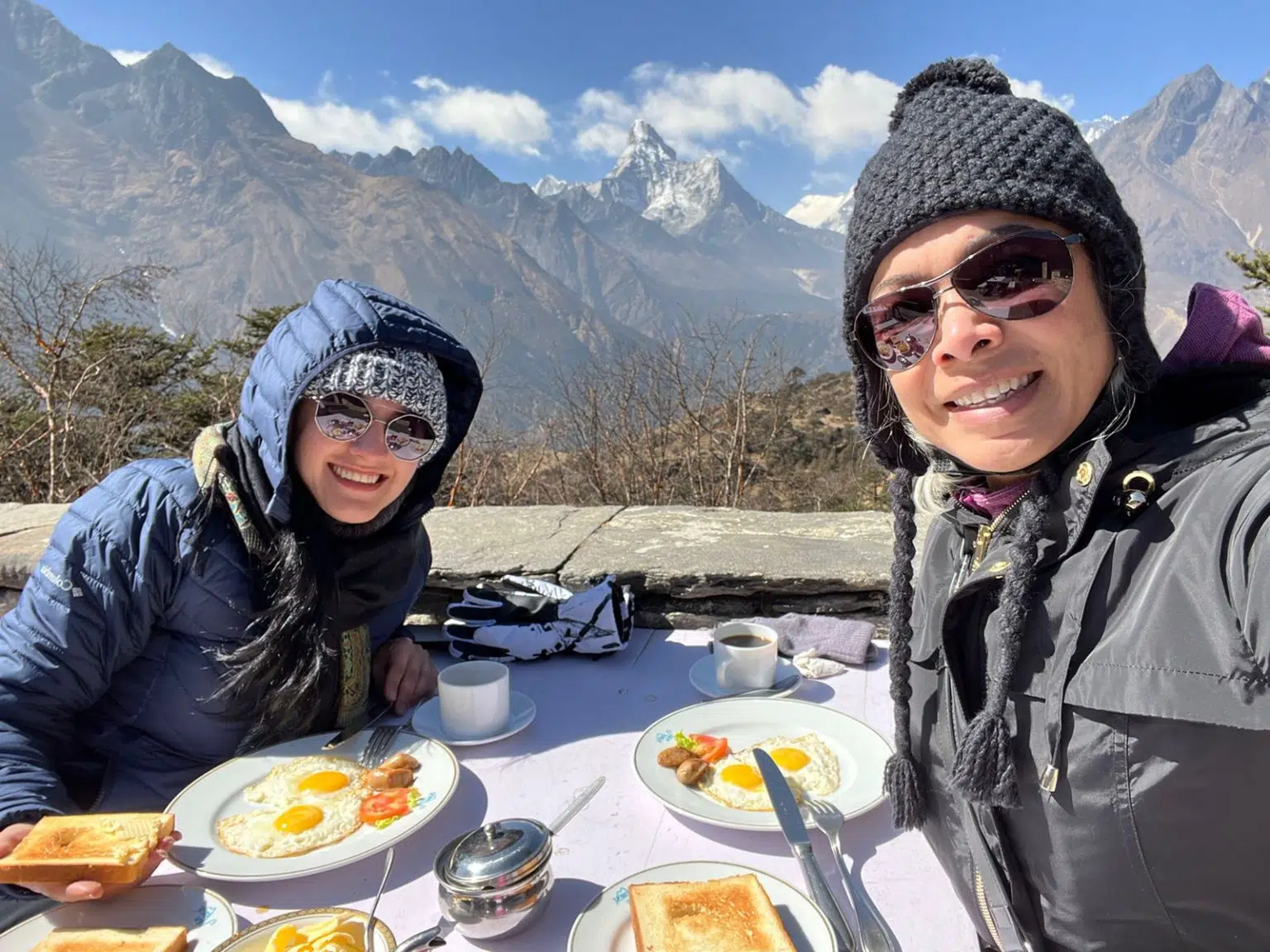
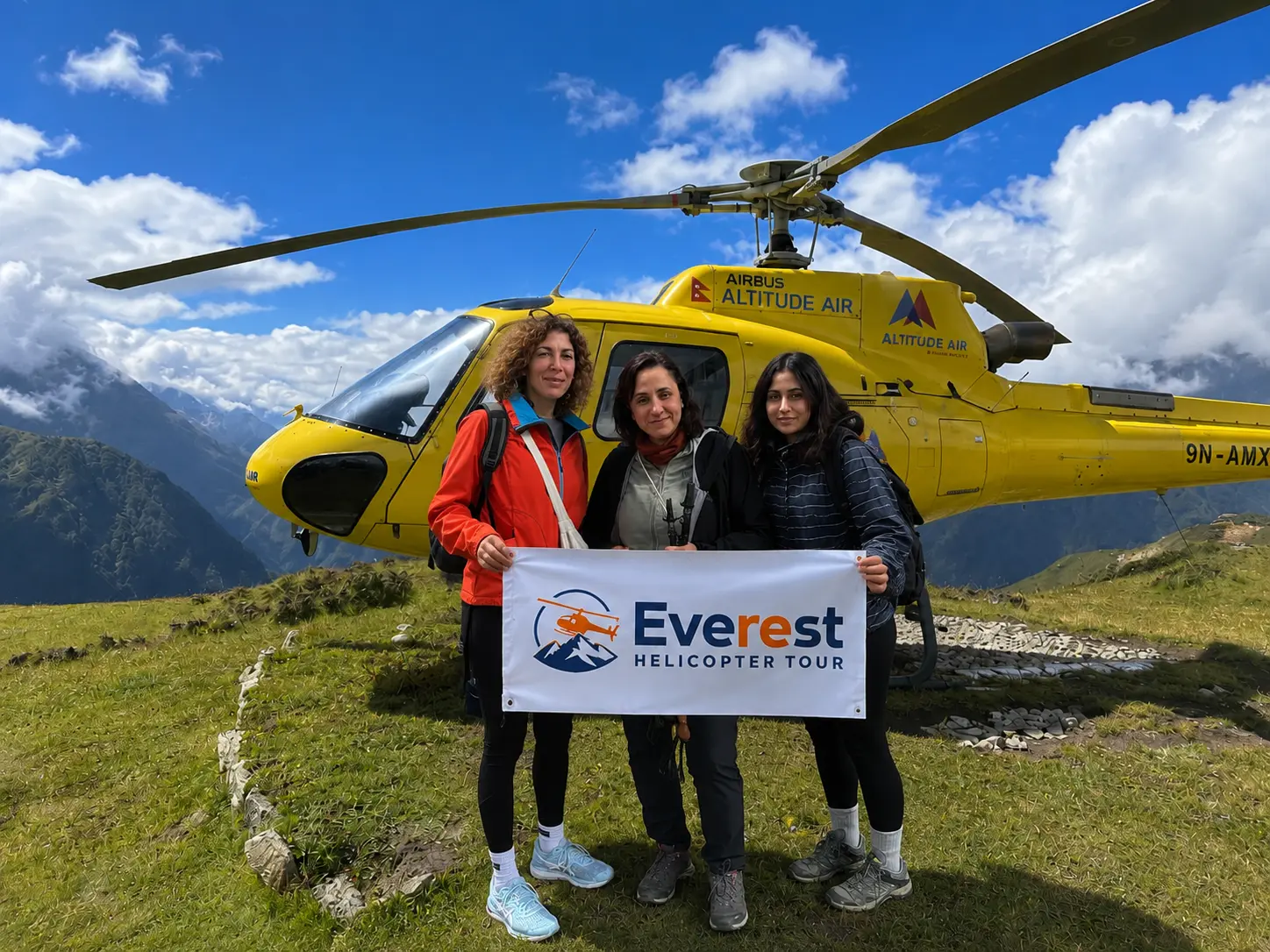
The everest base camp helicopter tour is a one-day aerial journey from Kathmandu (1,400m) to the foot of the world’s highest mountain, Mount Everest (8,849m). You fly aboard an AS350 B3e Airbus H125, Nepal’s most capable high-altitude helicopter, over the full Khumbu Valley from Lukla at 2,860m to an aerial pass above Everest Base Camp at 5,364m, then descend for breakfast at Hotel Everest View in Syangboche (3,780m), the Guinness World Record holder for the highest hotel with a direct Everest view. Total time from hotel pickup to hotel drop-off is 4 to 5 hours. Read the minute-by-minute guide to what happens on tour day.
Trekkers take 12 to 14 days to reach EBC on foot. This tour covers the same Khumbu geography in a single morning. The helicopter flies over the Khumbu Glacier, above the shattered seracs of the Khumbu Icefall, and circles the base camp area before breakfast at Syangboche with Everest, Lhotse (8,516m), Nuptse (7,861m), Makalu (8,485m), and Ama Dablam (6,812m) filling the horizon. No fitness preparation, no acclimatization schedule, and no permits to arrange yourself. Sagarmatha National Park entry (NPR 3,000 per person) and Khumbu Pasang Lhamu Rural Municipality fee (NPR 3,000 per person) are included.
Full Flight Route: Kathmandu to Everest Base Camp
Hotel pickup is at 5:30 am. Helicopter departure is 6:00 to 7:00 am. The route follows the Solu Khumbu valley northeast: Lukla (2,860m, Tenzing-Hillary Airport) for a fuel stop, then up through Namche Bazaar (3,440m), past Tengboche Monastery with Ama Dablam directly overhead, through Dingboche (4,410m) and Lobuche (4,940m) to the Khumbu Glacier. The helicopter makes a low aerial pass over Everest Base Camp (5,364m) where expedition tents are visible during climbing season (April to May). From above, the Western Cwm, the Khumbu Icefall, and the south face of Everest are clearly in frame. The flight then descends to Hotel Everest View, Syangboche (3,780m) for breakfast with Everest directly in the window, and returns to Kathmandu by 10:00 to 11:00 am.
Peaks Visible on the Everest Base Camp Helicopter Tour
| Peak | Altitude | When Visible |
|---|---|---|
| Mount Everest (Sagarmatha / Chomolungma) | 8,849m | Full flight route and from Syangboche terrace at 29km distance |
| Lhotse (4th highest) | 8,516m | Adjacent to Everest, visible as one massif from Hotel Everest View |
| Makalu (5th highest) | 8,485m | Distinctive eastern pyramid visible above the Barun Valley |
| Cho Oyu (6th highest) | 8,188m | Tibet border peak northwest, visible on the upper Khumbu leg |
| Nuptse | 7,861m | Long ridge forming the south wall of the Western Cwm |
| Pumori | 7,161m | Sentinel peak above Kala Patthar, directly above EBC |
| Ama Dablam | 6,812m | Most photographed peak in the Khumbu, below the flight path above Namche |
| Thamserku | 6,608m | Towers above Namche Bazaar on the right bank of the Dudh Kosi river |
Read the full guide to Ama Dablam and all peaks visible from the Everest helicopter tour.
Who Books the Everest Base Camp Helicopter Tour
Common booking profiles include: international travelers on tight Nepal itineraries who want to see Everest without two weeks of trekking; families with children or elderly members who cannot trek; couples wanting a memorable half-day Himalayan morning; trekkers who completed the EBC trail and are flying back from the trail by helicopter; business visitors to Kathmandu with one free morning; and senior travelers who want a full Everest experience with minimal physical exertion (see the senior travelers guide).
Upgrade Options from the Standard EBC Helicopter Tour
- Kala Patthar Landing (5,545m): Stand on the ridge with Everest’s southwest face directly in front of you at the highest helicopter landing point accessible to tourists in Nepal. See the Kala Patthar helicopter tour and the complete Kala Patthar viewpoint guide.
- EBC and Gokyo Lakes: Extended route west into the Gokyo Valley to see the six turquoise glacial lakes and Cho Oyu (8,188m). See the EBC with Gokyo Heli Tour.
- Honeymoon Private Charter: Full private aircraft with a dedicated Everest-facing breakfast table at Hotel Everest View. See the Honeymoon Helicopter Package.
- Group Tour: For parties of 5 to 20+ passengers across multiple helicopters. See the Everest Group Helicopter Tour and the group booking guide.
Book Without Any Advance Payment
You can confirm your Everest Base Camp helicopter tour booking without paying any deposit in advance. We hold your date on a confirmed basis once you provide passenger details and travel dates. Full payment is made on the morning of departure before the helicopter leaves. Zero financial risk if your Nepal plans change before arrival. Contact us to check availability. Before booking, read how to identify and avoid helicopter tour scams in Nepal.
More Reading for Your EBC Helicopter Tour
Overview
Everest Base Camp Helicopter Tour Overview
The Everest Base Camp Helicopter Tour is the most direct and spectacular way to experience the world’s highest mountain region without committing to a weeks-long trek. In a single morning flight from Kathmandu, you cover the same dramatic high-altitude terrain that trekkers spend 14 days crossing on foot, arriving at elevations above 5,000 metres with a bird’s-eye view of Everest, Lhotse, Nuptse, Ama Dablam, and the entire Khumbu Glacier stretching from Base Camp to the notorious Khumbu Icefall.
This tour suits travellers who want the authentic visual and emotional experience of standing in the shadow of Everest without the physical demands of the full trek. It also works well for those who have already trekked to Base Camp on foot and want to see the region from the air, for business travellers with limited time in Nepal, and for older travellers or those with health conditions that make high-altitude trekking inadvisable. The helicopter carries a supplemental oxygen cylinder on every flight, and the route is designed to give passengers maximum viewing time at altitude while minimising exposure to acute mountain sickness symptoms.
The flight typically departs Kathmandu in the early morning hours between 5:00am and 7:00am, because Himalayan weather is most stable and skies most clear in the first hours after sunrise. By midmorning, convective cloud often builds around the high peaks, reducing visibility and making safe mountain flying more difficult. Early departure is therefore not a scheduling preference but a practical necessity driven by mountain meteorology. Passengers should plan to be ready at their hotel lobby by the time given to them the evening before the flight.
What Makes Everest Base Camp Helicopter Tour Different
The Everest Base Camp region is one of the most photographed landscapes on the planet, but photographs cannot capture the scale of what surrounds you when you are in the air at 5,000 to 5,600 metres. The helicopter descends through the Khumbu Valley following the same route that trekkers walk, giving you low-level views of the teahouse villages of Lukla, Namche Bazaar, Tengboche Monastery, Pheriche, and Gorak Shep. By the time you approach the Base Camp area, the ice towers of the Khumbu Icefall are visible below and the South Face of Everest fills the horizon ahead.
Most standard EBC helicopter tours include a landing at either Kala Patthar (5,545 metres) or Hotel Everest View (3,880 metres), or both depending on the package selected. Kala Patthar is the famous black rocky ridge that provides the closest publicly accessible ground-level view of Everest’s South Face and is the point from which most summit photographs of Everest are taken. A landing here gives passengers 10 to 15 minutes on the ground at extreme altitude, surrounded by the full panorama of the Khumbu giants, before returning to the helicopter for the flight back to Kathmandu.
Private vs Group Helicopter Tours to Everest Base Camp
One of the most important decisions when booking an Everest Base Camp helicopter tour is whether to fly on a shared group seat or charter a private helicopter. Both options follow the same scenic route and visit the same high-altitude locations, but they differ significantly in price, flexibility, group size, and overall experience.
| Feature | Group Tour | Private Charter |
|---|---|---|
| Helicopter capacity | 4–5 passengers | 4–5 seats reserved for your group |
| Departure flexibility | Fixed schedule | Flexible, on request |
| Price per person | Lower (shared cost) | Higher (full charter) |
| Group composition | Other travellers | Your group only |
| Customisation | Standard route | Route and stops flexible |
| Minimum booking | Individual seat | Full helicopter |
| Waiting time | May wait for group to fill | Departs on your schedule |
| Photography control | Shared window access | Full control over seating |
Group tours are the most popular and cost-effective way to experience the Everest Base Camp helicopter flight. Individual travellers, couples, and small families typically book shared seats and fly alongside other tour participants. The helicopter departs when all seats are filled, which during peak season (March–May and September–November) usually means minimal waiting. In the off-season, departure may be delayed by a day if passenger numbers are low, though the operator generally works to minimise delays by consolidating bookings across available slots.
Private charters give your group exclusive use of the entire helicopter for the duration of the flight. This means you control the departure time (within the operational window), the pace of the flight, and which specific locations you spend the most time viewing. Private charters are popular with families travelling together, corporate groups, photography professionals who need extended time at specific angles, and couples celebrating special occasions such as anniversaries or proposals above Everest Base Camp. The higher per-seat cost reflects the convenience and exclusivity of having the aircraft reserved entirely for your party.
The Khumbu Valley Route Explained
The helicopter follows the Dudh Koshi River valley northeast from Kathmandu, gaining altitude gradually as the valley narrows and the terrain rises toward the high Himalayan ranges. The flight path passes over populated hill country in the first twenty minutes before the landscape changes dramatically as the Solukhumbu district comes into view. Lukla and its famous short, steep runway appear below at around 2,860 metres, and from that point onward the scenery intensifies with each minute of flying time.
Above Lukla the valley becomes narrower and steeper, with dense rhododendron and pine forests giving way to rocky alpine terrain as the helicopter climbs toward Namche Bazaar at 3,440 metres. Namche is the main trading hub and acclimatisation stop for EBC trekkers, perched in a dramatic bowl-shaped hollow in the hillside with views of Kongde Ri and the first glimpses of the high Himalayan peaks appearing above the valley walls. The helicopter passes directly over or near Namche, giving passengers a unique aerial perspective of this famous mountain town.
Continuing up the valley beyond Namche, the route crosses above Tengboche Monastery at 3,867 metres, one of the most photographed buildings in Nepal, set on a ridge with a full panorama of Ama Dablam, Everest, Lhotse, and Nuptse. The monastery and its surrounding landscape are visible from the helicopter at close range. The valley then opens into the high alpine terrain of the Khumbu, passing over Pheriche at 4,371 metres and Lobuche at 4,940 metres as the helicopter approaches the final section of the route near Gorak Shep and the Khumbu Glacier.
Everest Base Camp and the Khumbu Icefall
Everest Base Camp sits at 5,364 metres on the lateral moraine beside the Khumbu Glacier, and during the climbing seasons of April–May and September–October it is a sprawling tent city occupied by dozens of Everest expedition teams from countries around the world. The camp has no permanent structures and is completely dismantled outside the climbing seasons, but the glacier and the surrounding landscape remain year-round and are equally impressive from the air regardless of whether expeditions are in residence.
The Khumbu Icefall begins immediately above Base Camp and is widely regarded as one of the most dangerous sections of any high-altitude climbing route in the world. The icefall is a moving river of seracs, crevasses, and ice towers that shifts and collapses unpredictably, and climbers must cross it multiple times during their acclimatisation rotations before their summit attempt. From the helicopter, the full scale and chaos of the icefall is visible in remarkable detail, with ice towers the size of office buildings tumbling in slow motion over the centuries-long progression of glacial movement.
Above the icefall, the Western Cwm leads up to the Lhotse Face and the South Col, which form the standard route to the Everest summit used by almost all commercial expeditions. The South Face of Everest itself, also called the Nepal Face, is visible from the Kala Patthar landing point and from the air in the Base Camp approach. The distinctive summit pyramid, the rock bands, and the Hillary Step area (though altered since the 2015 earthquake and subsequent rockfall) are all identifiable with clear weather conditions.
Kala Patthar Landing: Standing at 5,545 Metres
Kala Patthar means “black rock” in Nepali and refers to the prominent rocky ridge rising to 5,645 metres above the village of Gorak Shep on the Khumbu Valley floor. The helicopter typically lands at around 5,545 metres on the upper sections of this ridge, which is high enough to provide clear, unobstructed views of the Everest South Face while remaining within the operational ceiling of the aircraft under normal conditions.
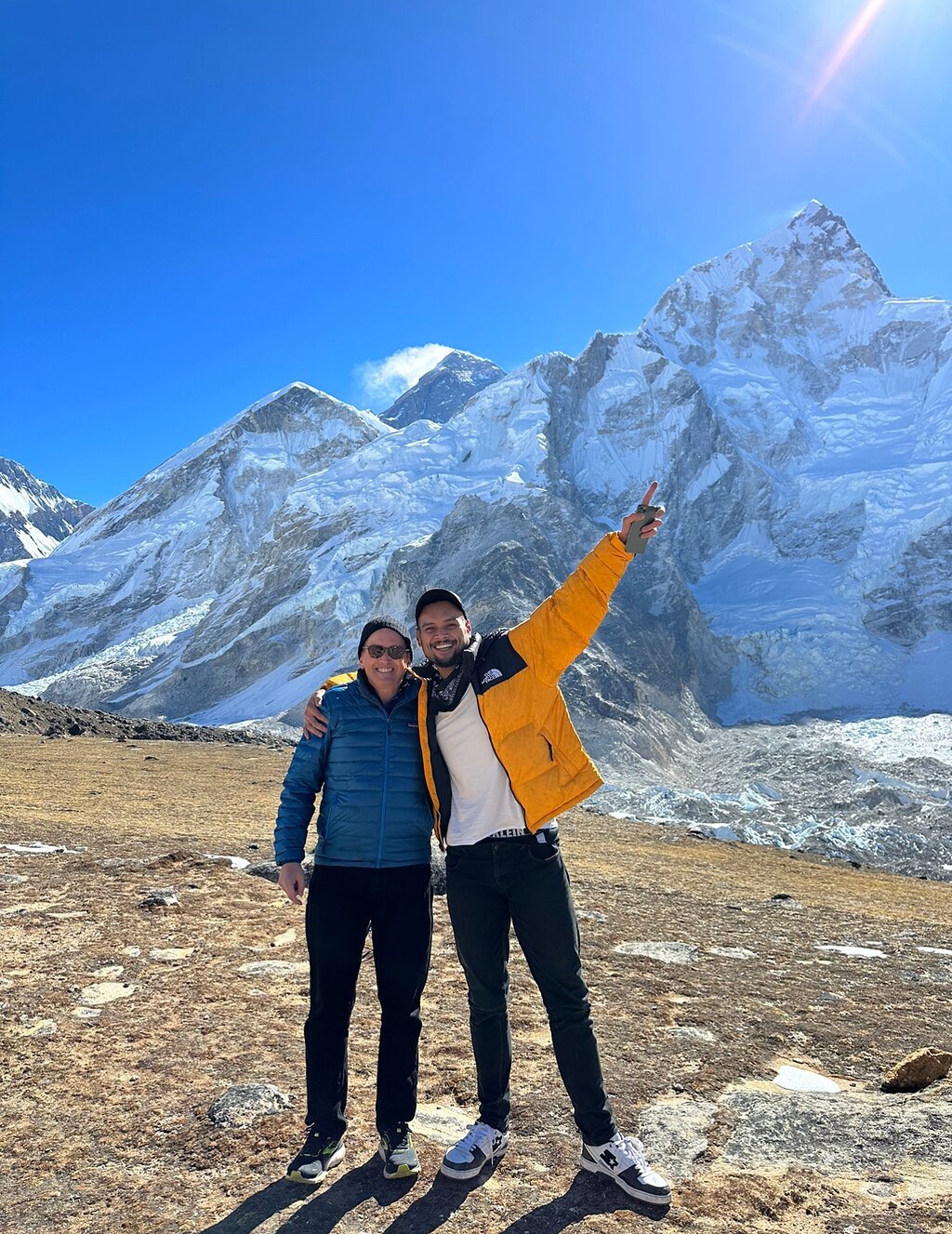
The landing at Kala Patthar is the centrepiece of the Everest Base Camp helicopter tour experience. Passengers step out of the helicopter onto rocky ground at an elevation higher than any mountain in the Alps, surrounded by a 360-degree panorama that includes Everest (8,849m), Lhotse (8,516m), Nuptse (7,861m), Changtse (7,543m), Pumori (7,161m), Lingtren, Khumbutse, and dozens of lesser Himalayan peaks. On clear days, the view extends south down the entire Khumbu Valley and north into Tibet.
Ground time at Kala Patthar is typically 10 to 15 minutes. This is sufficient for photographs, a few minutes of quiet reflection, and the brief experience of breathing at extreme altitude without the weeks of conditioning that trekkers undergo. Passengers should move slowly, avoid strenuous activity, and return to the helicopter promptly when the pilot signals. The supplemental oxygen cylinder carried on every flight is available if anyone feels lightheaded or uncomfortable during the landing.
Hotel Everest View Stop
Some packages include a brief stop at Hotel Everest View at 3,880 metres near Syangboche, which holds the distinction of being one of the highest-altitude hotels in the world. The hotel has a terrace and panoramic windows facing the Everest massif, and the stop provides an opportunity for tea or coffee with one of the most spectacular mountain views available from any dining venue on earth. The Everest View stop is not included in all standard packages and should be confirmed at the time of booking if it is important to your itinerary.
Best Time for the Everest Base Camp Helicopter Tour
| Season | Months | Weather | Visibility | Notes |
|---|---|---|---|---|
| Spring (Peak) | March–May | Mild, stable mornings | Excellent | Busiest season; book 2–4 weeks ahead |
| Autumn (Peak) | September–November | Clear, crisp | Excellent | Most popular; best photographic light |
| Winter | December–February | Cold, dry | Good | Fewer tourists; colder at Kala Patthar |
| Monsoon | June–August | Cloudy, wet | Poor | Not recommended; flights often cancelled |
Spring and autumn are the optimal seasons for the Everest Base Camp helicopter tour, matching the traditional trekking seasons when mountain weather is most reliable and summit views are clearest. Spring (March to May) brings warming temperatures and stable morning conditions after the winter cold lifts. Autumn (September to November) is particularly favoured by photographers because the post-monsoon air is exceptionally clear, the light quality is excellent in the early morning hours, and the Himalayan peaks stand out sharply against deep blue sky.
Winter flights are possible and the weather is often surprisingly good, with clear skies and excellent visibility common in December and January. The main consideration is temperature: at Kala Patthar in winter, temperatures can drop to minus 15 degrees Celsius or lower, and passengers should wear very warm clothing for the ground stop. Summer monsoon season (June to August) is not recommended because clouds consistently obscure the high peaks and flight cancellations or significant delays are common.
What to Expect on the Day of the Flight
Your operator will contact you the evening before the flight to confirm the exact pickup time and provide any last-minute weather updates. Pickup is from your Kathmandu hotel between 5:00am and 6:30am depending on your flight slot and the season. The early departure time is designed to ensure you reach the Khumbu region during the morning weather window before clouds develop around the peaks.
After hotel pickup, your representative drives you to the departure point and handles all check-in and briefing formalities. You receive a short safety briefing covering helicopter door procedures, seatbelt use, the supplemental oxygen equipment, what to expect during takeoff and landing at altitude, and emergency procedures. The entire briefing takes around 10 minutes. You are then escorted to the aircraft, shown to your assigned seat, and the pilot runs through final checks before departure.
The outbound flight from Kathmandu to the Khumbu takes approximately 45 minutes at cruising altitude, during which the landscape transitions from the crowded Kathmandu Valley to the middle hill country and eventually to the dramatic high-altitude terrain of the Solukhumbu district. Passengers are free to look out the windows throughout the flight. Seating is assigned to give all passengers reasonable window access, though some seats naturally have better forward views than others. Private charter passengers can discuss preferred seating arrangements with the pilot before boarding.
The return flight from Kala Patthar or the final landing point back to Kathmandu takes a similar amount of time, and the full round-trip door-to-door experience including hotel pickup and drop-off is typically completed within four to five hours from departure time.
Altitude and Health Considerations
The Kala Patthar landing at 5,545 metres exposes passengers to very high altitude for a brief period without any prior acclimatisation. Most healthy adults tolerate the short exposure well because the time at extreme altitude is limited to 10 to 15 minutes and the helicopter descends promptly. However, some people do experience mild symptoms including lightheadedness, slight headache, or shortness of breath during the landing, which are normal responses to reduced oxygen at extreme altitude.
The supplemental oxygen cylinder carried on every flight can be used by any passenger who experiences discomfort. The pilot and crew are experienced at recognising altitude symptoms and will help any passenger who needs assistance. Passengers with heart conditions, severe respiratory diseases, recent surgery, or other serious medical conditions should consult their physician before booking. Pregnant travellers are advised to avoid the Kala Patthar landing due to the extreme altitude.
People who are generally healthy and have no altitude-specific medical concerns typically have no problems on the tour. Unlike trekking to EBC on foot, which requires 14 days of gradual acclimatisation, the helicopter tour limits your exposure to extreme altitude to less than 30 minutes in total. The human body can tolerate this brief exposure without undergoing the physiological changes that extended time at altitude would require.
Photographic Opportunities on the Everest Base Camp Helicopter Tour
The Everest Base Camp helicopter tour is widely regarded as one of the great photography experiences available anywhere in the world. The combination of extraordinary subject matter (the world’s highest peaks, one of the world’s most famous glaciers, and the concentrated Himalayan landscape of the Khumbu) with the mobility and altitude of helicopter flight produces photographic opportunities that are simply not possible from the ground.
Inside the helicopter, the best photographic results come from keeping the camera lens close to the window glass to eliminate reflections, using a fast shutter speed to compensate for vibration, and shooting in RAW format if your camera supports it for maximum post-processing flexibility. The morning light during early departure provides warm, directional light on the southern faces of the peaks that is ideal for mountain photography.
At the Kala Patthar landing, you have unobstructed ground-level views for the duration of the stop. This is the same location where professional expedition photographers and climbers take the classic close-range shots of Everest’s South Face, and you will have the same compositional opportunities available to you during your ground time. Wide-angle lenses (16–35mm equivalent) work well for capturing the scale of the panorama, while a medium telephoto (70–200mm equivalent) allows detail shots of the summit pyramid, the Khumbu Icefall structure, and the Lhotse Face.
Mountains Visible on the Everest Base Camp Helicopter Tour
| Mountain | Elevation | Range / Notes |
|---|---|---|
| Mount Everest (Sagarmatha) | 8,849 m | World’s highest mountain; South Face visible from Kala Patthar |
| Lhotse | 8,516 m | Fourth highest mountain; shares South Col with Everest |
| Nuptse | 7,861 m | Connected to Everest by the Nuptse-Lhotse Ridge |
| Cho Oyu | 8,188 m | Sixth highest; visible to the northwest above the Ngozumpa Glacier |
| Makalu | 8,485 m | Fifth highest; visible to the east on clear days |
| Ama Dablam | 6,812 m | Most iconic Khumbu peak; visible from Tengboche area |
| Pumori | 7,161 m | Prominent northwest of Kala Patthar |
| Changtse | 7,543 m | North peak of Everest; Tibet side |
| Thamserku | 6,618 m | Distinctive twin-peaked mountain above Namche |
| Kongde Ri | 6,187 m | Impressive rock wall above Namche Bazaar |
Helicopter Safety and Aircraft
All Everest Base Camp helicopter tours operated through licensed Nepali aviation companies use aircraft certified for high-altitude mountain operations. The most common helicopters used for Khumbu tours are the AS350 B3 Eurocopter (Airbus H125) and the Bell 407, both of which are certified for operations above 5,000 metres and are widely used by Himalayan rescue teams, expedition support operators, and commercial tour companies throughout Nepal.
Pilots operating these routes hold Nepal Civil Aviation Authority licences and have specific high-altitude flying experience. Many Khumbu helicopter pilots have thousands of hours of mountain flying experience and know the Khumbu Valley weather patterns, wind conditions, and landing sites from years of regular operations. The Nepali aviation authority requires regular maintenance cycles and airworthiness inspections for all commercial tour helicopters.
Despite the extreme altitudes involved, the safety record of commercial Everest region helicopter tours is strong. Weather-related cancellations are far more common than incidents, which reflects the conservative approach pilots take to mountain flying: if conditions are not optimal, the flight is rescheduled rather than operated in marginal visibility or wind. Passengers sometimes experience frustration at weather delays, but these conservative decisions are the reason the safety record is maintained.
What to Wear and Bring
| Item | Recommended | Notes |
|---|---|---|
| Warm base layer | Yes | Thermal top and leggings for Kala Patthar stop |
| Insulated mid-layer | Yes | Down jacket or fleece; it gets cold at altitude |
| Outer shell jacket | Recommended | Windproof jacket for the outdoor landing stop |
| Warm trousers | Yes | Avoid shorts or thin trousers for Kala Patthar |
| Gloves | Yes | Even in spring; temperatures below zero at Kala Patthar |
| Warm hat | Yes | Covers ears; essential at 5,545m |
| Sunglasses | Yes | UV radiation at altitude is intense |
| Sunscreen | Yes | Apply before departure; SPF 50+ recommended |
| Camera / smartphone | Yes | Fully charged; cold drains batteries quickly |
| Personal medications | If needed | Acetazolamide (Diamox) if prescribed by your doctor |
The most important items to bring to Kala Patthar are warm clothing and a fully charged camera. The temperature at 5,545 metres can be significantly colder than at Kathmandu even in summer, and the wind chill at exposed ridge landings adds additional cooling. Many passengers are surprised by how cold it feels at the landing site even if Kathmandu was warm when they departed, so layering for cold conditions is strongly recommended regardless of the time of year.
Cold also affects camera batteries, which can drain rapidly at extreme altitude and low temperature. Keeping your spare battery in an inside jacket pocket close to your body until you need it will help maintain its charge through the landing stop.
Booking the Everest Base Camp Helicopter Tour
Booking in advance is strongly recommended for the spring and autumn peak seasons when helicopter seats fill quickly. During March to May and September to November, popular flight slots can be fully booked two to three weeks ahead, and last-minute availability for individual seats is not guaranteed. For private charters, advance booking of at least one week is recommended in peak season to secure your preferred date and flight time.
For the winter and shoulder periods, same-week bookings are generally possible, though confirming a few days ahead gives the operator time to assign a suitable flight slot and arrange hotel pickup logistics. Even outside peak season, helicopter tours are subject to weather cancellation, so planning some buffer days in your Kathmandu schedule is wise if your overall Nepal itinerary is tight.
Cancellations due to bad weather are rescheduled without penalty to the next available clear weather day. This policy protects passengers from losing their booking fee due to weather events outside anyone’s control, and it is the standard practice across all reputable Everest helicopter tour operators in Nepal. Passengers who need to cancel for personal reasons should check the specific cancellation policy at the time of booking.
Permits and Regulations
Commercial helicopter flights in the Khumbu region require Nepal Civil Aviation Authority (CAAN) approvals and comply with Sagarmatha National Park regulations covering overflights and landing permissions. The Kala Patthar landing area is used by licensed tour operators under specific authorisations, and landings outside designated areas are not permitted. All applicable government fees, park entry charges, and CAAN fees are included in the package price unless otherwise noted in the booking terms.
Foreign nationals visiting Nepal require a valid visa, which can be obtained on arrival at Tribhuvan International Airport in Kathmandu or in advance through a Nepalese embassy or consulate. The helicopter tour itself does not require a separate trekking permit since it is a commercial aviation operation rather than a trekking activity, but if passengers intend to go trekking in the Khumbu region separately, the Sagarmatha National Park entry permit and TIMS card would be required for those activities.
Why Book with Us
Everest Helicopter Tour is a Kathmandu-based operator with deep experience in high-altitude helicopter tours across the Nepali Himalayas. We work with certified aviation partners using aircraft maintained to international standards and operated by experienced mountain pilots. Our team handles all logistics from hotel pickup to return drop-off, giving you a seamless experience from beginning to end.
We offer both group (shared seat) and private charter options to suit different budgets and group sizes. Our guides and representatives are English-speaking, knowledgeable about the Khumbu region, and available to answer your questions before and on the day of your flight. We also offer flexible weather rescheduling at no additional cost, so if your flight day has poor conditions, we work with you to find the next available clear weather window.
Our transparent pricing includes all fees, permits, taxes, and airport handling charges in the quoted price. We do not add hidden surcharges after booking, and our booking confirmation clearly states exactly what is and is not included in your package.
Comparing Everest Base Camp Tour Packages
| Package | Type | Landing | Duration | Ideal For |
|---|---|---|---|---|
| Everest Helicopter Tour Group | Shared seat | Kala Patthar | 4–5 hrs total | Solo travellers, couples, small groups |
| Everest Helicopter Tour Private | Full charter | Kala Patthar + flexible | 4–5 hrs total | Families, corporate groups, photography professionals |
Both packages include the core Everest Base Camp helicopter tour experience: hotel pickup, pre-flight briefing, the scenic Khumbu Valley flight, close aerial views of Everest Base Camp and the Khumbu Icefall, the Kala Patthar landing at 5,545 metres, and the return flight to Kathmandu with hotel drop-off. The difference between group and private options is in exclusivity, departure flexibility, and the ability to customise the route and stops within operational constraints.
Everest Base Camp Helicopter Tour vs Everest Base Camp Trek: A Full Comparison
The question most visitors to Nepal face is whether to trek to Everest Base Camp on foot or take the helicopter tour. Both experiences are genuinely extraordinary, and the right choice depends entirely on your available time, physical condition, budget, and what you most want to get out of the Khumbu experience. Here is a detailed, honest comparison of both options to help you decide.
| Factor | Helicopter Tour | EBC Trek (14–16 days) |
|---|---|---|
| Total time required | 4–5 hours (one morning) | 14–16 days minimum |
| Physical fitness required | No specific fitness needed | Good fitness essential; 6–8 hours walking daily |
| Altitude acclimatisation | Not required (brief exposure only) | Gradual acclimatisation built into the schedule |
| Cost (approximate) | $1,100–$4,800 per person | $1,500–$3,500 per person (guides, lodges, permits) |
| Ground-level experience | 10–15 min at Kala Patthar | Days at Base Camp, Gorak Shep, EBC area |
| Village experience | Aerial views of Namche, Tengboche etc. | Walking through villages; staying in teahouses |
| Weather risk | Single-day flight window | Multi-week exposure to variable mountain weather |
| Cultural immersion | Limited (aerial only) | Deep; daily interaction with Sherpa communities |
| Panoramic mountain views | Exceptional from the air | Excellent from ground level |
| Best for | Limited time, restricted mobility, quick experience | Adventure seekers, endurance travellers, deep immersion |
The helicopter tour is the clear choice for anyone who has limited time in Nepal, cannot undertake the physical demands of 14 days of high-altitude trekking, or simply wants a concentrated, high-impact visual experience of the Khumbu in a single morning. The aerial perspective provides something the trek cannot: you see the full scale of the Himalayan landscape all at once, from the foothills to the summits, in a continuous unfolding panorama that would take a trekker two weeks to traverse on foot.
The trek, on the other hand, provides cultural depth, physical achievement, and ground-level immersion that the helicopter cannot replicate. Walking through Sherpa villages, staying in teahouses, watching the mountains grow larger with each day of trekking, and finally standing at Base Camp after two weeks on foot is a different kind of experience — more demanding, more time-consuming, but ultimately more transformative for those who undertake it. Many travellers who have done both describe them as complementary rather than competing experiences.
The Sherpa Villages of the Khumbu: What You See from the Air
One of the underappreciated aspects of the Everest Base Camp helicopter tour is the chance to see the famous Sherpa villages of the Khumbu from above. Each village has a distinct character that is visible even from the air, and knowing what you are looking at as you fly over them adds significant depth to the experience.
Lukla (2,860m) is the gateway to the Khumbu for virtually all trekkers and is famous for Tenzing-Hillary Airport, which has a runway that ends at a cliff edge and begins at a steep drop. The runway is 527 metres long and rises at a gradient of roughly 12 degrees, making it one of the most challenging airport approaches in commercial aviation. From the helicopter you have a clear aerial view of the entire Lukla bowl, the runway, and the cluster of lodges and shops that make up the town.
Namche Bazaar (3,440m) is the commercial capital of the Khumbu, a horseshoe-shaped town built into the sides of a steep valley bowl. From the air it looks like a perfectly curved amphitheatre of stone buildings and lodges, with trails radiating out in every direction and the broad valley of the Dudh Koshi below. Namche has a Saturday market where Tibetan traders and lowland Nepali merchants meet, and it serves as the main acclimatisation stop for trekkers before they push higher into the mountains.
Tengboche (3,867m) sits on a ridge spur with one of the most dramatic locations of any monastery in the world. The Tengboche Monastery, rebuilt after a 1989 fire destroyed much of the original structure, is the spiritual centre of the Khumbu Sherpa community and hosts the annual Mani Rimdu festival. The monastery and its surrounding meadows, chortens, and lodges are visible from the helicopter as you pass at ridge height, with Ama Dablam rising immediately behind the complex.
Dingboche (4,410m) and Pheriche (4,371m) are the last significant settlements before the high alpine desert begins. Both villages have stone-walled yak pastures surrounding the cluster of lodges, and the geometric patchwork of stone walls and flat fields is clearly visible from the air. The Himalayan Rescue Association operates an altitude sickness clinic in Pheriche that treats hundreds of trekkers each year for acute mountain sickness, pulmonary oedema, and other altitude-related conditions.
Gorak Shep (5,140m) is the highest permanently inhabited settlement in the Khumbu and the last stop before Everest Base Camp. It sits on an ancient glacial lake bed of flat sand and gravel, and the handful of lodges there are the last accommodation before Base Camp. From the air, Gorak Shep appears as a tiny cluster of buildings on a vast flat plain surrounded by the enormous scale of the high Himalayan landscape — a striking visual of human habitation at extreme altitude.
Ama Dablam: The Iconic Peak of the Khumbu
While Everest naturally dominates the imagination of visitors to the Khumbu, many experienced Himalayan travellers consider Ama Dablam to be the most beautiful and visually striking peak in the entire region. Rising to 6,812 metres, Ama Dablam has a distinctive shape — a sharp, dramatic pyramid flanked by two hanging glaciers — that is unlike any other mountain in the range and is instantly recognisable from almost any angle in the Khumbu Valley.
The name Ama Dablam translates roughly as “mother’s necklace” in Tibetan, referring to the hanging glaciers on the mountain’s flanks which resemble the traditional charm boxes worn by Sherpa women around their necks. The mountain is a technically demanding climb rated as one of the finest alpine routes in the Himalaya, attracting experienced mountaineers from around the world who consider its Northeast Ridge one of the great Himalayan rock and ice climbs.
From the helicopter, Ama Dablam is visible in spectacular fashion as you pass above the Tengboche area, rising directly ahead and to the right of the flight path. The clarity of the aerial view, unobstructed by valley walls or foreground terrain, gives a particularly powerful impression of the mountain’s elegant form. Many passengers describe the Ama Dablam view from the helicopter as one of the highlights of the entire flight.
The Khumbu Glacier: Understanding What You Are Seeing
The Khumbu Glacier is one of the largest glaciers in Nepal, flowing southward from the Western Cwm on the slopes of Everest, Lhotse, and Nuptse for approximately 17 kilometres before terminating at about 4,900 metres near Lobuche. It is a debris-covered glacier, meaning that its surface is largely obscured by rock and rubble deposited by repeated rockfalls from the surrounding peaks, giving it a grey and chaotic appearance that is quite different from the blue-ice glaciers commonly seen in temperate mountain regions.
Like most Himalayan glaciers, the Khumbu has been retreating and thinning over recent decades as a result of climate change. Scientific measurements show the glacier has lost significant mass and length over the past century, and the terminal moraine — the ridge of rubble deposited at the glacier’s furthest historical extent — now extends well beyond the current glacier terminus. The rate of glacial retreat in the Khumbu has accelerated in recent years and is the subject of ongoing research by Nepali and international scientific teams.
From the helicopter, the scale of the Khumbu Glacier is extraordinary. Flying above it gives a unique perspective on the glacier’s width, the chaos of its debris-covered surface, the ice towers and crevasses near its upper sections visible above the debris line, and the full extent of the moraine walls on either side. Everest Base Camp itself sits on the lateral moraine to the east of the glacier, at the point where the Khumbu Icefall begins its descent from the Western Cwm.
Frequently Asked Questions About Everest Helicopter Tours
Beyond the specific questions covered in the FAQ section of this page, there are several common practical questions that come up when planning an Everest Base Camp helicopter tour.
How many seats does the helicopter have? Most tour helicopters used for Khumbu operations seat 4 to 5 passengers plus the pilot. The exact configuration depends on the specific aircraft type used on your flight. For private charters, all passenger seats are reserved for your group regardless of whether they are all occupied.
Can children take the tour? Yes, children can take the tour with parental consent and supervision. The minimum age requirement may vary by operator, but children over 5 years old typically fly without restriction. The brief altitude exposure at Kala Patthar should be discussed with a paediatrician if you have any health concerns specific to your child.
Is the tour available year-round? The tour operates year-round, but the monsoon season (June to August) brings frequent cloud cover and poor visibility around the Himalayan peaks, making clear-weather flights difficult to guarantee. Most operators continue to offer tours in the monsoon season but cancellation rates are much higher. The optimal flying months are March to May and September to November.
Do I need travel insurance? Travel insurance is strongly recommended for all visitors to Nepal and is considered essential for any high-altitude activity. Standard travel insurance covering trip cancellation, medical evacuation, and emergency repatriation should be in place before departure. Medical evacuation from the Khumbu region by helicopter in the event of a serious illness or injury can cost tens of thousands of dollars without insurance coverage.
Can the helicopter fly to the Everest summit? No commercial tour helicopter flies to or near the Everest summit at 8,849 metres. High-altitude helicopters used in Nepal have operational ceilings that are well below the summit altitude, and summit approaches are restricted to mountaineering expeditions with specific permits. The tour provides aerial views of Everest from a range of altitudes up to approximately 5,600 metres at the Kala Patthar landing, which provides a clear and dramatic view of the upper mountain.
What languages does the crew speak? The pilot and representative speak English and Nepali. If you require assistance in another language, please notify us at booking and we will do our best to accommodate your request. Pre-flight briefing materials can be provided in multiple languages where available.
After Your Everest Helicopter Tour: What to Do in Kathmandu
The Everest Base Camp helicopter tour is typically completed by late morning, leaving the rest of the day available for exploring Kathmandu. The Kathmandu Valley is one of the richest cultural landscapes in Asia, with a concentration of UNESCO World Heritage Sites, ancient temples, vibrant markets, and extraordinary craft traditions that reward exploration over several days.
The Boudhanath Stupa, one of the largest Buddhist stupas in the world and a centre of Tibetan Buddhism in Nepal, is a 20-minute drive from most Thamel hotels. The Pashupatinath Temple complex on the Bagmati River is the most sacred Hindu site in Nepal and hosts cremation ceremonies on the river ghats that are open to respectful visitors. The medieval royal squares of Kathmandu, Patan, and Bhaktapur contain palace courtyards, temples, and wood-carved architecture dating back six hundred years and more.
For those wanting more Himalayan experiences after the helicopter tour, the Kathmandu Valley has excellent day hike options including Champadevi Hill and Nagarjun Forest, both offering views of the Himalaya on clear days. Pokhara, a five-hour drive or 30-minute flight west of Kathmandu, offers views of the Annapurna range and Machhapuchhre from beside a tranquil lake. Many visitors combine the Everest helicopter tour with a day in Chitwan National Park for wildlife viewing, creating a compact but remarkably diverse Nepal experience within a week.
The History of Everest and Why Base Camp Matters
Everest Base Camp is not simply a high-altitude camping ground — it is one of the most historically significant locations in twentieth-century exploration. The first serious attempts to climb Everest from the Nepal side began in 1951 after Tibet closed its borders to foreign expeditions, and the Khumbu Valley became the route of approach for virtually every major Everest expedition that followed. The 1953 British expedition led by John Hunt and including Edmund Hillary and Tenzing Norgay Sherpa established the template for modern Khumbu-approach expeditions, and the route they pioneered — through the Khumbu Icefall, up the Western Cwm, across the Lhotse Face to the South Col, and up the South East Ridge to the summit — remains the standard route used by the vast majority of Everest climbers today.
Hillary and Tenzing reached the summit on 29 May 1953, a date that resonates in Nepal and around the world. The achievement transformed Nepal’s international profile and established the Khumbu Valley as a place of global significance. The New Zealand beekeeper and the Sherpa from Thame village became symbols of human aspiration and cross-cultural partnership that still resonate seventy years later, and the legacy of that first summit is visible throughout the Khumbu in the Hillary schools, hospitals, and infrastructure projects that Edmund Hillary supported throughout his life through the Himalayan Trust.
Since 1953, more than 10,000 summits of Everest have been recorded, and Base Camp now receives hundreds of expedition members during each climbing season. The commercialisation of Everest has been widely debated — the queue of climbers on the South East Ridge on summit day photographs that have circulated since the early 2000s sparked global discussion about access, safety, and the environmental impact of expedition activity in the Khumbu. Nepal has responded with higher permit fees, stricter waste management requirements, and regulations on climbing standards, though debate about the appropriate management of the world’s highest mountain continues.
The Sherpa People and the Khumbu Community
The Khumbu Valley is home to the Sherpa people, a Tibetan Buddhist ethnic group who migrated from Tibet into northeastern Nepal approximately five hundred years ago and established communities throughout the high valleys of the Solukhumbu district. The Sherpas developed deep expertise in high-altitude trade, agriculture, and eventually mountaineering support, becoming indispensable partners to foreign climbing expeditions from the earliest days of Himalayan exploration.
The word “Sherpa” has entered global usage as a synonym for a mountain guide or high-altitude porter, though this usage conflates a specific ethnic identity with an occupational role. Not all Sherpas work in mountaineering or tourism, and not all high-altitude guides and porters in Nepal are ethnically Sherpa. The Khumbu Sherpas who work as climbing guides, expedition cooks, and high-altitude porters have an extraordinarily demanding and dangerous profession — more Sherpas have died on Everest than members of any other national or ethnic group, and the 2014 icefall disaster that killed 16 Sherpa guides forced a temporary closing of the mountain and renewed discussion about the inequities in the Everest industry.
The tourism economy centred on Everest trekking and helicopter tours has brought significant prosperity to the Khumbu communities, funding schools, health posts, electricity infrastructure, and improved trail conditions throughout the valley. At the same time, the rapid growth of tourism has brought environmental challenges including solid waste management on the mountain and in the villages, helicopter noise, and the cultural pressures of mass international exposure on a traditionally isolated Tibetan Buddhist community. Visiting the Khumbu region, whether by helicopter tour or on foot, carries a responsibility to support tourism practices that benefit the local community and minimise environmental impact.
Environmental Responsibility on the Everest Helicopter Tour
Helicopter tourism in the Khumbu has grown substantially over the past decade and brings with it genuine environmental considerations. Helicopter noise can disturb wildlife and the meditative environment of monasteries and high-altitude settlements, and the carbon footprint of helicopter flights is higher per passenger-kilometre than commercial aviation. Reputable tour operators take steps to mitigate their environmental impact by using modern, fuel-efficient aircraft, following designated flight corridors that minimise disturbance to sensitive areas, and supporting conservation organisations working in the Sagarmatha National Park buffer zone.
Passengers can contribute to responsible tourism by following leave-no-trace principles at all landing sites, not removing rocks, plants, or any natural materials from the Kala Patthar landing area, and choosing operators who demonstrate transparent environmental commitments. The Khumbu landscape that makes the helicopter tour so extraordinary is finite and fragile, and the experience will remain available for future generations only if current visitors treat it with the respect it deserves.
Carbon offset programmes are available through various international providers and can offset the emissions from your helicopter flight. While offsets are not a complete solution to aviation emissions, they represent a meaningful step for travellers who want to mitigate the environmental cost of their Everest helicopter experience.
Preparing for Your Everest Base Camp Helicopter Tour: A Complete Checklist
- Book your tour at least 1–2 weeks in advance in peak season (March–May and September–November)
- Confirm hotel pickup time with your operator the evening before the flight
- Set your alarm early — pickup is typically between 5:00am and 6:30am
- Wear warm, layered clothing suitable for temperatures below zero at Kala Patthar
- Bring warm gloves, a hat, and windproof outer layer regardless of the season
- Fully charge your camera battery the night before and carry at least one spare
- Keep spare batteries in an inside pocket to prevent cold drain during the ground stop
- Apply sunscreen (SPF 50+) before departure — UV radiation is intense at altitude
- Bring sunglasses rated for high-altitude UV exposure
- Carry any personal medications you may need, including altitude sickness medication if prescribed by your doctor
- Do not eat a large meal immediately before the flight if you are prone to motion sickness
- Confirm your travel insurance coverage before departure from your home country
- Leave non-essential baggage at your hotel — you may bring a small daypack or camera bag into the helicopter
- Follow all crew instructions regarding seatbelt use and the high-altitude landing stop
- Move slowly and breathe steadily during the Kala Patthar ground stop
- Use the supplemental oxygen provided if you feel any discomfort during or after the landing
What Guests Say About the Everest Base Camp Helicopter Tour
The Everest Base Camp helicopter tour consistently generates some of the most emotionally powerful travel experiences reported by visitors to Nepal. Guests who have taken the tour regularly describe it in superlatives — not because they are exaggerating, but because the visual scale of the Khumbu landscape genuinely exceeds most people’s ability to prepare for it in advance, regardless of how many photographs they have seen.
Solo travellers who booked the group tour often report that sharing the experience with other passengers adds unexpected warmth to the flight. The shared reaction to seeing Everest for the first time from the air, or stepping out of the helicopter at Kala Patthar and realising the scale of what surrounds you, creates a natural bond between passengers who may have been strangers an hour earlier. Many tour participants exchange contact details and stay in touch after the experience.
Couples and families who booked the private charter frequently describe the exclusivity as worth the premium, particularly when one or more members of the group are senior travellers, young children, or individuals with mobility limitations who benefit from the slower pace and greater crew attention that a private flight provides. The flexibility to linger a few extra minutes at a particularly good viewing angle, or to adjust the route slightly based on real-time conditions, is a meaningful advantage in a flight where every minute of viewing time is precious.
Professional photographers who have taken the private charter for commercial assignments consistently note that the combination of the helicopter’s altitude and mobility with the quality of the Himalayan light in early morning produces results that would be impossible to achieve from any ground-based position. The ability to circle, adjust altitude, and reposition gives photographers compositional control over a subject — the Everest massif — that is otherwise fixed relative to any ground observer.
Booking Your Everest Base Camp Helicopter Tour Today
The Everest Base Camp Helicopter Tour is one of the most remarkable travel experiences available anywhere on earth. Whether you choose the Group package for a shared adventure at an accessible price, or the Private charter for exclusive access to the Khumbu skies, the combination of the world’s highest mountain landscape, the history of Everest exploration, the living culture of the Sherpa communities below, and the visceral experience of standing at 5,545 metres on Kala Patthar makes this tour genuinely unlike anything else you will do in your lifetime of travel.
We invite you to use the booking form on this page to select your preferred package and date. Our team responds to all inquiries within 24 hours and is available to answer any questions about the tour, packages, customisation options, or any other aspect of your Nepal visit. We look forward to flying with you above the roof of the world.
Highlights
- Land at Everest Base Camp (5,364m / 17,598ft)
- Sunrise panorama from Kala Patthar (5,545m / 18,192ft)
- Fly over Khumbu Glacier and Icefall
- Breakfast at the world's highest hotel - Everest View Hotel
- Private and group options available
- Same-day return from Kathmandu
- Bell 407 or AS350 B3 luxury helicopter
- Experienced high-altitude pilots


