
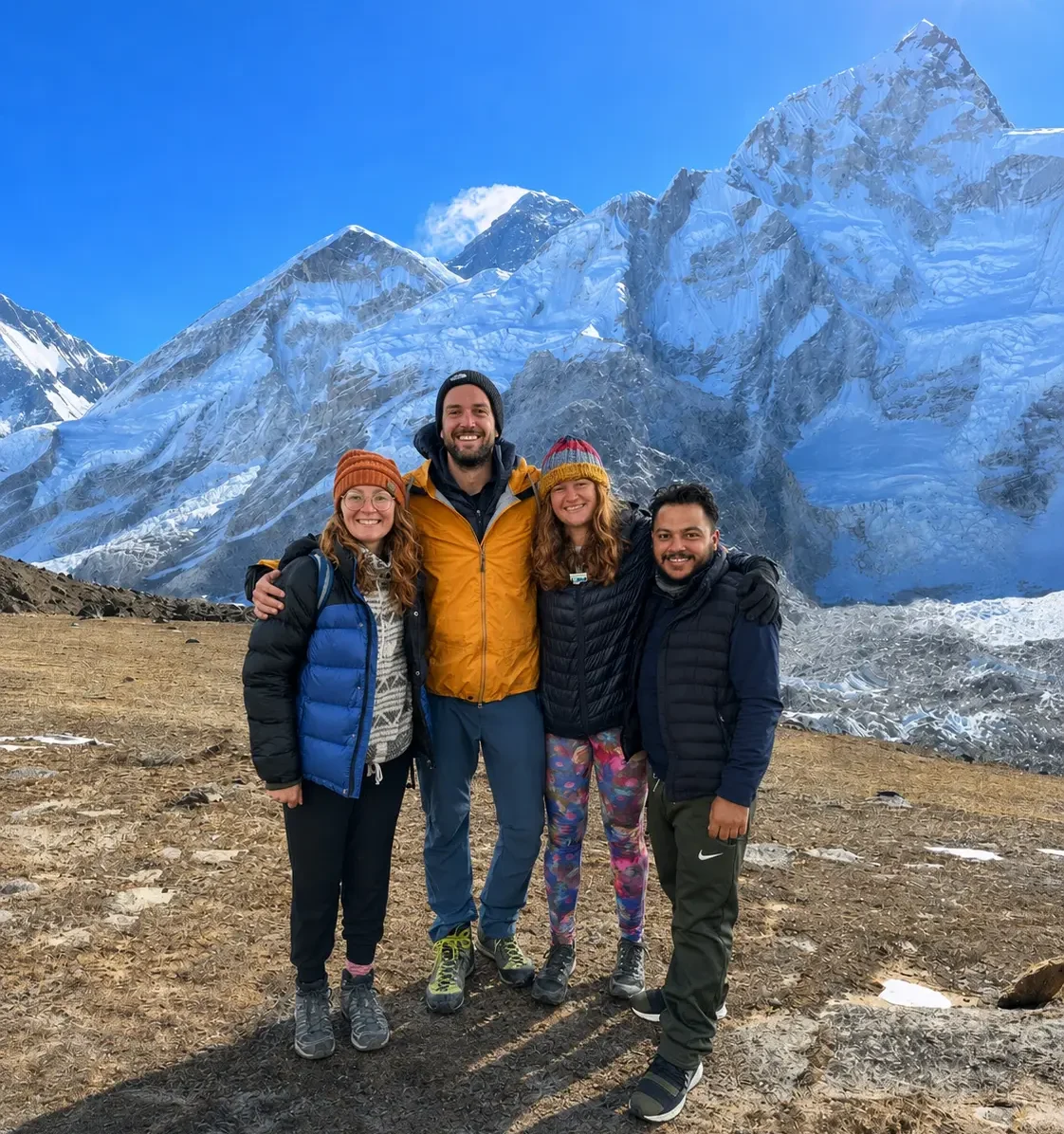
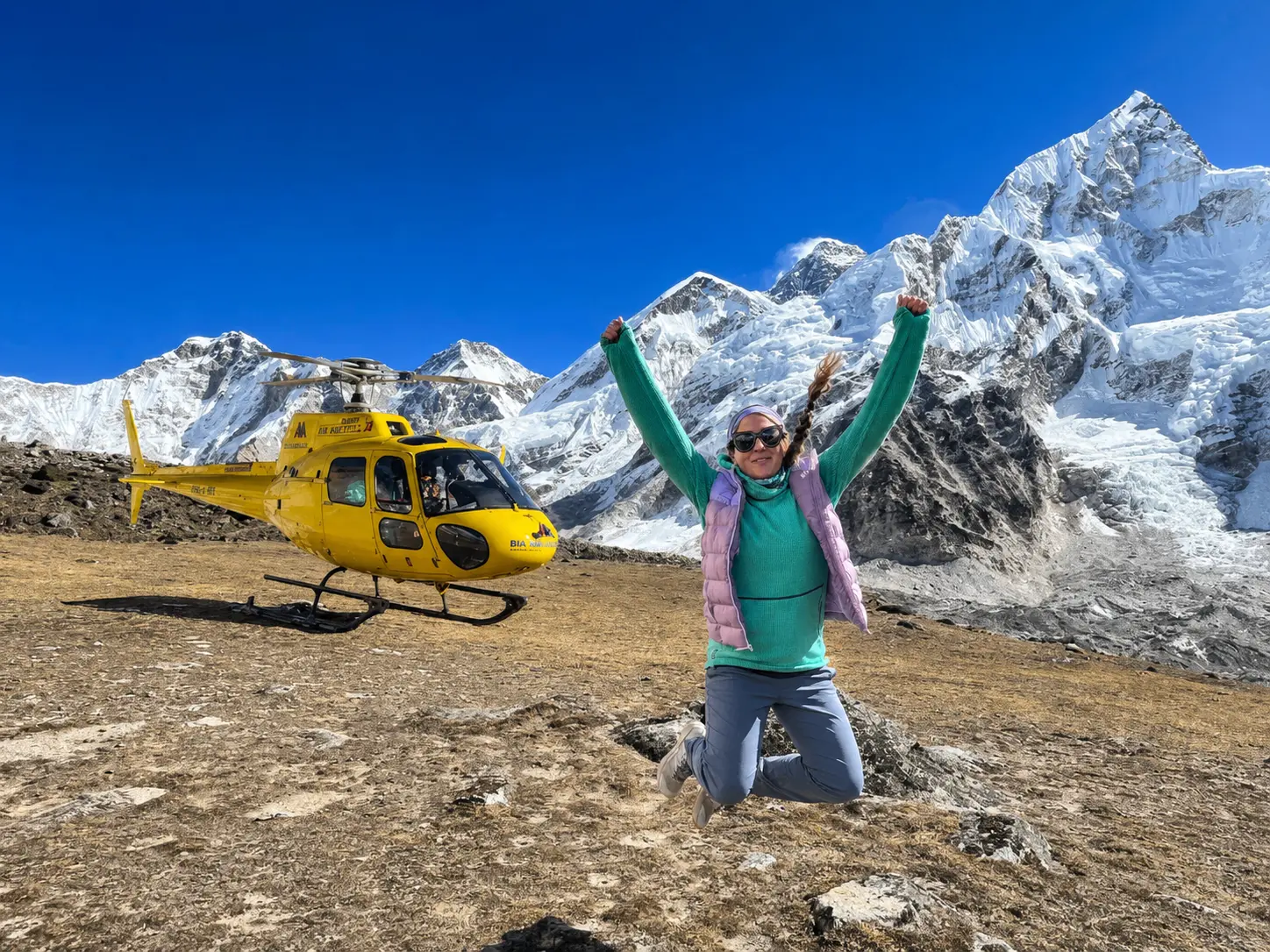
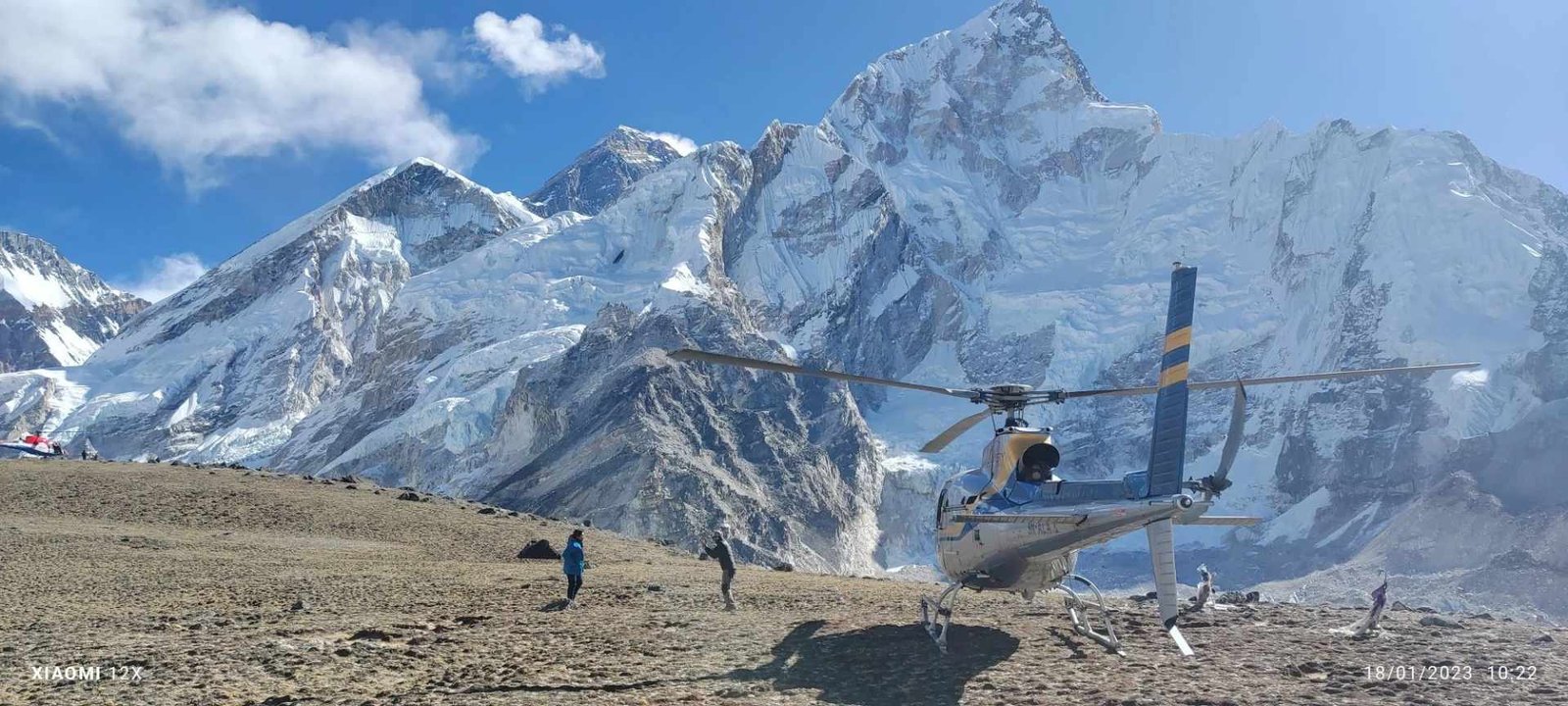
The Kala Patthar helicopter tour lands you on the highest point accessible by helicopter to tourists in Nepal: the rocky ridge at Kala Patthar (5,545m) on the shoulder of Pumori (7,161m), directly opposite the southwest face of Mount Everest (8,849m). Standing at 5,545m, you are 330 meters above the summit of Mont Blanc and eye-level with some of the highest points trekkers can reach in the Khumbu without technical climbing. The flight also includes a breakfast stop at Hotel Everest View in Syangboche (3,780m), the Guinness World Record holder for the highest hotel with a direct view of Everest. Total time from Kathmandu hotel pickup to return is 5 to 6 hours.
The Kala Patthar ridge is consistently ranked as the single best ground-level viewpoint for Mount Everest in the world. From the ridge, the entire southwest face of Everest is directly in front of you at a distance of approximately 7 kilometers. The Khumbu Icefall descends to your left, and the Western Cwm disappears into the mountain above. No other viewpoint accessible without technical climbing gear gives you this direct, unobstructed view of Everest’s full south face. Read the complete Kala Patthar viewpoint guide for details on what you see from the ridge.
What Makes Kala Patthar Different from the Standard EBC Tour
The standard Everest Base Camp helicopter tour circles above EBC at 5,364m aerially without landing there. The Kala Patthar tour physically lands the helicopter on the ridge at 5,545m and gives you 10 to 15 minutes standing on the ground with Everest directly in front of you. This is not an aerial view but a ground-level encounter with Everest from a ridge that trekkers take 9 to 12 days to reach on foot from Kathmandu.
Altitude at Kala Patthar (5,545m): What to Expect
At 5,545m, approximately 53% of the oxygen available at sea level is present in each breath. Breathlessness on any movement is certain and expected. Most passengers experience: significant breathlessness within 30 seconds of standing, moderate headache beginning within 5 minutes, occasional dizziness on standing from a seated position. These are normal responses to rapid altitude gain from Kathmandu (1,400m) without acclimatization. The crew carries supplemental oxygen at the landing site. The key guideline: move slowly, breathe deliberately, sit or stand still rather than walking, and return to the aircraft promptly if you feel unwell. Ground time is 10 to 15 minutes. You are back to 3,780m in under 20 minutes of flight.
| Altitude Reference | Elevation |
|---|---|
| Kala Patthar helicopter landing | 5,545m |
| Everest Base Camp | 5,364m |
| Summit of Mont Blanc (highest in the Alps) | 4,808m |
| Summit of Kilimanjaro (highest in Africa) | 5,895m |
| Hotel Everest View breakfast stop | 3,780m |
| Kathmandu departure altitude | 1,400m |
The Everest View from Kala Patthar Ridge
From the ridge at 5,545m, the southwest face of Everest (8,849m) rises directly ahead at approximately 7 kilometers distance. You see: the summit pyramid and Hillary Step above the South Col, the South-Southeast Ridge route used by most commercial expeditions, the Geneva Spur leading to the South Col (8,000m), the Lhotse Face dropping from the South Col to the upper Western Cwm, the Khumbu Icefall cascading from the Western Cwm on your left, and Nuptse (7,861m) forming the right boundary of the view. To your right is the Pumori massif (7,161m), on whose flank Kala Patthar sits.
Upgrade Options and Related Tours
- Standard EBC Aerial Tour: If you prefer an aerial pass over EBC without the Kala Patthar ground landing, the standard EBC helicopter tour is available at a lower price point.
- Gokyo Lakes Extension: Combine the Kala Patthar landing with a flight over the Gokyo Lakes and Cho Oyu (8,188m). See the EBC with Gokyo Heli Tour.
- Wedding Photo Shoot at Kala Patthar: The ridge is the most dramatic outdoor wedding photo location in Asia. See the Everest Wedding Photo Shoot package.
Book Without Any Advance Payment
You can confirm your Kala Patthar helicopter tour without paying any deposit in advance. We hold your date once you provide passenger details and travel dates. Full payment is made on the morning of departure. Contact us to check availability and confirm your slot. Before booking, see how to verify a legitimate Nepal helicopter tour operator.
Further Reading
Why choose a helicopter tour over trekking to Everest Base Camp
Walking to Everest Base Camp is one of the most rewarding treks in the world, but it takes twelve to sixteen days including acclimatization, a realistic level of fitness, and tolerance for cold teahouses and long trail days. Not everyone has that much time, and not everyone wants to spend two weeks at altitude to see the mountain. The Everest Base Camp Helicopter Tour with Kala Patthar Landing exists for the traveller who wants the same visual reward, the glaciers, the peaks, the scale of the Khumbu, compressed into a single morning.
It is worth being honest about what a helicopter tour is and is not. It is not a substitute for the physical and cultural experience of walking through Sherpa villages over two weeks, sleeping in teahouses, and adjusting to altitude gradually. What it does deliver is a wide angle, aerial view of terrain that trekkers only ever see from ground level, plus close range views of the Khumbu Icefall and the upper mountain faces that most trekkers never get close enough to see clearly even after two weeks of walking. For travellers with a layover in Kathmandu, a business trip with a free day, a family member who cannot handle the trek, or simply limited annual leave, this is the only realistic way to see Everest Base Camp and stand near Kala Patthar’s altitude in a single day.
There is also a genuine safety and comfort argument. Trekkers face altitude sickness risk that builds gradually over days at increasing elevation. A helicopter tour exposes you to high altitude for a much shorter window, typically ten to twenty minutes on the ground at Kala Patthar or Everest Base Camp altitude when a landing happens, with oxygen carried on board and a pilot trained to manage that exposure. That does not remove altitude risk entirely, and we explain the precautions later in this section, but the exposure window is short and controlled compared with two weeks of cumulative altitude gain on foot.
The route: Kathmandu to the Everest region and back
Your day starts in Kathmandu, either at Tribhuvan International Airport’s domestic terminal or, for private charters, sometimes from a private helipad depending on your package and the operator’s current airport allocation. After check in and a safety briefing, the helicopter lifts off and heads northeast out of the Kathmandu valley, climbing over the middle hills of Nepal before entering the mountain corridor that leads toward Lukla.
The first twenty five to thirty minutes of flying time takes you over terraced hillsides, rivers and forested ridgelines that gradually give way to steeper, rockier terrain as you approach the Khumbu. Lukla, home to Tenzing-Hillary Airport, is usually the first stop, mainly for refuelling since helicopters flying this route at high payload need a top up before continuing into higher terrain. This stop is typically brief, ten to fifteen minutes, and passengers usually stay near the aircraft.
From Lukla the helicopter continues up the Dudh Koshi valley, tracking roughly the same route trekkers walk over several days, but covering it in minutes. You will see Phakding, the switchback trail up to Namche Bazaar, and Namche itself, the amphitheatre shaped Sherpa trading town that serves as the gateway to the high Khumbu, from the air. Namche’s terraced houses and the surrounding ridgelines are one of the more photogenic sections of the flight on a clear day.
Continuing north, the route passes near Tengboche, home to the region’s most significant Buddhist monastery, with Ama Dablam’s distinctive sharp ridges usually visible to the east. From here the terrain opens into the wider glacial valley that leads toward Dingboche and Pheriche, two of the last permanent settlements before the high glacier zone.
Mountains you will see
Weather and exact flight path permitting, the peaks most commonly visible on this route include Mount Everest itself (8,849 m), Lhotse (8,516 m), Nuptse (7,861 m), Ama Dablam (6,812 m), Thamserku (6,623 m), Kangtega, Pumori (7,161 m), and a string of smaller but still dramatic peaks along the Khumbu skyline. On a clear morning, the combination of Everest’s black pyramid summit rising behind Nuptse’s wall and Lhotse’s steep south face is the visual high point of the flight for most passengers. Because weather in the high Himalaya changes quickly, particularly cloud building up around ridgelines as the morning progresses, flights are scheduled early, generally departing Kathmandu between 5:30am and 7:30am, to maximise the chance of clear mountain visibility.
Flying over Dingboche, Lobuche, Gorak Shep and the Khumbu Glacier
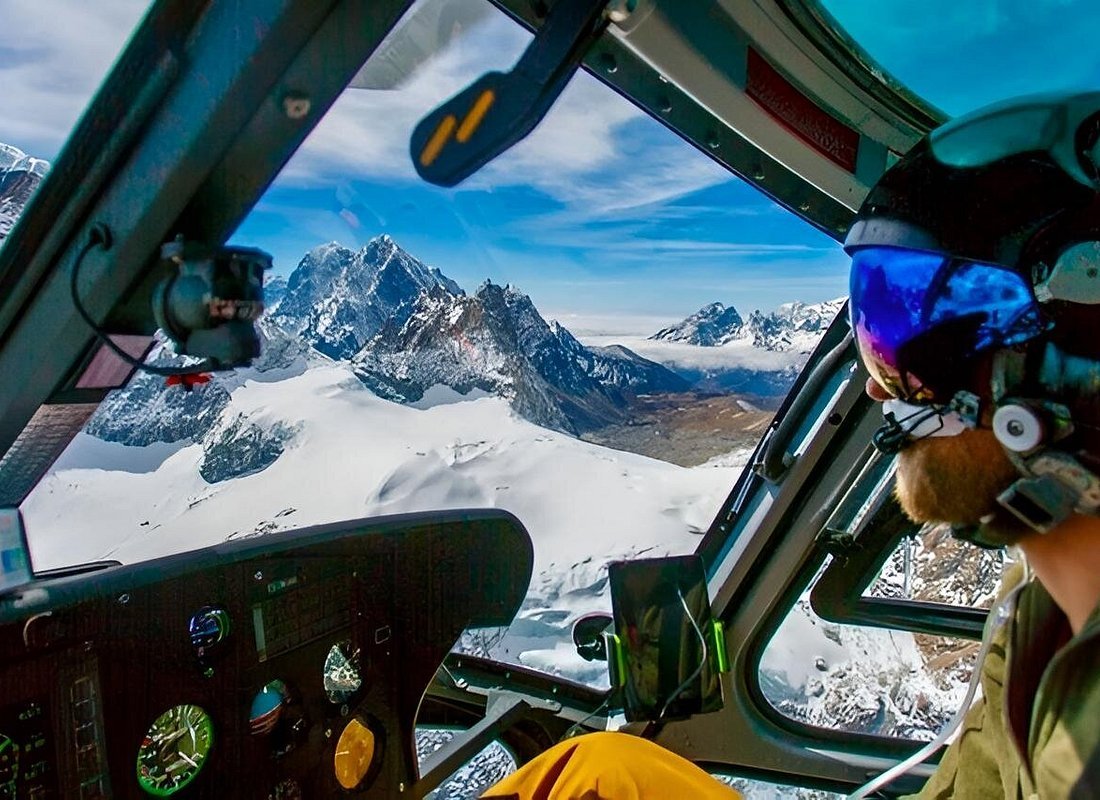
Past Pheriche and Dingboche, the valley narrows and climbs toward Lobuche and Gorak Shep, the last settlements before Everest Base Camp itself. From the air, this section shows you the full scale of the Khumbu Glacier, a river of ice and rock debris running for kilometres beneath the peaks, something that is genuinely difficult to appreciate from ground level even when trekking directly alongside it. The helicopter’s altitude on this stretch gives a clearer sense of how the glacier connects Base Camp to the Khumbu Icefall, the broken, crevassed section of ice that climbers must cross on the route toward the higher camps on Everest.
Everest Base Camp itself sits at approximately 5,364 m, at the foot of the Khumbu Icefall. During climbing season (roughly April and May) the camp is a temporary tent city; outside that window it is a comparatively empty stretch of rock and ice with prayer flags marking the site. Your pilot will typically fly a low pass over or near Base Camp so passengers can see the layout of the camp and the icefall above it, subject to air traffic in the area, which can be busy during peak climbing season with rescue and logistics helicopters also operating in the same air space.
Kala Patthar: what “landing” actually means today
Kala Patthar (5,644 m) is the viewpoint trekkers climb to for the closest possible ground level look at Everest’s summit pyramid, since Everest itself is hidden from Base Camp by Nuptse. It has historically been one of the most sought after helicopter landing points in the region for the same reason: it offers a dramatic, close range view of Everest that Base Camp itself does not.
We want to be direct about the current situation rather than oversell it. Helicopter landings in the Everest region, including at Kala Patthar, are governed by Nepal’s civil aviation authorities and by Sagarmatha National Park regulations, and these rules have tightened in recent years on safety and environmental grounds, including noise impact on wildlife and the technical difficulty of landing at nearly 5,650 m where air density is low and engine performance margins shrink. Depending on the regulations in force at the time of your flight, your pilot’s assessment of the aircraft’s performance with your specific passenger and baggage weight, wind conditions, and air traffic that day, your helicopter may land at or very near Kala Patthar, or it may fly a close pass over the area without touching down. Neither outcome is something we, or any operator, can guarantee at the time of booking. What we do guarantee is that our pilots make that call based on safety and current regulation, not on trying to please a departure schedule, and that our team will explain what actually happened on your flight before and after you fly, with no vague language designed to paper over a flyover versus a landing.
When a landing at or near Kala Patthar does happen, it is brief, typically five to ten minutes on the ground, enough time to step out, take photographs, and feel the altitude and cold before reboarding. Supplemental oxygen is carried on board for passengers who feel the altitude strongly during this stop.
Hotel Everest View and the breakfast stop
Most itineraries include a stop at Hotel Everest View, located above Namche near Syangboche at around 3,880 m, reputed to be one of the highest placed hotels in the world with a direct view of Everest, Lhotse and Ama Dablam from its terrace. On packages where breakfast is included, you will sit on the terrace with a hot breakfast while the mountains you just flew past are laid out in front of you at a more relaxed pace than the flight itself allows. On packages where it is not included, the stop may still happen briefly for photographs, or breakfast can usually be added for an extra charge, again depending on which specific package you book. Always check your chosen package’s Price Includes section rather than assuming breakfast is bundled in.
Passenger numbers, seating and the Pheriche shuttle
Nepal registered helicopters commonly used on this route (AS350 B3, B3e and similar models) typically seat five passengers plus the pilot at lower altitudes, but as altitude increases, air density drops and the aircraft’s safe carrying capacity drops with it. Above roughly 4,000 m, the same helicopter that comfortably carries five passengers at Kathmandu’s altitude may only be able to safely carry two or three, sometimes fewer depending on total passenger and baggage weight and air temperature that day, which also affects engine performance.
This is why shared group tours often use a shuttle system: the helicopter flies the full group from Kathmandu to a lower altitude point such as Pheriche, then makes two or more short shuttle flights carrying two or three passengers at a time up to the higher altitude sections near Kala Patthar and Everest Base Camp, before regrouping everyone for the return leg. This is standard industry practice across nearly every operator running shared Everest helicopter tours, not a shortcut specific to any one company, and it exists purely because of aircraft physics at altitude, not cost cutting. Private charters, where you book the whole aircraft, may still need to manage weight carefully depending on passenger count and baggage, but avoid sharing seats with other travellers.
How long the tour takes and what a typical day looks like
Total tour duration is normally three to four hours from Kathmandu hotel pickup to Kathmandu hotel drop off, including the flight itself, the Lukla refuelling stop, any Pheriche shuttle, the high altitude stop near Kala Patthar or Base Camp when conditions allow, and the Hotel Everest View stop. Because this is a full loop rather than a one way flight, you are back in Kathmandu the same morning, usually before midday, leaving the rest of your day free.
Morning departures are standard practice across the industry, not a marketing preference. Mountain weather in the Khumbu is generally clearest in the early hours and tends to cloud over as the day warms, so flights are scheduled to depart Kathmandu before or around sunrise wherever operationally possible, which means an early hotel pickup, often between 4:30am and 6am depending on the season and your specific departure slot.
Weather, delays, and what happens if your flight cannot go
Himalayan weather changes quickly and is genuinely unpredictable in the short term even with good forecasting. Wind, cloud cover, and visibility at altitude are assessed by the pilot and aviation authorities on the morning of the flight, and delays of a few hours, or in some cases same day cancellation, are a normal part of operating in this environment rather than a rare exception. Spring (March to May) and autumn (late September to November) offer the most consistently stable flying weather, which is why most travellers target those windows, but even in peak season, delays happen.
If your flight is delayed, we will attempt to reschedule you later the same day or the following day depending on your travel plans and aircraft availability. If a flight cannot go at all due to weather, our policy is to offer a full reschedule to another date within your stay in Nepal wherever possible, or a refund if rescheduling genuinely is not workable for your itinerary. This is covered in more detail in the FAQ section, but the short version is that weather related changes are handled fairly and are not treated as the traveller’s problem to absorb alone.
Altitude safety, oxygen and medical considerations
Altitude sickness (acute mountain sickness) can affect anyone above roughly 2,500 m regardless of fitness level, and Kala Patthar’s altitude of 5,644 m is high enough that a small number of passengers feel some effects, typically mild, headache or light headedness, during the brief time on the ground. Because the exposure window on a helicopter tour is short, generally under twenty minutes at the highest point, serious altitude sickness is uncommon on this style of tour compared with multi day trekking, but it is not impossible, and we do not pretend otherwise.
Every flight carries a supplemental oxygen cylinder and our pilots and ground crew have basic first aid training. If you have a pre-existing heart or lung condition, are pregnant, or have any medical concern about high altitude exposure, we ask you to tell us at the time of booking and to check with your doctor before flying. Children and older travellers can generally take this tour without issue since it does not require physical exertion, but we recommend a general health check for anyone with known cardiac or respiratory conditions, and we are always happy to talk through specific concerns before you book rather than after.
Age and fitness requirements
There is no trekking fitness required for this tour since you are not walking anywhere. The main physical requirement is the ability to sit for the flight duration and manage a short period of standing and walking at altitude during any ground stop. We have flown young children accompanied by parents and travellers well into their seventies and eighties. The main limiting factors are medical rather than physical fitness in the trekking sense, so if you have specific health questions, raise them with us directly before booking.
What to bring
Dress in layers since Kathmandu at departure time can be mild while Kala Patthar or Everest Base Camp altitude is well below freezing, particularly early morning. A warm jacket, gloves, and a hat are worth carrying even if you do not need them until you step out of the helicopter. Sunglasses and sunscreen matter at altitude even on a cool day because UV exposure is stronger. Bring a fully charged camera or phone, spare batteries (cold drains batteries fast), and keep baggage light and soft sided, since most operators cap personal luggage at around 5 to 10 kg per passenger and hard shell suitcases are generally not permitted on board due to space and weight distribution. Passports are usually required for identification at check in even for domestic flights within Nepal.
Photography on the flight
Window seats give the clearest photography angles, and on shared flights seat rotation is not guaranteed, so if photography is your priority, a private charter gives you control over where you sit and how long you spend at each stop. That said, most passengers get strong photographs from any seat given how close the aircraft flies to the peaks on a clear day. Avoid using a flash near the cockpit or during landing and takeoff, and always follow your pilot’s instructions about when it is safe to open a window or door for photographs.
Private charter versus shared group tours
A shared tour means you are grouped with other travellers, typically up to five people, splitting the cost of the aircraft, which brings the per person price down substantially compared with chartering the whole helicopter yourself. The tradeoff is a fixed departure schedule set by group availability, and at higher altitude sections, a shuttle system as explained above, since not everyone can fly the highest altitude leg together due to weight limits.
A private charter means you book the entire aircraft for your own group, with more control over departure time within the operational window, who is seated where, and how long you spend at each stop, subject to overall safety and scheduling limits. Private charters cost significantly more since you are paying for the whole aircraft rather than a shared seat, but suit couples, families or small groups who want flexibility, or anyone celebrating a specific occasion at altitude.
Cost factors and what changes the price
Price on any Everest helicopter tour depends primarily on whether you book a shared seat or a private charter, group size, the season (peak season demand in spring and autumn can affect availability and sometimes pricing), whether Hotel Everest View breakfast is included, and whether Everest region permits are bundled into your package price or charged separately. Fuel costs and aviation charges also factor into base pricing across the industry, and these can shift year to year. We publish a starting price for the standard shared package on this listing, but the accurate final figure depends on your specific date, group size and package choice, so we recommend confirming details directly with our team before payment.
Booking and payment process
Booking normally starts with an enquiry through our website or by email, where we confirm your preferred date, group size, and whether you want the shared or private option. Once we confirm seat or aircraft availability for your date, we ask for a deposit to secure your booking, with the balance due before or on the day of the flight depending on your payment method. We accept bank transfer and, for some bookings, card payment, and we will always give you a clear written cost breakdown before asking for any payment. We never ask for full payment through unofficial channels, and if anyone contacts you claiming to represent Mt Everest Helicopter Tour outside our official email and website, verify directly with us before sending money.
Cancellation, rescheduling and refunds
Life happens, and travel plans change. If you need to cancel or reschedule for reasons unrelated to weather, our cancellation terms depend on how close to the departure date you cancel, with fuller details provided at the time of booking. Weather related cancellations, which are the most common reason a flight does not go ahead as scheduled, are handled separately from personal cancellations: we prioritise rescheduling you to another available date within your trip, and if that is not workable, we work with you on a fair refund of the flight cost. We would rather lose a booking than have a passenger feel pressured into flying in marginal conditions.
Noise, comfort and what the flight actually feels like
If you have never flown in a helicopter before, it is worth knowing what to expect. Helicopters are noisier than fixed wing aircraft, and you will be given a headset before takeoff, both to protect your hearing and to let you communicate with the pilot and other passengers over the engine and rotor noise. Cabin space is tighter than a commercial plane, and you sit close to the windows, which is exactly what makes the views work so well. Turbulence can happen, particularly near ridgelines and in the afternoon as mountain air warms, which is another reason flights depart early. Most first time flyers find the experience exciting rather than uncomfortable, but if you are prone to motion sickness, consider taking a standard travel sickness remedy before departure and let our team know in advance.
Group size and choosing the right package
Mt Everest Helicopter Tour offers this trip as both a shared seat booking, where you join other travellers to fill a five passenger aircraft, and a private charter, where you book the whole helicopter for your own group. Solo travellers and couples on a budget usually choose the shared option. Families, small groups celebrating an occasion, or anyone who wants control over timing and seating tends to choose a private charter. If you are unsure which fits your plans and budget, tell us your group size and priorities and we will recommend the package that makes sense rather than upselling you into the more expensive option by default.
Travel insurance
We strongly recommend travel insurance that specifically covers high altitude activity and helicopter transport, since standard travel policies sometimes exclude activities above a certain elevation or exclude aviation related incidents outside scheduled commercial flights. Check your policy’s altitude limit against Kala Patthar’s 5,644 m and Everest Base Camp’s 5,364 m before you fly, and keep a copy of your policy details with you in Nepal. Insurance is not included in any of our packages and is entirely your responsibility to arrange before travel.
Why book with a specialist Everest helicopter operator
General travel agencies in Kathmandu sell everything from city tours to jungle safaris to trekking packages, and helicopter tours are often just one line item among dozens of products they resell through a broker, without direct control over aircraft, pilots or scheduling. Mt Everest Helicopter Tour works only on Everest region helicopter tours. That focus means our team understands the specific realities of this route: which mornings in a given season tend to have the clearest weather, how the Kala Patthar and Base Camp regulations currently apply, what the realistic weight and shuttle logistics look like for a given group size, and how to set expectations honestly before you pay a deposit.
We coordinate directly with licensed Nepalese helicopter operators and experienced high altitude pilots, handle your airport and hotel logistics ourselves rather than outsourcing to a third party on the day, and stay reachable before, during and after your flight if plans need to change. Pricing is quoted transparently with a clear breakdown of what is and is not included, and our weather rescheduling policy is explained upfront, not buried in fine print you only discover after a cancellation. The final call on route and landing always belongs to the pilot and Nepal’s aviation authorities, not to us and not to you, and we would rather explain that clearly now than have you disappointed on the day.
The Lukla Refuelling Stop: What to Expect
One of the operational realities of the Everest Base Camp helicopter tour that many passengers are surprised to discover is the refuelling stop at Lukla airport en route to the upper Khumbu. Because the helicopter carries a limited fuel load and the round trip from Kathmandu to Kala Patthar at 5,545 metres and back is a long and fuel-intensive journey at high altitude, most operators plan a brief technical stop at Lukla (2,860m) to top up the fuel tank before continuing to the Khumbu.
The refuelling stop at Lukla takes approximately 10 to 15 minutes. Passengers typically remain on board or step out beside the aircraft while the ground crew completes the refuelling procedure. This stop is also an opportunity to see Tenzing-Hillary Airport — one of the most famous and challenging airstrips in the world — at close range. The 527-metre runway with its 12-degree uphill gradient and cliff-edge approach is visible in full from the Lukla helipad area, and seeing it in person gives a vivid impression of the terrain challenges involved in flying the Khumbu region.
The return journey from Kala Patthar back to Kathmandu may or may not include a second Lukla stop depending on fuel levels and operational planning on the day. Passengers should factor the Lukla stop into their understanding of the total tour duration, and operators factor it into the quoted door-to-door time. The stop adds colour to the experience rather than detracting from it — Lukla is itself a fascinating place and seeing it as part of the helicopter tour gives context to the trekking culture of the Khumbu that a pure high-altitude flight would not provide.
Hotel Everest View: The World’s Highest-Altitude Breakfast
Hotel Everest View at Syangboche (3,880m) holds the Guinness World Record as one of the highest-altitude hotels in the world and offers a breakfast and refreshment stop option that some EBC helicopter tour packages include as either a standard feature or an optional upgrade. The hotel sits on a ridge above Namche Bazaar with panoramic windows and a terrace facing directly toward the Everest massif, Lhotse, Nuptse, Ama Dablam, and the full sweep of the high Khumbu peaks.
A breakfast stop at Hotel Everest View typically adds 30 to 45 minutes to the total tour duration and provides a ground-level encounter with the high-altitude Khumbu landscape at a more moderate altitude (3,880m) than the Kala Patthar landing. The combination of sitting at a table with a hot meal in front of you and one of the most dramatic mountain panoramas on earth outside the window is an experience that many passengers describe as unexpectedly moving — the contrast between the domestic ordinariness of eating breakfast and the extraordinary scale of the landscape visible through the glass creates a surreal and powerful impression.
Not all packages include the Hotel Everest View stop. Please check the inclusions of your specific package at the time of booking. If it is not included as standard and you would like to add it, please enquire when making your reservation and we will advise on availability and any additional cost.
Helicopter Models Used on the Kala Patthar Tour
The aircraft used for the Everest Base Camp Helicopter Tour with Kala Patthar Landing are specifically selected for their high-altitude performance and safety records. The two primary aircraft types used for Khumbu helicopter tours in Nepal are the Airbus H125 (AS350 B3 Eurocopter) and the Bell 407, both of which are certified for operations above 5,000 metres and are the standard workhorses of high-altitude helicopter aviation in Nepal and the wider Himalayan region.
| Aircraft | Manufacturer | Passenger Seats | Certified Ceiling | Key Strength |
|---|---|---|---|---|
| Airbus H125 (AS350 B3) | Airbus Helicopters | 4–5 passengers | 6,096m+ | Exceptional power-to-weight ratio at altitude; most common Khumbu tour aircraft |
| Bell 407 | Bell Textron | 4–5 passengers | 6,096m+ | Smooth, stable flight characteristics; wider cabin than H125 |
The Airbus H125 is powered by a single Turbomeca Arriel turbine engine that delivers high power output at the thin air densities of extreme altitude. It is widely used by military and rescue services across the Himalayan region, including the Nepali Army and the high-altitude rescue teams that operate in the Khumbu during climbing seasons. Its ability to maintain controlled flight and safe landing capabilities at Kala Patthar (5,545m) under standard tour conditions reflects decades of development specifically for mountain operations.
The Bell 407 provides a slightly wider cabin and is known for its smooth and stable flight characteristics, which many passengers find more comfortable than narrower aircraft. Both helicopter types are maintained to Nepal Civil Aviation Authority (CAAN) standards with regular airworthiness inspections, mandatory component replacement schedules, and documentation requirements that apply to all commercial aviation operations in Nepal.
Passenger Weight Limits and Payload Management
High-altitude helicopter operations are subject to strict payload restrictions that vary based on the aircraft type, ambient temperature, altitude of the landing site, and atmospheric conditions on the day of the flight. At extreme altitudes such as Kala Patthar (5,545m), the air is significantly less dense than at sea level, which reduces the lift generated by the rotor blades and requires the pilot to carefully manage the total weight of fuel, passengers, and equipment carried on board.
Most operators working the Khumbu region apply a combined passenger weight guideline of approximately 80 to 85 kilograms per seat, though this varies by aircraft type and conditions. Passengers whose weight significantly exceeds this guideline may be asked to book an additional seat to ensure the total payload remains within safe operating limits. If you have any concerns about weight restrictions for your specific situation, we strongly encourage you to contact us before booking so we can advise appropriately and without embarrassment.
Carry-on items in the helicopter cabin are also subject to space and weight considerations. Small camera bags, daypacks, and personal items are generally accommodated without difficulty. Large bags, wheeled suitcases, and oversize items cannot be taken into the helicopter cabin and must be left at your hotel on the day of the flight.
Essential Safety Measures on the Kala Patthar Helicopter Tour
Safety is the absolute foundation of every Everest Base Camp helicopter tour operation, and understanding the safety framework that governs commercial Khumbu helicopter flights helps passengers fly with confidence and make informed decisions about their tour.
| Safety Measure | Details |
|---|---|
| CAAN certification | All commercial tour helicopters hold Nepal Civil Aviation Authority airworthiness certificates |
| Pilot licensing | Commercial pilot licence with mountain flying authorisation required for all Khumbu pilots |
| Pre-flight inspection | Full mechanical inspection conducted before every flight |
| Weather monitoring | Real-time weather assessment; flights cancelled or delayed if conditions are unsafe |
| Supplemental oxygen | Oxygen cylinder carried on every flight for passenger use at altitude |
| Weight management | Total payload calculated before departure; adjustments made to ensure safe operation |
| Fuel planning | Fuel load calculated for round trip plus reserve; Lukla refuelling stop used as standard |
| Passenger briefing | Full safety briefing for all passengers before boarding on every flight |
| Emergency procedures | Crew trained in emergency altitude response and first aid |
| Insurance coverage | Passenger liability insurance carried by operator; personal travel insurance required of passengers |
Weather is the most significant safety variable in Khumbu helicopter operations. Pilots assess conditions continuously from the day before the flight through the morning of departure, and flights are cancelled or delayed whenever visibility, wind speed, cloud ceiling, or other meteorological factors fall outside the safe operating envelope for the specific route and aircraft. This conservative approach to weather decisions is the primary reason the safety record of commercial Khumbu helicopter tours is strong, and it is why passengers occasionally experience weather delays even when conditions in Kathmandu appear reasonable.
The mountain weather system in the Khumbu operates independently of Kathmandu conditions. It is possible for Kathmandu to have clear blue sky while the Khumbu is covered in cloud, or for the Khumbu to be clear while a weather system sits over the city. Pilots use a combination of direct observation, Kathmandu weather reports, and real-time radio contact with Lukla and other high-altitude points to build an accurate picture of conditions along the full route before committing to departure.
Major Attractions Along the Kala Patthar Helicopter Route
The Everest Base Camp Helicopter Tour with Kala Patthar Landing passes over and provides aerial views of some of the most significant natural and cultural landmarks in the Himalayan region. Understanding the significance of each landmark enriches the flight experience considerably.
| Attraction | Altitude | Significance |
|---|---|---|
| Sagarmatha National Park | 2,845m–8,849m | UNESCO World Heritage Site; protects the entire Khumbu ecosystem |
| Lukla (Tenzing-Hillary Airport) | 2,860m | One of the world’s most challenging airports; gateway to the Khumbu |
| Namche Bazaar | 3,440m | Commercial capital of the Khumbu; horseshoe-shaped Sherpa market town |
| Tengboche Monastery | 3,867m | Spiritual centre of the Khumbu; finest monastery-mountain backdrop in Nepal |
| Ama Dablam | 6,812m | Most beautiful mountain in the Khumbu; iconic double-summit form |
| Khumbu Glacier | 4,900–7,600m | 17km glacier; one of the largest in Nepal; feeds the Dudh Koshi River |
| Khumbu Icefall | 5,364–6,100m | Most dangerous section of the Everest climbing route; spectacular from the air |
| Everest Base Camp | 5,364m | World’s most famous base camp; aerial views of expedition tent city in season |
| Kala Patthar | 5,545m | Closest publicly accessible viewpoint to Everest South Face; helicopter landing site |
| Mount Everest (Sagarmatha) | 8,849m | World’s highest mountain; South Face, summit pyramid, and plume visible in clear conditions |
Detailed Packing List for the Kala Patthar Helicopter Tour
Packing correctly for the Everest Base Camp Helicopter Tour with Kala Patthar Landing makes the difference between a comfortable, enjoyable experience and an uncomfortable one. The Kala Patthar landing at 5,545 metres is cold in all seasons and demands preparation even if Kathmandu is warm when you leave. The following list is based on years of experience taking passengers to Kala Patthar across all seasons and conditions.
| Category | Item | Notes |
|---|---|---|
| Clothing | Thermal base layer (top and bottom) | Merino wool or synthetic; worn under all other layers |
| Clothing | Insulated jacket (down or synthetic) | Essential; at least 600-fill-power equivalent |
| Clothing | Windproof shell jacket | Blocks wind chill at the exposed Kala Patthar ridge |
| Clothing | Warm trousers | Hiking or softshell; avoid jeans which become painfully cold |
| Clothing | Insulated gloves | Full-finger gloves; touchscreen-compatible recommended for smartphone photographers |
| Clothing | Warm hat covering ears | Fleece or wool; wind at Kala Patthar makes ear coverage essential |
| Clothing | Buff or neck gaiter | Optional but useful for wind and cold protection |
| Eyewear | Sunglasses (UV400 or higher) | UV radiation at 5,545m is extremely intense; polarised recommended |
| Skin protection | Sunscreen SPF 50+ | Apply to all exposed skin before departure; altitude multiplies UV exposure |
| Skin protection | Lip balm with SPF | Lips burn and crack quickly at altitude without protection |
| Camera | Primary camera (DSLR, mirrorless, or smartphone) | Fully charged the night before; charged to 100% |
| Camera | Spare batteries (at least 2) | Cold drains batteries rapidly; keep spares in inside jacket pocket |
| Camera | Extra memory cards | You will shoot far more than expected; bring at least one spare card |
| Camera | Wide-angle lens (16–35mm) | For panoramic Kala Patthar landscape shots |
| Camera | Telephoto lens (70–200mm) | For summit detail and icefall structure |
| Health | Personal medications | Any regular medications; altitude sickness medication if prescribed |
| Health | Snack or energy bar | Light snack recommended; avoid large meals before the flight |
| Documents | Passport and Nepal visa | May be required for check-in procedures |
| Documents | Travel insurance documents | Emergency contact numbers and policy details |
| Bag | Small daypack or camera bag | Only item you can bring into the helicopter; leave large luggage at hotel |
All of the above items are available in Kathmandu’s Thamel district if you do not have them with you. The outdoor equipment shops of Thamel carry everything from genuine branded mountaineering gear to budget alternatives, and a couple of hours of shopping the day before your flight will equip you fully for the Kala Patthar landing. Many items can also be rented rather than purchased if you do not want to carry them home.
Booking Terms and Cancellation Policy
Understanding the booking terms for the Everest Base Camp Helicopter Tour with Kala Patthar Landing helps you plan confidently and avoid surprises. Our booking terms are designed to be fair to both passengers and operator while reflecting the realities of weather-dependent mountain aviation.
Reservation and deposit. A booking is confirmed upon receipt of the agreed deposit or full payment, depending on the booking lead time and package selected. Booking confirmation is provided by email with all relevant details including your flight date, pickup time range, package inclusions, and contact information for your representative on the day.
Weather cancellation. If your scheduled flight is cancelled due to unsafe weather conditions, it is automatically rescheduled to the next available clear weather day at no additional charge. Weather cancellations are the most common reason for schedule changes and are handled as a standard part of our operations. We monitor weather forecasts continuously and notify affected passengers as early as possible — typically the evening before the scheduled flight.
Passenger-initiated cancellation. If you need to cancel your booking for personal reasons, cancellation charges apply on a sliding scale based on notice given. Generally, cancellations made more than 7 days before the flight date receive a full or near-full refund; cancellations within 48 hours of the flight date may forfeit a larger portion of the payment. Specific terms are confirmed at booking and form part of your booking agreement.
No-show policy. Passengers who do not appear at the confirmed pickup time without prior notice forfeit their booking payment. If you anticipate being late or need to change your pickup arrangements, contact your representative immediately to avoid losing your booking.
Rescheduling. If you need to change your tour date for any reason other than weather, rescheduling is subject to availability and may incur an administrative fee. Early notification is appreciated and gives the best chance of finding a suitable alternative date within your Nepal visit window.
Why Choose the Everest Base Camp Helicopter Tour with Kala Patthar Landing
There are several Everest-region helicopter experiences available from Kathmandu, and understanding why the Kala Patthar landing tour stands out from alternatives helps you make the choice that best suits your expectations and priorities.
The highest accessible landing point. Kala Patthar at 5,545 metres is the highest point that commercial tour helicopters routinely land at in the Khumbu, and it provides the closest ground-level views of the Everest South Face available to non-climbers. Tours that do not include a Kala Patthar landing provide aerial views only and miss the unique experience of standing at extreme altitude with the full panorama of the Khumbu giants surrounding you.
The view that professional photographers prefer. Virtually every dramatic close-range photograph of the Everest South Face taken by non-climbers originates from Kala Patthar. The viewpoint has been used by expedition photographers, documentary filmmakers, and photojournalists for decades as the standard close-range shooting position for Everest South Face imagery. The helicopter tour with Kala Patthar landing gives you the same photographic position as these professionals for the duration of your ground stop.
A complete Khumbu experience in one day. The Kala Patthar tour passes over every major Khumbu landmark — Lukla, Namche, Tengboche, Ama Dablam, Pheriche, the Khumbu Glacier, the Khumbu Icefall, and Everest Base Camp itself — before the climactic Kala Patthar landing. No other single-day Kathmandu-based tour provides this breadth of exposure to the full Khumbu landscape and its cultural and natural landmarks.
Accessible to virtually all travellers. Unlike the 14-day EBC trek, the helicopter tour with Kala Patthar landing requires no physical fitness, no altitude acclimatisation, no camping, and no multi-week commitment. It is suitable for travellers of all ages and most health conditions (subject to the altitude considerations described elsewhere on this page), making the Khumbu experience genuinely accessible to the full range of Nepal visitors rather than just the trekking-fit minority.
Highlights
- Scenic helicopter flight from Kathmandu across the Everest region, covering in hours a route that takes trekkers up to two weeks to walk
- Aerial views of Mount Everest, Lhotse, Nuptse, Ama Dablam, Thamserku and Pumori, weather and visibility permitting
- Close range views of Everest Base Camp and the Khumbu Glacier and Icefall from the air
- Landing at or near Kala Patthar when weather, aircraft performance and current aviation regulations allow it, at the pilot's discretion
- Breakfast on the terrace of Hotel Everest View with direct mountain views, included on select packages
- Aerial views over Lukla, Namche Bazaar and Tengboche monastery during the route
- Choice of shared group seating or private helicopter charter depending on your package and budget
- Experienced, licensed high altitude pilots who fly this specific route regularly
- Supplemental oxygen and basic first aid equipment carried on every flight
- Hotel pickup and drop off in Kathmandu included, with airport transfer handled by our team


