Nobody warns you about Ama Dablam. Every piece of marketing for the Everest helicopter tour focuses on Everest itself, and rightly so. It is the highest mountain on earth and the reason most people book the tour. But somewhere on the approach into the Khumbu, usually around the Tengboche Monastery section of the flight, Ama Dablam appears ahead and slightly to the right, and a significant number of passengers react to it more strongly than to anything else they see that morning.
What follows is about Ama Dablam: what it is, why it looks the way it does, why it generates the response it does, what you see of it on the Everest helicopter tour, and why the “lesser” peaks of the Khumbu are worth paying attention to alongside the world record holder that everyone comes to see.
What Is Ama Dablam?
Ama Dablam (6,812m) is a mountain in the Khumbu region of the Nepal Himalayas, located roughly eight kilometres south of the Everest massif. Its name translates from Nepali as “Mother’s Necklace”: ama means mother and dablam refers to the traditional box containing sacred items worn by Sherpa women. The name describes both the shape of the mountain, a vertical tower rising from a body of lower ridges, and the hanging glacier on its southwest face that resembles the pendant of a necklace.
The peak was first climbed in 1961 by a New Zealand expedition that included Barry Bishop, who later climbed Everest as part of the 1963 American team. The route up the southwest ridge is now considered a standard route and sees around 200 to 400 summits per year during the October and November climbing season. Unlike Everest, Ama Dablam does not require supplemental oxygen for most climbers and is considered a high altitude technical climb rather than an extreme altitude endurance ascent.
Among mountaineers and photographers, Ama Dablam is consistently ranked as one of the most beautiful mountains in the world. The climber Ed Hillary, who first summited Everest with Tenzing Norgay in 1953, described Ama Dablam as the most beautiful mountain he had ever seen. Chris Bonington, the British climber who organised several significant Himalayan expeditions, said something similar. The superlative rankings are subjective, of course, but they reflect something real about the mountain’s form.
Why Ama Dablam Looks the Way It Does
Most mountains, even the most famous ones, look different from different angles. Everest looks like a pyramid from the south, a massive wall from the west, and a dome from the north. The form changes dramatically with the viewing angle. Ama Dablam is unusual in that it looks extraordinary from almost every angle, and the reason for this is its geological structure.
Ama Dablam is formed from a type of metamorphic rock called gneiss, which is older and harder than the sedimentary limestones that make up much of the Himalayan range. This hard rock has resisted the glacial erosion that rounded the slopes of softer peaks nearby, maintaining the sharp ridges and steep faces that give Ama Dablam its distinctive vertical character. The three main ridges that converge at the summit, the southwest, southeast, and northwest ridges, are all sharp aretes that define the peak’s silhouette as a series of almost architectural angles rather than the rounded shoulders of many Himalayan peaks.
The Dablam, the hanging glacier on the southwest face that gives the mountain its name, is a serac of ice approximately 300 metres high attached to the upper southwest face. It is visible from the Khumbu Valley below and from the Everest helicopter tour approach and adds the distinctive white pendant shape that makes the mountain immediately recognisable even to people who have never seen a photograph of it before.
Where You See Ama Dablam on the Helicopter Tour
Ama Dablam appears at several distinct moments on the Everest helicopter tour and each moment is different from the others in what it shows you about the mountain.
The first sighting is typically around the Tengboche area of the flight approach, when the helicopter is flying through the middle Khumbu Valley at an altitude somewhere between 3,500m and 4,000m. At this point, Ama Dablam appears directly ahead of the aircraft, its southwest face fully visible and the Dablam glacier catching the morning light. The mountain’s form at this angle is the one that most closely matches the classic photographs you will have seen: the sharp summit tower above the broad lower body, the hanging glacier on the southwest face, the ridges dropping steeply in all directions from the summit.
The second distinct view comes as the helicopter continues up the valley past Dingboche and into the upper Khumbu. As the route turns slightly northeast and climbs toward the Khumbu Glacier, Ama Dablam begins to appear from the east rather than the south, and the mountain’s form changes. The northeast face, which is steeper and darker than the southwest face, comes into view. The change in angle reveals the full height of the northeast buttress, a nearly vertical rock wall that most Khumbu Valley visitors never see because it faces away from the main trekking route.
On the return flight, Ama Dablam appears again from the opposite direction. Flying south from the Khumbu back toward Kathmandu, the mountain is to your left, lit by the mid morning sun at a different angle than the early morning approach. The light and shadow on the southwest face at this time of morning creates different texture on the rock and ice. Many passengers take their best photographs of Ama Dablam on the return leg rather than the approach, when the light is better developed and they have processed what they are looking at sufficiently to frame it deliberately.
What Ama Dablam Does to People
This is worth addressing because it happens consistently enough to be as a phenomenon rather than an individual reaction.
Many passengers who book the Everest helicopter tour specifically for Everest find that their most emotional response on the morning of the tour is not to Everest but to Ama Dablam. This surprises them. They expected to be overwhelmed by Everest and they are. But Ama Dablam produces a different kind of response, something closer to aesthetic recognition than awe at scale. Everest is enormous and its scale is what hits you. Ama Dablam is beautiful in a way that is more immediately accessible, more human scaled even at nearly 7,000 metres, and the response it produces is more like encountering a great work of architecture than looking at something geological.
The mountain’s symmetry is part of this. Ama Dablam is unusually symmetric from the south, with the southwest and southeast ridges dropping at similar angles from the summit and the central tower rising cleanly between them. The human visual system is disposed to respond to symmetry as beautiful, and Ama Dablam triggers that response reliably across cultures and individual preferences in a way that Everest, which is imposing rather than symmetric, does not.
Climbers who have been to the Khumbu multiple times often describe a specific phenomenon: the feeling that Ama Dablam is watching you. The mountain’s prominent position in the valley, its height relative to the surrounding terrain, and the way its summit appears at the end of multiple valley approaches create the impression that it is always present in the visual field. In the Khumbu, you can rarely look in any direction without Ama Dablam appearing somewhere in the frame. This persistent presence creates an intimacy with the mountain that the more remote and impersonal Everest massif does not.
Other Peaks Worth Looking For on the Tour
The Everest helicopter tour puts you in proximity to some of the world’s most extraordinary peaks beyond Ama Dablam and Everest itself. Knowing what to look for makes the flight significantly richer.
Lhotse (8,516m) is the fourth highest mountain on earth and shares a ridge with Everest via the South Col. From the helicopter at the approach to Kala Patthar, Lhotse’s massive south face is visible to the right of Everest. The south face of Lhotse is one of the most technically difficult routes in Himalayan climbing, a near vertical wall of rock and ice that rises 3,200 metres from the valley floor to the summit. Very few people have climbed it directly. From the helicopter, you see the full face in profile.
Nuptse (7,861m) stands to the left of Everest from the Kala Patthar viewpoint. Its south face is a wall nearly 2,500 metres high. Nuptse was first climbed in 1961 and sees very few ascents compared to its famous neighbours because the route is genuinely difficult. From the helicopter approach, Nuptse’s south face dominates the left side of the visual field as you move toward Kala Patthar.
Pumori (7,161m) rises directly above Kala Patthar. When you land on the ridge, Pumori’s southern face is overhead. The mountain was named by George Mallory, who attempted Everest multiple times before his disappearance in 1924. Pumori means “unmarried daughter” in Tibetan. From the helipad you cannot see it in full because you are on its southern flank, but the scale of the rock above you gives a sense of what an additional 1,600 metres of altitude above the landing site looks like.
Cho Oyu (8,188m) is the sixth highest mountain on earth and sits on the Nepal Tibet border at the head of the Ngozumpa Glacier. It is visible on the western horizon from Kala Patthar on clear days, appearing as a massive bulk above the ridge that separates the Khumbu Valley from the Gokyo Valley. Cho Oyu is climbed more frequently than almost any other eight thousander because its standard route is relatively straightforward by Himalayan standards, making it a popular choice for climbers attempting their first eight thousander.
Kangchenjunga (8,586m), the world’s third highest mountain, is on the far eastern horizon. On very clear days from Kala Patthar it is visible as a white mass on the skyline more than 120 kilometres away. Identifying it confidently requires good visibility and some knowledge of where to look, but if conditions are perfect, you can see five of the world’s fourteen eight thousanders from a single position on the Kala Patthar ridge.
Photography Guide: Getting the Best of Ama Dablam from the Helicopter
Photographing Ama Dablam from the helicopter requires preparation because the best moments come quickly and the light changes dramatically over the course of the morning.
The best natural light for Ama Dablam photographs from the helicopter is on the approach, when the early morning sun hits the southwest face at an oblique angle that creates strong shadows in the couloirs and ridges. This side lighting reveals the mountain’s three dimensional form far better than the flatter midday light on the return. The ideal window is roughly 7:00am to 8:00am, which falls within the standard helicopter approach timing.
Camera settings for helicopter photography at this time of morning: shutter speed 1/1000s or faster to freeze helicopter vibration. Use autofocus with continuous tracking if available. ISO should be set to whatever keeps the shutter speed above 1/1000s in the available light, typically ISO 400 to 800 at dawn and reducing as the morning brightens. A telephoto lens (70 to 200mm equivalent) lets you isolate the summit tower and the Dablam glacier as compositional elements without including the full mountain body.
For the best unobstructed view of Ama Dablam from the helicopter, seat selection matters. The mountain appears primarily on the right side of the aircraft on the approach and the left side on the return. In a five passenger aircraft, the front right seat (co pilot position, if available for passenger use) gives the widest field of view on the approach. The rear right window seat is the next best option. Discuss seat preferences with the operator when booking if this matters to you.
Why the Khumbu is Not Just About Everest
The Everest helicopter tour is named for its centrepiece destination and Everest is the mountain that most passengers have come to see. But the Khumbu is not a single mountain setting with supporting actors. It is a cluster of some of the most extraordinary peaks on earth, each with its own character, climbing history, and visual personality. Ama Dablam is the most immediate example, but Lhotse’s terrifying south face, Nuptse’s defensive wall, Pumori’s graceful pyramid, and the broader panorama of the Himalayan range from Dhaulagiri in the west to Kangchenjunga in the east are all part of the same morning.
Coming to the Everest helicopter tour focused exclusively on the summit of Everest is like going to Florence and only looking at the Duomo. The Duomo is extraordinary. So is everything around it. The visual richness of the Khumbu from the helicopter is most fully experienced by people who know something of what they are looking at and who give attention to the full panorama rather than waiting impatiently for the single famous peak.
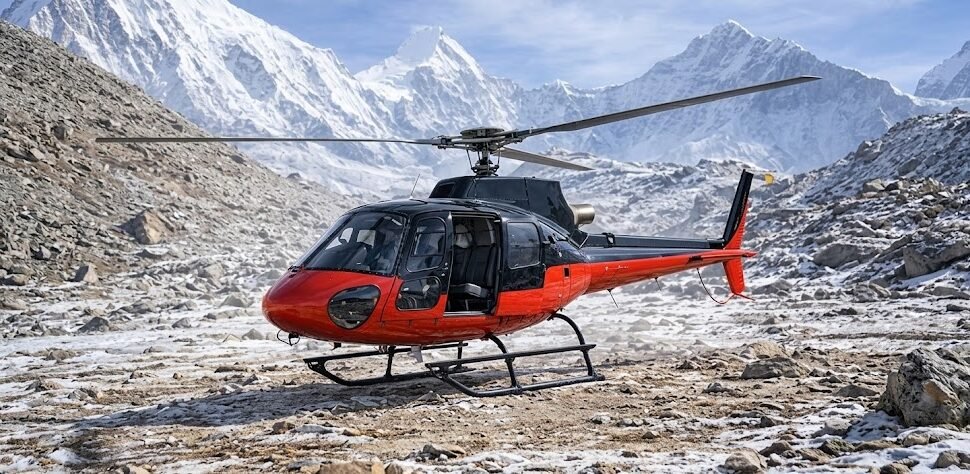
The Kala Patthar Landing Tour puts you at the centre of this panorama at 5,545m for 15 to 20 minutes. The EBC and Gokyo combined tour extends the flight into the Gokyo Valley where Cho Oyu appears at closer range alongside the turquoise Gokyo Lakes. Either tour gives you the full Khumbu mountain experience. What you make of Ama Dablam when it appears is up to you, but you will not be the first passenger to return to Kathmandu talking about it more than Everest.
Book an Everest or Kala Patthar Helicopter Tour
See Ama Dablam (6,812m) from above on the Everest Base Camp helicopter tour or the Kala Patthar landing tour. Ama Dablam is clearly visible from both routes. No advance payment required to hold your seat. Check availability: EBC tour → | Kala Patthar tour →