Most Everest helicopter tour guides tell you what you will see. This one tells you what will actually happen, from the moment your phone alarm goes off in your Kathmandu hotel room to the moment you are back at your hotel with the morning still ahead of you. Hour by hour, stop by stop. No marketing language, no “extraordinary panoramas” without the context of what comes before and after them. Just what the day actually looks like so you can arrive prepared, relaxed, and ready for the parts that matter.
5:00am, 5:30am: The Alarm and the Morning Routine
Your alarm will be set early. Hotel pickup for most Everest helicopter tours happens between 5:30 and 6:00am, which means a 5:00 or 5:15am alarm is realistic. This feels brutal when you set it the night before. It matters because the Himalayan weather window for mountain flying is the early morning, typically 6:00am to 10:00am, before solar heating generates cloud and turbulence in the valley systems.
Eat something light before you leave. Not a full breakfast: heavy food before a helicopter flight and high altitude exposure can worsen nausea. A banana, toast with jam, or yoghurt is enough. Drink a glass of water. Dehydration worsens altitude symptoms and the Kathmandu dry season air is drying on its own. You are not running a marathon, but showing up to 5,545m well hydrated makes the landing stop more comfortable.
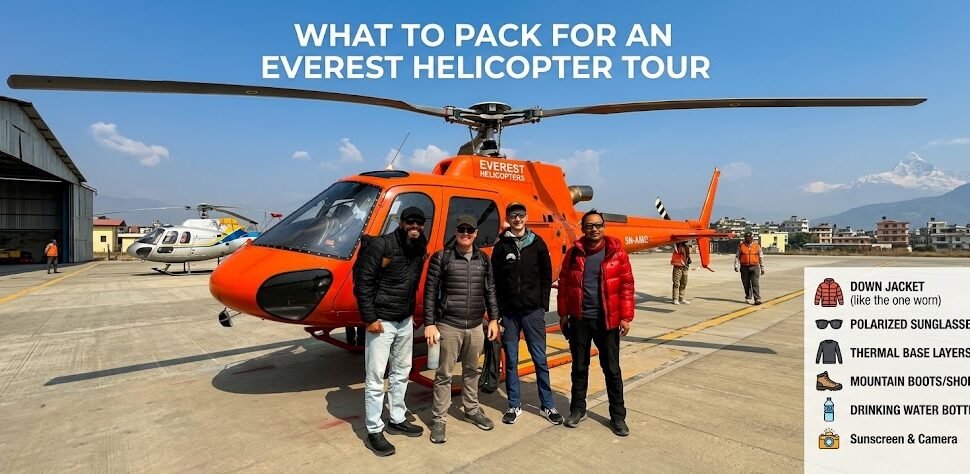
Dress in layers from the moment you leave your room. You will be warm in Kathmandu and cold at Kala Patthar. The layering system means you can remove the outer layers in the vehicle and put them back on before the helicopter landing. Specifically: thermal base layer, mid layer (fleece or light down), and outer layer (wind resistant jacket or heavier down) plus hat and gloves in your bag. Wear boots or sturdy walking shoes, not sandals or flip flops. The Kala Patthar helipad is rocky terrain.
5:30am, 6:00am: Hotel Pickup and Transfer
Your operator’s vehicle arrives at your hotel. This is typically a car or small van. The driver will confirm your name. For group tours, you may be picking up other passengers at nearby hotels. The transfer to the helipad takes 20 to 40 minutes depending on your hotel’s location and Kathmandu’s early morning traffic. At 5:30am the streets are mostly empty, so the transfer runs quickly.
Kathmandu in the early morning has a specific quality that many visitors mention. The city is quiet in a way it never is during the day. Stray dogs sleep in the streets. The smoke of early cooking fires sometimes drifts from the older neighbourhoods. The Himalayan peaks are occasionally visible to the north from the higher streets if the sky is clear, a first preview of what you will see much more closely in an hour. Use this drive to settle, to not be on your phone, to arrive at the helipad already present rather than still processing the previous day.
6:00am, 6:30am: The Helipad Briefing
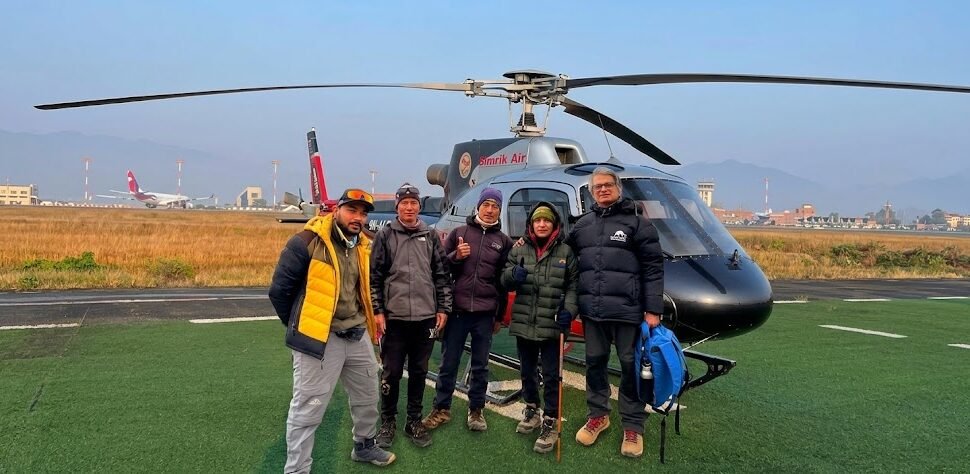
You arrive at the helipad. Most operators in Kathmandu use either Tribhuvan International Airport’s GA terminal or one of several private helipads in the city. You check in with the ground crew, confirm your name on the manifest, and receive the safety briefing. Pay attention to the briefing even if you have flown in helicopters before. The Himalayan mountain environment has specific protocols around boarding, communication with the pilot, and what to do at the high altitude landing site that differ from standard helicopter operations.
Weight check happens here. The Airbus H125 used for Khumbu operations has a maximum takeoff weight and each passenger seat has an expected weight allocation. If you are significantly over the standard guideline, the crew will discuss options. This is not personal. It is physics: high altitude helicopter operations are weight sensitive in a way that sea level flights are not.
You meet your co passengers if on a group tour. Group tours carry four to five passengers. Most groups are a pleasant mix of nationalities and travel contexts: a couple from Europe, a solo traveller, perhaps two friends. Conversations in the waiting area tend to be easy. Everyone is there for the same reason and most people are quietly excited.
There may be a weather delay at this stage. Mountain weather updates come in throughout the early morning and if visibility or wind conditions at Kala Patthar are marginal, the operator will hold departure until conditions improve or reschedule if they do not. A fifteen to twenty minute delay here is normal. Do not interpret it as a problem unless the operator specifically tells you the flight is being rescheduled for the day.
6:30am, 7:00am: Takeoff and the First Half Hour
The helicopter lifts from the helipad. Kathmandu drops away immediately. The city is extraordinary from above in the first few minutes, a basin ringed by green hills with the river systems cutting through neighbourhoods that look very different from the air than from street level. The Boudhanath Stupa, if you fly over the eastern side of the city, appears as a white dome among the surrounding rooftops.
The aircraft climbs northeast. The city gives way to the Kathmandu Valley suburbs, then the valley rim hills, then the progressively steeper topography of the Himalayan foothills. The vegetation changes as altitude increases: tropical and subtropical vegetation at lower elevations, conifer forests on the higher ridges. Rivers flash in the early morning light below.
Approximately twenty to thirty minutes into the flight, the character of what you are flying over changes. The hills become ridges. The ridges become shoulders of serious mountains. And somewhere around the thirty minute mark, on a clear day, the white mass of the Himalayan range appears to the north. At first it looks like a bank of white cloud. Then the sheer scale of it becomes apparent. The white wall that fills the northern horizon is not cloud. It is five hundred kilometres of peaks above 6,000 metres, with the eight thousanders rising from the general line like teeth above a jaw.
7:15am, 7:30am: Lukla Refuelling Stop
Most Everest helicopter tours stop at Lukla (2,800m) for a brief refuelling pause, typically five to ten minutes on the ground. Lukla is famous among aviation enthusiasts for its airport: a short runway at 2,800m on a hillside with a steep drop off at one end and a mountain wall at the other. You may see mountain flights landing and departing. The setting is dramatic and the brief ground stop lets you feel the Khumbu air for the first time, noticeably thinner and colder than Kathmandu.
Stay in or near the helicopter during the Lukla stop unless the crew directs you otherwise. The ground time is short and departure can happen quickly once refuelling is complete. Use the pause to put on your hat and gloves if you have not already and to take an extra layer on.
7:30am, 8:15am: The Khumbu Approach
The leg from Lukla to Kala Patthar is the visual centrepiece of the flight. The helicopter climbs up the Dudh Koshi River valley past Phakding, over Namche Bazaar’s horseshoe of white buildings on the hillside below, through the narrowing upper valley past Tengboche with its famous monastery visible on the ridge, past the high altitude settlements of Dingboche and Lobuche, and into the upper Khumbu.
Ama Dablam appears on this section and the reaction from most first time visitors is intense. Ama Dablam (6,812m) is a peak that photography does not adequately prepare you for. Its form, a vertical tower of ice and rock above a lower body of ridges, is so classically defined that it looks almost constructed rather than geological. Mountaineers consider it one of the most beautiful peaks on earth. From a helicopter at roughly the same altitude as its lower ridges, looking across at its full south face, the opinion is easy to understand.
Everest appears above the Nuptse ridge at some point on this approach, depending on the exact flight line and the weather. The sequence of its appearance, first the summit pyramid above the ridge, then more of the mountain as the helicopter climbs and angles, then the full southwest face as the upper Khumbu opens up, is one of those things that happens faster than you expect and produces a response that is harder to predict than you think. Many passengers go silent at this moment. Some say something. Some just watch.
8:15am, 8:35am: The Kala Patthar Landing
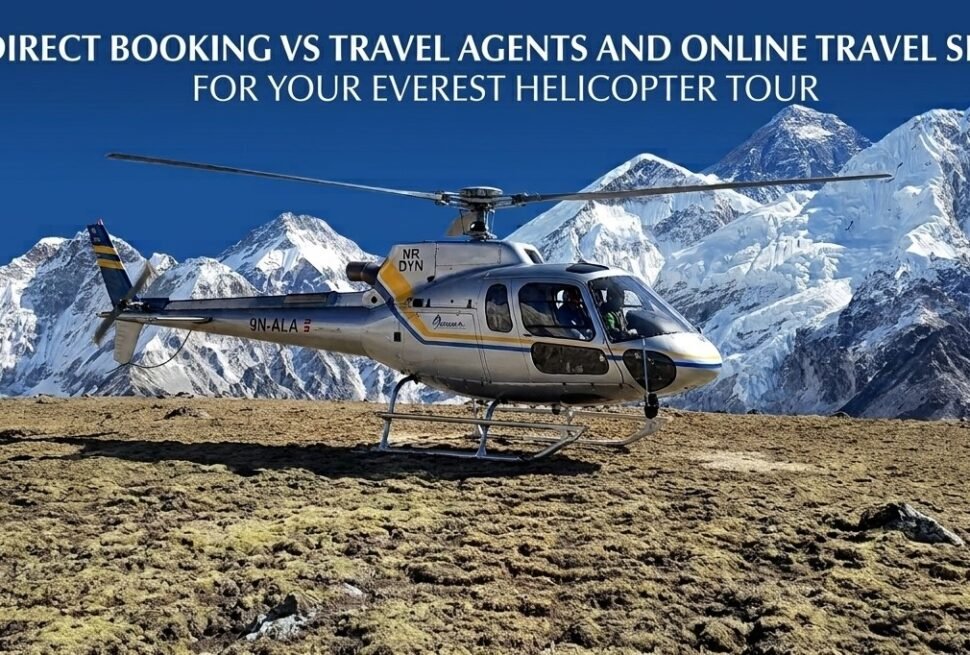
The helicopter descends toward the Kala Patthar ridge. The pilot approaches from the east, descending over the upper Khumbu Glacier toward the helipad on the ridge. The landing itself is smooth on a good day, though mountain air currents mean some movement during the approach is normal. The engines reduce and the aircraft settles onto the rocky ground.
The door opens. The cold arrives before anything else. Not a gentle chill but the specific cold of 5,545m at dawn in thin air. Breathe slowly. Do not jump out and jog to the viewpoint. Step out carefully onto the rocky ground and stand for ten seconds to let your system register the altitude. Reach for the supplemental oxygen provided and take several long slow breaths. You will feel the difference immediately.
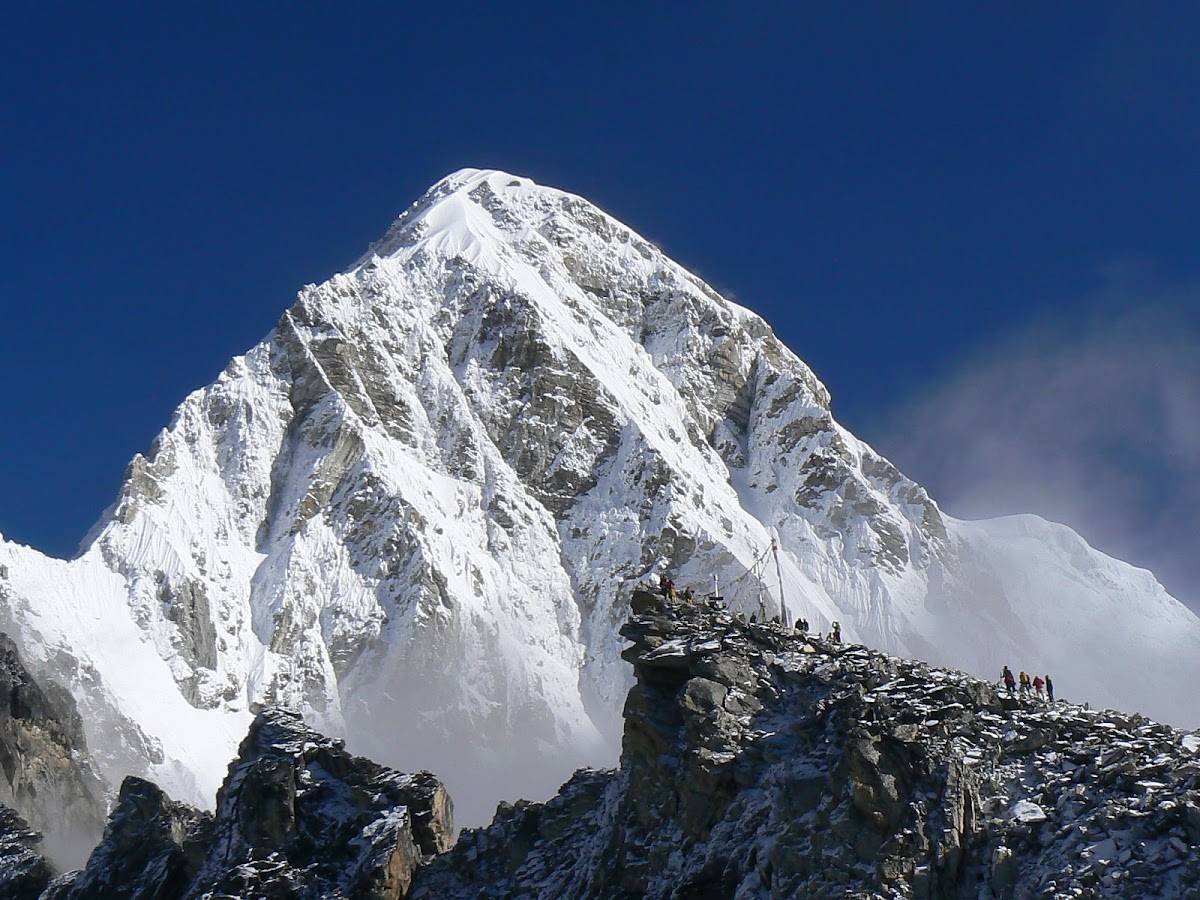
Everest is directly in front of you. Lhotse is to its right. Nuptse is to its left. The Khumbu Glacier runs below you. Everest Base Camp is visible as a cluster of coloured dots on the lateral moraine at the glacier’s edge. The scale of what is in front of you is not something that resolves quickly. Most people spend the first three or four minutes simply looking, trying to match what they see with any previous frame of reference and finding that the comparison does not hold.
Walk carefully to the viewpoint area on the ridge. The terrain is rocky and uneven with occasional patches of ice in colder months. Take photographs. Identify the peaks. Talk to your companions or stand quietly. There is no wrong response to being at 5,545m looking at Everest. The prayer flags strung along the ridge flutter in the constant wind. Some passengers add a flag they brought from Thamel. Some just stand. Both are appropriate.
At 15 to 20 minutes, the crew will indicate time to return. This is not negotiable. The pilot is managing weather, fuel, and schedule. Return to the helicopter without being pushed a second time. You have had the experience. The mountain will look the same from the helicopter on the way out.
8:35am, 9:15am: Hotel Everest View Breakfast (Optional Stop)
Some tours include a breakfast stop at the Hotel Everest View (3,880m) on the return. This is the world’s highest hotel, built in 1971 on a ridge above Namche Bazaar with a direct view of Everest, Lhotse, Ama Dablam, and Thamserku from the dining room window. The descent from Kala Patthar to the hotel altitude takes about five minutes of flying, and the air at 3,880m feels noticeably warmer and easier than the landing site.
Breakfast at the hotel typically includes tea or coffee, toast, eggs, and local items. The dining room’s panoramic window frames the Himalayan peaks that you have just been among from a perspective that combines comfort with the view still fully present. Most people find this stop one of the most pleasant parts of the tour: the intensity of the landing has passed, the views are still extraordinary, and the conversation tends to become reflective and enjoyable in a way that the altitude and cold of Kala Patthar do not permit.
9:15am, 10:00am: Return to Kathmandu
The return flight retraces the route. The Khumbu peaks gradually recede behind you as the helicopter descends the valley. Namche passes below again. The forest ridges of the lower Khumbu. Lukla. And then the Himalayan foothills give way to the broader valley topography and the approach into Kathmandu begins. The city appears below with the Kathmandu Valley rim hills in the background.
You land at the helipad, transfer back to your hotel by vehicle, and arrive back in Kathmandu typically before 10:30am. The entire tour, from hotel pickup to hotel return, has taken around four to five hours. You have the rest of the day in Kathmandu. Most people find the afternoon after the tour quietly strange in a pleasant way: sitting in a coffee shop or restaurant in Thamel, looking at photographs, being slightly disbelieving that four hours ago they were at 5,545m above sea level looking at Everest from above.
What to Do After the Tour
Give yourself the afternoon to process rather than immediately filling the rest of the day with activities. The experience of the Khumbu at altitude takes time to settle. A quiet lunch in Thamel, a walk to Boudhanath Stupa, or simply sitting in the hotel garden with the photographs and the memories is not wasted time. It is how the experience consolidates into something you will carry long term.
If you want to understand what you saw in more context, the International Mountain Museum in Pokhara (if you travel there after Kathmandu) has the best collection of Himalayan photography and expedition history in Nepal. The Sherpa cultural museum in Namche Bazaar, accessible only by trek, gives the deepest context for the communities whose land you flew over. For Kathmandu based follow up, the Himalayan Mountaineering Institute library at the Hotel Vajra has a collection of climbing literature that can deepen the experience of the morning in retrospect.
Book the Kala Patthar Landing Tour for the complete experience described in this guide. For the widest aerial route including Gokyo Lakes, explore the EBC and Gokyo combined tour. The Group Tour is ideal for solo travellers and couples; the private couples package gives you the same route with exclusive use of the aircraft.