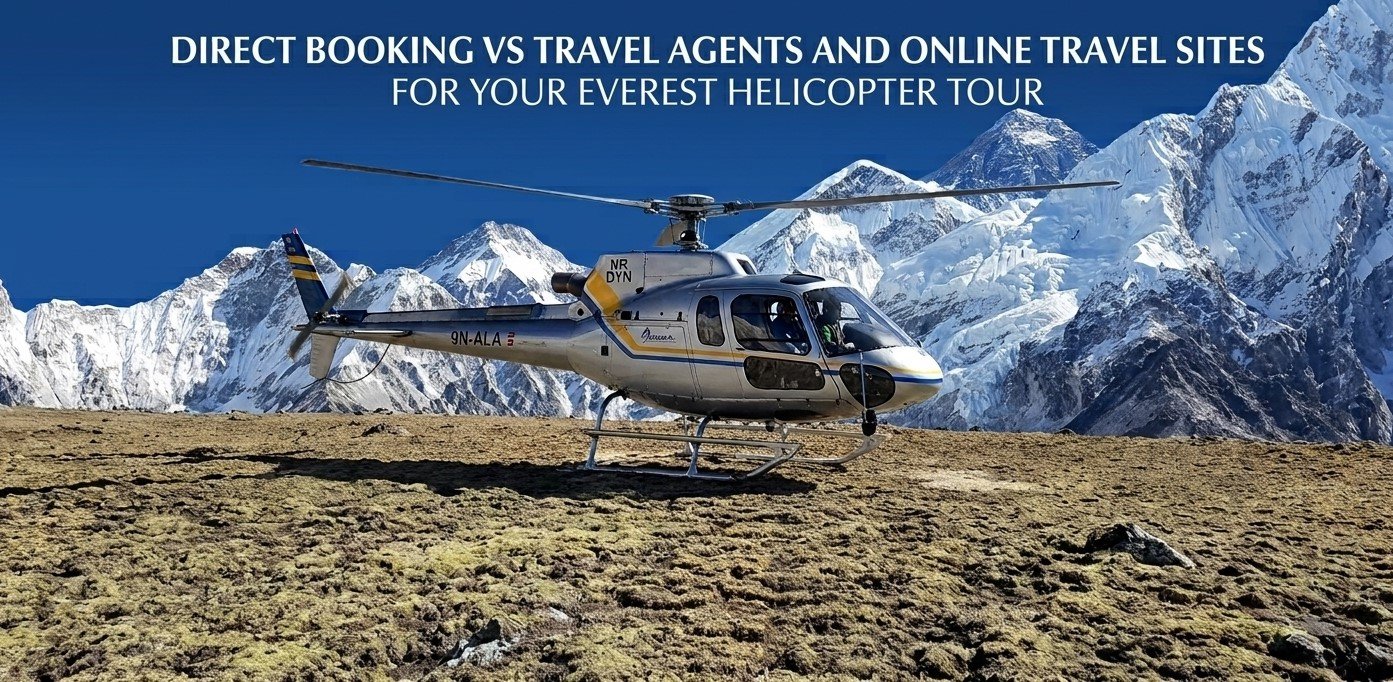
You have already decided you want to see Everest from the air. The harder decision, the one nobody warns you about, is who you actually hand your money to. A quick search for “Everest helicopter tour” turns up the operator’s own website, a dozen Kathmandu travel agencies offering the same flight, your hotel’s front desk handing you a laminated brochure, and two or three big international booking marketplaces all listing what looks like an identical product at three or four different prices. Which one you pick changes more than the number on your receipt. It changes who answers the phone if the weather turns bad on the morning of your flight, how fast you get your money back if it does, and whether the person you are emailing has ever actually met the pilot.
This is not a dramatic story of villains and heroes. Travel agents, hotel desks and online marketplaces all play a real role in tourism, and plenty of travelers have good experiences booking through them. But a helicopter flight to Everest Base Camp is a different kind of purchase than a city tour or a museum ticket. It depends on weather windows, precise timing, fast rebooking when a flight is delayed by cloud cover, and clear communication with the operator who is legally and operationally responsible for the aircraft. Those are exactly the things that get diluted the more people sit between you and the company flying the helicopter.
Below is a plain, honest look at how each booking channel actually works, where the extra cost goes, and what changes in practice when the weather does not cooperate, using how the wider tour and activity booking industry is known to operate as the backdrop, plus specifics from how Everest Helicopter Tour itself prices and runs its flights out of Kathmandu.
The Four Ways People Book an Everest Helicopter Tour
Almost every traveler who books an Everest helicopter tour goes through one of four channels.
- Direct with the operator. You contact the helicopter company itself, by phone, WhatsApp, email, or through its own website booking form, and pay the operator’s own rate.
- A Kathmandu travel agency or trekking agency. A local agency, often one you found through a trekking package search or a referral, sells you the same flight as part of its own product catalog.
- A hotel concierge or travel desk. Your hotel in Kathmandu or Thamel arranges the flight for you as a guest service, usually working with a partner agency behind the scenes.
- An international online travel marketplace or tour aggregator site. A large booking platform lists the Everest helicopter tour alongside thousands of other activities worldwide, and you book it the same way you would book a walking tour in Rome or a snorkeling trip in Bali.
Every one of these channels can get you on the helicopter. What differs is price, who you can reach when something changes, and how quickly problems get solved. Let us go through each one.
Booking Direct With the Operator
Booking direct means contacting the company that owns and flies the helicopter, with nobody else in between. For Everest Helicopter Tour, that means calling or messaging the Kathmandu office on WhatsApp, sending an email, or filling out a booking request on the company’s own website. There is no reseller, no partner agency, and no commission layer added to the price you see.
The most obvious advantage is price. Since there is no middleman taking a cut, the rate you pay is the operator’s actual rate, the same one that funds the pilot, the fuel, the aircraft maintenance, and the ground staff. A detailed breakdown of how this pricing is put together, including current per person rates for the shared group flight, the private charter, and the honeymoon package, is covered in the Everest helicopter tour cost and price guide, which is worth reading alongside this article if price is your main concern.
The less obvious advantage, and arguably the more important one, is who you are actually talking to. When you message Everest Helicopter Tour directly, you are talking to the people who schedule the pilots, track the weather at Lukla and Syangboche that morning, and make the call on whether a flight goes ahead, gets delayed by a few hours, or gets rescheduled to the next day. That is a very different conversation than one routed through a booking platform’s customer support queue or a travel agency that has to call the operator itself, wait for an answer, and then call you back.
Direct booking also tends to be faster for last minute travelers. If you land in Kathmandu with three days left in your trip and decide you want to fly to Everest, contacting the operator directly cuts out the back and forth of an agency checking availability on your behalf. The specifics of how same day and next day bookings actually work, including when they are realistic and when they are not, are covered in the guide to last minute Everest helicopter tour booking and availability.
The one thing direct booking does not give you is a local human standing next to you in your hotel lobby handing you a printed itinerary. If that kind of in person hand holding matters to you, a hotel desk or agency will feel more comfortable at first. In practice, though, most travelers who book a specific activity like a helicopter flight are already comfortable arranging things by phone, WhatsApp or email before they even leave home, so this gap tends to matter less than people expect.
What “Direct” Actually Looks Like in Practice
A direct booking with Everest Helicopter Tour typically involves a short exchange of messages confirming your preferred date, the package you want (shared seat, private charter, or the Kala Patthar landing upgrade), your hotel for pickup, and the number of passengers. Payment terms and identity verification are handled directly with the company, without an agency’s own separate booking system sitting on top. The full process, including what documents to have ready and how confirmation works, is laid out step by step in the step by step guide to booking an Everest helicopter tour.
Booking Through a Kathmandu Travel Agency or Trekking Agency
Local travel and trekking agencies are a fixture of Kathmandu tourism, and most of them sell helicopter tours as an add on to trekking packages, city tours, or general Nepal itineraries. This is often the channel travelers fall into without quite realizing it, because they booked a broader Nepal trip through one agency and the helicopter flight got bundled in.
Here is how the money generally works. A tour operator like a helicopter company sets either a fixed commission percentage or a net rate for agencies that resell its product. Under a percentage model, the agency earns an agreed cut, commonly somewhere in the range of ten to twenty percent for adventure and boutique tour products, of whatever the customer pays, and the operator keeps the rest. Under a net rate model, the operator tells the agency the flat amount it needs to receive per booking, and the agency is free to mark the price up by whatever amount it thinks the market will bear. Net rate arrangements are common precisely because they give agencies flexibility to compete, which also means two different agencies selling the exact same Everest flight can list two very different prices to the customer, neither of which is necessarily transparent about how much of it is markup.
This matters to you as a traveler for a simple reason: the agency’s fee is not a service charge with a receipt attached, it is baked invisibly into the quoted price. You are very unlikely to be told “this flight costs the operator X and we are adding Y on top.” You just see one number.
What you do get from a good local agency is convenience if you are already booking a larger, multi part Nepal trip through them, someone who speaks your language handling logistics, and a single point of contact for your whole itinerary rather than juggling separate bookings. Reputable agencies also tend to know the market well enough to steer you away from operators with weak safety records.
The risk sits on the other side of the same coin. Not every agency advertising an Everest helicopter tour actually has a direct relationship with a licensed operator, and Nepal’s helicopter tourism market has had its share of resellers who take payment and then either subcontract the flight out to whichever operator has a free slot that day, or in worse cases, are not properly connected to an operator at all. Because this is a genuine risk in the market, it is worth reading the dedicated breakdown of Nepal helicopter tour scams, red flags and fake operators before handing money to any agency you have not personally verified, whether that is for an Everest flight or any other adventure activity in Nepal.
There is also a practical, day of the flight problem with agency bookings: when weather grounds the helicopter, and it does happen regularly given how quickly conditions change in the Khumbu, you are not talking to the people making the flight decision. You are talking to the agency, who then has to contact the operator, get an answer, and relay it back to you. Every one of those extra steps adds delay at the exact moment you most want a fast, clear answer about whether you fly today, fly tomorrow, or get refunded.
Refunds and Rescheduling Through an Agency
When a flight is cancelled for weather, which is a safety decision and not something any operator or agency controls, the money still has to move back to you or get applied to a new date. If you booked direct, that refund or reschedule happens in one step, between you and the operator. If you booked through an agency, the operator first has to settle with the agency, and the agency then has to settle with you, and depending on the agency’s own policies and how quickly they process refunds, that can add real time to how long you wait for your money. Some agencies also apply their own cancellation terms on top of the operator’s policy, which is worth reading closely before you pay. The general mechanics of how weather cancellations, refunds and rebooking work for Everest helicopter flights, regardless of which channel you booked through, are explained fully in the guide to Everest helicopter tour weather cancellations, refunds and rebooking, and it is genuinely worth reading before you book anywhere, direct or otherwise.
Booking Through a Hotel Concierge or Travel Desk
For travelers already staying in Kathmandu, the hotel front desk is often the path of least resistance. You ask about helicopter tours, the desk hands you a brochure or makes a phone call, and within an hour you have a quote and a pickup time arranged. It feels simple, and for a lot of travelers it is genuinely convenient.
Behind that convenience is almost always a commission arrangement similar to the travel agency model, except with an added layer. Many hotels do not have a direct relationship with helicopter operators at all. Instead, the front desk calls a local travel agency partner, who then contacts the operator. That means a hotel booking can effectively be a travel agency booking with an extra step, and an extra markup, added on top. Hotels typically earn a referral commission for sending business to their partner agency, and that commission is, again, built into your final price rather than itemized separately.
The convenience is real. If you are jet lagged, do not want to research operators yourself, and are happy to pay somewhat more for someone else to make a few phone calls, a hotel desk can save you time. Where it tends to fall short is exactly where the agency channel falls short, and often more so: communication speed on the morning of the flight. If your 6am departure is delayed by fog over the Khumbu Valley, you are relying on the hotel desk to reach the agency, who then reaches the operator, and word travels back down that same chain. On a morning where minutes matter for catching a later weather window, that chain can be the difference between getting rebooked into a later slot the same day or being pushed to a standby list for tomorrow.
There is also generally less accountability with a hotel desk than with a dedicated travel agency. A trekking or travel agency’s whole business is arranging tours, so a serious one will usually have processes for handling cancellations and complaints. A hotel’s core business is rooms, and the helicopter booking is a side service, so the people handling it may not be as fluent in the operator’s actual policies, aircraft type, or flight route as either the operator itself or a specialist agency would be.
Booking Through International Online Travel Marketplaces and Tour Aggregator Sites
The newest and, for many international travelers, the most familiar channel is the large online booking marketplace, the kind of site where you can browse thousands of tours and activities worldwide, read reviews, and book with a credit card in a few clicks. These platforms have become a dominant way people book single activities like a helicopter tour, a cooking class, or a day trip, mainly because they feel familiar and low risk to someone who has never been to Nepal before.
The commercial reality behind these marketplaces is worth understanding clearly, because it explains a lot about pricing. Tour and activity booking platforms typically charge the operator listing on their site a commission that, across the industry, generally lands somewhere between fifteen and thirty five percent of the sale price, with something closer to twenty to twenty five percent being a common range for many mainstream platforms. That is a meaningfully larger cut than most local agencies take, and it is charged on every single booking that comes through the platform, not negotiated case by case the way a local agency relationship might be.
For an operator, that commission is either absorbed into a higher listed price on the marketplace than the operator’s own direct rate, or, in some cases, the exact same nominal price is kept but the operator’s margin on that booking is simply much thinner than a direct sale. Either way, the practical result for you as a customer is the same: booking through a major marketplace is very unlikely to be cheaper than booking direct, and it is often noticeably more expensive once you compare like for like packages.
What you gain from a marketplace is a familiar checkout process, buyer protection policies that are usually well documented, and the ability to compare an Everest helicopter tour against other Nepal activities on the same platform. What you lose is direct contact with the operator during the booking process, and often during the trip itself. Marketplace bookings usually flow through the platform’s own customer support system first. If your flight needs to be rescheduled for weather, you may be filing a request through the marketplace’s app or support portal, which then contacts the operator, rather than simply calling the person who is flying you.
Response time is the real cost here. A weather delay at 5,364 meters near Everest Base Camp is not something that waits patiently for a support ticket to be triaged. Operators need to communicate quickly with passengers about a new departure window, a same day standby slot, or a next day reschedule, and that works best when the conversation is direct. Refunds through a marketplace can also take longer to reach you, since the money has to flow from the operator back through the platform’s own payment and refund system before it reaches your card, which can add days compared to a direct refund arranged straight with the operator.
Reviews Are Useful, But Read Them Carefully
One genuine strength of marketplace bookings is the review system, which can help you avoid poorly run operators. The catch is that reviews on a large aggregator site are sometimes left against the marketplace listing itself rather than clearly tied to the specific operator who actually flew the tour, particularly in markets where a listing gets resold or subcontracted. When comparing an Everest helicopter tour on a marketplace against the same tour on the operator’s own website, it is worth checking that the aircraft type, route, and included stops such as the Hotel Everest View landing actually match, since marketplace listings are not always kept as current as an operator’s own site.
How Pricing Actually Compares Across Channels
Here is a general comparison of what you can expect from each channel, based on how these arrangements typically work across the tour and activity industry and on how Everest Helicopter Tour’s own direct pricing is structured.
| Booking channel | Typical price versus operator’s direct rate | Refund or reschedule speed after weather cancellation | Direct contact with operator and pilots | Overall reliability |
|---|---|---|---|---|
| Direct with the operator | Baseline rate, no added markup | Fastest, handled in one step | Full, from first message to flight day | Highest, you know exactly who you booked with |
| Kathmandu travel or trekking agency | Often ten to twenty percent above direct, sometimes more | Slower, agency must relay between you and operator | Limited, agency acts as go between | Varies widely by agency, verification matters |
| Hotel concierge or travel desk | Similar to or higher than agency pricing, an added referral layer | Slowest, extra layer between hotel, partner agency and operator | Minimal, several steps removed | Depends on the hotel’s actual operator relationship |
| International OTA or tour marketplace | Often fifteen to thirty five percent above direct, per typical industry commission ranges | Slower, routed through platform support and payment systems | Low during booking, moderate on flight day at best | Generally reliable for payment security, weaker for flight day communication |
None of this means an agency, hotel desk, or marketplace booking is a bad choice for every traveler. It means you are trading a certain amount of money and a certain amount of communication speed for convenience, and it is worth knowing exactly what that trade looks like before you pay.
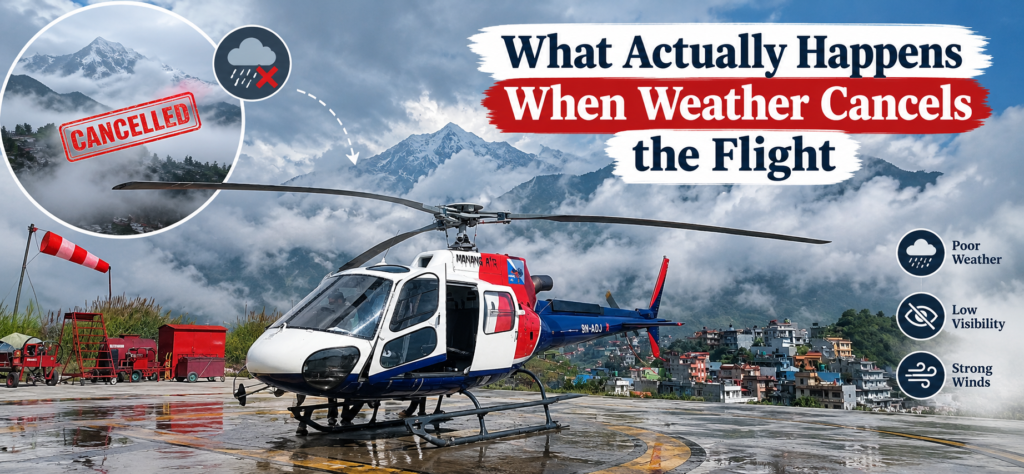
What Actually Happens When Weather Cancels the Flight
This is the single most important practical difference between booking channels, and it is worth spending real time on, because weather is the biggest variable in any Everest helicopter tour. The route climbs from Kathmandu at 1,400 meters past Lukla at 2,860 meters to an aerial pass above Everest Base Camp at 5,364 meters, over the Khumbu Glacier and Khumbu Icefall, with a breakfast stop at Hotel Everest View in Syangboche at 3,780 meters. That is a lot of altitude and a lot of mountain terrain, and conditions can shift fast enough that a flight scheduled for early morning gets delayed, moved to a later slot the same day, or rescheduled entirely.
When that happens, speed of communication is everything. A direct booking means the operator can reach you immediately, and you can ask questions and get real answers about your specific flight rather than generic policy language. You know exactly who is deciding whether today’s flight goes ahead, because you already have their number.
An agency or hotel booking adds at least one extra link in that chain. The operator has to tell the agency, and the agency has to tell you, and if it is early morning and phone lines are busy with dozens of other travelers experiencing the same weather delay across the valley, that chain can slow down exactly when you need it to be fast. A marketplace booking often adds a similar or larger delay, since the operator has to update the marketplace’s system, and you have to interact with the marketplace’s own support process to get your reschedule or refund confirmed, rather than dealing with the operator face to face.
Refund timing follows the same pattern. Paid direct, a refund is a straightforward transaction between you and the operator. Paid through an agency, hotel, or marketplace, your money went to that third party first, and it has to come back through the same route, which in practice usually means it takes longer to land back in your account, and you have less visibility into where it is at any given moment. None of this is unique to Everest Helicopter Tour, it is simply how payment chains work whenever a third party sits between a buyer and a service provider. For a full explanation of how weather related delays, refunds, and rebooking work specifically for this route, the article on weather cancellation, refunds and rebooking covers what to expect and how to plan a flexible itinerary around it, regardless of which channel you book through.
Communication With the People Actually Flying You
There is a less quantifiable but genuinely important difference between channels: knowing who is flying you. Everest Helicopter Tour operates the Airbus H125, known also as the AS350 B3e, a single engine helicopter widely used across Nepal specifically because of its strong high altitude performance, which matters enormously on a route that climbs to a landing at Hotel Everest View above 3,700 meters and passes close to terrain above 5,000 meters. When you book direct, your questions about the aircraft, the route, the pilot’s experience, or the safety standards behind the flight go straight to the company that operates that helicopter and employs that pilot.
When you book through an agency, a hotel, or a marketplace, those same questions get relayed, and the answers you receive are only as accurate as whatever the reseller happens to know or bother to confirm. This is not a small point. Aviation safety and maintenance standards are exactly the kind of detail that should come from the source, not filtered through a sales intermediary who may be more focused on closing the booking than explaining the aircraft. If safety and operational standards matter to you as they should for any helicopter flight, the detailed explanation of Everest helicopter tour safety, pilots, aircraft maintenance and CAAN standards is a useful companion piece, and it is far easier to get straight answers about any of it when you are already talking to the operator directly.
Direct communication also tends to produce a better, more personal experience on the day itself. Pilots and ground crews who deal directly with their own booked passengers, rather than an anonymous name handed to them by a reseller, generally have more context on who is flying, any special requests such as the honeymoon package or the Kala Patthar landing upgrade, and any details that matter for a smooth pickup from your specific hotel.
Comparing Actual Package Prices
To make this concrete, here is how Everest Helicopter Tour’s own direct pricing is structured for its main packages. These are the operator’s own rates, without any agency, hotel, or marketplace markup added on top.
- Shared group tour, five or more travelers per helicopter: around 1,250 dollars per person
- Everest Helicopter Tour group package: around 1,100 dollars per person
- Private helicopter charter, the whole aircraft, about five passengers: around 4,800 dollars total
- Honeymoon private couple package: around 2,800 dollars
- Kala Patthar landing upgrade, shared seat, the highest tourist accessible helicopter landing point in Nepal at 5,545 meters: around 1,250 dollars per person
Apply even a conservative agency markup of ten to fifteen percent, or a marketplace commission in the fifteen to thirty five percent range discussed earlier, and the same shared group seat that costs 1,250 dollars direct can easily climb well past 1,400 or 1,500 dollars sold through a third party, without you gaining anything extra for that difference other than the convenience of booking through a channel you happened to find first. On a private charter at 4,800 dollars total, that same percentage gap can mean several hundred dollars in pure markup on a single booking. For full details on the Kala Patthar landing option, including what makes it different from the standard base camp overflight, see the Everest Base Camp helicopter tour with Kala Patthar landing page directly.
When a Travel Agent, Hotel Desk, or Marketplace Can Still Make Sense
It would be dishonest to pretend third party booking channels never make sense, because for some travelers they genuinely do. If you are booking a long, multi part Nepal itinerary that includes trekking, city tours, and the helicopter flight all together, working with one trusted agency for the whole trip can simplify your planning considerably, and a small markup on the flight may be a reasonable price for that convenience. If you already have a trusted travel advisor you have used for years and who has a track record of vetting operators carefully, their judgment and relationship may be worth the added cost to you.
Marketplaces also offer genuine value for travelers who want the reassurance of a familiar payment system and a platform level dispute process, particularly first time visitors to Nepal who are still building confidence in the destination generally. That reassurance has real value, even if it comes with a higher price and a slower path to the operator if something needs to change.
What matters is going in with clear eyes. If you choose a third party channel, ask directly what operator will actually be flying you, confirm the aircraft type and route match what you are expecting, and ask what the cancellation and refund process looks like before you pay, rather than after a flight gets delayed. A good agency or reputable marketplace listing should be able to answer all of that without hesitation.
How to Book Directly With Everest Helicopter Tour
If price, speed, and direct contact with the operator matter more to you than having someone else make the phone call, booking direct is straightforward. You can reach Everest Helicopter Tour by phone, by WhatsApp for a quick written exchange with time stamps you can refer back to, by email if you prefer a formal record of your booking details, or through the booking form on the company’s own website. Provide your preferred date, how many passengers, which package you want, whether that is the standard Everest Base Camp helicopter tour or the version with the Kala Patthar landing, and your hotel in Kathmandu for pickup.
From there, confirmation, payment terms, and any questions about the route or the aircraft all happen in direct conversation with the people actually running the flight, with no reseller relaying messages back and forth. The complete walkthrough, including what to have ready before you contact the company and how confirmation and payment typically proceed, is covered in full in the step by step guide to booking an Everest helicopter tour.
Frequently Asked Questions
Is it actually cheaper to book an Everest helicopter tour directly with the operator?
In most cases, yes. Travel agencies, hotel desks, and online marketplaces all generally add some form of commission or markup on top of the operator’s own rate, whether that shows up as a straightforward percentage or as pricing flexibility built into a net rate arrangement. Booking direct with Everest Helicopter Tour means paying the operator’s own listed rate with no added layer in between.
Are online travel marketplaces safe for booking a helicopter tour in Nepal?
Generally yes, in the sense that reputable marketplaces have solid payment security and buyer protection policies. Where they tend to fall short is speed and directness of communication if your flight is delayed or cancelled for weather, since your request usually has to be routed through the platform’s own support system before it reaches the operator.
How much extra does booking through a travel agency typically cost?
It varies by agency and by whether the arrangement is a straight percentage commission or a net rate the agency marks up on its own. Across the wider tour and activity industry, agency commissions on smaller or boutique operators commonly land somewhere around ten to twenty percent, though the exact figure is rarely disclosed to the customer since it is built into the quoted price rather than itemized separately.
What happens to my refund if my flight is cancelled and I booked through a third party?
Your refund has to travel back through whichever party you paid. If you paid an agency, hotel desk, or marketplace, the operator refunds that party first, and the party then refunds you, which typically takes longer than a direct refund arranged straight with the operator. Policies can also differ between what the operator offers and what the reseller applies on top, so it is worth checking both before booking.
Does the hotel concierge actually deal directly with the helicopter operator?
Sometimes, but often not. Many hotels do not have a direct relationship with helicopter operators and instead route the booking through a partner travel agency, which adds an extra layer, and often an extra markup, between you and the company actually flying the helicopter. It is worth asking your hotel directly which operator they use and whether they have a direct relationship with that company.
Can I still get help quickly on the morning of my flight if I booked through an agency or marketplace?
You can, but expect an extra step. Instead of speaking directly with the operator making the weather call, you will typically be relaying questions through the agency or platform’s support process, which then contacts the operator on your behalf. This can add real delay on a morning when a quick decision about rebooking into a later slot matters.
Is the aircraft and route the same no matter which channel I book through?
It should be, since the same operator is ultimately flying the aircraft, but it is worth confirming rather than assuming, particularly on a marketplace listing that may not always be kept fully current. Ask specifically about the aircraft type, the route past Lukla to the pass above Everest Base Camp, and the breakfast stop at Hotel Everest View to make sure the package matches what is described.
What is the safest way to avoid a fake or unlicensed reseller when booking a helicopter tour in Nepal?
Verify who you are actually dealing with before paying. Confirm the company has a direct, named relationship with a licensed operator, ask which helicopter and route you will be flying, and be cautious of unusually large discounts that seem well below typical market pricing. The full list of common red flags and how to spot them is covered in the guide to Nepal helicopter tour scams and fake operators, which is worth reading before booking through any unfamiliar agency or listing.
The Bottom Line
Every booking channel can get you into the air over the Khumbu Valley and past Everest Base Camp. What changes is how much of your money goes to the flight itself versus a markup you cannot see, and how quickly and directly you can reach the people actually responsible for getting you there and back safely if the weather has other plans. Agencies, hotel desks, and marketplaces all have a place in tourism, and for a complex multi part trip they can genuinely simplify your planning. But for a single, weather dependent, high value activity like a helicopter flight to Everest, the case for booking direct is straightforward: a fair price with no hidden layer, and a direct line to the operator from your first message through to touchdown back in Kathmandu.
If you are ready to book, the most direct route is straight through the operator itself. You can review full details, current pricing, and the complete flight route on the Everest Base Camp helicopter tour page, and reach the team by phone, WhatsApp, email, or the website booking form to check availability for your dates. No agency, no hotel commission, no marketplace fee, just a clear price and a direct conversation with the people flying you to the highest mountain on earth.