
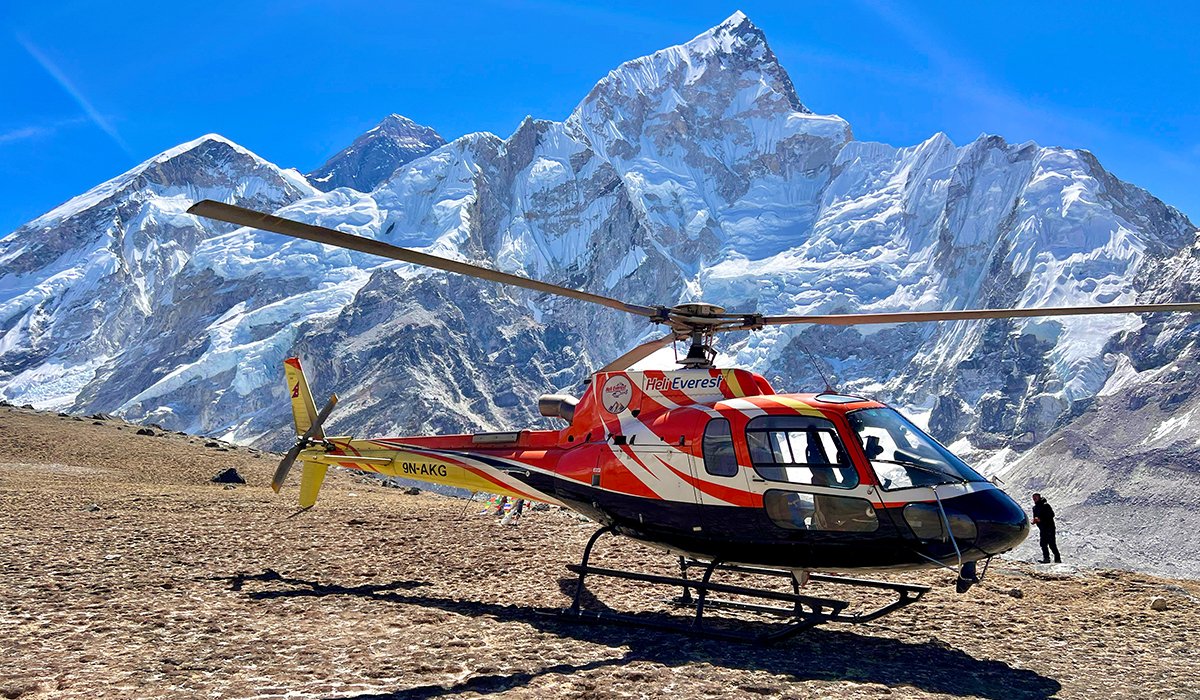
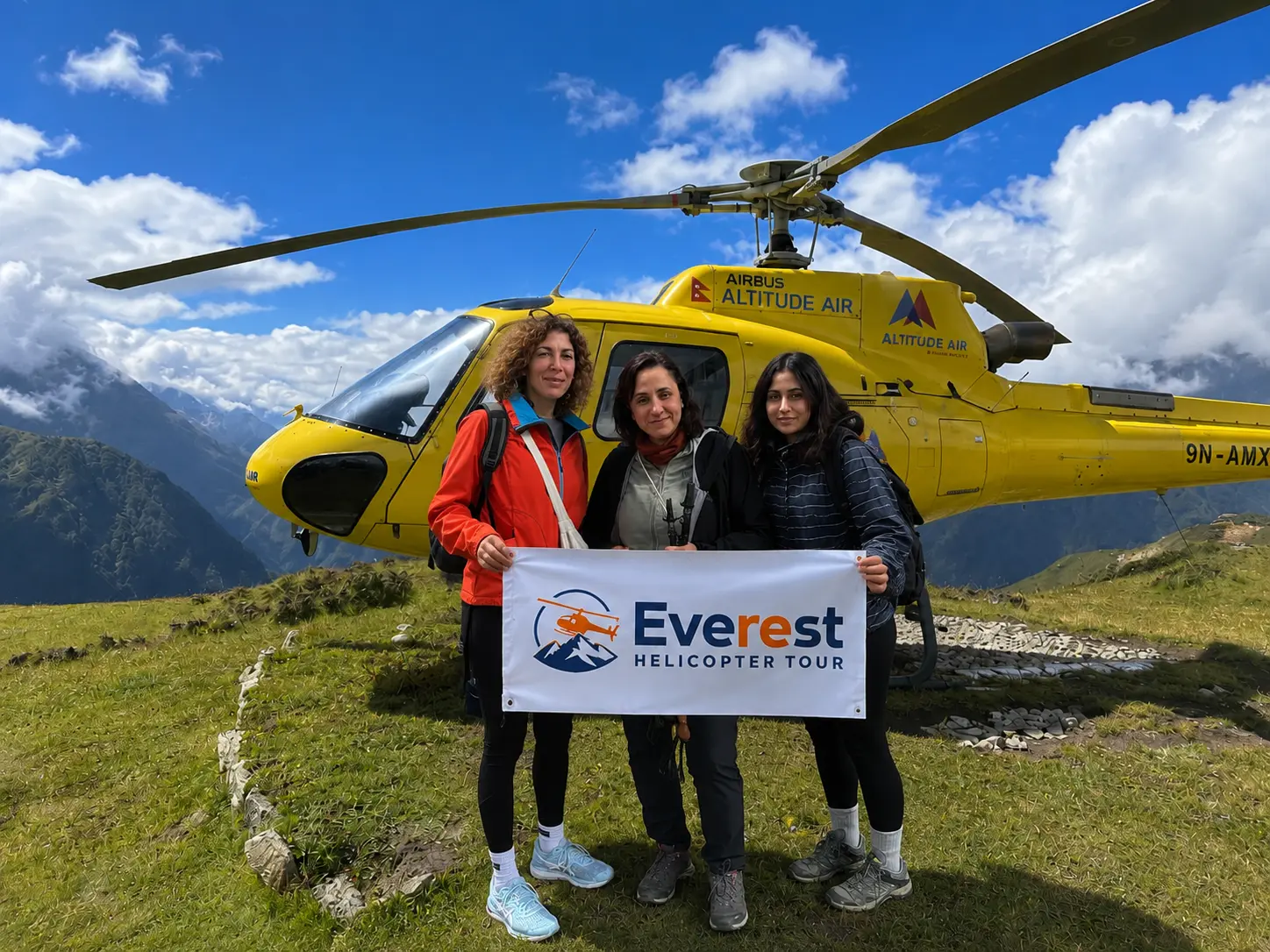
The Everest helicopter tour group package combines private aircraft charter for corporate teams, family reunions, school expeditions, and large social groups visiting Everest Base Camp (5,364m) and the Khumbu Himalaya. A standard helicopter seats 5 passengers plus the pilot, so groups of 5 use one aircraft; groups of 6 to 10 use two aircraft flying in formation; groups of 11 and above use three or more aircraft. All aircraft depart together and land together at each ground stop, so the full group shares the experience simultaneously. The tour flies aboard CAAN-certified AS350 B3e Airbus H125 helicopters operated by licensed Khumbu-route pilots.
Group bookings are the most cost-efficient way to experience an Everest helicopter tour. Per-person cost on a group charter of 10 or more is typically equivalent to or lower than a public group seat booking, while providing the flexibility of private charter timing, routing, and ground time. Corporate clients frequently book this package for employee reward programs, incentive travel, team building, and high-performance recognition events.
Group Size and Fleet Requirements
| Group Size | Aircraft Required | Format |
|---|---|---|
| 2 to 5 | 1 helicopter | Private charter, standard route |
| 6 to 10 | 2 helicopters | Formation flight, same schedule, same ground stops |
| 11 to 15 | 3 helicopters | Formation flight, coordinated itinerary |
| 16 to 25 | 4 to 5 helicopters | Staged departure, same destination schedule |
| 25+ | Custom fleet allocation | Contact us for large group logistics |
What Group Bookings Include
- Aerial pass over Everest Base Camp (5,364m) and Khumbu Icefall
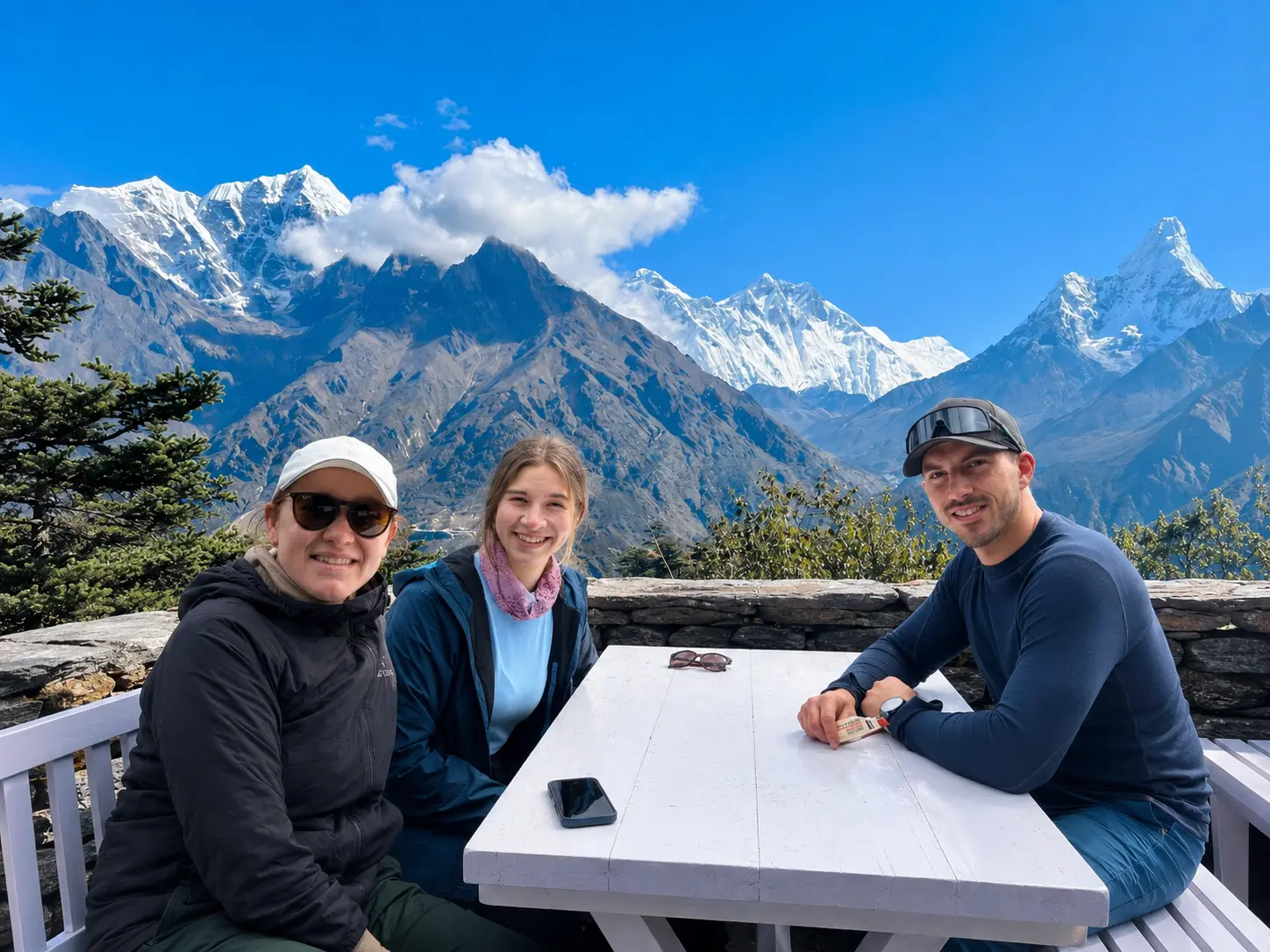
- Breakfast at Hotel Everest View, Syangboche (3,780m) for all group members
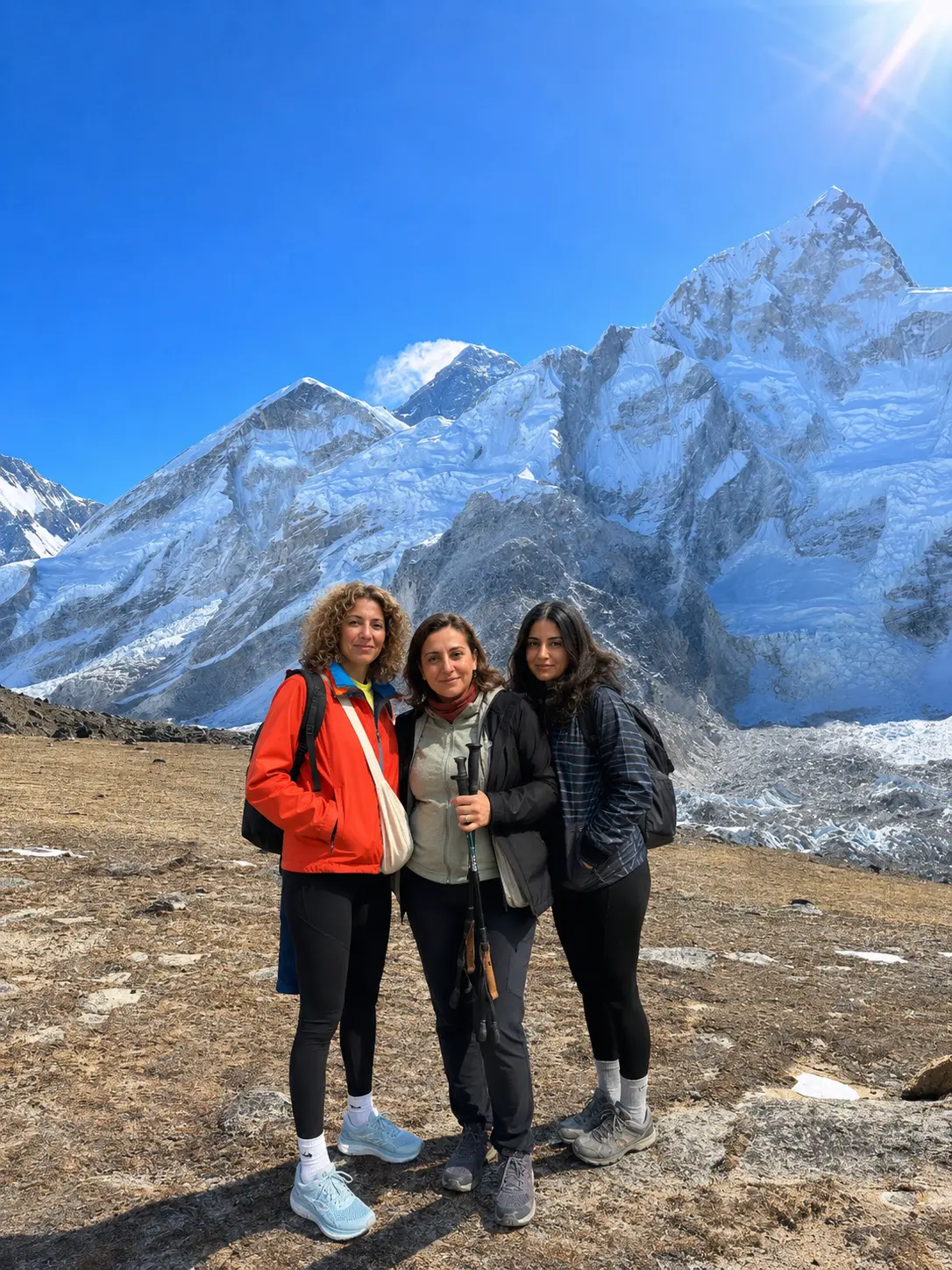
- Optional Kala Patthar landing (5,545m) for dramatic group photos
- All Sagarmatha National Park permits (NPR 3,000 per person) and municipal fees
- Dedicated ground coordinator for groups of 10 or more
- Hotel pickup and return transfer for all group members in Kathmandu
- Aviation taxes, helipad fees, and passenger flight insurance
Corporate and Incentive Group Bookings
Everest helicopter tour group packages are used by multinational corporations for annual incentive travel, employee recognition events, board retreats, and product launch celebrations in Nepal. The Khumbu Valley is the most dramatic incentive travel setting in Asia and requires no trekking fitness — the group steps off the helicopter at Hotel Everest View (3,780m) and boards again after breakfast. Contact us to discuss your corporate group requirements, custom branding at Hotel Everest View, or group photography coordination.
Book Without Any Advance Payment
No deposit or advance payment is required to hold seats for your group. We confirm the group booking once you provide the number of participants and preferred dates. Passenger details (names, nationalities, passport numbers, weights) are collected closer to the tour date. Full payment is made on the morning of departure. For corporate invoicing and group billing arrangements, contact us in advance. See our complete guide to group and corporate helicopter tours for more information.
Everest Helicopter Tour Group
The Everest Helicopter Tour Group is the most accessible way to experience the world’s highest mountain region from the air. By sharing the helicopter with fellow travellers, you access the same extraordinary Khumbu Valley flight, the same close aerial views of Everest Base Camp and the Khumbu Icefall, and the same Kala Patthar landing at 5,545 metres — at a significantly lower per-person cost than a private charter. For solo travellers, couples, and small groups who want the full Everest helicopter experience within a sensible budget, the group tour is the ideal choice.
The group format does not compromise the core experience. You fly in the same high-altitude certified helicopter, over the same breathtaking terrain, with the same licensed mountain pilot, and you land at the same Kala Patthar viewpoint with its unobstructed 360-degree panorama of Everest, Lhotse, Nuptse, Pumori, and the entire Khumbu Himalayan range. The difference is simply that you share the aircraft with other like-minded travellers, each of whom has made the journey to Nepal for the same reason: to see the world’s highest mountain from as close as it is possible to get without a climbing permit.
Group helicopter tours operate year-round with early morning departures timed to the most stable mountain weather window. During peak season from March to May and September to November, group seats fill quickly and advance booking of one to two weeks is strongly recommended. Outside peak season, same-week bookings are generally possible. In either case, confirming your seat a few days ahead gives the operator time to assign your flight slot and arrange hotel pickup logistics efficiently.
What the Group Tour Includes
The group tour package covers the complete Everest Base Camp helicopter experience from door to door. Hotel pickup, airport transfer, safety briefing, round-trip Khumbu Valley flight, Kala Patthar landing, supplemental oxygen, national park permits, government taxes, and hotel drop-off on return — everything is included in the quoted per-person price with no hidden extras at the time of the tour.
| Included | Details |
|---|---|
| Hotel pickup | Kathmandu hotel, 5:00–6:30am |
| Helipad transfer | Dedicated vehicle and representative |
| Safety briefing | Full pre-flight briefing for all passengers |
| Round-trip flight | Full Khumbu Valley route, both ways |
| Kala Patthar landing | 5,545m; 10–15 minutes ground time |
| Supplemental oxygen | On board throughout the flight |
| National Park permits | Sagarmatha National Park entry |
| All taxes and fees | Government taxes and handling charges |
| Hotel drop-off | Return to your Kathmandu hotel |
The Group Tour Flight Experience Step by Step
Your group tour morning begins with a hotel pickup between 5:00am and 6:30am depending on your assigned flight slot and the season. The early departure is deliberate — Himalayan mountain weather is most stable and skies most clear in the first hours after sunrise, and the entire group tour schedule is designed around reaching the Khumbu during this optimal morning window before valley clouds develop. Your operator contacts you the evening before the flight to confirm your exact pickup time.
At the departure helipad, your representative introduces the group and runs through the safety briefing covering helicopter operations, seatbelt use, the supplemental oxygen equipment, what to expect at the Kala Patthar landing, and emergency procedures. The briefing covers everything you need to know and takes about 10 minutes. Any questions from any group member are answered before boarding. You are then assigned your seat in the helicopter, positioned to give each passenger reasonable window access for the views ahead.
The outbound flight from Kathmandu to the Khumbu takes approximately 45 minutes. The landscape transforms progressively from the Kathmandu Valley to rolling hill country to the dramatically rising terrain of the Solukhumbu district. By the time you enter the Khumbu Valley proper — above Lukla at 2,860 metres — the scenery has become extraordinary, with deep gorges, dense rhododendron forest, and the first towering Himalayan peaks visible above the valley walls. From this point the scale and beauty of the landscape intensifies with every minute of flight.
The helicopter passes above Namche Bazaar at 3,440 metres, then above Tengboche Monastery with its famous Ama Dablam backdrop, then over the high alpine terrain of Pheriche and Lobuche as the flight approaches the upper Khumbu. The Khumbu Glacier comes into view below, grey and chaotic with its debris-covered surface, and directly ahead the Khumbu Icefall rises toward the Western Cwm with Everest’s South Face towering above it. The entire group typically falls quiet as this view opens up.
Kala Patthar: The Group Tour’s Highlight
The helicopter descends to land at Kala Patthar at approximately 5,545 metres, and the group steps out together onto a point higher than any mountain in Europe, Africa, or the Americas. The panorama that surrounds you at the landing site is the defining moment of the group tour: Everest’s South Face directly ahead, Lhotse and Nuptse flanking it, Pumori to the northwest, the full sweep of the Khumbu peaks in every direction, and the vast landscape of the Sagarmatha National Park stretching south down the entire length of the Khumbu Valley.
Ground time at Kala Patthar in the group tour is typically 10 to 15 minutes — sufficient for photographs, a few minutes of quiet experience at extreme altitude, and the chance to look in every direction at a mountain panorama that very few people in the world ever see at this range. The supplemental oxygen cylinder is available on the aircraft for any passenger who experiences discomfort during the landing. The pilot signals when it is time to reboard, and the return flight back to Kathmandu follows the same scenic route.
The complete door-to-door group tour experience — hotel pickup, flight to the Khumbu, Kala Patthar landing, return flight, and hotel drop-off — is typically completed by mid-morning, leaving the rest of the day free for exploring Kathmandu or continuing with other Nepal activities.
The Social Experience: Flying with Other Travellers
One aspect of the group tour that many participants report as unexpectedly rewarding is the social dimension of sharing the experience with fellow travellers. The people who book Everest helicopter group tours come from around the world but share a common motivation: the desire to see the world’s most famous mountain landscape from the air. This common purpose creates an immediate bond among group members that most tour participants describe as warm and natural rather than awkward.
The shared reaction to seeing Everest for the first time from the air, or stepping out of the helicopter at Kala Patthar and instinctively turning to share the view with whoever is standing next to you, is something that group tour participants consistently mention in their accounts of the experience. At 5,545 metres, surrounded by the world’s highest mountains, the details that normally separate people — nationality, language, background, age — feel less significant than the shared human experience of being in this extraordinary place together.
Many group tour participants exchange contact details at the end of the flight and stay in touch. Several have reported meeting lifelong friends or travel companions through a shared Everest helicopter tour. For solo travellers in particular, the group tour provides a social dimension to what might otherwise be a solitary experience, and the combination of the extraordinary shared setting with the openness that high-altitude adventure tends to produce in people makes for remarkably good conversations at the helipad after the flight.
Mountains Visible on the Group Tour Flight
| Mountain | Elevation | Notes |
|---|---|---|
| Everest (Sagarmatha) | 8,849 m | World’s highest; South Face viewed from Kala Patthar |
| Lhotse | 8,516 m | Fourth highest; shares South Col with Everest |
| Nuptse | 7,861 m | Dramatic ridge flanking the Everest-Lhotse wall |
| Cho Oyu | 8,188 m | Sixth highest; northwest from Kala Patthar |
| Makalu | 8,485 m | Fifth highest; visible east on clear days |
| Ama Dablam | 6,812 m | Most iconic Khumbu peak; above Tengboche |
| Pumori | 7,161 m | Stands northwest of Kala Patthar landing |
| Changtse | 7,543 m | North peak of Everest on Tibet side |
| Thamserku | 6,618 m | Twin-peaked mountain above Namche |
| Kongde Ri | 6,187 m | Dramatic rock wall above Namche Bazaar |
Best Season for the Everest Group Helicopter Tour
| Season | Months | Visibility | Group Availability | Notes |
|---|---|---|---|---|
| Spring (Peak) | March–May | Excellent | High demand; book 2 weeks ahead | Climbing season; Base Camp occupied |
| Autumn (Peak) | Sep–Nov | Outstanding | High demand; book 2 weeks ahead | Post-monsoon clarity; best light |
| Winter | Dec–Feb | Good | Available; less crowded | Cold at Kala Patthar; clear skies |
| Monsoon | Jun–Aug | Poor | Low; frequent cancellations | Not recommended |
Spring and autumn are the prime seasons for the Everest group helicopter tour. Spring (March to May) brings stable morning weather, the start of the Everest climbing season with expedition teams at Base Camp, and the spectacular flowering of the rhododendron forests at lower Khumbu elevations. Autumn (September to November) offers the clearest skies of the year — the post-monsoon air is exceptionally clean and the mountain views are at their sharpest and most vivid, making autumn the favourite season for photographers and first-time visitors who want the best possible visual conditions.
Winter group tours are available and the weather is often surprisingly good, with clear skies and excellent visibility common through December and January. The main consideration is cold: temperatures at Kala Patthar in winter can drop to minus 15 to minus 25 degrees Celsius, and group tour passengers should dress appropriately for cold conditions regardless of the warm Kathmandu temperature at departure. Warm, layered clothing for the Kala Patthar stop is essential in all seasons and critical in winter.
Altitude and Health Information for Group Tour Passengers
The Kala Patthar landing at 5,545 metres involves brief exposure to extreme altitude without prior acclimatisation. This sounds alarming but is generally well tolerated by healthy adults because the ground time is limited to 10 to 15 minutes and the helicopter descends promptly. The human body can cope with brief exposure to extreme altitude much better than it can cope with extended time at the same elevation, which is why EBC trekkers require 14 days of acclimatisation while group helicopter tour passengers experience the same altitude without difficulty.
Some group tour passengers experience mild and transient symptoms at Kala Patthar including slight lightheadedness, a mild headache, or noticeable shortness of breath. These are normal physiological responses to reduced oxygen at extreme altitude and typically resolve within minutes of boarding the helicopter and descending. The supplemental oxygen cylinder on every flight is available to any passenger who needs it, and the pilot and crew are experienced at recognising altitude symptoms and responding appropriately.
Passengers with serious heart conditions, severe respiratory diseases, or other significant medical conditions should consult their physician before booking. Pregnant travellers are advised to skip the Kala Patthar landing. Beyond these specific groups, the group tour is suitable for the vast majority of healthy adults regardless of age or general fitness level, since no physical exertion beyond walking from the helicopter to a viewpoint position is required.
Photography Tips for Group Tour Passengers
The Everest group helicopter tour is one of the great photography experiences available anywhere in the world, and making the most of the photographic opportunities requires a little preparation before the flight.
| Tip | Details |
|---|---|
| Fully charge your battery | Cold at altitude drains batteries; carry a spare warm in your jacket |
| Bring extra memory cards | You will take many more photos than you expect |
| Shoot in RAW | Maximum flexibility for the extraordinary light conditions |
| Press lens to glass | Eliminates window reflections inside the helicopter |
| Use fast shutter speed | Compensates for helicopter vibration; 1/500s or faster recommended |
| Wide angle for landscape | 16–35mm equivalent captures the full Kala Patthar panorama |
| Telephoto for detail | 70–200mm for Icefall structure, summit pyramid, Lhotse Face |
| Shoot early and often | Ground time is brief; don’t save your shots for a “perfect moment” |
Comparing Group Tour vs Private Charter
| Feature | Group Tour | Private Charter |
|---|---|---|
| Helicopter occupancy | Shared with other passengers | Exclusive to your group |
| Price per person | Lower — shared cost | Higher — full charter |
| Departure schedule | Fixed group slot | Flexible within morning window |
| Ground time at Kala Patthar | Standard 10–15 min | Extended, at your discretion |
| Route flexibility | Standard Khumbu route | Adjustable on request |
| Group composition | Mixed travellers | Your group only |
| Photography control | Shared window positions | Full seating control |
| Best for | Solo travellers, couples, budget-conscious | Families, corporates, honeymoons, photographers |
For the vast majority of individual travellers visiting Nepal, the group tour is the right choice. It delivers the complete, authentic Everest helicopter experience at a per-person price that makes the tour accessible to travellers who would otherwise be unable to afford a private charter. The things that distinguish a private charter — exclusivity, extended ground time, route flexibility — are meaningful for specific situations (families with young children, honeymoon couples, professional photographers) but are not necessary for a typical traveller who wants the best aerial view of Everest available without climbing it.
The group tour also offers a social dimension that some travellers actively prefer. Meeting other people who have made the journey to Nepal and sharing a once-in-a-lifetime experience with them creates connections and memories that a solitary private flight cannot replicate. For solo travellers especially, the group format transforms what could be a slightly lonely experience into a shared adventure with immediate human warmth.
What to Wear and Bring on the Group Tour
Preparation for the Kala Patthar landing is the most important practical consideration for group tour passengers. The temperature at 5,545 metres can be significantly below freezing in any season, and the wind chill at an exposed ridge position adds additional cooling beyond the ambient temperature. Group tour passengers who arrive at Kala Patthar underdressed spend their ground time cold and uncomfortable rather than enjoying the view, which is entirely avoidable with the right clothing.
| Item | Essential? | Notes |
|---|---|---|
| Thermal base layer | Yes | Top and bottom; worn under everything else |
| Insulated mid-layer | Yes | Down jacket or heavy fleece |
| Windproof outer shell | Recommended | Blocks wind chill at the landing site |
| Warm trousers | Yes | Not jeans; too cold and restrictive |
| Insulated gloves | Yes | Essential in all seasons |
| Warm hat | Yes | Must cover ears |
| Sunglasses | Yes | UV radiation intense at altitude |
| Sunscreen SPF 50+ | Yes | Apply before departure |
| Camera or smartphone | Yes | Fully charged; spare battery recommended |
All of the above clothing items are readily available in Kathmandu’s Thamel area, which has dozens of outdoor equipment shops selling everything from genuine mountaineering gear to budget-friendly alternatives. If you arrive in Kathmandu without appropriate cold-weather clothing for the Kala Patthar stop, a couple of hours in Thamel the day before your flight will equip you adequately. Many group tour operators can also advise on where to rent or buy the specific items needed for the tour.
The History of Group Helicopter Tours to Everest Base Camp
Helicopter tourism in the Khumbu region began in the 1990s and expanded rapidly through the 2000s as Nepal’s aviation infrastructure developed and licensed high-altitude helicopter operators established commercial tour products for the growing Nepal tourism market. The early tours were primarily private charters arranged for wealthy individual travellers, but as the market grew and operators introduced shared-seat models, the Everest helicopter tour became accessible to a much broader range of visitors.
The development of the group tour model was significant for Nepal tourism because it democratised access to the Khumbu aerial experience. Before shared-seat tours became available, the helicopter flight was essentially available only to travellers who could afford a full private charter — a relatively small and affluent segment of the Nepal visitor market. The group tour model opened the experience to solo travellers on moderate budgets, families who wanted to share a once-in-a-lifetime experience without the full charter premium, and the large segment of Nepal visitors who had the desire but not the resources for a private flight.
Today, group helicopter tours are the most commonly booked form of Everest aerial experience in Nepal, and the market supports multiple departures per day during peak seasons from several Kathmandu-based operators. The competition among operators has driven improvements in service quality, aircraft maintenance standards, and the overall passenger experience, making the current group tour product exceptionally good value compared to what was available even a decade ago.
The Khumbu Valley: Every Village You Fly Over
One of the most enriching aspects of the group helicopter tour is the aerial perspective it gives on the famous villages of the Khumbu Valley. Trekkers who walk this route spend days moving between these settlements, seeing each one at ground level from the trails that connect them. The helicopter tour gives you all of them in a single continuous aerial view — a spatial understanding of the valley geography and its human settlements that would take weeks to develop on foot.
Lukla (2,860m) is the gateway to the Khumbu and home to Tenzing-Hillary Airport, famous for one of the most challenging approaches in commercial aviation. The runway is 527 metres long, slopes upward at 12 degrees, and ends against a mountain wall at the top and drops off a cliff at the bottom. Pilots landing at Lukla have one approach and one chance — there is no go-around at this altitude with the terrain involved. From the helicopter you see the full runway, the town clustered around the airstrip, and the valley falling away steeply to the south and rising dramatically to the north.
Namche Bazaar (3,440m) is the commercial and social capital of the Khumbu, built into the sides of a perfectly curved bowl in the mountainside. Its distinctive horseshoe shape is clearly visible from the air, with trails radiating outward in every direction and the Dudh Koshi Valley far below. Namche has a Saturday market, dozens of lodges and teahouses, a bakery famous among trekkers, internet cafes, and shops selling everything from yak cheese to down jackets. It is the last place where you can buy supplies and rest comfortably before the trail ascends into the high alpine terrain above.
Tengboche (3,867m) occupies a narrow ridge spur with what many consider the finest mountain view of any monastery location in the world. The Tengboche Monastery, rebuilt after a catastrophic fire in 1989, is the spiritual centre of the Khumbu Sherpa community. The annual Mani Rimdu festival held here draws pilgrims and visitors from across the region. From the helicopter, the monastery appears on its perfect ridge with Ama Dablam rising directly behind it and Everest, Lhotse, and Nuptse framed above the ridge on the far side — a composition of monastery, forest, and mountain that is one of the iconic views of Nepal.
Pheriche (4,371m) and Dingboche (4,410m) sit in the high alpine zone where the vegetation gives way to alpine scrub and stone. Both villages are acclimatisation stops for EBC trekkers, and Pheriche hosts the Himalayan Rescue Association’s altitude sickness clinic that treats hundreds of trekkers each season. The stone-walled yak pastures around both villages create a geometric patchwork pattern visible from the air that marks the upper limit of seasonal agricultural and pastoral activity in the valley.
Lobuche (4,940m) is a cluster of lodges at the edge of the lateral moraine of the Khumbu Glacier, where the valley floor rises steeply and the terrain becomes increasingly inhospitable. Beyond Lobuche the landscape is rock, ice, and moraine, with the glacier flowing alongside the trail all the way to Gorak Shep (5,140m) — the highest permanently inhabited settlement in the Khumbu and the last stopping point before Everest Base Camp itself. Gorak Shep sits on a flat ancient glacial lake bed of sand and gravel, its handful of lodges looking extraordinarily small against the enormous scale of the surrounding mountains.
Everest Base Camp: What You See from the Air
Everest Base Camp at 5,364 metres is not a permanent settlement — it is a seasonal camp established by climbing expeditions during the spring (April–May) and autumn (September–October) climbing seasons and completely dismantled between seasons. During the climbing season the camp is a colourful and surprisingly large tent city occupied by dozens of international expedition teams, complete with kitchen tents, equipment stores, communications setups, and the characteristic orange, red, and blue expedition dome tents arranged on the lateral moraine beside the Khumbu Glacier.
From the helicopter, the Base Camp site is visible as a flat section of moraine beside the glacier, whether or not expeditions are currently in residence. What is always visible, in every season, is the Khumbu Glacier itself and the spectacular chaos of the Khumbu Icefall rising immediately above. The icefall is the most dramatic visual element of the Base Camp area — a tumbling, fractured river of ice towers, seracs, and crevasses that climbers must cross repeatedly on their way to the higher camps on the mountain. Ice towers the size of multi-storey buildings topple and collapse unpredictably, making the icefall one of the most dangerous sections of the entire Everest climbing route.
Above the icefall, the Western Cwm leads to the Lhotse Face and the South Col — the standard route to the summit used by almost all commercial Everest expeditions. The South Col at 7,906 metres, shared between the Everest and Lhotse routes, is visible on very clear days as a dark notch between the two peaks. From Kala Patthar, the full upper mountain — the Yellow Band of limestone, the Geneva Spur, the South Summit, and the final ridge to the true summit at 8,849 metres — is laid out in remarkable detail for anyone who knows what they are looking at.
Group Tour Booking: How It Works
Booking a group tour seat is straightforward. You select your preferred date, confirm the number of seats required, and complete the booking with the deposit or full payment as required by the operator. You then receive a booking confirmation with your flight date, pickup time range (exact pickup time is confirmed the evening before), and all the practical information you need for the day of the flight.
Group tours operate on a seat-by-seat basis. If you are travelling alone, you book one seat. If you are two people, you book two seats. If you are a family or small group, you book the seats you need. The helicopter departs when the group is assembled and all passengers are ready, typically at the assigned flight slot time. During peak season, groups assemble quickly because demand is high and all seats are usually filled well in advance.
Weather is the only variable that can change the planned departure. Nepali mountain weather is generally reliable in the morning during spring and autumn, but occasional delays or cancellations do occur. When a flight is cancelled due to weather, it is rescheduled to the next available clear-weather day at no additional cost. Passengers who cannot reschedule due to fixed travel dates receive a full refund for weather cancellations. The operator monitors weather forecasts continuously and communicates any changes to passengers the evening before their scheduled flight.
Frequently Asked Questions — Everest Helicopter Tour Group
How many people are in the group? The helicopter seats four to five passengers plus the pilot. Your group will be made up of individual travellers, couples, or small groups who have each booked seats on the same flight slot. During peak season all seats are typically filled. During quieter periods there may be fewer passengers on the aircraft.
Can I book a group tour as a solo traveller? Yes — and solo travellers are the most common group tour participants. You will join other individually booked passengers on the flight. The experience is shared, and many solo travellers report that meeting their fellow passengers and sharing the Kala Patthar landing together adds a human dimension to the experience that they did not expect and genuinely appreciated.
What happens if the group flight doesn’t fill up? During peak season this rarely happens. Outside peak season, the operator may consolidate passengers across nearby flight slots if numbers are low, which can occasionally mean a slight change to your departure time. You will always be notified in advance of any scheduling changes. If the operator cannot assemble a group on your preferred date, alternative dates are offered or a full refund is provided.
Is the group tour suitable for older travellers? Yes. The group tour requires no physical fitness beyond the ability to walk a short distance at the Kala Patthar landing site. Many older travellers take the group tour specifically because it provides the Everest experience without the 14-day trekking commitment. The main consideration for older travellers with health conditions is the brief altitude exposure at Kala Patthar, which should be discussed with a physician if there are any cardiac or respiratory concerns.
Can I upgrade from a group tour to a private charter after booking? Yes, subject to availability. If you book a group tour seat and subsequently decide you would prefer a private charter, contact the operator as soon as possible. If a private charter slot is available on your preferred date, the upgrade can typically be arranged with payment of the price difference. Availability is not guaranteed, particularly during peak season.
Is there a weight limit for passengers? High-altitude helicopter operations have payload restrictions that vary by aircraft type and conditions. Most operators have a combined passenger weight limit per flight. If you have concerns about weight restrictions, contact the operator before booking to confirm your specific situation can be accommodated.
After the Group Tour: Making the Most of Your Nepal Visit
The group tour is completed by mid-morning, leaving the rest of your Nepal visit open for exploring everything else this extraordinary country offers. Kathmandu alone could occupy several days of sightseeing: the UNESCO World Heritage Sites of Pashupatinath, Boudhanath, Swayambhunath, and the three Durbar Squares of Kathmandu, Patan, and Bhaktapur form the core of a cultural itinerary that rewards unhurried exploration.
Pokhara, a 30-minute flight or 5-hour drive west of Kathmandu, offers a completely different atmosphere — a relaxed lakeside town beneath the Annapurna range with excellent restaurants, boat rides on Phewa Lake, and day hikes to ridge viewpoints above the city with front-row views of Machhapuchhre (Fishtail Mountain) and the Annapurna massif. Many group tour participants who arrive in Nepal with a week or more in hand combine the Everest helicopter tour with two or three days in Pokhara to see the Annapurna range as well, giving them views of two of Nepal’s great mountain groups within a single trip.
Chitwan National Park in the southern lowlands provides a dramatic contrast with the high Himalayan experience of the group helicopter tour — jungle walks, elephant encounters, canoe rides on the Rapti River, and wildlife including rhinos, tigers, leopards, and hundreds of bird species. The combination of an Everest aerial experience and a Chitwan jungle safari within a single Nepal trip is a popular itinerary that most visitors find enormously satisfying in its variety and depth.
For trekkers, the group helicopter tour serves as an excellent introduction to the Khumbu region that can motivate a return trip for the full EBC trek. Many group tour participants describe arriving at Kala Patthar, looking down the valley they flew over and understanding for the first time the full scale of what trekkers walk, and deciding on the spot that they want to come back and walk it. The helicopter tour and the EBC trek are not competing experiences — they are complementary views of the same extraordinary landscape, and many dedicated Nepal travellers have done both.
Book Your Everest Helicopter Tour Group Seat Today
The Everest Helicopter Tour Group delivers one of the most remarkable travel experiences on earth at a per-person price that makes it genuinely accessible. Whether you are a first-time visitor to Nepal fitting the Everest flight into a packed itinerary, a solo traveller looking for a shared adventure with fellow explorers, or a couple wanting the Khumbu experience without the full private charter cost, the group tour gives you everything that matters: the flight, the mountains, the glacier, the icefall, and the Kala Patthar landing at 5,545 metres with the world’s highest mountain standing before you.
Use the booking form on this page to select your preferred date and complete your reservation. Our team responds to all group tour enquiries within 24 hours and is happy to answer any questions about the experience, the route, what to bring, or how to combine the tour with the rest of your Nepal itinerary. We look forward to flying with you above the roof of the world.
The Sherpa Culture You Observe from the Air
The Khumbu Valley is the heartland of the Sherpa people, a Tibetan Buddhist ethnic group who migrated from Tibet into northeastern Nepal approximately five hundred years ago. The Sherpas are among the most accomplished high-altitude peoples on earth — their physiology, developed over generations of life at altitude, gives them measurably superior oxygen-processing efficiency compared to lowland peoples, and their cultural relationship with the high mountains is one of reverence and deep familiarity rather than conquest or exploitation.
The landscape you fly over on the group tour bears the imprint of Sherpa culture at every level. The chortens (stone Buddhist reliquary monuments) visible on ridges and hilltops throughout the valley are markers of both the spiritual landscape and the historical routes of movement through the mountains. The prayer walls of Mani stones — flat rocks carved with Buddhist mantras, stacked into long low walls beside the trails — define the paths between villages and remind travellers to proceed with awareness and respect through a landscape understood as sacred. The monastery at Tengboche, visible from the helicopter on its perfect ridge, is the spiritual centre of the Khumbu community and has been rebuilt by the community after each of the fires and earthquakes that have damaged it over the years.
The yak remains central to Sherpa subsistence and culture, serving as pack animal, dairy provider, and protein source throughout the high valleys above the treeline. From the helicopter, the characteristic stone enclosures of the yak pastures are visible at Dingboche, Pheriche, and Lobuche, and yaks themselves can often be spotted on the valley floor during the summer and autumn grazing seasons. The Sherpa relationship with the yak is ancient and practical, and the animal’s ability to thrive at altitudes above 4,000 metres makes it uniquely suited to the high Khumbu environment.
The impact of tourism on Sherpa culture is significant and complex. The wealth generated by Everest expedition support and the broader trekking and helicopter tourism industry has funded schools, hospitals, electricity infrastructure, and improved living standards throughout the Khumbu, dramatically reducing the poverty and isolation that characterised life in the high valleys before tourism began. At the same time, the rapid exposure to global tourism has brought cultural pressures, environmental challenges, and the inevitable changes that come when a traditionally isolated community is connected to the global economy. Responsible tourism practices — choosing local operators, tipping fairly, respecting cultural sites and customs — help ensure that the benefits of tourism flow to the Sherpa community in sustainable ways.
Environmental Responsibility on the Group Tour
The Khumbu is a UNESCO World Heritage Site and one of the most ecologically sensitive mountain environments in the world. The Sagarmatha National Park, which covers the entire Khumbu Valley from Lukla upward, was established in 1976 and protects the landscape, wildlife, and ecosystem of the Everest region under Nepali and international conservation frameworks.
Helicopter tourism contributes to the Nepali aviation economy and the livelihoods of pilots, ground crews, and tour operators, but it also generates noise, emissions, and the physical impact of landings at sensitive high-altitude sites. Responsible operators work to minimise these impacts by using modern, fuel-efficient aircraft, following designated flight corridors, adhering to landing protocols that respect the integrity of the Kala Patthar site, and supporting conservation and waste management initiatives in the national park.
As a group tour passenger, you can contribute to responsible Khumbu tourism by following leave-no-trace principles at all landing sites — taking nothing from the natural environment, leaving the ground exactly as you found it, and treating the sacred Khumbu landscape with the respect it warrants. The flight you are taking uses the same resource — the extraordinary natural beauty and ecological integrity of the Khumbu — that will make future visits and future flights possible. Protecting that resource is in every traveller’s long-term interest.
Nepal Tourism: Why Group Tours Matter
Tourism is Nepal’s largest source of foreign exchange and one of the primary drivers of economic development in communities throughout the country, particularly in remote high-altitude areas with few alternative income sources. The group helicopter tour model is especially valuable to the Nepal tourism economy because it makes the Everest aerial experience accessible to a wide range of visitors — not just the wealthiest segment of the market — increasing the total volume of tourism spending that reaches the Khumbu communities and the Kathmandu operators who serve them.
Each group tour seat booked contributes to the livelihoods of a pilot, a representative, a vehicle driver, a helipad ground crew, and the administrative team behind the booking. It also contributes to the Sagarmatha National Park fund through the permit fees included in the package price, which directly supports conservation and infrastructure maintenance in the park. The economic multiplier effect of tourism spending in Nepal means that money spent on a well-managed group tour reaches a surprisingly large number of households and individuals throughout the value chain.
Choosing a reputable, locally operated group tour over an internationally intermediated booking platform also helps ensure that a greater proportion of the tour price remains in Nepal rather than being extracted as commission by foreign booking agents. We are a Kathmandu-based operator employing Nepali staff, working with Nepali aviation partners, and paying Nepali taxes. When you book your group tour directly with us, you are making a choice that maximises the local economic benefit of your visit to Nepal.
Complete Pre-Flight Checklist for Group Tour Passengers
- Book your seat at least 1–2 weeks ahead during peak season (March–May, September–November)
- Confirm hotel pickup time with the operator the evening before your flight
- Set an early alarm — pickup is between 5:00am and 6:30am
- Dress in warm layers suitable for well below zero at the Kala Patthar landing
- Pack gloves, hat, sunglasses, and sunscreen SPF 50+ in accessible pockets
- Fully charge your camera or smartphone battery the night before
- Carry at least one spare battery kept warm inside a jacket pocket during the flight
- Bring extra memory cards — you will shoot more than you expect
- Do not eat a large meal immediately before the flight if you are prone to motion sickness
- Avoid alcohol the night before and on the morning of the flight
- Carry any personal medications you may need during the day
- Ensure your travel insurance is active and covers the tour activity
- Leave large luggage at your hotel — bring only what fits under a helicopter seat
- Follow all safety briefing instructions and crew directions throughout the tour
- Move slowly and breathe steadily at the Kala Patthar landing site
- Use the supplemental oxygen available on the aircraft if you feel any discomfort
Combining the Group Tour with a Full Nepal Itinerary
The Everest Helicopter Tour Group is completed by mid-morning, which means it slots perfectly into a wider Nepal itinerary without consuming an entire travel day. Whether you have three days in Nepal or three weeks, the group tour fits efficiently into your schedule and delivers a concentrated high-impact experience of the Himalaya that complements everything else Nepal offers.
| Days in Nepal | Suggested Itinerary with Group Tour |
|---|---|
| 3–4 days | Day 1: Arrive Kathmandu. Day 2: Group helicopter tour (morning) + Thamel and Boudhanath (afternoon). Day 3: Patan Durbar Square, Bhaktapur. Day 4: Depart. |
| 5–6 days | Days 1–2: Kathmandu sightseeing. Day 3: Group helicopter tour. Day 4–5: Pokhara (flight or drive). Day 6: Return Kathmandu, depart. |
| 7–9 days | Days 1–2: Kathmandu. Day 3: Group helicopter tour. Days 4–6: Pokhara and Sarangkot sunrise. Days 7–8: Chitwan National Park. Day 9: Return Kathmandu, depart. |
| 10–14 days | Full Nepal experience: Kathmandu, group tour, Pokhara, Chitwan, Lumbini (birthplace of the Buddha), return Kathmandu. |
The three-destination Nepal classic — Kathmandu, Pokhara, Chitwan — is the most popular itinerary for international visitors and pairs perfectly with the Everest group helicopter tour as the defining mountain experience of the trip. This combination gives travellers encounters with Nepal’s three distinct landscape zones (high Himalaya, mid-mountain lake, subtropical jungle) and three different dimensions of Nepali culture (Newar Buddhist-Hindu heritage, Gurung and Magar mountain communities, Tharu jungle culture) within a single trip.
For travellers with more time, adding Lumbini (the birthplace of the Siddhartha Gautama, the historical Buddha, in the Terai lowlands of western Nepal) and Chitwan creates a particularly rich cultural and religious itinerary alongside the natural highlights. Lumbini is a UNESCO World Heritage Site with an extraordinary concentration of monasteries built by Buddhist nations from around the world, surrounding the sacred garden where the Buddha was born over 2,500 years ago. Visiting Lumbini after the Everest helicopter tour — after standing in the presence of the mountain the Tibetan Buddhists call the Goddess Mother of the World — adds a spiritual dimension to the Nepal trip that many visitors find unexpectedly moving.
Aircraft Used on the Everest Group Helicopter Tour
The Everest group helicopter tour uses aircraft specifically selected and certified for high-altitude mountain operations. The most commonly used helicopters for Khumbu tours are the Airbus H125 (formerly known as the AS350 B3 Eurocopter) and the Bell 407, both of which are certified for operations above 5,000 metres and are the workhorses of high-altitude helicopter operations across Nepal.
The Airbus H125 is a single-engine turbine helicopter with a high power-to-weight ratio that makes it particularly effective at extreme altitude. It is used extensively by the Nepali military for mountain rescue operations and by commercial operators for high-altitude tours and expedition support. The Bell 407 is a four-bladed single-engine turbine helicopter with slightly greater passenger capacity and a reputation for smooth operation at altitude. Both aircraft types are maintained to Nepal Civil Aviation Authority (CAAN) standards with regular airworthiness inspections.
Pilots operating Khumbu routes hold CAAN commercial pilot licences with specific authorisations for mountain operations. Many Khumbu helicopter pilots have thousands of hours of high-altitude flying experience and know the Khumbu weather patterns, wind conditions, and landing sites with the intimacy that comes from years of daily operations in the same terrain. The safety record of commercial Khumbu helicopter tours reflects the conservative flying standards of experienced mountain pilots who consistently prioritise passenger safety over schedule pressure.
Why Book the Group Tour with Us
We are a Kathmandu-based helicopter tour operator with years of experience in the Everest region. Our group tours use certified, well-maintained aircraft operated by experienced mountain pilots. Our team manages all logistics from hotel pickup to return drop-off, giving you a seamless experience from the moment your vehicle arrives at the hotel to the moment you return with your photographs and memories of the morning above the world’s highest mountains.
Our transparent pricing policy means the quoted group tour price includes everything described in the inclusions list — there are no surprise fees at the helipad, no park permit charges added on the day, and no handling fees discovered at check-in. What you pay when you book is what you pay in total for the experience described on this page.
Our weather rescheduling policy protects your booking in the event of poor mountain conditions. If your scheduled flight day has unsafe or poor-visibility weather, we reschedule to the next available clear weather day at no additional cost. This policy exists because we believe that a cancelled flight should never result in a financial loss for our passengers, and it reflects our confidence that you will get your flight — it may just require a day’s patience while the weather clears.
We respond to all enquiries within 24 hours and are available by phone, email, and WhatsApp to answer questions before, during, and after your booking. Our representative is with your group from hotel pickup to hotel drop-off on the day of the flight, ensuring a smooth and well-managed experience throughout. We look forward to showing you the world’s highest mountains from the best seat available: the air above the Khumbu Valley at sunrise on a clear Himalayan morning.
Everest Group Tour vs Other Nepal Helicopter Experiences
Nepal offers several helicopter tour options beyond the standard EBC group tour. Understanding how the Everest group tour compares to these alternatives helps you choose the experience that best fits your interests, budget, and available time.
| Tour | Route | Duration | Highlight | Best For |
|---|---|---|---|---|
| Everest Group Tour | Kathmandu–Khumbu–Kala Patthar–return | 4–5 hours total | Kala Patthar landing at 5,545m | All travellers; best value EBC experience |
| EBC with Gokyo Tour | Kathmandu–Khumbu–Gokyo Lakes–return | 5–6 hours total | Gokyo Lakes landing + EBC aerial views | Those wanting two landing sites |
| Annapurna Helicopter Tour | Pokhara–Annapurna Base Camp–return | 3–4 hours total | Annapurna Base Camp at 4,130m | Travellers based in Pokhara |
| Langtang Helicopter Tour | Kathmandu–Langtang Valley–return | 3–4 hours total | Langtang Valley and Gosaikunda views | Day trip from Kathmandu; less crowded |
The Everest Group Tour is the flagship Nepal helicopter experience and the most popular for good reason: it visits the world’s most famous mountain in a region with the greatest concentration of extreme altitude in the world, with a landing at Kala Patthar that provides a genuinely extraordinary ground-level encounter with the Everest landscape. The EBC with Gokyo tour adds the Gokyo Lakes valley for those who want a second landing and a broader Khumbu aerial experience. The Annapurna and Langtang tours are excellent alternatives for travellers who are based in Pokhara or want a closer-to-Kathmandu mountain flight, but neither offers the scale and global iconic status of the Everest group tour route.
For most first-time Nepal visitors with limited time, the Everest Group Tour is the obvious choice. It is the experience that people who have never been to Nepal imagine when they picture a Nepal mountain flight, and the reality consistently exceeds the imagination. If you have the time and budget for a second helicopter tour, the EBC with Gokyo extension adds the beautiful turquoise lakes of the Gokyo Valley to the already extraordinary Everest Base Camp aerial experience.


