Almost every traveller who calls our Thamel office with questions about an Everest helicopter tour eventually asks some version of the same thing: “Is that the full price, or are there extra fees once we get there?” It is a fair question, and it is one that a surprising number of operators answer badly, either because they genuinely do not explain it well on their own websites, or because leaving it vague gives them room to add line items later. We would rather spend a few thousand words clearing it up properly than let you find out at the airport.
This guide walks through every government and park charge that can legitimately apply to a helicopter tour into the Khumbu, why each one exists, who actually collects it, and how it differs from what a trekker walking to Everest Base Camp on foot has to deal with. Flying and trekking share the same mountain, but they do not share the same paperwork, and a lot of the confusion we see comes from travellers who researched EBC trekking permits first and then assumed the same rules carry over to a same-day flight. They mostly do not.
We will also be direct about the parts of this that are genuinely a bit fuzzy right now, particularly around Kala Patthar landings, because a regulator can revise a rule faster than a tour operator can revise a website, and pretending otherwise would not be honest.
Why Sagarmatha National Park Charges an Entry Fee at All
Sagarmatha National Park was established in 1976 and became a UNESCO World Heritage Site in 1979, and it covers the upper Khumbu region including Everest itself, Base Camp, Kala Patthar, and the flight corridor that helicopters use on the way up the valley. The park is managed jointly by Nepal’s Department of National Parks and Wildlife Conservation and, in the buffer zone areas, by local community management committees, and the entry fee is the mechanism that funds a lot of what keeps that management running: ranger posts, trail and helipad maintenance at the higher elevations, waste management programs (which matter enormously in a place where every non-biodegradable item has to be carried or flown back out), wildlife monitoring for species like the snow leopard and Himalayan tahr, and general park administration.
The fee is charged per person, not per group and not per aircraft, because the legal basis for it is that you are entering protected federal land, whether you arrive on foot over several days or by air in a matter of hours. A helicopter landing at Kala Patthar or setting down near Base Camp is still, in the eyes of the park regulation, a person entering the park boundary. The National Park does not really distinguish between how you got there for the purposes of the entry fee; it distinguishes based on whether your route and landing point fall inside the park boundary, which for essentially every Everest helicopter tour itinerary, they do.
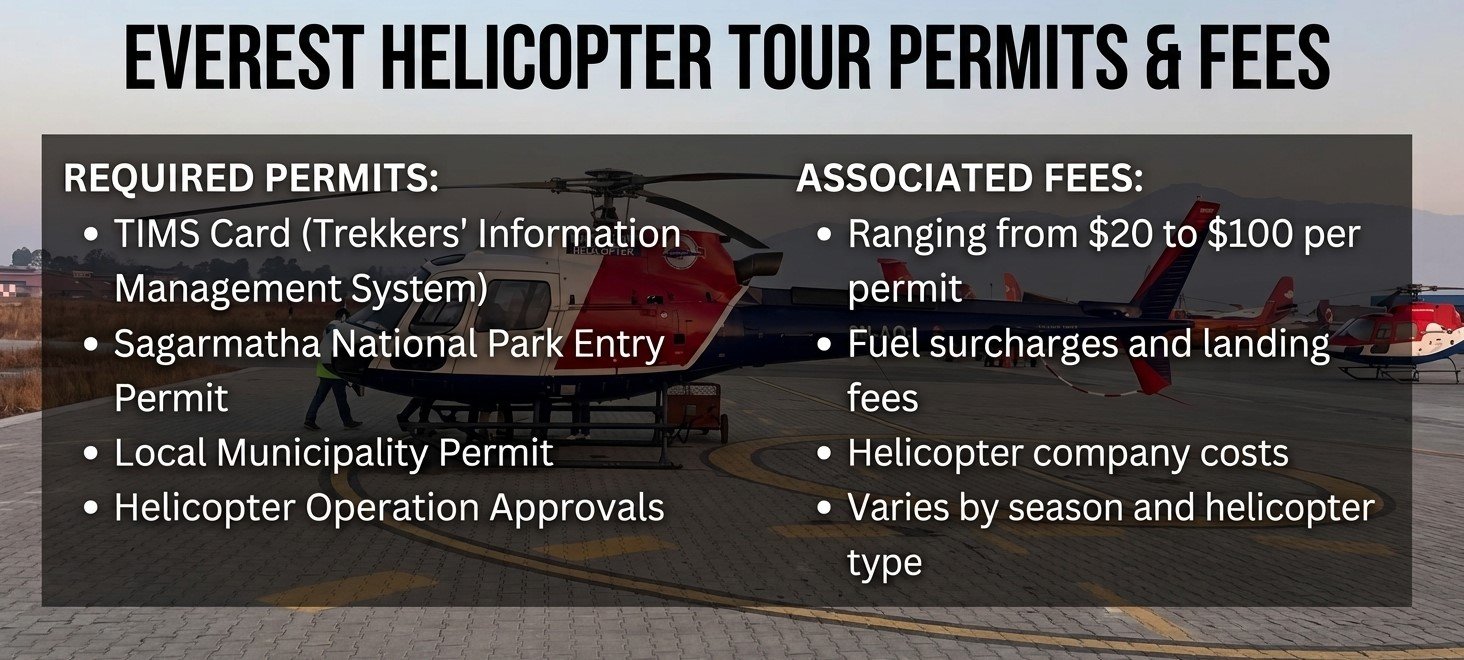
The current figure our trip pages quote is NPR 3,000 per person, which works out to roughly USD 22 depending on the day’s exchange rate. We say “figures like” this deliberately rather than treating it as fixed for all time, because Nepal’s government fee schedules for national parks and conservation areas do get revised periodically, sometimes with fairly limited public notice, and a number that was accurate when we last confirmed it can shift by the time you fly. Any operator who tells you a park fee number with total certainty a year in advance is either guessing or hasn’t checked recently. Our own practice is to confirm the current published figure with park authorities close to your flight date and to flag if anything has changed, and we would encourage you to ask any operator you are considering to do the same rather than just take a number off their site at face value.
How the Park Fee Actually Gets Collected When You’re Flying
This is the part that trips people up, because it works differently for a helicopter day tour than it does for a trekker walking the trail. A trekker heading up from Lukla on foot passes through a physical checkpoint, usually at Monjo, where a park official checks permits, stamps a card, and issues a paper receipt for the entry fee on the spot. There is a queue, a desk, a ledger. It is a very tangible, very manual process, and it is one of the small rituals of the trek that most trekkers end up describing in their trip reports.
A helicopter tour does not pass through that checkpoint, because the flight goes over the lower valley rather than through it on foot. Instead, the entry fee for helicopter passengers is handled administratively by the operator, generally paid in bulk or per flight manifest to the relevant park or municipal authority as part of the flight’s clearance and permit paperwork, rather than collected from each passenger individually at a desk on the mountain. In practice this means you as a passenger typically never touch cash for this fee at all on the day of your flight; it has already been settled by the company operating the aircraft, using your passport details submitted in advance, before the helicopter is cleared to fly the route.
What this also means is that the only real evidence you have of whether it was paid is what your operator tells you in writing before you fly, generally in the “Price Includes” section of your itinerary or booking confirmation. There is no personal checkpoint stamp you will get as a passenger to independently verify it happened, the way a trekker gets a stamped TIMS card and park permit card as physical proof. That puts more weight on booking with an operator who has an actual, verifiable CAAN license and a track record, because the fee-paying part of this process happens behind the scenes, on trust and on paperwork you generally do not see. It is one of the reasons we list the specific entry fee figures on our own trip pages rather than folding them into a single unexplained number: if a client wants to ask us how the NPR 3,000 park fee was accounted for, we can show them.
The Khumbu Pasang Lhamu Rural Municipality Fee: A Separate, Local Charge
The second charge you will see mentioned on our Everest Base Camp helicopter tour pages is the Khumbu Pasang Lhamu Rural Municipality fee, also NPR 3,000 per person, and it is worth being clear that this is a genuinely separate fee from the national park entry charge, collected by a different authority, for a different purpose. People sometimes assume the two NPR 3,000 figures are the same fee listed twice, or a typo, and they are not.
The Khumbu Pasang Lhamu Rural Municipality is the local government body covering the Khumbu region, named after Pasang Lhamu Sherpa, the first Nepali woman to summit Everest, who died during her descent from the summit in 1993. The municipality was formed as part of Nepal’s shift to a federal structure with local governments responsible for their own areas, and like other rural municipalities across the country, it charges an entry or service fee to visitors as a source of local revenue. This is money that funds municipal level services and infrastructure within the Khumbu, things like local administration, waste management at the village level, trail and bridge upkeep outside the strict national park mandate, and other community services that the national park budget does not cover.
This fee is the direct descendant of what many people who have researched EBC trekking already know as the “Khumbu local fee” or the local entry charge collected alongside TIMS at the trekking checkpoints. It used to sit somewhat awkwardly next to the TIMS system in a lot of explanations, and it still gets grouped with TIMS informally in a lot of older trekking blog content, but structurally it is a municipal charge, independent of the trekking permit system, and it applies to trekkers and flying visitors alike, again because it is based on entering the municipality’s jurisdiction rather than on the specific mode of transport used to get there.
Because it is collected by a different office than the park fee, using a different administrative channel, it is technically possible for an operator to have accounted for one and not the other, which is exactly why we list them separately on our trip pages rather than bundling them into one unexplained “government fees” line. If you are comparing quotes between operators and one number seems suspiciously low compared to another for what looks like the same itinerary, this is one of the first places we would suggest checking: ask directly whether both the Sagarmatha National Park entry and the Khumbu Pasang Lhamu Rural Municipality fee are included, using those specific names, rather than accepting a vague “yes, permits are included” answer.
Do You Need a TIMS Card for a Helicopter Tour?
This is probably the single most common point of confusion we field from people who have spent time reading about Everest Base Camp trekking before they started looking into the helicopter option, so it is worth explaining properly rather than in a single line.
TIMS, the Trekkers’ Information Management System, is a permit and registration system built specifically to track independent trekkers as they move on foot through the trail network in regions like the Khumbu, Annapurna, and Langtang. It exists primarily as a safety and monitoring tool: if something goes wrong on a multi-day trek (a trekker goes missing, gets injured somewhere between villages, or needs evacuation), the TIMS registration gives authorities and rescue teams a record of who is on the trail, their planned route, and their itinerary. It is administered through the Nepal Tourism Board and trekking agency associations, and it is checked at trail checkpoints as trekkers pass through, alongside the national park entry permit.
None of that logic applies to a same-day helicopter tour. You are not walking through the trail network over multiple days, you are not passing through the villages and checkpoints where a trekker might need to be tracked over a period of time, and you are not at risk of the kind of “went missing somewhere on the trail” scenario that TIMS is built to guard against, because you are on a manifested commercial flight with a specific crew, a specific route, and a specific return time, all of which is already tracked through the aviation system rather than the trekking permit system. For that reason, TIMS is generally not required for helicopter day tours that do not involve trekking on foot through the region. Your identity, nationality, and passport details are still recorded, but through the flight manifest and the park/municipality fee paperwork described above, not through a TIMS card.
The exception worth knowing about is if your itinerary is a hybrid one, for example a helicopter tour combined with several days of trekking (which is uncommon for the tours we run, since most of our packages are same-day out and back from Kathmandu, but it does exist in the market as an option through some operators, and our own EBC with Gokyo Heli Tour, priced on request, involves more ground movement and should be discussed permit by permit with our team before booking). If any part of your trip involves multi-day trekking on foot through park checkpoints, TIMS and the standard trekking permit rules apply to that portion, separately from anything related to the flight itself. For a genuine one-day, fly-in-fly-out or fly-in-land-return helicopter tour with no overnight trekking, you should not be asked to pay for or carry a TIMS card, and if an operator tells you that you need one for a standard same-day helicopter tour, that is worth a direct follow-up question, because it suggests either confusion on their part about how the two systems actually work, or, less charitably, an extra fee being tacked on for something that does not actually apply to your trip type.
Airport and Aviation Charges: Kathmandu, Lukla, and the Paperwork Behind the Scenes
Separate from the park and municipal fees, there is a category of charges that come from operating out of Nepal’s airports rather than from entering the Khumbu region itself. Every flight departing from the domestic terminal at Tribhuvan International Airport in Kathmandu is subject to airport charges: things like domestic terminal usage fees, embarkation charges, and the general operational costs of using TIA’s domestic apron and helipad facilities. For itineraries that also touch down at Lukla’s Tenzing-Hillary Airport, which is one of the more operationally demanding airports anywhere given its short runway and mountain approach, there are further airport-specific charges tied to using that facility.
None of this is something a passenger typically pays for directly out of pocket at a counter. These charges are built into the operator’s cost structure and rolled into the quoted tour price, which is one of the practical reasons Everest helicopter tour pricing is not a single flat national number, since it depends on the specific route flown, how many airports or landing points are involved, and the operator’s own arrangements with airport authorities. When you get a quote for an Everest Base Camp helicopter tour cost, whether it is a shared seat on a group flight or a private charter, the airport and aviation-related charges should already be inside that headline figure. If you ever see a quote that looks unusually low compared to others for a similar route, and then get told at check-in that there is an additional “airport fee” or “aviation charge” that was not mentioned upfront, that is a legitimate concern, not a normal industry practice, and it is exactly the kind of thing we cover in more detail in our guide to Nepal helicopter tour scams and red flags, because undisclosed last-minute charges at the airport are one of the more common complaints we hear about from travellers who booked with unlicensed or informal operators.
Where CAAN, the Civil Aviation Authority of Nepal, comes into this picture is slightly different from the park and municipal fees. CAAN does not charge passengers a direct per-person fee the way the park and municipality do. Instead, CAAN is the regulatory body responsible for licensing the aircraft, certifying the operating company, licensing the pilots, and approving the specific routes and altitude ceilings that helicopters are permitted to fly and land at. Every legitimate Everest helicopter tour operator, including us, holds a CAAN operating license, and every flight is conducted under CAAN’s operational rules covering things like weather minimums, weight and balance limits, and permitted landing zones. This regulatory framework is part of why pricing, available landing points, and even whether a particular tour type is being sold at a given time can shift from one season to the next: CAAN can, and periodically does, update safety inspection requirements, altitude rules, or landing zone permissions, and operators have to adjust accordingly. It is not a fee you pay, but it is very much a reason your quoted price and itinerary options are what they are.
The Kala Patthar Landing Question: An Honest Look at a Moving Target
We want to spend a proper section on this because it is the single area in this whole topic where we think honesty matters more than a clean, simple answer, and it is also directly tied to price and permits, since a landing changes both the flight profile and, in some cases, the permit and fee situation.
Kala Patthar, the viewpoint above Gorak Shep that offers the closest ground-level view of Everest’s summit pyramid without technical climbing, is a landing point that some helicopter tours include and others do not. Our Everest Base Camp Helicopter Tour with Kala Patthar Landing package is built specifically around that landing, while the standard Everest Base Camp Helicopter Tour is an aerial pass over Base Camp with a landing and breakfast stop at Hotel Everest View instead, without a landing at Kala Patthar itself. Both are legitimate, well-established products, and the difference in what they offer is exactly why we do not treat them as interchangeable in our own marketing.
What we will not do is promise you that a Kala Patthar landing is guaranteed, on any package, for any operator, at any time of year, because it genuinely is not. Landings at that altitude are subject to weather on the day (wind, visibility, and cloud cover at nearly 5,600 meters change quickly and can close a landing window that was open an hour earlier), to aircraft weight and performance limits at that elevation, which affect how many passengers and how much fuel a helicopter can safely carry on a given flight, and to the current regulatory situation around whether shared group flights versus private charters are permitted to land there at all at a given time. This last point specifically has shifted in the past and can shift again: the rules around group landing permissions at high-altitude points like Kala Patthar are an area of ongoing regulatory attention, partly for safety and capacity reasons and partly tied to broader conversations about managing tourism pressure at extremely high-altitude sites. We would rather tell you plainly that this is a live regulatory question you should ask us about at the time of booking, rather than print a permanent guarantee on our website that a future rule change could turn into a promise we cannot keep.
Practically, what this means for you as a traveller is: if a landing at Kala Patthar matters to you specifically, book the package built around it, ask us directly at the time of booking what the current landing situation is for shared versus private flights, and treat weather-based cancellation or route substitution as a real possibility rather than a rare edge case, the way you would with any high-altitude aviation activity anywhere in the world. Any operator who tells you a landing is 100% guaranteed regardless of weather or current regulation is telling you something they cannot actually back up, and that kind of overpromising is worth treating as a caution flag rather than reassurance.
What “Included” Actually Means on Your Quoted Price
With the individual fees explained, the practical question is how to read a quoted price and know what you are actually getting. Our own trip pages for the Everest Base Camp helicopter tour state plainly that the quoted price generally includes the Sagarmatha National Park entry fee and the Khumbu Pasang Lhamu Rural Municipality fee, bundled into the headline number rather than added on afterward. That much is fairly consistent across our packages because those two fees apply to essentially every route into the park regardless of which specific product you book.
Where it genuinely does vary, and where we tell every client to check the specific package rather than assume, is around things like the Hotel Everest View breakfast stop, whether a Kala Patthar landing is part of the itinerary, and how any permits specific to add-ons (a wedding photo shoot at altitude, for instance, or an extended Gokyo routing) are accounted for. These depend on your specific package, which is exactly the language we use on our own trip pages, because a $1,250 Everest Base Camp Helicopter Tour without the Kala Patthar landing is a genuinely different product from the $1,250 Everest Base Camp Helicopter Tour with the Kala Patthar Landing, and the fee and permit line items behind each one are not identical even when the headline price happens to match. The honest answer to “is X included” is almost always “check the Price Includes section for that specific package,” not a blanket yes or no that applies across our entire offering.
This is also where we think a good cost breakdown does more for a traveller than a single flat number. We have a dedicated guide to Everest helicopter tour cost that goes through pricing across our shared, private, and specialty packages in more depth, and we would genuinely rather you cross-reference that alongside this post than take either one in isolation, because pricing and inclusions are two sides of the same question. A price only means something once you know what is inside it.
| Charge | Who Collects It | Typical Amount | Usually Bundled Into Tour Price? |
|---|---|---|---|
| Sagarmatha National Park entry fee | Department of National Parks and Wildlife Conservation (via operator paperwork for flights) | NPR 3,000 per person (about USD 22) | Yes, on our standard EBC packages, but confirm per package |
| Khumbu Pasang Lhamu Rural Municipality fee | Local rural municipality office | NPR 3,000 per person | Yes, on our standard EBC packages, but confirm per package |
| TIMS card | Nepal Tourism Board / trekking agencies | Not applicable to standard same-day heli tours | Not required for same-day flights with no on-foot trekking |
| Domestic airport / embarkation charges (Kathmandu, Lukla) | Airport authority, via the operator | Varies by route | Yes, built into quoted price |
| CAAN regulatory framework | Not a passenger fee; regulates aircraft, pilots, and routes | Not applicable | Not a line item, but shapes route/landing availability |
| Hotel Everest View breakfast stop | Hotel, via the operator | Varies | Depends on the specific package, always check |
How This Breaks Down Across Our Different Packages
It helps to walk through this against our actual product range rather than keep it abstract, because “it depends on the package” is a true statement but not a very useful one on its own.
The standard Everest Base Camp Helicopter Tour, priced at $1,250, is an aerial pass over Base Camp with a landing and breakfast stop at Hotel Everest View, and does not include a Kala Patthar landing. The Sagarmatha National Park entry and Khumbu municipality fees are bundled into that price, and the Hotel Everest View breakfast is part of the package as sold. If your priority is seeing Everest, Lhotse, and the Khumbu glacier system from the air with a comfortable breakfast stop at altitude and a straightforward same-day return to Kathmandu, this is generally the package we point people toward, and you can see the full current itinerary and inclusions on the trip page for the Everest Base Camp helicopter tour.
The Everest Base Camp Helicopter Tour with Kala Patthar Landing, also listed at $1,250, is built around the landing itself, subject to the weather and regulatory caveats already covered above. Because a landing at that elevation changes the flight profile, weight considerations, and timing compared to the aerial-pass version, we treat it as a distinct product with its own Price Includes breakdown, viewable on the Kala Patthar landing trip page, and we would encourage anyone specifically chasing that landing to read that page’s inclusions closely rather than assume it mirrors the standard tour exactly.
Our Everest Helicopter Tour Group option at $1,100 is the shared-seat version, where costs (including the same park and municipality fees) are split across multiple passengers on the same aircraft rather than charged at a private-charter rate. Shared flights are a genuinely different experience from a private charter in terms of flexibility around timing, photography space, and who else is on board with you, and we have written a separate comparison of private versus group Everest helicopter tours that goes into which type of traveller tends to prefer which option, which is worth reading if cost versus flexibility is the main thing you are weighing.
The specialty packages, the Everest Base Camp Helicopter Tour with Wedding Photo Shoot at $3,200 and the Everest Helicopter Tour Honeymoon Package at $2,800, carry the same underlying park and municipality fee logic as the standard tours, but the overall price reflects the added services (photography, styling, private charter arrangements, sometimes champagne or a curated stop) rather than a different permit structure. If you are booking one of these for an occasion like an engagement, wedding, or anniversary, it is still worth asking specifically which fees and stops are bundled, because the added-value inclusions can vary by exact arrangement and season.
The EBC with Gokyo Heli Tour, priced on request, is the one product in our range where the itinerary can extend beyond a single same-day out-and-back flight, which is also why it is the one place TIMS or additional trekking-related permits could genuinely come into play depending on the final itinerary agreed with you. For that package specifically, we go through the permit and fee situation individually with each client based on the exact route, rather than quoting a fixed inclusion list in advance, precisely because it does not fit the same-day pattern the rest of this guide is built around.
Red Flags: How Some Operators Bury Fees in the Fine Print
We are not going to pretend every operator in Kathmandu handles this the way we think it should be handled, so it is worth being specific about the patterns that should make a traveller pause.
The first is a quoted price that looks noticeably lower than every other operator’s price for what is described as the same route and landing profile, with no itemized breakdown of what is and is not included. A price that undercuts the market by a wide margin on paper sometimes reflects a genuinely leaner cost structure, but it can also reflect fees quietly left out of the headline number, to be added later as “government charges payable locally” once you have already committed and paid a deposit. If a quote does not mention the Sagarmatha National Park fee or the Khumbu municipality fee by name at all, that silence is itself worth asking about directly, not assuming in your favor.
The second is vague language like “permits included” without naming which permits, or a Price Includes section that lumps “government taxes and fees” into one unspecified line. This is not automatically a scam (plenty of legitimate operators write loosely worded itineraries out of habit rather than intent), but it puts the burden on you to ask follow-up questions before you pay, and an operator’s willingness to answer those questions clearly and specifically is itself a useful signal about how they run their business.
The third, and the one we would treat most seriously, is any pressure to pay the full amount immediately, in cash, with no formal invoice, booking confirmation, or company registration details provided. A licensed, CAAN-registered operator has no operational reason to avoid giving you a proper written confirmation showing the flight date, route, aircraft type, and a Price Includes breakdown before you pay anything. If you want a fuller rundown of the specific patterns we have seen over the years, from fake booking sites to unlicensed brokers reselling seats on flights they do not actually operate, our guide to Nepal helicopter tour scams and red flags goes through this in more depth than fits naturally here, and we would genuinely recommend reading it alongside this post if you are booking with any operator, us included, for the first time.
To be fair to the rest of the industry, most established Kathmandu operators handle the park and municipality fees correctly and simply do not spend much time explaining the mechanics of it, because most travellers never ask. The gap is less about widespread dishonesty and more about a genuine lack of plain-language explanation anywhere on most companies’ websites, which is the specific gap this post is meant to close for our own clients.
Questions Worth Asking Before You Pay a Deposit
Rather than leave this as an abstract warning, here is what we would suggest actually asking, in your own words, before you commit to any operator for an Everest helicopter tour from Kathmandu.
Ask whether the Sagarmatha National Park entry fee and the Khumbu Pasang Lhamu Rural Municipality fee are both included in the quoted price, by name, rather than accepting “permits are included” as a full answer. Ask whether a Kala Patthar landing is part of your specific itinerary or an aerial pass only, since these are different products even when priced similarly, and ask what happens to your price and schedule if weather prevents the landing on the day. Ask whether the Hotel Everest View breakfast stop is included, since it is one of the inclusions that genuinely differs package to package. Ask for a written Price Includes and Price Excludes breakdown before you pay any deposit, and treat reluctance to provide one as a real signal rather than a minor inconvenience. And if your itinerary involves anything beyond a single same-day flight (an overnight component, extended trekking, or the Gokyo routing), ask specifically whether TIMS or additional trekking permits apply to that portion, since that is the one scenario in this whole guide where the standard “you don’t need TIMS for a helicopter tour” answer does not automatically hold.
If you want a structured walk-through of the booking process itself, from initial inquiry to deposit to final confirmation, our step-by-step guide to booking an Everest helicopter tour covers that end to end, and it is worth reading before you commit to any operator, not just us, since the general sequence of what a legitimate booking should look like is fairly consistent across reputable companies in this market.
What This Looks Like on the Day of Your Flight
It is worth walking through what you will and will not experience personally, since a lot of the fee handling happens well before you ever arrive at the airport. In the days before your flight, our team collects your passport details, which get used to prepare the flight manifest and to handle the park and municipality fee paperwork on your behalf, the same way an airline collects passport information for an international ticket, just on a smaller and more locally specific scale. This is also, incidentally, why last-minute bookings can sometimes be tighter to arrange than bookings made a few days out; the paperwork does take some lead time to process properly, even though the flight itself is a single day.
On the morning of your flight, you check in at the domestic terminal area used for helicopter departures, go through a standard security and weight check (relevant to baggage allowance, which is a topic detailed enough that we have written about it separately), and board once weather clearance is given by the pilot and CAAN’s operating rules for that route and day. You are not handed a park permit card, and you are not stopped at a checkpoint desk the way a trekker is at Monjo. The fee payment already happened administratively before that morning. What you should have in hand instead is your booking confirmation and Price Includes documentation from before the flight, which is your actual record of what was paid for and what was not, since there is no on-the-day physical receipt process for a helicopter passenger the way there is for someone walking through the park gate.
If you land at Base Camp, Kala Patthar (weather and regulation permitting), or stop at Hotel Everest View, none of those stops involve you personally handling any additional government paperwork or fee payment on the ground; that is all handled at the operator level, which again is why the operator’s licensing and reputation matters more here than it might for a type of tour where you are more of an active participant in the permit process yourself.
Frequently Asked Questions
Is the Sagarmatha National Park fee different from the Khumbu Pasang Lhamu Rural Municipality fee?
Yes, these are two separate charges collected by two different authorities for two different purposes, even though the figure quoted for each is currently the same, NPR 3,000 per person. The park fee funds national park management under the Department of National Parks and Wildlife Conservation; the municipality fee funds local government services in the Khumbu Pasang Lhamu Rural Municipality. Both are typically included in our standard EBC helicopter tour pricing, but they should be confirmed as two separate line items, not assumed to be duplicates of one another.
Do I need a TIMS card for an Everest helicopter tour?
Generally no, if your trip is a same-day helicopter tour with no on-foot trekking through the trail network. TIMS exists to track independent trekkers moving through the Khumbu on foot over multiple days, and it is not designed around or typically required for a single-day flight. If your itinerary includes an extended trekking component, such as our Gokyo routing, ask specifically whether that portion requires TIMS, since the answer can differ from the standard same-day tours.
Will I personally have to pay any fees at the airport on the day of my flight?
On our standard packages, no. The Sagarmatha National Park fee, the Khumbu municipality fee, and the relevant airport and aviation charges are handled by us in advance and bundled into your quoted price. Your booking confirmation and Price Includes documentation are your record of this, since there is no on-the-day checkpoint receipt process for helicopter passengers the way there is for trekkers on the trail.
Why do two operators sometimes quote different prices for what looks like the same tour?
Sometimes it reflects genuine differences in aircraft, route, or service level, but sometimes it reflects one operator including the park and municipality fees in the headline price and another leaving them out to be added later, or quietly leaving out costs like the Hotel Everest View breakfast or full aviation charges. This is exactly why we recommend asking for an itemized Price Includes and Price Excludes list from any operator you compare us against, rather than comparing headline numbers alone.
Is a Kala Patthar landing guaranteed if I book the landing package?
No, and we would be cautious of any operator who tells you otherwise. Landings at that altitude depend on weather conditions on the day, aircraft performance limits, and the current regulatory situation around group versus private landing permissions, all of which can change. Booking the Kala Patthar landing package means that landing is the planned itinerary and the aircraft and route are arranged around it, but it does not mean a landing is certain regardless of conditions on the day.
Do these fees change over time?
They can. Government fee schedules for national parks and local municipalities in Nepal are periodically revised, and CAAN’s regulatory rules around routes, altitude, and landing permissions are also subject to updates. The figures in this guide reflect what our trip pages currently quote, and we would encourage you to confirm the current figures with our team close to your travel date rather than treat any number, ours included, as fixed indefinitely.
Does the fee structure differ between a private charter and a shared group flight?
The per-person park and municipality fees themselves do not change based on whether you book a private or shared flight, since they are charged per person entering the park regardless of aircraft arrangement. What differs is the overall cost per seat, since a private charter spreads the aircraft’s operating cost across fewer passengers (or one party) while a shared flight like our Everest Helicopter Tour Group option splits it across more passengers, which is reflected in the price difference between the two, not in the underlying government fees.
A Straightforward Summary
If you take one thing away from all of this, let it be that an Everest helicopter tour price should be something you can ask about, item by item, and get a straight answer to before you pay. The Sagarmatha National Park entry fee and the Khumbu Pasang Lhamu Rural Municipality fee are real, government-mandated charges that apply because your route and landing points sit inside protected park and municipal jurisdiction, and on our standard packages they are already built into the headline price we quote. TIMS, despite being a familiar term to anyone who has researched EBC trekking, generally does not apply to a same-day flight with no on-foot trekking involved. Airport and aviation charges are a real part of what it costs to operate these flights, but they are an operator-side cost that should already be reflected in your quote, not a separate bill waiting for you at check-in. And CAAN’s role is regulatory rather than fee-collecting, shaping what routes and landings are available and safe at any given time, including the honestly still-evolving question of Kala Patthar group landings, which is worth a direct conversation with whichever operator you book rather than an assumption either way.
None of this needs to be a source of anxiety in your planning. It is genuinely just a matter of asking specific questions, by name, of whichever operator you are considering, reading the Price Includes section of the exact package you are booking rather than a general page, and treating a clear, itemized answer as the baseline you should expect, not a bonus. That is the standard we hold ourselves to on every quote we send out of our Thamel office, and it is the standard we would suggest you hold any operator to before you send a deposit.
Two related guides worth reading if you are still in the planning stage: a full breakdown of Everest helicopter tour weight limits and baggage rules, which covers the practical side of what you can bring and how weight affects your flight, and a direct comparison of the EBC helicopter tour versus the Kala Patthar landing tour, which goes deeper into which of those two specific products makes more sense for what you actually want to see and experience. It is also worth pairing this with our guide to travel insurance for the Everest helicopter tour, since permits and insurance are the two costs travellers most often forget to budget for separately from the headline tour price. Between this post, the cost guide, and those, you should have a genuinely complete picture of what you are paying for before you ever call us to book.