You are going to stand at over 5,300 metres above sea level. You will have taken no time to acclimatise, you left Kathmandu at 1,300 metres two hours ago. At this altitude, the air contains roughly half the oxygen molecules per breath that you are accustomed to at sea level. Your blood oxygen saturation will drop. Your heart will beat faster. Your breathing will deepen. And most of this will happen in the 10 to 15 minutes you spend on the ground at Everest Base Camp or Kala Patthar.
That is the honest physiological reality of an Everest helicopter tour. Now here is the equally honest reassurance: for the vast majority of healthy adults, this brief, same day exposure to 5,300 to 5,545 metres causes nothing worse than mild breathlessness and perhaps a slight headache. You descend immediately after the landing stop, and whatever you were feeling disappears within minutes of dropping back to lower altitude.
Understanding why is as important as knowing the outcome. Here is the physiology, the genuine risks, who should be careful, and what to do if you feel unwell at altitude, based on what we know about altitude physiology and from years of operating these tours.
What Altitude Actually Does to Your Body
Altitude sickness, the collective term for a range of conditions caused by insufficient oxygen at high elevation, is not simply a matter of being unfit or unprepared. It is a physiological response that affects fit people and unfit people, young and old, in ways that are not reliably predictable. The primary driver is hypoxia: insufficient oxygen delivery to tissues, particularly the brain.
At sea level, the partial pressure of oxygen (the “push” that drives oxygen across your lung surface into your blood) is about 160 mmHg. At 5,300 metres, it is approximately 80 mmHg, half. Your body compensates by breathing faster and deeper, by increasing heart rate to circulate blood more rapidly, and by triggering a cascade of adaptations over days and weeks (increased red blood cell production, changes in blood chemistry). The problem with a rapid helicopter ascent is that these adaptations take time, hours to days, and you are at altitude for only 15 minutes. Your body barely begins to respond before you are descending again.
The good news embedded in that physiology: because you are not staying at altitude long enough for fluid to shift into your brain tissue (the mechanism behind severe altitude illness), the acute mountain sickness (AMS) that trekkers must contend with over days is not the risk profile for helicopter tour passengers. The risk is more circumscribed: transient discomfort, an unusual physiological experience for your cardiovascular and respiratory systems, and in rare cases, a brief episode of more significant distress that the rapid descent resolves.
Acute Mountain Sickness: What It Is and What It Feels Like
AMS is the most common altitude related condition. It is defined by the presence of a headache in combination with one or more of the following: fatigue, dizziness, loss of appetite, nausea, or difficulty sleeping. The last item, difficulty sleeping, is irrelevant to a helicopter tour, but the others are not.
On an EBC helicopter tour, the altitude related symptoms you might experience during the brief high altitude stop include:
- Headache, typically frontal (forehead), mild to moderate in severity
- Breathlessness at rest, needing more effort to breathe even while standing still
- Rapid heart rate, noticeable as a pounding or racing sensation
- Light-headedness or dizziness, particularly when moving quickly
- Mild nausea, usually transient and not severe
- A general sense of feeling “off” or unusual, hard to describe but immediately noticeable
These symptoms are the normal physiological response to rapid ascent to high altitude. They do not necessarily indicate that anything dangerous is happening. The key distinction is between symptoms that are temporary and self-resolving with descent versus symptoms that indicate something more serious.
The Spectrum of Altitude Illness: From Mild to Serious
Altitude illness exists on a spectrum. Understanding where on that spectrum your symptoms sit is critical for making good decisions at altitude.
Mild AMS (Common, Usually Self-Resolving)
Headache, mild dizziness, breathlessness, slightly elevated heart rate. These are the most common symptoms on the brief high altitude stop of a helicopter tour. They are uncomfortable but not dangerous in the timeframe of a 15-minute landing stop. Descent resolves them quickly. Most helicopter tour passengers who experience symptoms experience only this level of discomfort.
Moderate AMS (Less Common, Descent Required)
Severe headache that does not improve with rest, persistent nausea or vomiting, significant fatigue, marked ataxia (difficulty walking a straight line). These symptoms indicate that your body is struggling to compensate for hypoxia and that continued time at altitude is not appropriate. Tell the pilot immediately. The helicopter descent to Kathmandu altitude resolves moderate AMS symptoms rapidly in most cases.
high altitude Cerebral Edema (HACE), Rare, Serious
HACE occurs when fluid accumulates in the brain in response to hypoxia. Symptoms include confusion, loss of coordination, extreme fatigue, loss of consciousness. This is a medical emergency. In the context of a helicopter tour, it is extremely rare, the time at altitude is simply too short for HACE to develop in most people. The exception is someone with a pre existing condition that makes them unusually vulnerable to altitude effects. Again: immediate descent is the treatment.
high altitude Pulmonary Edema (HAPE), Rare, Serious
HAPE is fluid accumulation in the lungs. Symptoms include progressively worsening breathlessness (beyond what is expected for the altitude), a persistent cough that produces pink or frothy fluid, and inability to catch your breath even at rest. Like HACE, this is a medical emergency and is extremely rare in the timeframe of a helicopter tour. Descent is the treatment. The helicopter is already the fastest possible vehicle for descent, tell the pilot immediately.
Who Is at Higher Risk?
Altitude sensitivity is not reliably predicted by fitness, age, or prior Himalayan experience. Experienced mountaineers get AMS. Sedentary first time visitors feel nothing. However, certain factors do increase risk.
People Who Live at Low Altitude
People who live near sea level have lower baseline red blood cell concentrations and haemoglobin adapted for sea level oxygen levels. They experience altitude effects more acutely than people living at 2,000 to 3,000 metres elevation. This is not a reason to avoid the tour, it is a reason to be aware of how you feel and to communicate clearly with the pilot if something feels wrong.
People with Cardiovascular Conditions
The rapid heart rate increase and reduced blood oxygen that altitude causes stress the cardiovascular system. People with well controlled mild hypertension, stable angina, or previous mild cardiac events may be cleared by their cardiologist for brief altitude exposure, but this requires individual medical assessment, not a general guide. People with recent cardiac events, significant arrhythmias, severe hypertension, or significant heart failure should not be at 5,500 metres without explicit medical clearance. Read more about this: Everest Helicopter Tour for Families, here is everything on health conditions in detail.
People with Respiratory Conditions
Asthma, COPD, and other respiratory conditions reduce the efficiency of oxygen transfer in the lungs even at sea level. At altitude, where there is less oxygen to transfer, these conditions mean your blood oxygen saturation may drop more than average. Mild, well controlled asthma typically does not prevent participation in a helicopter tour. Significant COPD or poorly controlled respiratory disease requires medical assessment.
Anyone with a Recent Upper Respiratory Infection
A cold or upper respiratory infection reduces lung efficiency and may increase altitude sensitivity. If you are coming to Nepal with a significant respiratory infection, consider whether your planned helicopter tour date gives your lungs adequate recovery time.
Prior Altitude Sickness History
If you have had AMS, HACE, or HAPE in the past, you have a higher-than-average risk of experiencing it again at similar altitudes. This does not automatically exclude you from the helicopter tour, but it means you should discuss your history with your doctor before booking and should be particularly alert to early symptoms during the high altitude stop.
What Actually Happens to Blood Oxygen on the Tour
Numbers are more useful than vague descriptions here. At Kathmandu (1,300 metres), a healthy person’s blood oxygen saturation (SpO2) is typically 95 99 percent, functionally identical to sea level. At Kala Patthar (5,545 metres), SpO2 typically drops to somewhere between 65 and 85 percent in an unacclimatised person after a few minutes at that altitude. For context: in a clinical setting, an SpO2 below 90 percent generally prompts supplemental oxygen. Below 80 percent is considered serious hypoxia requiring immediate intervention.
The reason helicopter tour passengers experience this drop without emergency-level consequences is duration and direction. You are at this SpO2 level for 10 to 15 minutes and then immediately descending to 3,000 to 4,000 metres within minutes. At 3,000 metres, SpO2 rebounds to 85 92 percent. At Kathmandu’s 1,300 metres, you are fully recovered. The body can tolerate brief, rapidly reversed hypoxia far better than sustained hypoxia.
Practical Steps to Minimise Altitude Effects on the Tour
You cannot fully prevent altitude effects on a rapid helicopter ascent. But you can reduce their severity through sensible preparation.
Hydrate Well Before Departure
Dehydration increases altitude sickness risk. Drink at least 500ml of water the evening before your tour and another 500ml with your pre dawn preparation. Avoid alcohol the night before, alcohol suppresses normal respiratory responses to hypoxia, which makes altitude effects worse. Caffeine in moderation is fine.
Eat Lightly Before Departure
A large meal before a high altitude flight can make nausea worse if you experience altitude effects. A light meal or snack 1 to 2 hours before departure is appropriate. If you are taking the Hotel Everest View breakfast option, the breakfast stop is at 3,962 metres, a more moderate altitude where eating is comfortable for most people.
Move Slowly at the high altitude Stop
When you exit the helicopter at Kala Patthar or near EBC, resist the urge to sprint for the best photography position. Moving quickly at altitude, running, crouching and standing rapidly, dramatically increases the body’s oxygen demand at the moment it is least able to meet it. Walk slowly, breathe deeply, and take a moment to let your body adjust to what it is experiencing before moving more than a few steps from the helicopter.
Breathe Deeply and Consciously
At altitude, the instinct to breathe faster is correct but insufficient if your breaths are shallow. Consciously take slow, deep breaths, filling your lungs fully with each inhale. This maximises the oxygen transfer across each breath, partially offsetting the reduced partial pressure of oxygen in the thin air.
Tell the Pilot Immediately If Something Feels Wrong
This is the most important practical advice in this entire guide. Pilots flying the Khumbu route are trained to recognise altitude illness symptoms. They are not going to think less of you for feeling unwell, it happens to passengers regularly and is not a sign of weakness or poor fitness. If you have a severe headache that appeared suddenly, feel markedly confused or dizzy, cannot catch your breath despite standing still, or feel genuinely alarmed by how you feel, tell the pilot. The helicopter descends. The symptoms resolve. This is the right outcome.
Supplemental Oxygen on the Tour
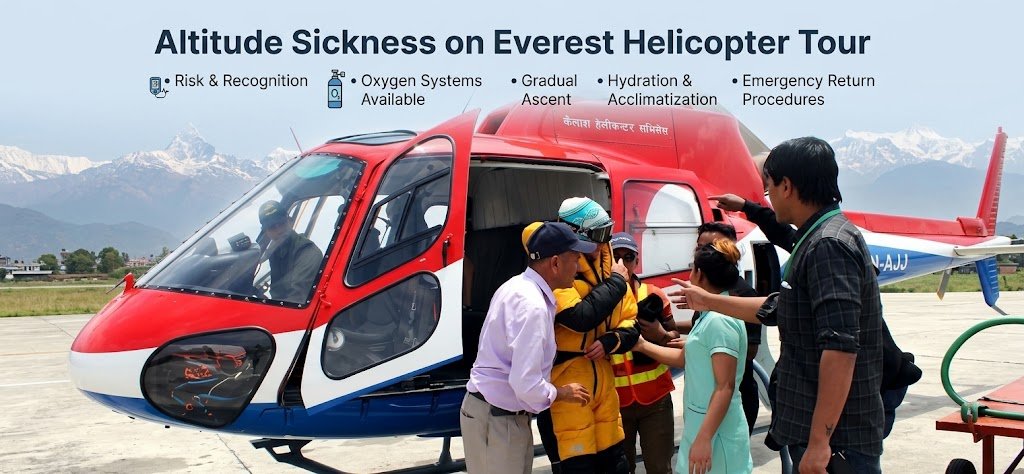
Many reputable operators carry portable supplemental oxygen in the helicopter for use during or after the high altitude stop. If you experience significant distress during the 10 to 15 minute landing stop, the pilot or crew can administer supplemental oxygen before or during the descent. This is effective for rapidly improving SpO2 and reducing symptom severity.
If you have a specific health condition that makes you want to be sure supplemental oxygen is available on your flight, ask your operator to confirm this before booking. It is a reasonable question and a good operator will confirm it straightforwardly.
Diamox (Acetazolamide): Does It Help on a Helicopter Tour?
Acetazolamide (trade name Diamox) is a prescription carbonic anhydrase inhibitor that accelerates acclimatisation by stimulating faster and deeper breathing, which helps maintain blood oxygen during altitude ascent. It is genuinely effective for preventing AMS in people who are ascending gradually over multiple days, EBC trekkers, for example.
For a brief helicopter tour, the case for Diamox is much weaker. You ascend in 90 minutes to a very high altitude, stay for 15 minutes, and descend. The acclimatisation mechanisms that Diamox supports take hours to days to matter, more time than the tour provides. The medication’s side effects (increased urination, tingling in the hands and feet, altered taste for carbonated drinks) are real and may be more bothersome than the altitude itself on such a brief exposure.
Most wilderness and travel medicine specialists do not recommend Diamox prophylaxis specifically for brief helicopter altitude exposure. If you have a history of serious AMS or a specific health situation that concerns you, discuss it with your doctor before the tour. Do not self-prescribe Diamox on the basis of general altitude advice that was written for trekkers.
Children and Altitude Sickness on the Helicopter Tour
Children’s altitude physiology is similar to adults, they are not inherently more or less vulnerable to AMS based on age alone. The practical concern with children is that young children may not be able to articulate what they are feeling, and their distress signals (pallor, unusual quietness, irritability, refusal to stand) may be subtler than an adult’s. Parents should watch their children carefully during the high altitude stop and tell the pilot immediately if anything seems off. More complete guidance: Everest Helicopter Tour for Families.
The Descent Is the Treatment
The most important principle of altitude medicine, the one that guides everything else, is this: descent is the fastest and most effective treatment for altitude illness of any severity. Supplemental oxygen helps. Medications help. But nothing works as reliably and immediately as getting to lower altitude.
On an Everest helicopter tour, the “descent” is already built into the tour. The helicopter at Kala Patthar (5,545 metres) is 15 minutes of flight from Namche Bazaar (3,440 metres) and 45 minutes from Kathmandu (1,300 metres). If you feel unwell, seriously unwell, not just mildly breathless, the treatment is already parked 15 metres away from you. Tell the pilot. Get back in. Descend.
This is why the Everest helicopter tour, done correctly, is far safer from an altitude-illness perspective than an EBC trek. Trekkers who develop AMS at altitude may have to walk down for hours or days, or wait for a rescue helicopter from remote terrain. Helicopter tour passengers have an immediate, rapid descent mechanism. The “emergency” scenario that would take 18 hours of evacuation from an EBC trek takes 45 minutes from a helicopter tour.
After the Tour: What to Expect
Most helicopter tour passengers feel completely fine after returning to Kathmandu altitude. If you experienced any headache or breathlessness at altitude, these symptoms typically resolve within minutes of the descent and are gone completely by the time you return to your Kathmandu hotel.
In rare cases, a mild lingering headache may persist for a few hours after the tour. Standard over the counter pain relief (ibuprofen or paracetamol) is appropriate for this. Staying well hydrated and avoiding strenuous activity for the rest of the day is sensible advice.
If you experience any symptoms that feel genuinely alarming after returning to Kathmandu, persistent confusion, inability to catch your breath at rest, severe chest pain, or visual disturbances, seek medical attention promptly. CIWEC Hospital in Kathmandu has extensive experience with altitude related conditions and is familiar with helicopter tour passenger presentations. This scenario is rare, but knowing where to go matters.
Frequently Asked Questions About Altitude and the Helicopter Tour
How high is the Everest helicopter tour?
The highest landing point is Kala Patthar at 5,545 metres. The standard EBC landing is near Everest Base Camp at approximately 5,364 metres. Kathmandu, where you start and finish, is 1,300 metres. You ascend approximately 4,200 metres in about 90 minutes of flight.
Will I definitely feel something at altitude?
Not necessarily. Many passengers complete the entire tour without any notable altitude effects. Others feel mild breathlessness or a slight headache that resolves immediately on descent. Severe symptoms are uncommon among healthy adults on this brief exposure.
Can I take ibuprofen for headache before the flight?
Ibuprofen has some evidence for reducing AMS headache and can be taken preventatively. The evidence for altitude prophylaxis with ibuprofen is less strong than for Diamox but also comes with fewer side effects. 600mg ibuprofen taken 1 to 2 hours before the high altitude landing is a reasonable strategy for people who are prone to headaches at altitude. Take with food.
What is the highest I will be on the helicopter tour?
Kala Patthar at 5,545 metres, if you take the Kala Patthar landing package. The Kala Patthar helicopter landing guide covers what to expect at this specific altitude.
Can I take the tour if I have high blood pressure?
well controlled mild hypertension is not an automatic exclusion. Your blood pressure will rise transiently at high altitude, as it does with any physical or cardiovascular stress. If your blood pressure is well controlled on medication and you have no other cardiac risk factors, many doctors clear patients for brief altitude exposure. The key word is “well controlled”, poorly controlled hypertension at altitude carries real risk. Discuss your specific situation with your doctor before booking.
Does the tour stop if I feel unwell?
Yes. Tell the pilot. The pilot is not going to complete the sightseeing route if you are experiencing serious altitude symptoms. Your safety comes first, and an experienced pilot flying the Khumbu regularly has seen altitude illness presentations before and knows how to respond. The helicopter returns to lower altitude.
Book the Tour With Confidence
The altitude reality of the Everest helicopter tour is manageable for the vast majority of healthy adults. The brief, same day nature of the exposure, combined with the helicopter’s immediate descent capability, makes this experience significantly safer from an altitude illness perspective than multiday high altitude trekking.
Prepare sensibly, hydrate, move slowly at altitude, communicate openly with your pilot, and the 10 to 15 minutes you spend above 5,000 metres will be among the most remarkable of your life.
- Standard EBC Helicopter Tour
- EBC with Kala Patthar Landing, the highest landing point available
- EBC with Gokyo Heli Tour
Should You Carry a Pulse Oximeter on the Tour?
A pulse oximeter is a small clip-on device that measures your blood oxygen saturation (SpO2) and pulse rate through a non-invasive infrared sensor on your fingertip. They cost NPR 2,000 to 5,000 ($15 to $38) at pharmacies in Kathmandu’s Thamel district, or they can be ordered online before your trip.
For multiday trekking, a pulse oximeter is genuinely practical. Checking your SpO2 each morning tells you whether your body is acclimatising normally and alerts you to drops that precede AMS symptoms by hours. For a helicopter tour specifically, the value calculation is different.
You are at high altitude for 10 to 15 minutes. By the time you take a reading, look at it, and decide what it means, you have used several of those minutes. A pilot who has flown to Kala Patthar hundreds of times reads the visible signs of altitude distress faster and more accurately than most passengers can interpret a number on a small screen in the cold, with numb fingers.
That said, for passengers with specific medical conditions, a pulse oximeter has genuine value before the tour for an informed discussion with your doctor. Bring one to your pre-tour medical appointment if you have cardiovascular or respiratory concerns. Knowing your resting SpO2 at Kathmandu altitude (which should be 95 percent or above for most people) gives your doctor a useful baseline.
What the numbers mean at altitude: SpO2 of 85 to 95 percent at 5,300 metres is typical for an unacclimatised adult on a brief visit. Below 80 percent combined with feeling genuinely unwell, confused, or unable to catch your breath at rest: board the helicopter immediately. Above 90 percent and feeling physically fine: you are coping adequately with the brief exposure.
The Day Before Your Tour: A Simple Preparation Protocol
The choices you make on the day before your helicopter tour have a measurable effect on how you feel at altitude the following morning. These are not abstract wellness suggestions. They are practical adjustments with physiological rationale.
Hydration: Drink two to three litres of water across the day before. Dehydration reduces blood volume and makes the cardiovascular response to hypoxia less efficient. Alcohol suppresses the hypoxic ventilatory response, meaning your body breathes less deeply than it should in response to low oxygen. If you want to have a drink the evening before your tour, one glass with dinner is the limit. Arriving at altitude slightly dehydrated after a big night is one of the most common reasons for unpleasant altitude symptoms on an otherwise short exposure.
Sleep: A poor night before altitude exposure does not cause altitude sickness by itself, but it reduces your body’s capacity to manage physical stress of any kind. The 5:00 AM departure means you will be awake by 4:30 AM at the latest. An early night is not optional. If you sleep poorly in new environments, consider a mild sleep aid the night before the tour. Discuss prescription options with your doctor before the trip if this is a recurring issue.
Food: Eat a light dinner the evening before. A heavy meal the night before a very early high altitude exposure can increase nausea symptoms. On the morning of the tour, eat something light one to two hours before departure. An empty stomach at altitude is also uncomfortable. A piece of toast, a banana, and some water is the right level of intake for a 5:00 AM morning.
Medications: Take any regular prescription medications as normal. If you are considering ibuprofen for altitude headache prevention, 400 to 600 mg taken one hour before the high altitude landing is a reasonable approach. Do not take Diamox without a doctor’s recommendation for your specific situation, as discussed earlier in this guide.
After the Tour: Recovery and What to Expect for the Rest of the Day
Most passengers feel completely normal within 30 to 60 minutes of returning to Kathmandu altitude from the high altitude stop. If you experienced mild breathlessness or a slight headache at the landing zone, these symptoms typically disappear during the descent and are entirely gone by the time you reach Kathmandu.
Some passengers notice mild fatigue in the afternoon after a helicopter tour. This is a normal physiological response to the cardiovascular stress of rapid altitude change and rapid return, not a sign that something went wrong. Rest, proper hydration, and a light meal address it adequately. Avoid alcohol during the rest of the day following a helicopter tour.
In rare cases, a mild headache persists for two to four hours after the tour. Standard ibuprofen or paracetamol, taken with a full glass of water, resolves this in most cases. If a headache worsens rather than improves over time after returning to Kathmandu, or if you develop unusual symptoms (blurred vision, significant confusion, chest tightness), seek medical attention at CIWEC Hospital in Lazimpat. Their travel medicine physicians are familiar with helicopter tour patient presentations and understand the difference between normal post-altitude fatigue and something that requires attention.
Related reading: Is Everest Helicopter Tour Safe? | What to Pack | How to Book | Tour for Families