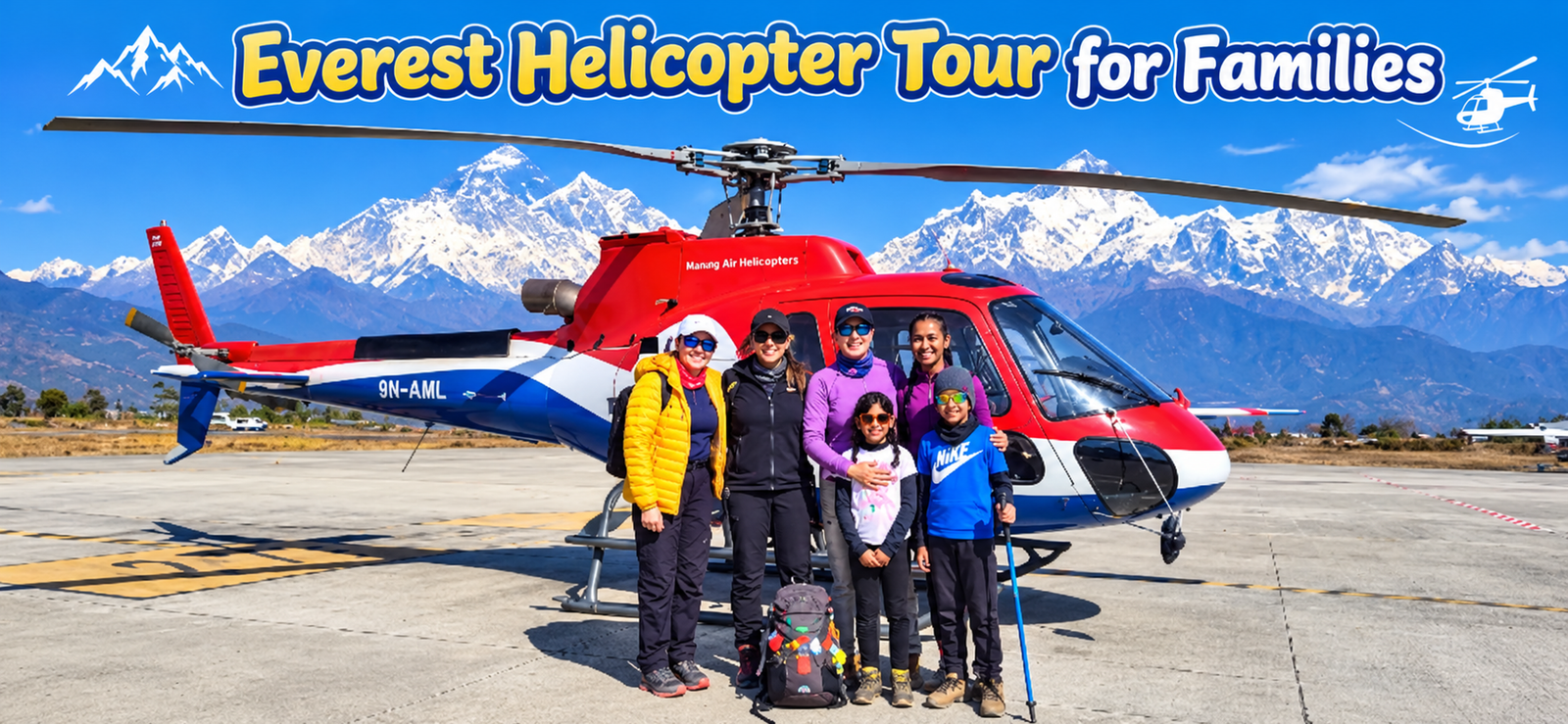
One of the questions we get most often from families planning Nepal travel: can my kids do the Everest helicopter tour? What about my 75-year-old parent who cannot trek but wants to see Everest? What about my husband who has a heart condition?
The honest answers are more nuanced than most tour operators tell you. The Everest helicopter tour involves real altitude, a real environment, and real physiological stress. For most families, it is completely fine. For some situations, it requires medical consideration. And for a small number, it is not appropriate.
Here is the specific information you need to make a good decision for your family.
What the Tour Actually Involves
You depart Kathmandu (1,300 metres) at approximately 6:30 AM. The flight to the Khumbu takes 45 to 50 minutes. You land near Everest Base Camp (5,364 metres) or at Kala Patthar (5,545 metres). You spend 10 to 15 minutes on rocky, uneven terrain exposed to cold and wind, at over 5,000 metres. Then you return to Kathmandu.
The altitude is the single biggest variable for family suitability. A rapid ascent to 5,300 to 5,545 metres without prior acclimatisation affects everyone differently. The saving factor: the exposure is brief, and descent is immediate. For most healthy adults and children, the stop causes nothing worse than mild breathlessness and a slight increase in heart rate.
Children on the Everest Helicopter Tour
Age and Suitability
There is no universal minimum age requirement across all operators. The relevant question is not which operator has the lowest age cutoff, it is what the actual risk is for a child of a given age.
Children’s altitude physiology is similar to adults. The practical considerations specific to children:
- Young children may not articulate what they are feeling, a 4-year-old experiencing headache at 5,300 metres may show it as pallor, unusual quiet, or irritability rather than saying “I have a headache”
- Children must sit securely in a standard aircraft seat with a seatbelt for the 45-50 minute flight each way
- Recent respiratory infections increase altitude sensitivity in children, just as in adults
Our guidance: children 5 and older who are healthy and can communicate clearly are suitable for the standard EBC helicopter tour. Children younger than 5 should be discussed individually with your operator and paediatrician. Infants are not appropriate on this tour.
Warning Signs to Watch for in Children at Altitude
During the high altitude landing stop, watch for: unusual pallor; confusion or difficulty responding to simple questions; unusual crying or distress that doesn’t resolve quickly; vomiting; loss of coordination or stumbling. Any of these means: tell the pilot immediately and board the helicopter. The descent is the treatment. More: Altitude Sickness Guide.
Children’s Pricing and Private Charter
Most operators offer children’s discounts of 20 to 30 percent for ages 5 to 12 on shared tours. For families with multiple children or children of varying ages, a private charter is strongly worth considering, it gives you full control over the landing duration, seating flexibility, and direct communication with the pilot without social pressure from other passengers. For families of 3 or more, the per-person cost of a private charter is often comparable to the shared rate. See our Group Charter page for details.
Elderly Passengers: Honest Guidance
Age alone is not the issue. A healthy, active 72-year-old has a better risk profile for this tour than a 45-year-old with uncontrolled hypertension. What matters is health status, not years.
What the Tour Does to the Cardiovascular System
At 5,300+ metres, blood oxygen saturation drops from 97 99 percent (Kathmandu) to approximately 65 85 percent (landing zone). The body responds by increasing heart rate and breathing. For a normally functioning heart, this is a temporary, manageable stress. For a heart with compromised function, narrowed coronary arteries, significant valve disease, recent myocardial infarction, or significant arrhythmia, this transient stress may not be manageable.
The duration matters enormously: 10 to 15 minutes of hypoxia followed by immediate descent is profoundly different from overnight altitude exposure. Many elderly passengers with mild to moderate cardiovascular disease are cleared by their cardiologists for brief altitude exposure, but that assessment must come from a doctor who knows the individual’s specific cardiac history.
Conditions That Often Allow Participation
- well controlled mild hypertension on stable medication: many cardiologists clear this
- History of mild, well controlled angina without recent changes: may be cleared with precautions
- Rate-controlled stable atrial fibrillation: discuss with cardiologist
- Stable mild COPD not requiring supplemental oxygen at sea level: may be appropriate
Conditions That Often Preclude Participation
- Uncontrolled hypertension (systolic consistently above 160 mmHg)
- Recent cardiac event within 3 6 months
- Significant heart failure with symptoms at moderate exertion at sea level
- Pulmonary hypertension
- Significant COPD requiring supplemental oxygen at sea level
See your doctor before booking. Explain specifically: “I am planning a 10 15 minute stop at 5,300 5,500 metres, reached by helicopter in a rapid 90-minute ascent from 1,300 metres. Is this appropriate for my health situation?” If your doctor advises against the high altitude landing, the Annapurna helicopter tour (4,130m maximum) or the Langtang helicopter tour (3,870m maximum) may be appropriate lower-altitude alternatives.
Pregnant Passengers
Standard medical guidance: avoid elective altitude exposure above 3,500 metres during pregnancy, particularly in the first and third trimesters. At 5,300+ metres, maternal blood oxygen saturation drops significantly, and the fetus, which depends on maternal blood for its own oxygen, is affected. The duration is brief (10 15 minutes), which limits the significance, but most obstetricians advise against it on a precautionary basis.
If you are pregnant and want a Nepal mountain helicopter experience, the Langtang tour (3,870 metres maximum) falls below the typical caution threshold. Discuss your specific situation with your obstetrician. Most operators will not carry passengers beyond approximately 24 weeks gestation regardless, confirm the policy when booking.
Passengers with Specific Health Conditions
Diabetes: well controlled diabetes is not a barrier. Bring glucose monitoring equipment and fast-acting carbohydrates. Altitude can affect blood sugar regulation, discuss any medication adjustments with your endocrinologist.
Asthma: well controlled asthma is not typically a barrier. Carry your rescue inhaler and have it immediately accessible, not buried in your bag. Cold, dry air at altitude can trigger bronchospasm, breathe through your nose when possible. Poorly controlled asthma requiring regular nebuliser treatment should be discussed with your pulmonologist before booking.
Previous altitude sickness: If you have experienced AMS, HACE, or HAPE in the past, your risk of recurrence is above average. This does not automatically exclude you, but discuss it honestly with your doctor. Consider whether lower-altitude helicopter tours are more appropriate. Full guide: Altitude Sickness on the Everest Helicopter Tour.
The Weight Limit: An Honest Conversation
high altitude helicopter operations have practical weight limits, at 5,500 metres, every kilogram reduces the aircraft’s performance margin. Most operators work with a practical maximum of 100 to 110 kg per passenger position including hand luggage. This applies to every passenger without exception.
If weight may be a consideration for any family member, contact your operator in advance rather than discovering the issue at the helipad on the morning of your tour. Operators handle these situations regularly and will work with you discreetly to find a solution, an additional seat booking, an alternative landing point, or a private charter with different load distribution.
Making the Most of a Family Helicopter Tour
Designate a child monitor: One adult manages the camera. One adult is solely watching the children at the high altitude stop. The pilot is flying the aircraft, not monitoring your children.
Brief everyone beforehand: Tell children what to expect: “You might feel a bit breathless, like running up stairs very fast. Tell me immediately if you feel sick or dizzy.” This normalises the experience and make sures children communicate distress rather than silently endure it.
Dress everyone appropriately: Children lose body heat more rapidly than adults and are often less able to communicate cold until genuinely uncomfortable. Layer children more aggressively than you think necessary. Full gear guide: What to Pack.
Consider the Hotel Everest View breakfast option: For families with children or elderly members uncertain about the high altitude landing, this stop at 3,962 metres provides a meaningful Himalayan experience at lower altitude, Everest view, sit-down breakfast, inside the warmth of the hotel. The high altitude landing can then be assessed on the day based on how everyone is feeling. Guide: Breakfast at Hotel Everest View.
Best Packages for Families
| Package | Best For | Max Altitude |
|---|---|---|
| Standard EBC Tour | Healthy families, first timers | 5,364m |
| EBC with Kala Patthar | Adventurous families, teenagers | 5,545m |
| Group Charter | Families of 4+, full privacy | Custom |
| EBC + Gokyo | Older children, photography families | 5,545m |
Frequently Asked Questions
Is there a minimum age for the Everest helicopter tour?
No universal industry minimum, but we recommend 5+ for healthy children who can sit independently and communicate clearly. Younger children should be discussed with your operator and paediatrician.
My parent is 78 and cannot trek, can they do the helicopter tour?
Possibly yes, but this requires medical clearance from their doctor, not a tour guide. The relevant question is their cardiovascular and respiratory health, not their age. Many healthy 78-year-olds complete this tour without incident, because they got appropriate medical advice first.
Can we do the tour as a family of four on a shared helicopter?
Yes, a shared helicopter typically seats 4 to 5 passengers. A family of four may fill most of the helicopter, making it functionally semi private. Confirm with your operator how your group will be seated and whether you will share with other passengers. Enquire about private charter pricing at this group size, the math often favours it.
What if someone in our group feels unwell at altitude?
Tell the pilot immediately. The tour ends, the helicopter descends. No group pressure, no minimum completion requirement. The pilot prioritises the health of any passenger experiencing altitude distress over completing the planned route.
Which helicopter tour is best if we want lower altitude?
The Langtang helicopter tour (3,870 metres at Kyanjin Gompa) and the Annapurna helicopter tour (4,130 metres at ABC) both offer extraordinary mountain scenery at meaningfully lower altitude than the EBC tour. Both are appropriate starting points for families with members who need to avoid the 5,000+ metre exposure.
Travel Insurance for Helicopter Altitude: What to Confirm Before Buying
Standard travel insurance frequently excludes altitude above a specific elevation or excludes helicopter activities entirely. Before buying a policy for a Nepal trip that includes an Everest helicopter tour, confirm the following coverage explicitly with the insurer.
- Helicopter rescue and evacuation at altitude above 5,000 metres
- Emergency medical treatment in Nepal for altitude related conditions
- Medical repatriation from Nepal to your home country if needed
- Trip cancellation for medical reasons, including late cancellation after a health development close to departure
Specialist adventure travel insurers such as World Nomads, True Traveller (UK), and Battleface typically include high altitude helicopter evacuation as standard. Mass-market travel insurance from credit cards or package deals often excludes it. Read the exclusions section, not just the coverage headline. For family policies: confirm altitude coverage extends to children at the same level as adults. Some policies limit minor altitude coverage or require a separate rider.
One item travel insurance almost never covers: commercial weather cancellations. If your tour is cancelled because of cloud at the landing zone, that is not a travel insurance claim. This is why your operator’s written weather cancellation and refund policy is the critical document to confirm before paying any deposit.
CIWEC Hospital: Primary Healthcare Contact in Kathmandu
CIWEC Hospital Travel Medicine Center has operated in Kathmandu since 1982. It is Nepal’s leading travel and altitude medicine clinic and has treated trekkers, climbers, and tourists for altitude related conditions for over 40 years. If any family member requires medical attention after the helicopter tour, CIWEC is the right first contact.
Located in Lazimpat, 10 to 15 minutes from Thamel, CIWEC’s clinical staff include doctors trained in altitude medicine and travel health. They understand how altitude illness presents in helicopter tour passengers, which differs from the presentation in trekkers who have been at altitude for days. Save their address and phone number in your phone before the tour. Your hotel concierge will know the clinic. If any post-tour symptom is worsening or unusual, go to CIWEC directly rather than waiting to see if it improves on its own.
Preparing Children for What They Will Experience
Children who know what to expect at altitude handle the high altitude stop far better than children who are surprised by it. A child who has been told what the thin air feels like will communicate distress quickly and clearly, rather than sitting quietly with a symptom they do not understand.
A simple conversation the evening before works well: “Tomorrow we fly in a small helicopter very high up a mountain. The air up there is thinner, so breathing might feel harder, like after running up stairs fast. That is completely normal. If your head hurts or you feel sick or dizzy, tell me straight away. We will get back in the helicopter and it goes away fast. The view is going to be great.”
That framing normalises the sensation, gives a clear instruction, and ends on positive anticipation. Children briefed this way arrive curious and communicative rather than anxious or, worse, silently tolerating discomfort because they think they should be brave about it.
Related reading: Altitude Sickness Guide | What to Pack | How to Book | Cost Guide 2026 | Safety Guide | Private vs Group