The World’s Most Extraordinary Morning Meal
There are famous breakfasts in famous hotels all over the world, the Ritz in Paris, the Peninsula in Hong Kong, the Four Seasons in Tokyo. But there is only one hotel in the world where you can sit at a breakfast table with Mount Everest visible through the window at close range, at 3,880 metres above sea level, having arrived by helicopter as the sun rose over the Himalayas. That hotel is Hotel Everest View in Syangboche, Nepal, and the Everest Base Camp helicopter tour with Hotel Everest View breakfast is the only way to reach it in a single morning from Kathmandu and return the same day.
This is not breakfast as a functional meal. It is breakfast as an event, a confluence of extraordinary setting, extraordinary views, and extraordinary experience that places it among the most singular morning activities available anywhere on earth. The combination of the helicopter flight over the Khumbu, the Kala Patthar landing with its face to face encounter with the Everest South Face, and then the descent to Syangboche for a hot breakfast with panoramic mountain views creates a sensory arc that is difficult to describe to anyone who hasn’t experienced it, and impossible to forget once you have.
Here is everything you need to know about this extraordinary experience: what Hotel Everest View is and why it’s unique, what the helicopter journey to reach it involves, what the breakfast experience is actually like, what the views show you, what to expect at 3,880 metres, how to prepare, and why so many travellers describe the Everest View breakfast as one of the most memorable meals of their entire lives.
Hotel Everest View: The World’s Highest-Altitude Luxury Hotel
Hotel Everest View in Syangboche, in Nepal’s Khumbu Sagarmatha region, holds a remarkable distinction: it is one of the world’s highest-altitude permanently staffed hotels, sitting at approximately 3,880 metres (12,730 feet) above sea level on a ridge directly overlooking the Dudh Koshi valley with an unobstructed panoramic view of the Khumbu Himalayan massif. The hotel was built in the 1970s, initially by a Japanese group, and has been operating as a mountain lodge since, a remarkable feat of supply chain management given that virtually everything brought to the hotel must be carried up from lower elevations by yak or helicopter.
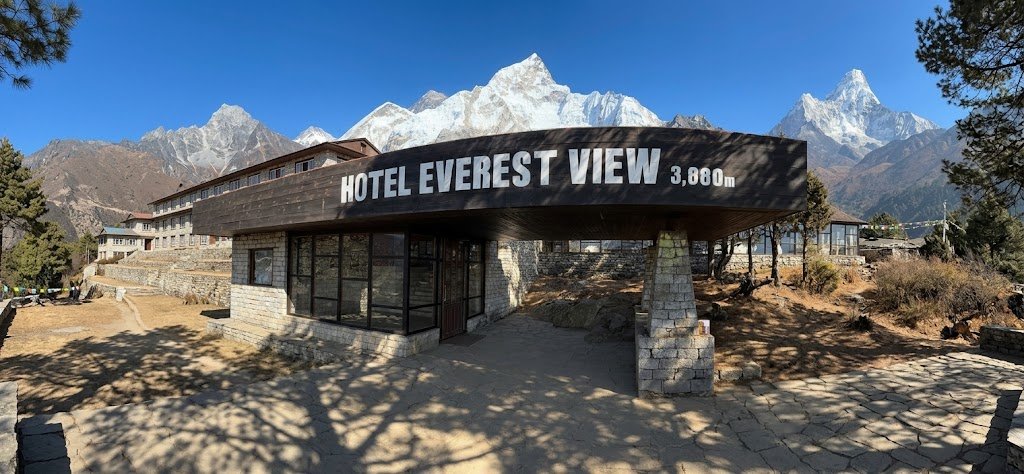
The hotel’s position on the Syangboche ridge is exceptional from a viewing standpoint. Unlike Namche Bazaar, which sits in a bowl that obscures some mountain views, Syangboche is on an elevated platform with clear sightlines to the north and northeast. The mountains visible from the hotel’s terrace include Everest (8,849m), its distinctive pyramidal summit visible above the Lhotse-Nuptse wall, Lhotse itself (8,516m), Nuptse (7,861m), Amadablam (6,812m), Thamserku (6,618m), Kangtega (6,782m), and numerous other Khumbu peaks. The hotel terrace in the early morning, with the Himalayan giants glowing in first light and a cup of hot tea steaming in your hands, is one of those views that stops conversation.
The physical hotel is a stone and wood structure consistent with the aesthetic of Sherpa architecture, with a dining room, terrace, and basic but comfortable accommodation (though helicopter tour passengers use the hotel only for the breakfast stop and do not stay overnight). The hotel maintains a generator for electricity and has a kitchen capable of producing both international and local Nepali dishes despite the challenging supply situation at high altitude. It has welcomed royalty, celebrities, mountaineers, and tens of thousands of ordinary travellers over its decades of operation, and the visitors’ book contains names from virtually every country on earth.
The Helicopter Journey to Hotel Everest View: What Happens When
Understanding the sequence of the morning helps passengers prepare and makes the experience more enjoyable. Here is a typical step by step account of what happens from the moment your hotel pickup begins to the moment you return.
4:30am, 5:00am: Hotel pickup in Kathmandu. A vehicle from the tour operator collects you from your Kathmandu hotel in the pre dawn darkness. The early hour is essential: you need to be airborne by sunrise to catch the best morning weather window in the Khumbu. The drive to the Tribhuvan International Airport domestic terminal takes 20 to 40 minutes depending on traffic, which at 5am is virtually non-existent, making the pre dawn drive through the sleeping city a quietly surreal part of the experience.
5:00am, 5:30am: Check-in and safety briefing. At the domestic helipad, passengers check in with their passport and tour confirmation, complete a brief weight and baggage check (weight management is critical at high altitude), and receive a safety briefing from the operations team. The brevity and efficiency of this process reflects how many times the team has done it, it is professional without being rushed.
5:30am, 6:15am: Flight to Lukla. The helicopter lifts off from Kathmandu as dawn begins breaking. The flight to Lukla (2,860m) takes approximately 45 minutes, during which the landscape transitions from the Kathmandu Valley’s urban sprawl to the rolling green hills of the mid-hills region, then to the progressively more dramatic terrain of the Khumbu foothills. The first light on the high Himalayan peaks as you approach Lukla, visible at a distance of 50 to 80 kilometres, is one of the first great visual rewards of the morning.
6:15am, 6:30am: Lukla refuelling stop. The helicopter makes a brief operational stop at Lukla (Tenzing-Hillary Airport) to refuel. Passengers remain on board or stand beside the aircraft for 10 to 15 minutes. Lukla airport at close range is a remarkable sight, a short, steep runway perched on a mountainside at 2,860 metres, one of the world’s most technically demanding airports for fixed-wing aircraft. Seeing it from the helipad adds a dramatic context to the adventure.
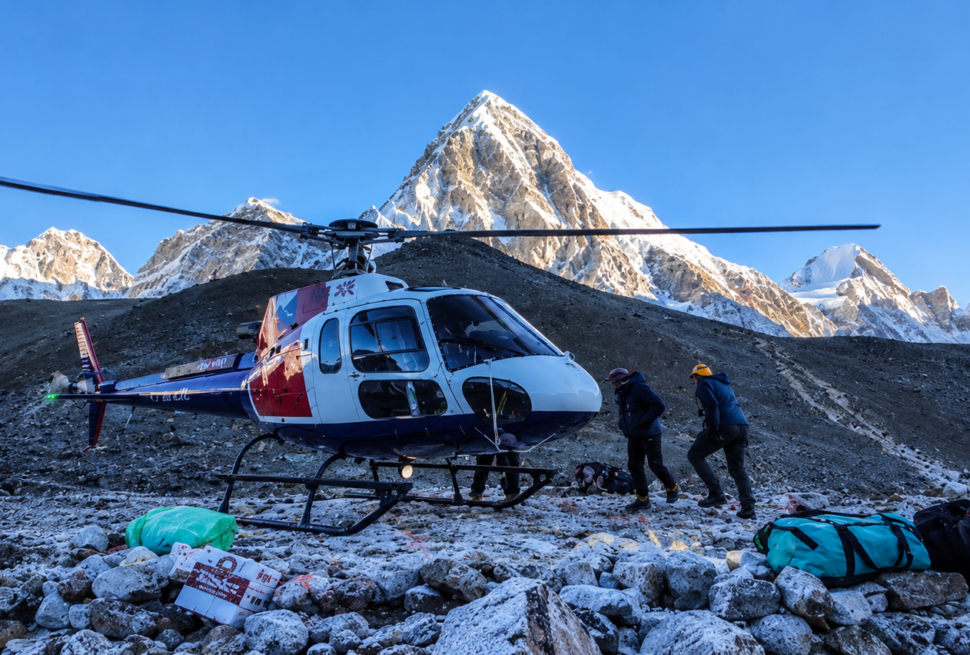
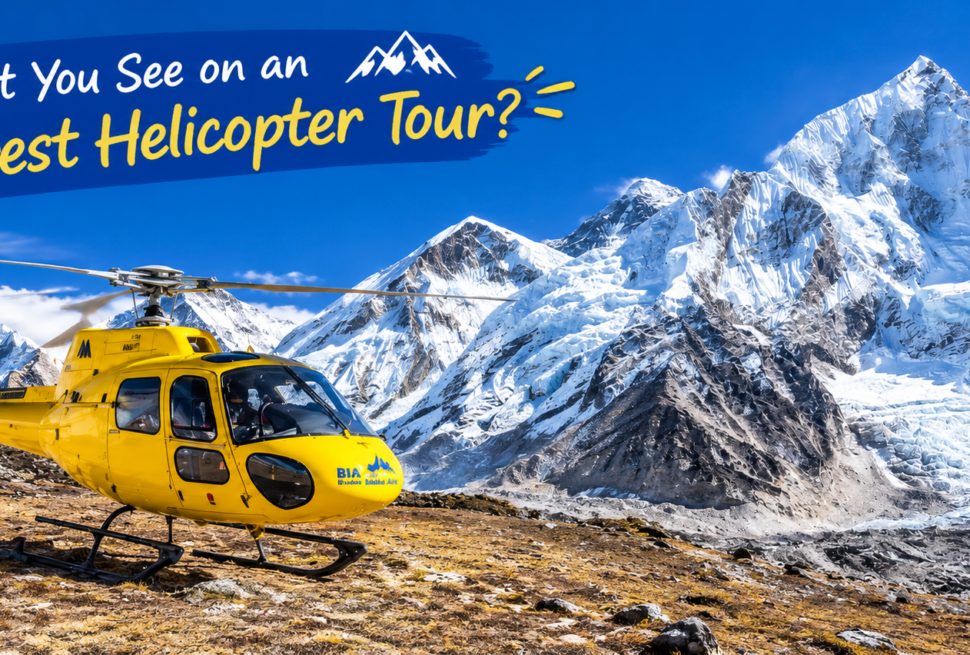
6:30am, 7:00am: Flight to Kala Patthar and the Khumbu tour. From Lukla, the helicopter ascends rapidly into the upper Khumbu, flying over Namche Bazaar, Tengboche monastery, Dingboche, and the upper Khumbu Glacier region. The views on this section of the flight are the heart of the experience, the Everest massif appears in full, the Khumbu Icefall and glacier system spread below, and the sense of being deep inside the world’s highest mountain range is overwhelming. The Kala Patthar landing at 5,545 metres is the high point of the morning, 20 to 30 minutes on the ground at the foot of Pumori with Everest looming directly to the north.
7:30am, 8:30am: Descent to Syangboche and Hotel Everest View breakfast. From Kala Patthar, the helicopter descends to Syangboche (3,880m), landing at the small helipad adjacent to Hotel Everest View. The descent from extreme altitude to the relative comfort of 3,880 metres is noticeable, breathing becomes slightly easier, the temperature rises a few degrees, and the relaxation of leaving the extreme altitude zone allows passengers to begin processing what they have just experienced. Breakfast at the hotel typically lasts 45 to 60 minutes.
9:00am, 10:00am: Return flight to Kathmandu. After breakfast, the helicopter flies directly back to Kathmandu, arriving between 9:00am and 10:00am. The return flight takes approximately 45 minutes, retracing the route over the Khumbu foothills and mid-hills. A vehicle returns you to your hotel. By 10:30am you are back in Kathmandu with the entire rest of the day available, having already experienced one of the most extraordinary mornings of your life.
The Breakfast Itself: What to Expect at the Table
The breakfast served at Hotel Everest View is a genuinely good meal by any standard, not just by high altitude standards. The kitchen produces both international and Nepali options, and the menu typically includes continental breakfast items such as eggs cooked to order, toast, butter and jam, fruit, yoghurt, and a selection of cereals, alongside hot beverages including coffee, tea, hot chocolate, and the traditional Tibetan butter tea that warms you from the inside out on a cold mountain morning.
The physical experience of eating at altitude is subtly different from sea level, appetite may be slightly reduced, and some passengers feel mild altitude effects (a light headache or gentle breathlessness) that affect their engagement with food. The team recommends eating lightly: the breakfast is part of an experience, not the entire purpose of the morning, and forcing yourself to eat a large meal at 3,880 metres is not necessary or advisable. A cup of hot tea or coffee, some toast, eggs, and fruit is the best approach, enough to fuel the return flight and enjoy the moment without overloading a digestive system that is operating at reduced capacity.
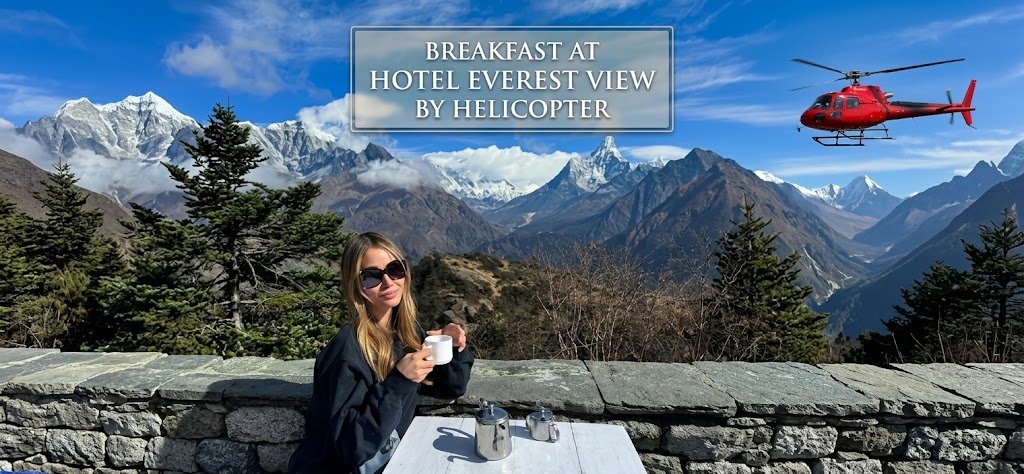
What transforms the meal into something extraordinary is, of course, the view. The dining terrace and windows of Hotel Everest View face directly toward the Khumbu Himalayan range. Everest’s summit pyramid is visible above the Lhotse-Nuptse wall to the north. Amadablam’s elegant spire rises to the east. The Dudh Koshi valley spreads below, with Namche Bazaar’s cluster of white buildings visible in the bowl of the hillside far below the hotel. On a clear morning, which is the usual condition for a successfully operated helicopter tour, this view across the entire Khumbu massif from a terrace at 3,880 metres is genuinely one of the most extraordinary vistas available from any hotel dining room in the world.
Many passengers describe the breakfast pause as the most emotionally intense part of the morning precisely because it gives them stillness after the intensity of the flight and the Kala Patthar landing. In the helicopter, you are moving, and the sensory input is continuous and rapid. At the Kala Patthar landing, the altitude and wind demand attention and physical management. At the breakfast table, everything becomes quiet and you can simply sit, hold a warm cup, look at the mountains, and let the experience settle into you. Several passengers have described moments of completely unexpected emotion during the breakfast, tears, not from sadness, but from the dissonance between the scale of what surrounds them and the ordinariness of sitting at a breakfast table.
Photography Tips at Hotel Everest View
The Hotel Everest View breakfast stop is one of the two great photography opportunities of the morning (the other being the Kala Patthar landing). Here is how to make the most of it photographically.
Use the terrace, not just the windows. The dining room windows provide good views, but the hotel terrace gives you unobstructed 180-degree sightlines across the full Khumbu panorama. Step out to the terrace immediately on arrival and spend a few minutes photographing the full width of the mountain panorama before sitting down for breakfast.
Include the hotel in your shots. The combination of the hotel’s stone terrace, the tea cups and table settings, and the mountain panorama in the background creates one of the most evocative travel photographs possible, the juxtaposition of the intimate and domestic against the vast and elemental. Don’t only photograph the peaks; photograph the peaks with you at the table, with the breakfast setting, with your travelling companions.
Time of day matters. Arriving at Hotel Everest View at approximately 7:30am to 8:00am means the early morning light is still relatively low and directional, casting long shadows across the valley and illuminating the peak faces with warm light. This is excellent photography light. By the time you leave (approximately 8:30am to 9:00am), the light has risen and become slightly more neutral, still beautiful but less dramatically angled.
Photograph Amadablam specifically. Amadablam (6,812m), visible to the southeast from the hotel terrace, is often described as the world’s most beautiful mountain, a slender, technically demanding peak with a dramatically tapering summit. From Syangboche, Amadablam is visible in its full profile and at a distance that allows you to capture its entire form in a single frame. It is worth a dedicated set of photographs separate from the Everest shots.
Health at 3,880 Metres: What to Know
Hotel Everest View sits at 3,880 metres, high enough for altitude to be a real consideration for some passengers, though far lower than the Kala Patthar landing at 5,545 metres. At 3,880 metres, oxygen availability is approximately 60% of sea level, which is noticeably lower but not the severe reduction experienced at 5,000+ metres. Most healthy people feel a mild sensation of breathlessness on exertion at this altitude but are comfortable at rest and during a seated breakfast.
Symptoms to be aware of at this altitude include mild headache, reduced appetite, and slight fatigue. These are normal physiological responses to altitude and are not dangerous in themselves. If symptoms are more pronounced, significant headache, nausea, disorientation, or difficulty walking, inform the crew immediately. The helicopter is always available for rapid descent, and descent is the most effective treatment for altitude sickness. Our crew are trained to monitor all passengers throughout the ground stops and respond quickly to any signs of altitude intolerance.
Supplemental oxygen is available at the landing sites and on the helicopter for any passenger who requests it. There is no stigma or hesitation about using oxygen during the experience, it is a standard safety measure, not an admission of weakness, and many perfectly healthy passengers choose to use it prophylactically at the Kala Patthar landing to maximise their comfort and enjoyment.
Who Is This Experience Best For?
The Hotel Everest View breakfast as part of the helicopter tour is best suited to a specific type of traveller and occasion, and understanding this helps you decide whether it is the right add-on for your particular visit.
Travellers who appreciate food and setting equally: If you are someone for whom the context of a meal matters as much as the food itself, if you travel for experiences and meals that you will describe for years afterward, the Everest View breakfast was designed for you. The food is good, but the setting is extraordinary, and the combination creates a memory that persists long after the flavours have faded.
Special occasion travellers: The helicopter breakfast to Everest View is used as a celebration for birthdays, anniversaries, honeymoons, and milestone birthdays by a significant number of our passengers. Our Honeymoon Helicopter Package specifically includes this breakfast stop as a romantic highlight of the morning, and couples who share this experience consistently describe it as one of the most intimate and memorable moments of their relationship.
First-time Nepal visitors with limited time: The helicopter tour with Everest View breakfast compresses the most iconic elements of a Nepal Khumbu experience into a single morning, the flight, the Himalayan views, the Kala Patthar landing at extreme altitude, and breakfast with Everest through the window. For travellers on short visits to Nepal who want the most concentrated, highest-impact version of the Himalayan experience available in a single day, this is it.
Trekkers who have already been to EBC on foot: Many experienced trekkers who have previously completed the full EBC route on foot choose the helicopter breakfast tour as their way of revisiting the Khumbu on a return Nepal trip. Having seen the landscape at ground level, they now experience it from the air and from the comfort of the Everest View Hotel, discovering that the aerial perspective and the high altitude breakfast reveal dimensions of the landscape they didn’t see on foot.
Combining the Breakfast with a Gokyo Extension
For travellers who want to extend the morning beyond the standard breakfast stop, our EBC with Gokyo Heli Tour adds the dramatic Gokyo Lakes district to the flight, covering the full western Khumbu before landing at the Hotel Everest View for breakfast. The Gokyo extension adds significant flying time and geographic coverage, the turquoise lakes at 4,750 to 5,000 metres and the vast expanse of the Ngozumpa Glacier (Nepal’s longest) are among the most dramatic features of the greater Khumbu region and normally require a three to four day side trek from the main EBC route. Seeing them from the air on the same morning as your Everest View breakfast creates a single-day experience of extraordinary scope.
Booking the Helicopter Tour with Hotel Everest View Breakfast
The Hotel Everest View breakfast is included in specific helicopter tour packages and represents one of the most popular optional enhancements for passengers who want to extend their morning beyond the basic flight and Kala Patthar landing. Check our current packages on the Everest Base Camp Helicopter Tour page, where you will find full details of what is included in each package tier, pricing for the group sharing and private charter options, and how to book.
We recommend booking at least two weeks in advance for the spring and autumn peak seasons, and allowing one day of schedule flexibility in your Kathmandu itinerary for weather rescheduling. The breakfast stop adds time to the morning, so make sure your day’s subsequent plans allow for a late morning return from the tour, typically between 10:00am and 11:00am depending on conditions and exact routing.
The Everest helicopter breakfast is one of those rare travel experiences that lives up to its promise without qualification. The setting, the journey, the altitude, and the stillness of that mountain morning at the breakfast table combine to create something that goes beyond the sum of its parts. When experienced Himalayan travellers say this morning changed the way they think about breakfast, and the world, they are not exaggerating. Come and find out why for yourself.
The History of Hotel Everest View and Its Remarkable Story
Few high altitude hotels have a story as interesting as Hotel Everest View. The hotel was originally conceived and built in the 1970s through a Japanese investment initiative that recognised the extraordinary commercial potential of providing luxury accommodation with a direct view of the world’s highest mountain. Building a hotel at 3,880 metres in the Khumbu region, before helicopters made regular supply flights routine, before the Khumbu’s infrastructure development of the 1980s and 1990s, and before the global growth of high altitude tourism, was an act of ambitious, visionary planning.
The construction of the hotel itself was a logistical feat. At that altitude in the 1970s, without helicopter access for large supplies, essentially all building materials, furnishings, and equipment had to be carried up from lower elevations by yak or human porter. The stone for the walls came from the immediate area, but everything else, glass for the windows, metal for the roof, kitchen equipment, bedding, furniture, came up the mountain on someone’s back. The hotel that stands today is a testament to the same resourcefulness and physical capability that characterises Sherpa culture more broadly: things get done in the mountains not through sophisticated machinery but through human endurance and determination applied with great intelligence.
Over the decades since its opening, Hotel Everest View has welcomed an extraordinary range of visitors. The guest book includes members of European royal families, Bollywood film stars, mountaineering legends, travel writers whose accounts of the breakfast view launched thousands of visits, and many ordinary travellers from around the world who have made the pilgrimage to this ridge for the singular experience of seeing Everest over the morning tea. The hotel has survived multiple political upheavals in Nepal, the 2015 earthquake (which caused significant damage to structures across the Khumbu but from which the hotel recovered), and the COVID-19 pandemic’s complete shutdown of Himalayan tourism in 2020 and 2021. It remains one of the most iconic dining destinations in all of Asia, which, given Asia’s extraordinary restaurant culture, is saying something remarkable.
The Syangboche Helipad and What You See Landing There
The helicopter landing at Syangboche is itself a memorable experience. The Syangboche airstrip sits at approximately 3,780 metres and was originally constructed for small fixed-wing aircraft (Pilatus Porters and similar mountain aircraft) to supply the hotel and the surrounding area. Today it serves primarily as a helipad and is one of the key operational landing sites in the Khumbu region for helicopter tour operations.
Landing at Syangboche gives you an immediate view of the Dudh Koshi valley below, with Namche Bazaar’s distinctive horseshoe-shaped settlement visible in the bowl of the hillside approximately 500 metres below the landing site. Looking north from the landing area, the full Khumbu Himalayan massif is visible from Everest to Amadablam and the surrounding peaks. The approach to the landing site by helicopter is particularly dramatic, the aircraft crosses the valley at altitude, then drops down to the narrow ridge of Syangboche in a rapid descent that gives passengers their first unobstructed ground level view of the northern panorama as the helicopter turns to align with the landing area.
The short walk from the helipad to the hotel takes five to ten minutes along a well maintained stone path. At 3,880 metres, even this short walk may feel slightly more effortful than at sea level, this is a good reminder to move slowly and deliberately, not rushing the transition from the helicopter to the hotel. The moderate pace actually enhances the experience: the path gives you time to look at the surrounding landscape and adjust to the altitude before sitting down for breakfast.
The Altitude Advantage: Why Breakfast Tastes Different at 3,880 Metres
There is an interesting physiological dimension to the Hotel Everest View breakfast that experienced altitude travellers will recognise: food and drink genuinely taste different at altitude. The reduced oxygen environment of 3,880 metres causes mild changes in sensory perception, taste buds are slightly less responsive, carbonated drinks taste less fizzy, and strong flavours (coffee, tea, spices) can seem more intense than at sea level while mild flavours seem more muted.
Hot beverages are particularly welcome at altitude, not just for warmth but because the reduced humidity of mountain air creates a persistent mild dehydration that hot liquids address directly. The first cup of tea or coffee at Hotel Everest View after the cold of the Kala Patthar landing has a restorative quality that goes beyond the caffeine, it is warming, hydrating, and grounding in a way that makes the subsequent breakfast feel genuinely nourishing rather than merely pleasant.
The hotel serves traditional Nepali butter tea (po cha or gur-gur cha) alongside the international breakfast options, and we specifically recommend trying it even if you are not generally a tea drinker. Made from tea leaves, yak butter, and salt, it is an acquired taste for many Western palates, but at 3,880 metres after a cold morning at Kala Patthar, its fat and salt content is genuinely effective at warming the body and providing rapid energy. Sherpa climbers have depended on this drink for altitude performance for generations, and there is wisdom in the recipe that becomes apparent when you are sitting at nearly 4,000 metres needing warmth and fuel.
Namche Bazaar Visible Below: The Sherpa Capital in Miniature
One of the most visually satisfying elements of the Hotel Everest View position is the view down into the Dudh Koshi valley and the clear sight of Namche Bazaar 500 metres below. Namche is the principal trading hub of the Khumbu region and the place where EBC trekkers spend their first mandatory acclimatisation days. Seeing it from above at Syangboche makes the mountain geography immediately comprehensible in a way that maps cannot achieve, you can see the bowl-shaped valley in which Namche sits, the trails climbing the surrounding ridges, and the individual buildings of the town clustered in their famous horseshoe pattern around the natural amphitheatre of the hillside.
Helicopter tour passengers who have also trekked to EBC find this overhead view of Namche particularly resonant: they have walked those streets, sat in those teahouses, acclimatised on those ridgelines above the town. Seeing it all from above, with the full Khumbu context visible simultaneously, creates a new spatial understanding of a place they thought they knew.
First-time visitors, seeing Namche from above without having walked there, experience a different but equally compelling response: the remote mountain town visible far below, surrounded by ridge after ridge of Himalayan terrain, makes viscerally clear just how deep into the mountains the helicopter has brought you in a single morning.
After the Breakfast: The Return Flight and What It Shows You
The return flight from Syangboche to Kathmandu is not simply a commute home, it is a second chance at the views, now from the perspective of someone who has been at altitude and is descending back into the familiar world. Many passengers find the return flight emotionally interesting in a different way from the outbound journey: where the outbound flight was all anticipation and mounting wonder, the return has a quality of reflection and consolidation. The mountains recede behind you, the terrain gradually transitions from Himalayan grandeur to the green mid-hills, and the Kathmandu Valley reappears on the horizon as a reminder of the ordinary world.
Some passengers report using the return flight for their best photography of the day, they are warmer, more relaxed, and more familiar with the landscape now, and can compose shots more deliberately than in the first-flight excitement of the outbound journey. The light at 8:30am to 9:00am is softer and warmer than the dawn light of the outbound flight, creating slightly different photographic conditions that experienced photographers learn to use effectively.
The arrival back in Kathmandu, typically between 9:30am and 10:30am, produces a distinctive feeling among helicopter tour passengers: the city feels both more familiar and more foreign than it did at 5:00am. The scale and pace of Kathmandu’s urban life, after two to three hours in one of the most remote and dramatic landscapes on earth, has a slight quality of unreality. Most passengers describe wanting to sit quietly for a while and let the morning settle, a natural response to an experience of unusual emotional and sensory intensity.
Practical Details: What to Bring to the Breakfast
A brief practical list of what to bring and what to expect for the Hotel Everest View breakfast portion of your morning:
Camera and power bank. You will want to photograph extensively at the hotel and on the terrace. Make sure your camera or phone battery is fully charged at departure, and bring a power bank as a backup, cold temperatures at altitude drain batteries faster than at sea level, and you will have already been photographing intensively at Kala Patthar before arriving at the hotel.
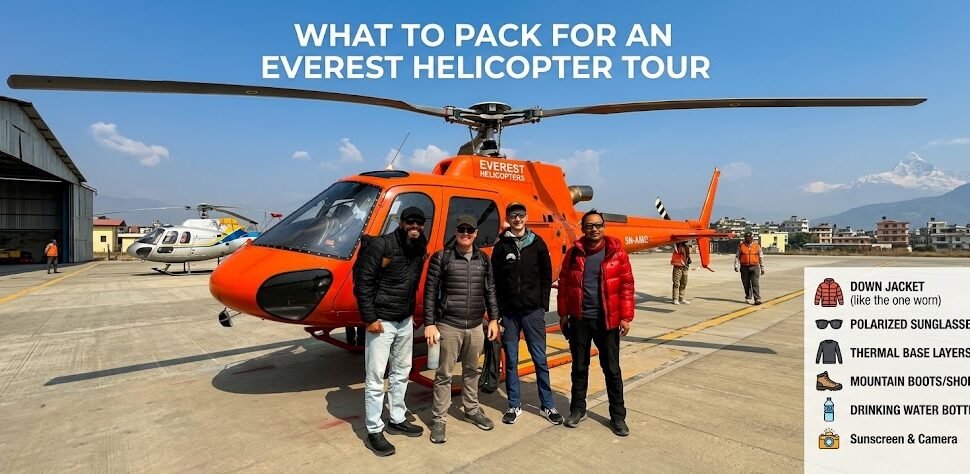
Warm clothing. Even in October or April, 3,880 metres is cool to cold, particularly in the morning before the sun has had time to warm the landscape. Keep your jacket on during the terrace photography session. The hotel dining room is warmer, but the terrace where the best views are is exposed to the mountain air.
Sunscreen and sunglasses. UV intensity at 3,880 metres is significantly higher than at sea level even on cool or overcast mornings. Snow and ice reflect UV effectively, increasing exposure further. Apply sunscreen before leaving the hotel in Kathmandu and keep sunglasses accessible throughout the morning.
A light appetite. As noted above, altitude suppresses appetite and large meals are not advisable. Come to the breakfast with modest expectations for the quantity you will eat, and focus on the quality of what you taste and the view that accompanies it.
Time for stillness. The most important thing you can bring to the Hotel Everest View breakfast is the willingness to be still. Put the camera down for at least a few minutes. Look at the mountains without composing a shot. Let the tea cool slightly and let the view settle into your consciousness without mediation. This is the moment where the experience transforms from activity into memory, and it requires nothing more than your presence and attention.
Explore our full range of helicopter tour options including the Everest Base Camp Helicopter Tour, the Kala Patthar Landing Tour, and the Honeymoon Package to find your perfect Khumbu morning.
What Past Guests Say: Testimonials from the Breakfast Table
No description of the Hotel Everest View breakfast experience is complete without acknowledging what travellers who have done it actually say afterward. The consistency of responses across different ages, nationalities, and types of travellers is striking and worth sharing.
Couples who have taken the helicopter breakfast as a honeymoon or anniversary experience consistently use the same words: memorable, extraordinary, surreal, perfect. Several have described the morning as more emotionally significant than they expected, with the mountains providing a context for their relationship that felt simultaneously humbling and expansive. The combination of physical intensity (the cold of Kala Patthar, the effort of altitude, the early morning wake-up), followed by the sudden warmth and stillness of the breakfast table with Everest through the window, creates an emotional contrast that couples find deeply bonding.
Solo travellers who have taken the breakfast tour often describe it as a turning point in how they think about travel. The experience of being genuinely alone with one of the world’s great landscapes, or sharing it briefly with strangers who become temporary companions in a shared moment of wonder, changes their sense of what travel can be. Many solo travellers who took the breakfast tour as a one-off Nepal experience report returning to Nepal specifically to trek to the Khumbu on foot, inspired by what the helicopter showed them.
Family groups, particularly those that include elderly grandparents who cannot trek, consistently describe the morning as one of the greatest shared experiences their family has had. The ability to bring a 75-year-old grandparent to Kala Patthar and then to a breakfast with Everest through the window, sharing the same view that trekkers work 12 days to earn, within a single accessible morning, is something that families return to again and again in conversation as a defining shared memory.
Professional travellers who have visited dozens of countries and hundreds of hotels almost universally rank the Hotel Everest View breakfast as the most memorable meal setting of their lives. For people who have eaten at Michelin-starred restaurants, resort properties on tropical islands, and rooftop restaurants in global cities, the combination of altitude, history, wilderness, and that unobstructed Everest view produces an experience that no other restaurant or hotel can replicate. The food is not Michelin-starred, it is good, straightforward mountain cooking, but the setting is singular, and setting is ultimately what creates the memory.
How to Include This Experience in Your Nepal Itinerary
Adding the Hotel Everest View breakfast to your Nepal itinerary requires minimal planning beyond booking the helicopter tour that includes it. Because the tour is completed by mid morning, it fits naturally into any Nepal schedule without consuming a full day. A typical Nepal itinerary that includes the helicopter breakfast might look like this:
Day 1: Arrive in Kathmandu, check in, explore Thamel district and Boudhanath Stupa.
Day 2: Helicopter tour day. 4:30am pickup, return by 10:30am. Afternoon free for Pashupatinath, Swayambhunath, or Patan Durbar Square.
Day 3: Day trip to Bhaktapur, Nagarkot for sunset Himalayan views, or further cultural exploration in the Kathmandu Valley.
Day 4: Depart Nepal with a full Khumbu Himalayan experience including the Everest View breakfast already under your belt.
This four-day Kathmandu itinerary with a helicopter tour day is the most common template for short-stay Nepal visitors, and the helicopter breakfast is consistently the highlight that participants describe when they return home. You do not need to be in Nepal for two weeks to experience the Khumbu at its best, you need one well-chosen morning and the willingness to be up before sunrise.
Book your experience now through our Everest Base Camp Helicopter Tour page, or explore our Honeymoon Package and EBC with Gokyo Heli Tour for extended versions of this extraordinary morning.