When you begin researching an Everest helicopter tour, you will often see helicopter names such as Airbus H125, AS350 B3e, AS350 B3 or simply B3. For travelers unfamiliar with aviation, these names can be confusing.
Are the H125 and B3e different helicopters? Is one more powerful than the other? Why are these particular helicopters commonly seen flying around Mount Everest, Everest Base Camp, Kala Patthar and the high valleys of the Khumbu region?
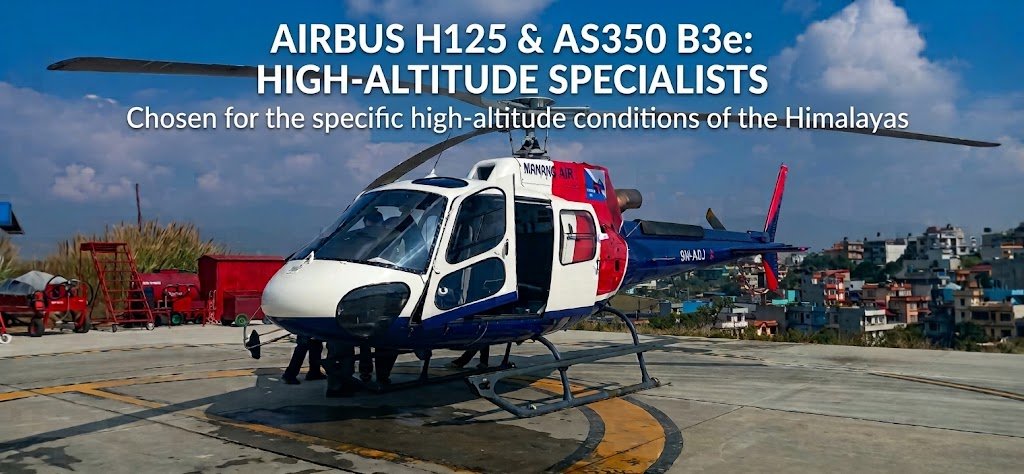
The simple answer is that the Airbus H125 is the current name of the AS350 B3e. It belongs to the proven Airbus Écureuil helicopter family and is designed to perform well in high-altitude and demanding mountain environments.
This does not mean that every H125 can carry a full cabin of passengers to any altitude or land anywhere near Everest. Himalayan helicopter operations depend on aircraft weight, fuel, temperature, wind, visibility, landing conditions and the final decision of the pilot.
However, the H125 has the power, responsive handling and high-altitude capability needed for operations in places where the air is thin and the terrain leaves little room for error. That is why it has become one of the most recognized helicopters for Everest sightseeing flights, mountain transport, and rescue work in Nepal.
What Is the Airbus H125 Helicopter?
The Airbus H125 is a light, single-engine turbine helicopter manufactured by Airbus Helicopters. It is part of the long-running Écureuil family, which includes helicopters previously manufactured under names such as the AS350.
In North America, the same helicopter family is commonly known as the AStar. In other parts of the world, including Nepal, pilots and operators may call it the H125, AS350 B3e, B3e or simply B3.
The H125 is not designed only for tourism. It is a multi-purpose helicopter used for passenger transport, mountain rescue, emergency services, firefighting, external-load work, law enforcement, aerial filming and utility operations.
Airbus reports that more than 7,200 helicopters from the wider Écureuil family have been delivered in 137 countries. Together, aircraft in this family have accumulated more than 40 million flight hours. The long service history is one reason operators understand the aircraft well and can access established training, maintenance and technical support.
For sightseeing operations, the H125 offers a relatively open cabin, wide windows and flexible seating arrangements. Its standard passenger configuration can accommodate one pilot and up to six passengers, although the actual number carried on a Himalayan flight may be lower because altitude performance depends heavily on weight.
Is the AS350 B3e the Same as the Airbus H125?
Yes. The AS350 B3e and Airbus H125 are essentially the same modern helicopter under different names.
The aircraft was originally marketed under the Eurocopter name as the AS350 B3e. Eurocopter later became Airbus Helicopters, and the company introduced a new naming system for its helicopter range.
The AS350 B3e was redesignated as the Airbus H125. Airbus states that the H125 is the current designation for the AS350 B3e Écureuil. The H125 name became the modern commercial identity, while the B3e name remains widely used by pilots, engineers and helicopter operators.
This is why a traveller may book an Everest helicopter tour advertised with an H125 and then hear the pilot or ground staff refer to the helicopter as a B3e.
They are not necessarily discussing two different aircraft.
What does the “e” in B3e mean?
The B3e was an improved development within the AS350 B3 series. One of its most important upgrades was the Safran Arriel 2D engine, together with modern engine-management technology.
The B3e name therefore identifies a later and more advanced version of the B3 family. When Airbus changed the product name to H125, the aircraft itself did not suddenly become a completely different helicopter.
A practical way to understand the naming is:
AS350 B3: An earlier high-performance version of the AS350 family.
AS350 B3e: A later version equipped with the Arriel 2D engine and updated systems.
Airbus H125: The current Airbus name for the AS350 B3e.
The older AS350 B3 is especially important in Himalayan aviation history because it was the variant used for the record-setting Mount Everest summit landing in 2005. The current H125 continues the high-altitude design heritage of that helicopter family, but it is important not to claim that the record aircraft itself was a B3e.
Why Is the H125 Suitable for Everest Helicopter Tours?
An Everest helicopter tour is different from a normal sightseeing flight over a city or low-altitude landscape.
The aircraft leaves Kathmandu at approximately 1,400 metres and flies towards the much higher terrain of the Everest region. Along the route, it may pass Lukla, Namche Bazaar, Tengboche, Dingboche, Pheriche, Lobuche, the Khumbu Glacier and Everest Base Camp.
Some itineraries also include a short landing in the Everest region when weather, weight and local operating conditions permit.
As the helicopter climbs, the air becomes thinner. Thin air affects the engine, rotor blades and the amount of lift the helicopter can produce. The aircraft must work harder while having less air available.
The H125 is used in the Everest region because it was developed for demanding operations in high and hot environments. Its combination of engine power, low airframe weight, rotor performance and responsive controls gives experienced mountain pilots an aircraft suitable for thin-air operations.
1. Strong Performance in Thin Mountain Air
Helicopters do not perform the same way at every altitude.
At lower elevations, dense air helps the rotor blades produce lift. At higher elevations, the air has fewer molecules. The rotor blades must move through thinner air, while the engine also has less oxygen available.
This creates a condition pilots describe through density altitude. Density altitude is not simply the height shown on a map. It is the altitude at which the helicopter feels it is operating after air pressure and temperature are considered.
A landing place may be located at 4,500 metres, but on a warmer day the aircraft can perform as though it is flying even higher. This is one reason early-morning flights are generally preferred for Everest helicopter tours. Morning conditions are often cooler, and mountain weather is normally more stable before clouds and strong winds develop.
Airbus lists the H125’s maximum flight altitude as 7,010 metres or 23,000 feet. Its certified out-of-ground-effect hover ceiling at maximum takeoff weight is around 3,871 metres or 12,700 feet under standard atmospheric conditions. The difference between those numbers is important. Flying through an altitude is not the same as hovering there at maximum weight.
At higher landing points, pilots manage fuel and payload carefully rather than assuming the helicopter can hover at its published maximum takeoff weight.
2. The Safran Arriel 2D Engine
The Airbus H125 is powered by one Safran Arriel 2D turboshaft engine.
According to Airbus and Safran, the engine provides up to 952 shaft horsepower for takeoff and 856 shaft horsepower as maximum continuous power. It is controlled by a dual-channel Full Authority Digital Engine Control system, commonly called FADEC.
FADEC is an electronic engine-management system. Instead of requiring the pilot to make every engine adjustment manually, it controls important engine functions and helps keep the engine operating within the correct limits.
This is especially valuable in mountain flying because the pilot is already monitoring terrain, wind, cloud movement, aircraft weight, landing conditions and escape routes.
The engine’s available power does not remove the challenges of high-altitude flight. It gives the helicopter a stronger performance base from which the pilot can make safe operational decisions.
Safran states that the Arriel 2D was certified in 2011 and powers both the Airbus H125 and H130. It also has a published time between overhaul of 5,000 hours. The wider Arriel engine family has accumulated more than 66 million operating hours across different helicopter types.
3. A Favourable Power-to-Weight Relationship
A helicopter may have a powerful engine, but engine power alone does not determine mountain performance.
The weight of the aircraft also matters.
The helicopter must lift its airframe, pilot, passengers, fuel, baggage and any additional equipment. Every additional kilogram affects the amount of power required to hover and climb.
The H125 combines a relatively light airframe with a powerful turbine engine. This produces the strong power-to-weight relationship that is valuable in the Himalayas.
Airbus lists the helicopter’s maximum internal takeoff weight at up to 2,370 kilograms when equipped with the applicable dual-hydraulic configuration. However, a published maximum does not mean the aircraft will depart for every high-altitude flight at that weight.
For an Everest helicopter tour, the pilot and operations team calculate the allowable load for the actual conditions that morning.
They consider:
The weight of each passenger
The amount of fuel required
Baggage and equipment
Outside air temperature
Wind direction and speed
Expected landing altitude
Available landing space
Surface conditions
Cloud and visibility
The amount of fuel needed for diversion or operational reserves
This is why every passenger is asked to provide an accurate body weight before the flight. It is not an unnecessary booking question. It is part of aircraft load planning.
4. Flexible Passenger Configuration
The Airbus H125 can be configured for one pilot and up to six passengers. Its cabin has forward-facing seating options, broad visibility and baggage compartments that make it suitable for passenger transport and sightseeing.
However, the number of available seats and the number of passengers carried to a high-altitude landing are not always the same.
A helicopter may carry more passengers between Kathmandu and Lukla or another lower-altitude airport than it can carry during a landing operation near Kala Patthar.
For this reason, passengers may occasionally be divided into smaller groups before the highest section of the flight. The exact arrangement depends on the combined passenger weight, aircraft configuration and conditions on the day.
A responsible operator should never guarantee that every seat will remain occupied during the highest-altitude section simply because the cabin physically contains those seats.
5. Good Visibility for Mountain Flying
Visibility from the cockpit is extremely important in the Himalayas.
Mountain pilots must continuously observe ridgelines, valleys, clouds, wind movement, landing areas and possible escape paths. Passengers also book an Everest helicopter tour because they want clear views of the mountains.
The H125 has a compact cabin with large windows and good external visibility. Airbus describes the aircraft as having built-in manoeuvrability, low cabin vibration and excellent visibility.
Depending on seating configuration, passengers can see different sides of the Himalayan landscape during the journey. The pilot may also adjust the flight path when operationally possible so that passengers on both sides can enjoy the major mountain views.
Nevertheless, the aircraft is not flown solely to improve photographs. Terrain clearance, traffic, weather and instructions from air traffic control always come before sightseeing preferences.
6. Responsive Handling in Mountain Terrain
The Khumbu region contains deep valleys, steep ridgelines, glaciers and rapidly changing weather.
Mountain airflow can behave very differently from the wind reported at an airport. Air may rise along one slope and descend sharply behind a ridge. Valleys can channel wind, and clouds can form quickly around high peaks.
The H125 is known for responsive handling and manoeuvrability, making it suitable for experienced pilots working in confined mountain areas.
That responsiveness should not be confused with the ability to fly in all conditions. Even a high-performance helicopter has operational limits.
The safest decision may be to delay departure, change the route, avoid a landing, use a lower landing point or return to Kathmandu. The pilot has final authority because the conditions visible from the cockpit may be different from those seen by passengers on the ground.
7. Proven Use in Nepal’s Mountain Environment
The H125 and earlier AS350 variants have been widely used in Nepal for mountain flights, passenger transport and rescue operations.
Airbus reported in a 2018 feature that the H125 represented a large majority of Nepal’s light single-engine helicopter fleet at that time. The same report described how Nepalese operators use the aircraft for operations in areas where altitude, terrain and weather create significant challenges.
More recently, Airbus reported in March 2026 that 30 H125 helicopters were operating in Nepal across 13 operators. Airbus also brought an H125 virtual-reality simulator to Nepal for pilot training focused on emergency procedures, mountain flying and high-altitude decision-making.
This local operating experience matters.
A capable helicopter is only one part of a safe Everest helicopter tour. The operator must also have properly maintained aircraft, licensed pilots, experienced engineers, realistic weather procedures and strong knowledge of the Everest region.
The AS350 B3 and the Mount Everest Landing Record
The connection between the AS350 family and Mount Everest is one of the most remarkable stories in helicopter history.
On 14 May 2005, test pilot Didier Delsalle landed an AS350 B3 on the summit of Mount Everest. The helicopter touched down at approximately 8,848 metres and later took off again.
The achievement established the world record for the highest helicopter landing and takeoff, a record Airbus says remains unbroken.
This record is often used in marketing for Everest helicopter tours, but it needs to be explained honestly.
The summit landing was a carefully prepared test flight performed by a highly experienced test pilot in a controlled aircraft configuration. It does not mean that tourist helicopters land on the summit of Mount Everest.
Normal Everest helicopter tours do not land on the Everest summit, Everest Base Camp glacier or any random mountain location requested by passengers.
Tour landings are limited to approved or operationally suitable areas. They depend on aviation rules, weather, aircraft performance, local restrictions and the pilot’s decision.
The record demonstrates the capability of the AS350 design family. It should not be presented as a normal tourism operation.
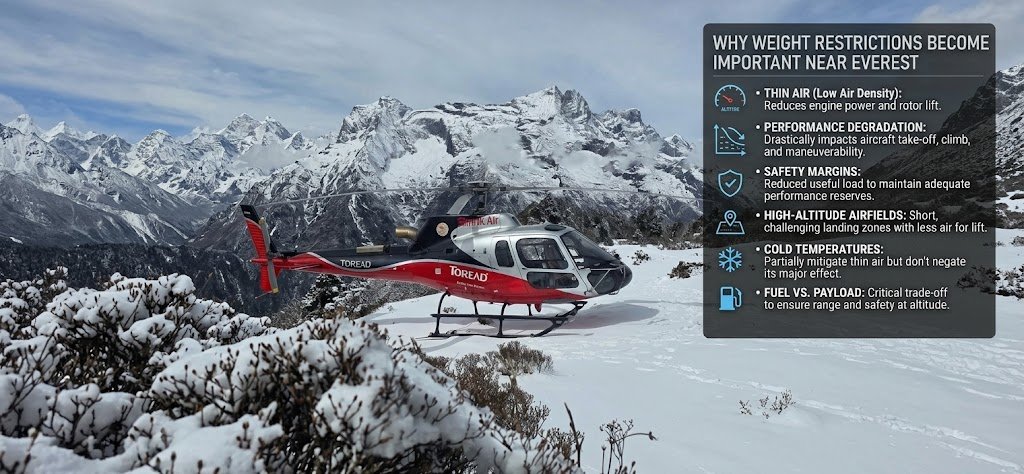
Why Weight Restrictions Become Important Near Everest
Passengers sometimes ask why they must provide their weight or why a helicopter that has six passenger seats cannot always take six travellers to the highest landing point.
The reason is simple: the helicopter’s lifting ability decreases as altitude and temperature increase.
A lighter helicopter requires less power to hover. Removing weight creates a larger performance margin for the pilot.
Fuel is also weight. The aircraft needs enough fuel to complete the planned flight safely, but carrying unnecessary fuel into the highest section would reduce available payload.
Operations teams may therefore plan refuelling stops, divide passengers or adjust the sequence of the flight. Airbus has described how Himalayan operators carefully manage helicopter weight and fuel during high-altitude missions because thin air reduces performance.
Passengers should never hide their correct weight to avoid being divided into another shuttle. Accurate information is essential for load calculations and seating arrangements.
Does the H125 Guarantee a Kala Patthar Landing?
No helicopter type can guarantee a landing near Kala Patthar.
The Airbus H125 has the high-altitude performance needed for demanding Himalayan operations, but a landing still depends on the conditions at the time the helicopter reaches the area.
The pilot must assess:
Cloud cover and visibility
Wind speed and direction
Snow or loose surface conditions
The number and weight of passengers
Other helicopter traffic
Available power
Landing-area condition
Local operational restrictions
A tour may fly into the Everest region but be unable to complete the planned landing. In that situation, the pilot may select a safer alternative or continue with aerial sightseeing.
A cancelled landing does not automatically mean the helicopter lacks power. It may mean the pilot is protecting the passengers from a combination of weather, terrain and limited landing margins.
Is a Single-Engine H125 Safe for an Everest Helicopter Tour?
The H125 is a single-engine helicopter, meaning it has one turbine engine rather than two.
Some travellers assume that two engines automatically make a helicopter safer in every situation. The reality is more complicated.
Aircraft safety depends on certification, maintenance, pilot training, operational planning, weather decisions and whether the aircraft is suitable for the intended mission.
The H125 is widely used for high-altitude operations because it offers strong performance for its weight. A heavier twin-engine helicopter may not provide the same payload or hover performance at a particular mountain altitude.
The H125 includes systems intended to reduce pilot workload and improve monitoring. Modern versions use Airbus’ Vehicle and Engine Multifunction Display, while current aircraft may include a touchscreen glass cockpit and Garmin avionics. Airbus states that the display allows pilots to monitor major aircraft and engine information clearly during flight.
The helicopter model alone, however, cannot guarantee safety. Travellers should also consider the operator, aircraft maintenance, pilot experience and willingness to cancel a flight when conditions are unsuitable.
H125 Technical Specifications
The following figures are published by Airbus for the current H125. Actual tour performance varies with aircraft configuration and daily operating conditions.
Engine: One Safran Arriel 2D turboshaft engine
Maximum takeoff power: 952 shp
Maximum continuous engine power: 856 shp
Maximum flight altitude: 7,010 metres or 23,000 feet
Fast cruise speed: Approximately 252 kilometres per hour or 136 knots
Maximum published range: Approximately 630 kilometres or 340 nautical miles
Maximum published endurance: Approximately 4 hours and 27 minutes
Maximum occupants: One pilot and up to six passengers, depending on configuration
Main rotor diameter: Approximately 10.69 metres
Maximum internal takeoff weight: Up to 2,370 kilograms with the applicable configuration
These are manufacturer specifications, not a promise that the helicopter will carry a maximum load at its maximum altitude.
What Passengers Should Understand Before Booking
The H125 is one of the most suitable helicopters for Everest sightseeing operations, but a good tour depends on much more than the aircraft name.
Before booking, ask whether the price is based on a shared or private flight. Confirm the expected route, possible landing locations, passenger-weight rules and what happens when weather prevents the planned flight.
You should also understand that the final itinerary may change on the morning of departure.
A clear morning in Kathmandu does not always mean the weather is clear near Lukla, Namche Bazaar or Everest Base Camp. Conditions can differ from one valley to another.
A trustworthy helicopter tour company should provide direct information rather than guaranteeing a landing that remains under the pilot’s control.
Frequently Asked Questions
Are Airbus H125 and AS350 B3e different helicopters?
No. The H125 is the current Airbus designation for the AS350 B3e. The B3e name is still commonly used by helicopter pilots and operators.
Is the AS350 B3 the same as the B3e?
They belong to the same helicopter family, but they are not exactly the same variant. The B3e is a later development equipped with the Safran Arriel 2D engine and updated systems.
Which helicopter landed on the summit of Mount Everest?
An AS350 B3 piloted by Didier Delsalle landed on the summit of Mount Everest on 14 May 2005. It was an earlier version of the helicopter family that later developed into the B3e and H125.
Do Everest helicopter tours land on the summit?
No. Tourist helicopter flights do not land on the summit of Mount Everest. Depending on conditions and current operating arrangements, a tour may include an approved landing elsewhere in the Everest region.
How many passengers can an H125 carry?
The cabin can be configured for one pilot and up to six passengers. At high altitude, the actual passenger load may be reduced according to weight, fuel, temperature and landing conditions.
Why do passengers need to provide their body weight?
The operations team needs accurate passenger weights to calculate the aircraft’s total load, seating arrangement, fuel requirement and high-altitude performance.
Can an H125 fly when the weather is cloudy?
It depends on visibility, cloud location, wind and the planned route. Flights may be delayed, changed or cancelled when the pilot considers the conditions unsuitable.
Is the H125 used only for helicopter tours?
No. The H125 is also used for mountain rescue, utility work, law enforcement, emergency services, firefighting, passenger transport and aerial filming.
Final Thoughts
The Airbus H125, previously known as the AS350 B3e, has earned an important place in Himalayan aviation.
Its strong Arriel 2D engine, favourable power-to-weight relationship, responsive handling and high-altitude capability make it well suited to the challenging environment of the Everest region.
Its connection to Mount Everest is also historic. The earlier AS350 B3 set the world record for the highest helicopter landing and takeoff when it landed on the summit in 2005.
But the helicopter’s impressive record should never be used to make unrealistic promises.
A safe Everest helicopter tour depends on the aircraft, experienced high-altitude pilots, proper maintenance, accurate passenger weights, careful fuel planning and a willingness to change the flight when the mountains are not suitable.
When all these parts work together, the H125 offers travellers an extraordinary opportunity to see Everest, the Khumbu Glacier, Himalayan villages and some of the highest mountains on Earth within a single morning.