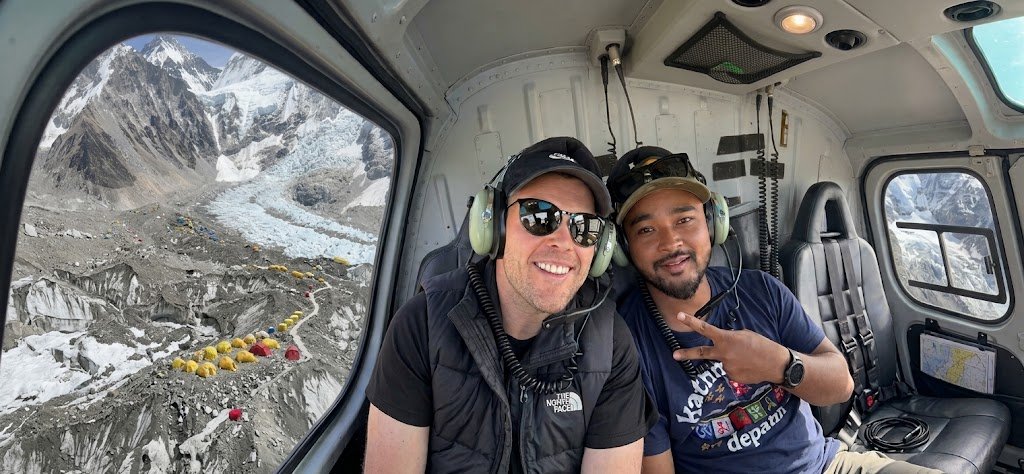
When people ask whether an Everest helicopter tour is safe, they usually mean one thing: will the weather cooperate, and will the ride be smooth. Those are fair questions, and we answer them in detail in our broader look at how safe an Everest helicopter tour really is. But there is a second, quieter question that matters just as much and gets asked far less often: who is actually flying this helicopter, how old is it, who signed off on its last inspection, and what rules govern all of that in Nepal.
This article is about that second question. We are not going to talk about turbulence or cloud cover here. We are going to walk through the actual machinery of trust behind an Everest helicopter tour: the regulator that licenses pilots and certifies operators in Nepal, the flight hour and training standards a pilot is expected to meet before commanding a flight into the Khumbu Valley, how an aircraft like the Airbus H125 is kept airworthy between flights, and what a traveler can reasonably ask any operator, including us, to confirm before handing over a deposit.
Everest Helicopter Tour is a Kathmandu based operator running the Everest Base Camp Helicopter Tour and related Himalayan flights using the Airbus H125 (AS350 B3e), the aircraft most widely used for mountain tourism and mountain rescue work in Nepal. We think travelers deserve a plain, honest explanation of how this industry is regulated and how a well run operator actually functions day to day, not marketing language about safety with nothing behind it. So here is the real framework, sourced from Nepal’s civil aviation regulator and general facts about this aircraft type, along with the questions you should feel free to put directly to us or to any company you are considering.
Who Regulates Helicopter Tourism in Nepal
Every commercial flight in Nepal, whether it is a fixed wing flight to Pokhara or a helicopter tour past Everest Base Camp, sits under the authority of the Civil Aviation Authority of Nepal, generally shortened to CAAN. CAAN was established at the end of 1998 under the Civil Aviation Authority Act, taking over responsibilities that had previously sat inside the Department of Civil Aviation within a government ministry. It is headquartered in Kathmandu and reports through Nepal’s Ministry of Culture, Tourism and Civil Aviation, though it operates as the country’s designated safety regulator, similar in function to the Federal Aviation Administration in the United States or the Civil Aviation Authority in the United Kingdom.
CAAN’s job covers a long list of responsibilities that touch every part of how a helicopter tour company operates. It issues and renews the licenses held by pilots, engineers, and other aviation personnel. It certifies aerodromes and helipads, including the ones used for mountain landings. It grants and audits the Air Operator Certificate, often called an AOC, that a company must hold before it can legally sell seats on a helicopter for hire. It sets the technical requirements operators must follow for maintenance, flight operations, and crew training. And through its Aircraft Accident and Incident Investigation Division, it investigates when something does go wrong, feeding lessons back into the rules that govern everyone else.
An Air Operator Certificate is the document that actually makes a company allowed to fly paying passengers. To get one, an operator has to show CAAN it has qualified pilots and engineers on staff or under contract, an approved system for maintaining its aircraft, an operations manual describing exactly how flights are planned and conducted, and a safety management system for tracking hazards and near misses over time. This is not a one time approval either. CAAN inspectors carry out ongoing audits, and an operator can lose its certificate, or have it restricted, if it fails to keep meeting these standards.
A Regulator Under Its Own Scrutiny
We think it is worth being honest about something rather than pretending it does not exist. Nepal’s broader civil aviation sector, mostly its fixed wing airlines, has spent years on the European Union’s air safety list, which restricts certain Nepali carriers from operating into European airspace. This designation has been reviewed repeatedly, and Nepal’s government has pursued reforms in response, including proposals to split CAAN’s dual role as both regulator and service provider into two separate bodies, a structure that international bodies like the International Civil Aviation Organization have recommended for years. As of 2026, that reform process is still ongoing, and discussions with the European Union continue.
Why mention this in an article about helicopter safety? Because it makes the point we most want travelers to understand. A national regulator sets the floor, not the ceiling. CAAN licensing is the baseline every legal operator in Nepal must meet, and it is a real, meaningful baseline. But the gap between an operator that does the legal minimum and one that goes well beyond it, in pilot experience, in maintenance discipline, in how it handles a marginal weather day, is enormous. That gap is exactly what the rest of this article is about, and it is why we always encourage travelers to look past a company’s marketing and ask specific, pointed questions, something we cover at length in our guide to warning signs of scam and fake operators in Nepal’s helicopter tourism market.
| CAAN Function | What It Means For Your Tour |
|---|---|
| Pilot and crew licensing | Sets the legal minimum qualifications a person must hold before commanding a commercial helicopter |
| Air Operator Certificate approval | Confirms the company itself, not just the pilot, meets standards for maintenance, operations, and safety management |
| Aerodrome and helipad certification | Covers landing sites such as those used for mountain stops on tourist routes |
| Technical standards and directives | Defines maintenance, inspection, and airworthiness requirements aircraft must meet to keep flying |
| Accident and incident investigation | Feeds real world findings back into rules and enforcement across the industry |
What It Takes to Become an Everest Helicopter Pilot
A helicopter pilot flying tourists past Everest Base Camp did not walk into that seat straight out of flight school. The path there runs through several distinct stages, each with its own requirements, and the gap between the legal minimum and what a responsible operator actually requires is significant.
The Licensing Ladder
Every helicopter pilot begins with a Private Pilot License, which typically requires somewhere around 40 to 50 hours of flight training and allows a person to fly a helicopter but never for hire. To fly passengers commercially, a pilot must then earn a Commercial Pilot License, known as a CPL(H). International civil aviation standards set a minimum total flight time for this license, generally in the range of 150 hours, though individual countries, Nepal included, can and do set requirements above that floor. This license, combined with a valid medical certificate and passing written and practical exams, is what legally permits a pilot to be paid to fly passengers.
Holding a CPL(H) is only the entry point, not the finish line, for flying tourist routes into the Himalaya. Before a pilot ever sits at the controls with paying passengers headed toward Everest, they need a type rating on the specific aircraft, in our case the Airbus H125 or its earlier AS350 B3e designation. A type rating involves dedicated ground school on that aircraft’s systems and limitations, followed by supervised flight training and a formal check ride with an examiner. It confirms the pilot actually knows this machine, not just helicopters in general.
| Stage | Typical Requirement | What It Establishes |
|---|---|---|
| Private Pilot License | Around 40 to 50 flight hours | Basic control and handling skill, no paid passengers |
| Commercial Pilot License, CPL(H) | Roughly 150 hours total time as a common international minimum, higher in many countries | Legal authority to fly passengers for hire |
| Type rating on H125 or AS350 B3e | Dedicated ground and flight training on the specific aircraft, checked by an examiner | Demonstrated competence on the exact helicopter used for the tour |
| Mountain and route qualification | Supervised flights into Himalayan valleys, often built over a year or more and hundreds of additional hours | Judgment for density altitude, confined landings, and fast changing mountain weather |
| Command status on Everest routes | Typically several thousand total flight hours, a large share of them in Nepal’s mountains on this aircraft type | The experience base most reputable operators require before a pilot commands passengers to Everest Base Camp or beyond |
Mountain and High Altitude Training Beyond the License
None of the licenses above, by themselves, teach a pilot to fly safely into the Khumbu Valley. That comes from a separate body of training and accumulated experience specific to mountain flying, and it is where the real difference between operators shows up most clearly.
Mountain flying training covers density altitude, which is the effective performance altitude an aircraft experiences once temperature and pressure are accounted for. A helicopter behaves very differently at 3780 meters on a warm afternoon than it does at sea level, and a pilot has to plan power margins, fuel loads, and passenger weight with that difference constantly in mind. Training also covers confined area landings, since spots like Everest Base Camp itself and the terrace at Hotel Everest View in Syangboche do not offer the wide, flat approach paths a pilot would have at a normal airport. Pilots learn steep, controlled approach and departure techniques, how to read rotor wash and wind behavior around ridgelines and valley walls, and how quickly Himalayan weather can shift from clear to closed in.
Physiology matters here too. Flying and briefly landing at elevations between roughly 4000 and 5500 meters, which is where routes to Everest Base Camp and the Kala Patthar landing point sit, exposes crew to thinner air and lower oxygen levels than they experience at Kathmandu’s own elevation of about 1400 meters. Pilots receive training on the physical effects of that reduced oxygen on judgment and reaction time, which matters because a pilot needs to make sharp decisions in exactly the environment where thin air makes sharp thinking harder. This is also part of why our own guide to altitude sickness on this tour is worth reading before you fly, since the same thin air affects passengers too, even during a short stop.
Because none of this can be taught in a classroom alone, the standard path in Nepal’s helicopter industry is a long apprenticeship. A newly type rated pilot typically flies dozens or hundreds of hours alongside a senior route captain on the exact routes they will eventually fly solo, building familiarity with specific landmarks, specific wind patterns at specific times of day, and specific landing zones, before ever being cleared to carry passengers into the mountains without supervision. Operators that take safety seriously treat this progression as non negotiable, regardless of how experienced a pilot already is on paper.
Staying Current
Licensing is not a one time achievement. Commercial pilots in Nepal go through recurrent training and periodic check flights with senior training captains to confirm their skills remain sharp, their emergency procedures are current, and their judgment continues to meet the standard the operator expects. Crew Resource Management training, which focuses on communication, decision making under pressure, and catching each other’s mistakes before they matter, is part of this ongoing cycle as well. A pilot who flew safely five years ago still has to prove, on a recurring basis, that they fly safely today.
The Aircraft: Why the H125 and How It Stays Airworthy
The helicopter itself matters just as much as the person flying it, and this is where the Airbus H125, still often called by its earlier name AS350 B3e, earns its reputation. We cover the aircraft’s story in more depth in our detailed guide to the Airbus H125, but the short version relevant to safety is this: the H125 is a single engine helicopter built specifically to keep flying strongly in thin, high altitude air where many other aircraft lose the power margin they need.
Built for Thin Air
The H125 is powered by a Safran Arriel 2D turboshaft engine managed by a dual channel Full Authority Digital Engine Control system, commonly called FADEC, which continuously adjusts engine performance for changing conditions rather than leaving that work entirely to the pilot’s throttle hand. This combination gives the aircraft an unusually strong power reserve for its size, which is precisely what mountain flying demands, since a helicopter needs spare power available for hovering, for climbing quickly out of a valley, and for handling gusts near terrain.
That power margin is not a marketing claim, it is demonstrated history. In 2005, a test pilot flying this aircraft’s earlier variant set the world helicopter altitude record by landing on the summit of Everest itself, at 8849 meters, a feat that remains one of the most extreme demonstrations of any helicopter’s high altitude capability on record. The same aircraft family has since logged tens of millions of flight hours across well over a hundred countries, doing everything from firefighting and power line work to emergency medical evacuation and, closer to our own operation, mountain rescue throughout the Himalaya. It is the aircraft search and rescue teams in Nepal themselves rely on when a climber needs to be lifted off a mountainside, which is a strong practical endorsement of its reliability in exactly the terrain our tours fly through.
How Maintenance Actually Works
An aircraft this capable still only stays safe through disciplined maintenance, and the H125 follows a maintenance structure set by Airbus Helicopters and enforced through Nepal’s civil aviation rules, which require operators to maintain their aircraft under an approved maintenance program, either through their own certified maintenance organization or a contracted one.
That program blends two different kinds of scheduling. Some inspections are triggered purely by flight hours, since parts wear according to how much they are actually used. Others are triggered by calendar time regardless of hours flown, since rubber seals age, hydraulic fluid degrades, and metal fatigues from vibration and temperature cycling even when an aircraft sits idle. A responsible maintenance program tracks both clocks at once for every component on the aircraft, not just the obvious ones like the engine.
| Maintenance Activity | Typical Trigger | What It Covers |
|---|---|---|
| Pre flight inspection | Before every single flight | Visual walkaround of the airframe, rotor blades, fluid levels, control linkages, and fasteners |
| Post flight inspection and log entry | After every flight | Pilot records any unusual noise, vibration, or indication before the aircraft flies again |
| Minor scheduled inspection | Roughly every 50 flight hours | Detailed check of engine, transmission, and flight control systems |
| Major scheduled inspection | Roughly every 100 to several hundred flight hours | More extensive inspection tasks defined in Airbus’s approved maintenance program for the H125 |
| Calendar based inspection | At fixed intervals such as every 12 months, regardless of hours flown | Aging effects that time and environment cause even when flight hours are low |
| Life limited component replacement | At the specific hour or calendar limit Airbus sets for that part | Main and tail rotor blades, hub components, and certain drivetrain parts, replaced on a fixed schedule rather than waiting for visible wear |
| Airworthiness directive compliance | As issued by the aircraft’s certifying authority | Mandatory design related inspections or fixes applied across the entire fleet of that aircraft type |
Pre Flight and Post Flight, Every Single Time
The table above describes the scheduled side of maintenance, but two of its rows deserve extra attention because they happen constantly, not on a calendar. Before every flight, a pilot walks around the aircraft checking rotor blades for damage, fluid levels for the engine and hydraulic systems, control linkages for play or wear, and the general condition of the airframe, engine cowlings, and landing gear. This is not a formality. On a morning when the Everest Base Camp Helicopter Tour may fly several rotations back to back, that walkaround happens again before each one, not just once at the start of the day.
After landing, the pilot logs anything unusual in the aircraft’s technical log, whether that is a slightly rough engine indication, an unfamiliar vibration, or simply nothing to report. A licensed engineer reviews that log and signs off before the aircraft is cleared to fly again. This cycle, fly, inspect, log, review, sign, repeat, is what keeps a maintenance program connected to how the aircraft is actually performing that day, rather than relying only on inspections scheduled weeks in advance.
Fuel and weight planning happen every flight too, and at altitude they carry more weight than they would at sea level. Because a helicopter’s available power shrinks as air gets thinner, pilots recalculate how much fuel and passenger weight the aircraft can safely carry on a given day based on temperature, altitude, and wind, sometimes limiting seats or adjusting fuel loads accordingly. This is one of the quieter reasons private charters and smaller group configurations exist alongside larger shared flights, since it gives an operator more flexibility to match weight to the day’s actual performance margins.
How This Compares to Standards Elsewhere
Nepal is far from the only place in the world running mountain helicopter tourism at altitude, and it is worth knowing that the practices described above are not unique to the Everest region. Helicopter tour operators working the Alps, the Canadian Rockies, and parts of Alaska follow broadly similar structures: a national aviation regulator issuing pilot licenses and operator certificates, manufacturer defined maintenance programs tied to both flight hours and calendar time, mountain specific pilot training beyond basic licensing, and safety management systems meant to catch small problems before they become large ones.
What sets the Everest region apart is not the framework, it is the terrain and altitude at the extreme end of what any of these systems are designed to handle. Landing at 3780 meters for breakfast at Hotel Everest View, or briefly touching down at 5545 meters for the Kala Patthar landing upgrade, asks more of a pilot’s judgment and an aircraft’s performance margin than almost anywhere else this kind of tourism happens. That is exactly why the H125’s power reserve at altitude, and why the depth of a pilot’s specific mountain route experience, matter so much more here than they would on a scenic flight over gentler terrain.
Weather adds another layer that any serious operator plans around rather than gambles with. Himalayan conditions can shift quickly, and a responsible company will delay or reschedule a flight rather than push into marginal conditions, even when that disappoints a traveler on a tight schedule. We explain exactly how that decision making works, along with what happens to your booking if it does, in our detailed weather cancellation and refund policy. A willingness to cancel or delay a flight for weather, even at real cost to the company, is itself one of the clearest signs of a safety focused operator, and it is worth remembering when you compare quotes from different companies.
Safety Management Systems and Insurance
Beyond licenses and inspection schedules, CAAN requires every Air Operator Certificate holder to run a safety management system, a structured way of tracking hazards, near misses, and minor incidents over time rather than only reacting after something serious happens. In practice this means a company keeps records of things like a rough landing in gusty wind, a maintenance squawk that recurred more than once, or a route where pilots consistently report tricky air currents, and then uses that information to adjust training, timing, or procedures before a pattern turns into an actual problem. It is a quiet, unglamorous part of running a helicopter operation, and travelers rarely see it directly, but it is one of the clearest differences between a company treating safety as an ongoing discipline and one treating it as a slogan on a website.
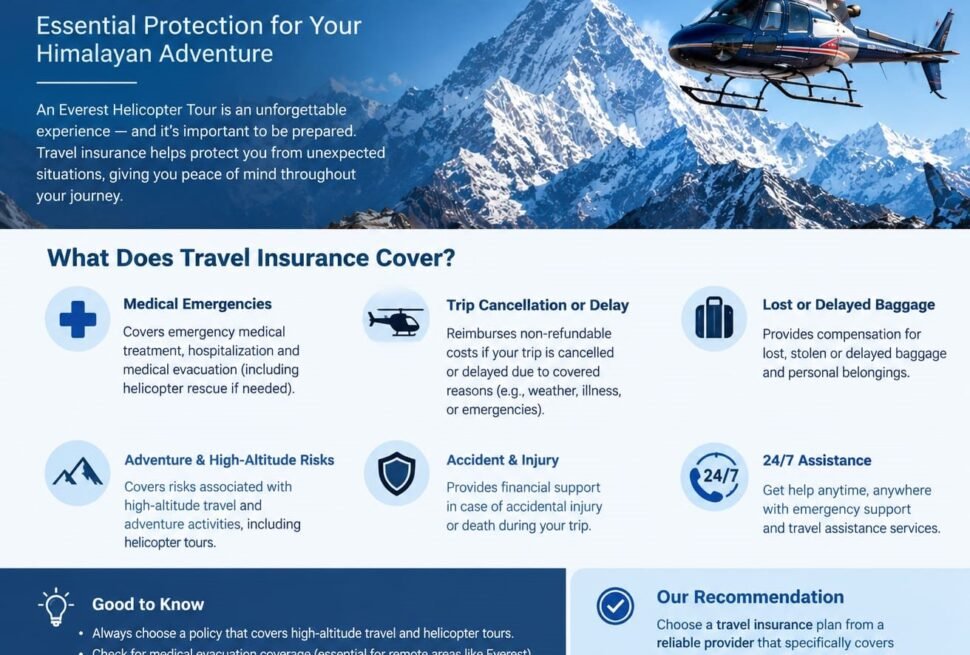
Insurance is the other piece worth understanding, since it protects you as a passenger and reflects how seriously a company takes its own obligations. A properly run operator carries passenger liability coverage appropriate to commercial helicopter tourism, on top of the aircraft insurance CAAN requires as part of holding an Air Operator Certificate. This is not the most exciting detail in a helicopter tour, but it is exactly the kind of unglamorous, verifiable fact that separates a serious operator from one cutting corners, and it belongs on the list of things you ask about rather than assume.
Questions Worth Asking Any Everest Helicopter Tour Operator
We would rather you ask hard questions before you book than assume every company selling this tour operates the same way. Here are the questions we think matter most, and that any operator confident in its own practices should be able to answer clearly and specifically, not with vague reassurance.
- Does the company hold a current Air Operator Certificate issued by CAAN, and can it name the certificate and confirm it is active
- What aircraft type will actually fly the tour, and how is that aircraft maintained, by an in house certified team or a contracted maintenance organization
- How many total flight hours does the assigned pilot hold, and how much of that time is specifically on Himalayan mountain routes rather than general flying elsewhere
- Has the pilot completed a supervised route qualification process on this specific tour before flying it in command
- What is the company’s actual policy when weather is marginal on the morning of a scheduled flight, and what happens to your payment if the flight is delayed or cancelled
- Are group flights limited to a specific passenger count for weight and performance reasons, and how is that limit enforced
- Does the price include hotel pickup and drop off in Kathmandu, and exactly what stops and landings are included, such as the breakfast stop at Hotel Everest View or the optional Kala Patthar landing
- What insurance coverage applies to the flight, and is it disclosed clearly before you pay a deposit
If a company hesitates on any of these, treats the questions as rude, or gives you an answer that does not actually address what you asked, that tells you something important on its own. Our own step by step walkthrough of the entire process, from first inquiry to the morning of your flight, is available in our step by step booking guide, and we would rather you use it to compare us against other companies than take our word for anything without checking.
What This Means for the Everest Base Camp Helicopter Tour
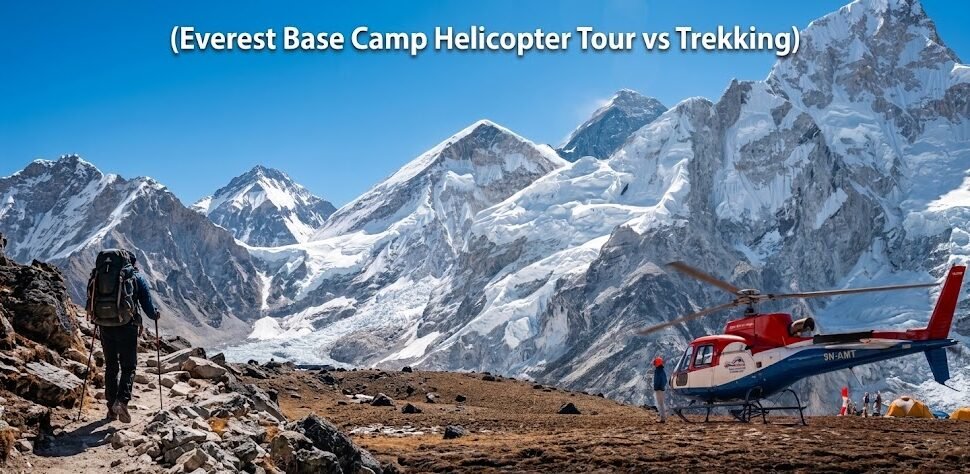
All of this framework exists for one practical reason: to get you safely to a view very few people ever see, and back again. Our flagship Everest Base Camp Helicopter Tour begins with hotel pickup in Kathmandu at roughly 1400 meters, then climbs into the Khumbu Valley, passing near Lukla at 2860 meters, before reaching an aerial pass directly above Everest Base Camp itself at 5364 meters, over the Khumbu Glacier and the Khumbu Icefall. From there the flight descends to Syangboche at 3780 meters for a landing and breakfast at Hotel Everest View, the Guinness World Record holder for the highest hotel with a direct view of Everest, before returning to Kathmandu. Total time from hotel pickup to hotel drop off runs about four to five hours. Along the way you will see Everest itself at 8849 meters, Lhotse at 8516 meters, Nuptse at 7861 meters, Makalu at 8485 meters, and Ama Dablam at 6812 meters, all from a vantage point almost no trekking route can match in a single morning.
Every part of that route sits within the exact operating envelope this article has described. The climb past Lukla and the pass above Base Camp both happen where density altitude and rotor performance genuinely matter, which is why the H125’s high altitude power margin is not a footnote for this particular flight, it is the reason the aircraft can do it at all. The landing at Syangboche and the optional stop at Kala Patthar both call on exactly the confined area landing training and route specific experience we described earlier. None of this is theoretical for the crew flying you. It is the same judgment, the same maintenance discipline, and the same regulatory framework, applied to the specific mountains you will be looking down at from the window.
Pricing reflects the different ways travelers choose to experience this flight. A shared group tour with five or more travelers per helicopter runs around 1250 dollars per person, while our Everest Helicopter Tour Group package runs around 1100 dollars per person. Travelers who want the aircraft to themselves can book a private helicopter charter, taking the whole aircraft for about five passengers, at around 4800 dollars total, and couples often choose our honeymoon private package at around 2800 dollars for a more personal flight. Travelers who want to stand at the highest point a tourist helicopter can legally reach in Nepal can add the Kala Patthar landing upgrade, at around 1250 dollars per person on a shared seat basis, landing briefly at 5545 meters, the highest tourist accessible helicopter landing point in the country.
Whichever version of the flight you choose, the safety framework behind it does not change. The same CAAN licensed pilots, the same maintenance discipline on the same aircraft type, and the same weather judgment apply whether you are in a shared seat or chartering the whole helicopter for your family.
Frequently Asked Questions
Is CAAN the same as an airline, or is it the government regulator
CAAN, the Civil Aviation Authority of Nepal, is the government regulator, not an airline or tour operator. It licenses pilots and engineers, certifies aircraft operators through the Air Operator Certificate process, certifies aerodromes and helipads, sets technical maintenance and operating standards, and investigates accidents. Every legal helicopter tour company in Nepal, including ours, operates under CAAN’s certification and ongoing oversight.
What license does a pilot need to fly an Everest helicopter tour
At minimum, a Commercial Pilot License for helicopters, known as a CPL(H), along with a valid medical certificate and a type rating on the specific aircraft, in this case the Airbus H125 or AS350 B3e. Beyond that legal minimum, responsible operators also require a supervised mountain route qualification process before clearing a pilot to command flights into the Everest region without direct supervision.
How many flight hours does a typical Everest helicopter pilot have
There is no single universal number, since it depends on the individual and the operator’s own internal standards, but pilots who command tourist flights into the Khumbu Valley and toward Everest Base Camp on a regular basis typically hold several thousand total flight hours, with a substantial share of that time specifically flown in Nepal’s mountains on the aircraft type they are flying.
How often is the helicopter itself inspected and maintained
The aircraft receives a visual inspection before every flight and another review after every flight, with any anomaly logged for an engineer to review before the next flight. Beyond that daily cycle, it follows Airbus’s approved maintenance program, which includes inspections at set flight hour intervals, separate inspections at set calendar intervals regardless of hours flown, and scheduled replacement of certain rotor and drivetrain components once they reach a fixed hour or calendar limit set by the manufacturer.
Why is the Airbus H125 used for Everest helicopter tours specifically
The H125, also known by its earlier name AS350 B3e, is built around a strong power margin at altitude, which matters enormously in the thin air of the Himalaya. An earlier variant of this aircraft set the world helicopter altitude record by landing on the summit of Everest in 2005, and the same aircraft family is widely used across the world for mountain tourism, aerial work, and mountain rescue, including rescue operations in Nepal itself.
What happens if the weather is not good on the day of my flight
A responsible operator will delay or reschedule the flight rather than fly into marginal conditions, since mountain weather in the Khumbu region can change quickly and safety margins matter more than keeping a fixed schedule. Our full policy on delays, cancellations, refunds, and rebooking is explained in our weather cancellation and refund policy, and we encourage you to compare it against any other operator’s stated policy before booking.
Will altitude affect me during the tour, even though I am only landing briefly
It can, particularly at the landing stops around 3780 meters and, for those adding the upgrade, 5545 meters at Kala Patthar. Most travelers feel nothing more than brief lightheadedness or shortness of breath during a short stop, but it is worth understanding the symptoms and precautions in advance, which we cover in our guide to altitude sickness on this tour.
How can I verify an operator’s safety practices before booking
Ask directly about the points covered in this article: whether the company holds a current CAAN Air Operator Certificate, the assigned pilot’s total hours and mountain specific experience, how the aircraft is maintained, and the company’s actual weather cancellation policy. A company confident in its own standards will answer clearly. We also outline common red flags to watch for in Nepal’s helicopter tourism market in our guide to warning signs of scam and fake operators.
Everest Base Camp from the air is one of the most extraordinary sights available to any traveler, and it deserves to be flown by people and equipment that have earned your trust in specific, checkable ways, not just a confident sales pitch. We have tried to lay out exactly how CAAN’s licensing works, what it actually takes for a pilot to command flights into these mountains, and how an aircraft like the Airbus H125 stays airworthy flight after flight, so you can ask good questions of any operator you consider, us included. When you are ready to see Everest, Lhotse, Nuptse, Makalu, and Ama Dablam from above the Khumbu Icefall and land for breakfast beneath the highest hotel view on earth, book your seat on our Everest Base Camp Helicopter Tour with a clear understanding of exactly who is flying you there and why we trust them to do it.
Related Reading
- Everest Helicopter Tour Experience: What Past Travelers Wish They Knew Before Booking
- Everest Helicopter Tour Plus Pokhara and Chitwan: Best Multi Day Nepal Packages
- Last Minute Everest Helicopter Tour Booking: Availability, Pricing and What to Know
- Everest Helicopter Tour for First Time Visitors to Nepal: Planning Your Trip From Arrival to Departure