Every week our reservations team gets some version of the same nervous message. “I am 95 kilos, can I still do the Everest helicopter tour?” Or, “My husband is a big guy, will they even let him on?” Or, from a photographer with two camera bodies and a 400mm lens, “How much gear can I actually bring up there?” These are good questions, and they deserve honest, specific answers rather than a vague reassurance that “it will be fine.” It usually is fine, but only because weight is planned for in advance, not guessed at on the morning of the flight.
Weight limits on an Everest helicopter tour are not a marketing detail or a bit of bureaucratic caution. They come directly from the physics of flying a helicopter at extreme altitude, and they affect every single passenger who books a flight toward Everest Base Camp or Kala Patthar, not just the heavier ones. A five foot two, 50 kilo traveller and a six foot three, 100 kilo traveller are both subject to the same underlying constraint, they just experience it differently. This guide is the deep explanation we wish every traveller read before booking, covering why the limits exist, what the real numbers tend to look like, how baggage allowance works, how the Pheriche shuttle system functions on shared flights, what happens at check-in, and what a heavier passenger or a photographer with serious gear should actually do about it. None of the figures below are promises for your specific flight. Aircraft configuration, fuel load, temperature, and wind on the day all shift the exact numbers, and any responsible operator will confirm the specifics with you directly. But the ranges and the reasoning are consistent across the industry, and understanding them will make your booking process and your flight day considerably less stressful.
Why a Helicopter That Carries Five People in Kathmandu Cannot Do the Same at Kala Patthar
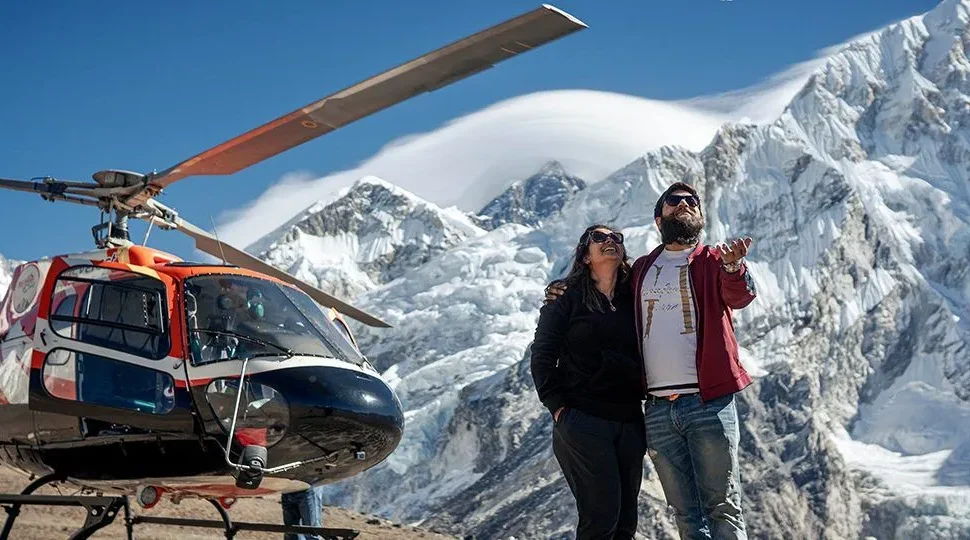
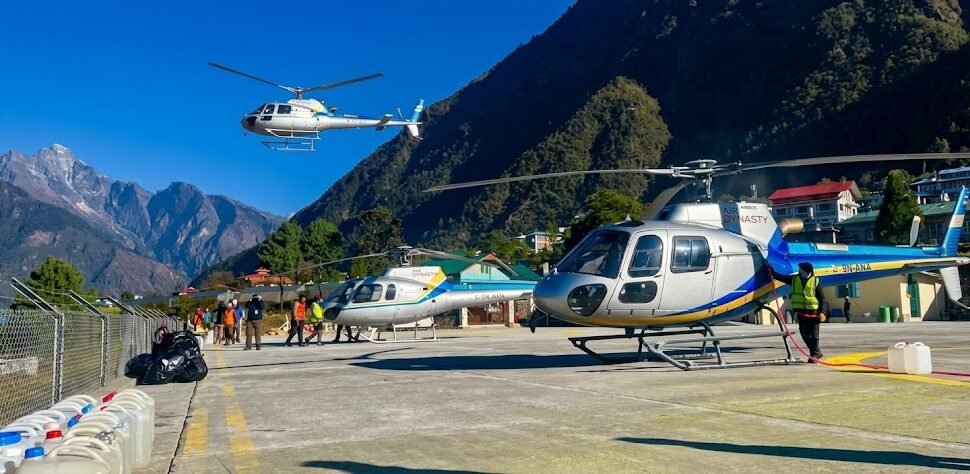
The aircraft most commonly used on this route, and the one we fly, is the Airbus H125, also known by its earlier name the AS350 B3e. It is a single engine helicopter with a strong reputation for high altitude performance, which is exactly why it has become the standard choice for Everest helicopter tours out of Kathmandu. We go into detail on the aircraft itself, its cabin layout, and why operators favor it over other models in our dedicated guide to the H125 and AS350 B3e, but the short version relevant here is this: at Kathmandu’s airport, sitting at roughly 1,400 meters above sea level, this aircraft can typically carry up to five passengers plus the pilot. That is the number most people fixate on when they picture the flight. What they do not picture is that the same aircraft, flying the same route an hour later, cannot carry that same load once it climbs toward Everest Base Camp or Kala Patthar, both of which sit above 5,000 meters.
The reason is air density, and it is worth explaining properly because understanding it removes most of the mystery and anxiety around weight limits. A helicopter rotor generates lift by pushing air downward as the blades spin. The amount of lift produced for a given rotor speed depends heavily on how dense the air is. At sea level, air molecules are packed relatively close together, so each pass of the rotor blade interacts with a lot of mass and produces strong lift. As altitude increases, atmospheric pressure drops, and the air thins out. At 5,000 meters, the air is roughly half as dense as it is at sea level. The rotor blades are moving through the same volume of space but encountering far fewer air molecules to push against, so they generate meaningfully less lift for the same amount of engine power and rotor RPM.
It is not only the rotor that suffers. The turboshaft engine itself also loses performance at altitude, because it too depends on a dense supply of oxygen to burn fuel efficiently. Thinner air means less oxygen intake per cycle, which means less power output from the same engine at the same throttle setting. So a helicopter climbing toward Everest is fighting a double penalty: the rotor is generating less lift per unit of power, and the engine is producing less power to begin with. Add to this the fact that temperature also drops with altitude in a way that further thins the air (though cold air is technically denser than warm air at the same pressure, the pressure drop dominates at these elevations), and you get a genuine, well understood aviation phenomenon called high altitude, high density altitude performance degradation. Pilots training for Himalayan flying spend a considerable amount of time studying exactly this.
What this means practically is that the payload, meaning the combined weight of passengers, baggage, and anything else on board beyond the aircraft and its fuel, has to shrink as the flight climbs higher. An aircraft that comfortably lifts five adults and their bags out of Kathmandu simply does not have the surplus lift available to carry that same load safely at 5,364 meters, which is roughly where Kala Patthar sits, or at the airstrip near Everest Base Camp. This is not a conservative rule invented by cautious operators. It is a hard physical ceiling, and pilots who ignore it are the ones you read about in accident reports. Every reputable operator flying the Everest helicopter tour from Kathmandu builds its passenger and baggage planning around this reality, and any operator who tells you weight does not matter at altitude is either inexperienced or not being straight with you.
What the Payload Numbers Actually Look Like
Because this varies by operator, by the specific aircraft and its exact configuration, by fuel load, and by the weather and temperature on the day of your flight, we are giving you industry-typical ranges here rather than a single fixed number, and we would encourage you to treat any operator who quotes you an oddly precise figure with a little skepticism unless they can explain how they arrived at it. That said, the pattern across operators flying the AS350 B3e and H125 on this route is consistent enough to describe clearly.
At lower altitudes, meaning Kathmandu itself and destinations up to around 4,000 meters such as some of the lower Everest region landing points, total payload capacity, which covers passengers and their baggage combined, commonly sits around 500 kilograms. That is enough, in most configurations, for five adult passengers at typical body weights plus a modest baggage allowance each. Above roughly 4,000 meters, where air density has dropped enough to matter significantly, that figure commonly falls to somewhere around 250 kilograms or a bit above, roughly half of the lower altitude capacity. Above about 4,400 meters, on the final approach segments into Everest Base Camp or the landing at Kala Patthar, capacity is often reduced further still, with some operators working to figures closer to 240 kilograms or even less depending on conditions that day.
To put that in concrete terms: a payload budget of around 240 to 250 kilograms for the highest segments of the flight might comfortably support two adult passengers at average weights along with a small baggage allowance and the safety margin the pilot needs to hold in reserve. It does not support five. This single fact is the reason the shuttle system exists, which we explain in detail further down, and it is the reason your booking conversation about weight matters more on this particular route than it would on almost any other short helicopter flight you might take elsewhere in the world.
Here is a simplified summary table. Treat every figure in it as a general planning range to confirm with your specific operator, not as a guarantee for your flight.
| Altitude band | Approximate elevation | Typical total payload capacity (passengers + baggage) |
|---|---|---|
| Kathmandu and lower valley | ~1,400m | Around 500kg (commonly up to 5 adults + bags) |
| Mid-route / lower Khumbu | up to ~4,000m | Around 500kg, tapering as altitude increases |
| Upper Khumbu approach | ~4,000m to 4,400m | Roughly 250kg or somewhat above |
| Kala Patthar / EBC landing zone | above ~4,400m, up to ~5,364m | Roughly 240kg or less |
Notice how sharply that final column drops. Between the valley floor and the landing zone near Kala Patthar, usable payload roughly halves, and then halves again. That is not a rounding error or operator caution stacked on operator caution, it is the direct arithmetic of air density loss over roughly 4,000 vertical meters. Once you see the numbers laid out this way, the entire logic of shared flight planning, the shuttle system, and the questions you get asked at booking start to make a great deal more sense.
Per Passenger Weight Limits and What They Mean for You
Individual passenger weight limits follow directly from the payload math above, but they get expressed as a per person figure because that is what a traveller actually needs to plan around. Across the industry, a commonly cited per passenger weight limit for a standard seat on this route sits somewhere in the 100 to 110 kilogram range. Passengers above that threshold are not turned away outright, but they typically need to book an additional seat, effectively occupying two of the aircraft’s five passenger positions so their weight is properly accounted for in the load plan. This is standard practice on the Everest helicopter tour and nothing to be embarrassed about. Aircraft seating on a helicopter is fundamentally different from a bus or even a fixed wing plane, because every kilogram on board directly affects whether the aircraft can generate enough lift at altitude, so operators have to treat weight as a hard planning input rather than an approximate guess.
If you are close to or above that 100 to 110 kilogram range, by far the best thing you can do is raise it with the operator at the time of booking, not on the morning of the flight. There are workable solutions. Booking an extra seat is the most common one, and it simply means your fare reflects the fact that your weight is displacing a seat that would otherwise carry another paying passenger. In a group booking, the operator may also adjust who else is on your particular flight, balancing heavier and lighter passengers across two departures rather than clustering several heavier travellers on one aircraft. For private charter bookings, adjusting the total load plan is often more flexible still, since you are not sharing capacity with strangers and the operator can plan the whole flight’s weight budget around your specific group from the outset. None of these are difficult problems to solve. They only become difficult, and occasionally embarrassing, when they are discovered for the first time at the helipad scale on departure morning with other passengers waiting.
We would also gently push back on the instinct some heavier travellers have to under-report their weight when booking, thinking a few kilograms here or there will not matter or will not be checked. It is checked, and it does matter, for reasons that go well beyond comfort or fairness to other passengers. We cover the weighing process in detail further down, but the short version is that helicopter weight and balance calculations at altitude are precise engineering figures, not estimates, and inaccurate information anywhere in that calculation reduces the safety margin the pilot is relying on. Booking an extra seat if you need one is a completely normal, unremarkable transaction. Discovering a mismatch between declared and actual weight at the helipad is the situation that actually causes delays, awkward conversations, and in the worst case a missed flight.
Baggage Allowance: What You Can Bring and What You Should Leave Behind
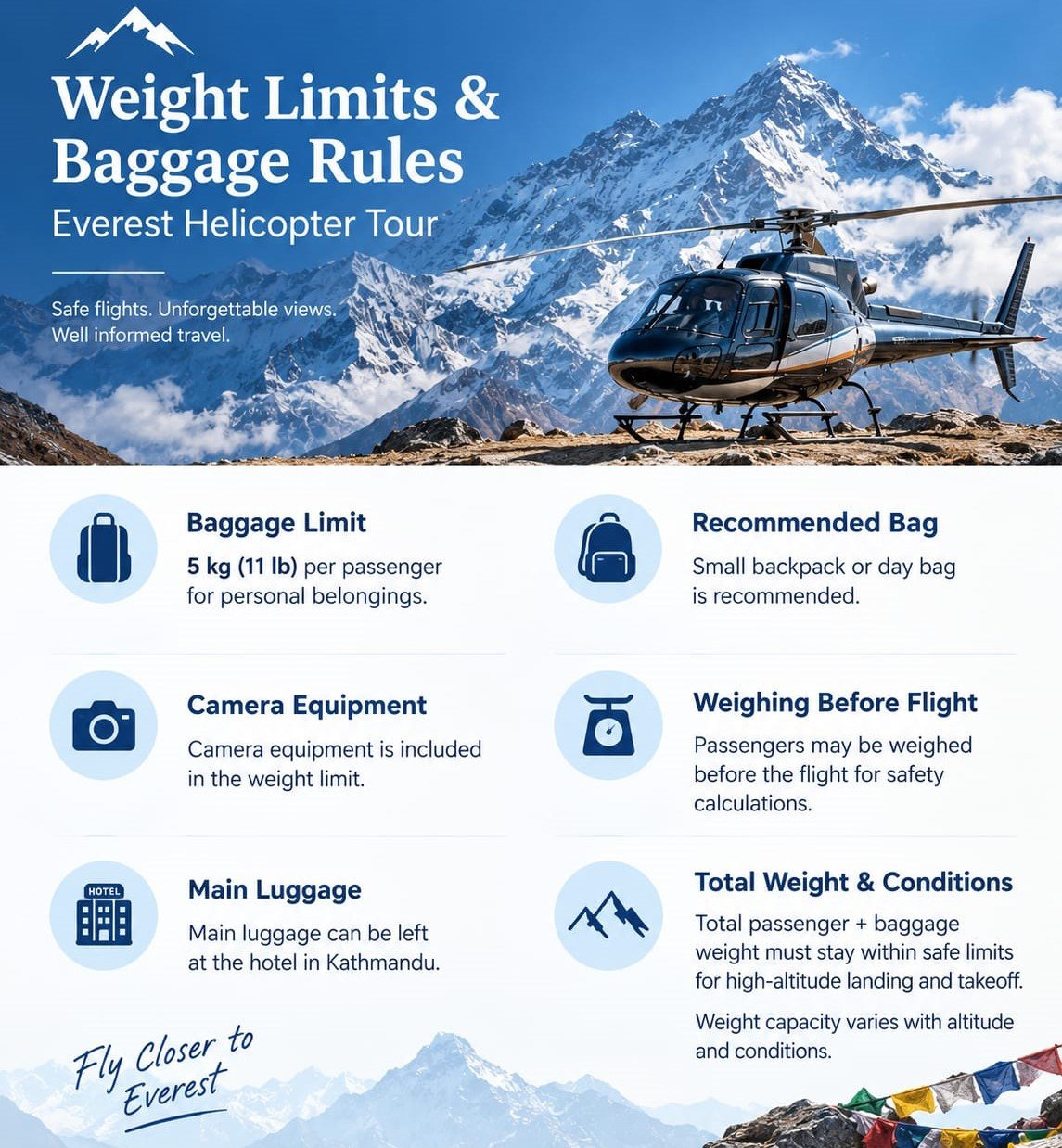
Personal baggage allowance on the Everest helicopter tour is typically capped in the 5 to 10 kilogram range per passenger, and this is one of the most misunderstood parts of trip planning because people often confuse it with the much larger baggage allowances they are used to from international flights. This is a short, spectacular helicopter flight departing from and returning to Kathmandu on the same day, not a multi day trek requiring a full duffel of gear, and the allowance reflects that. It is also, again, a direct function of the payload math we walked through above. Every kilogram of baggage on board is a kilogram not available for passenger weight, and at the altitudes near Kala Patthar and Everest Base Camp where total payload might be around 240 kilograms, baggage has to be kept genuinely minimal to leave room for the passengers themselves.
Bag shape matters here almost as much as bag weight. Operators strongly prefer, and in many cases require, soft sided duffel style bags rather than hard shell suitcases. This is not an arbitrary style preference. Helicopter baggage compartments are small and irregularly shaped, tucked into whatever space is left around the airframe, fuel tanks, and mechanical components. A soft duffel can be compressed, folded, and wedged into that irregular space efficiently. A hard shell suitcase cannot flex to fit the compartment, which means it either does not fit at all or it fits poorly and wastes usable space that could otherwise hold other passengers’ bags. Given how tight baggage allowances already are at altitude, that inefficiency is not something operators can absorb. If you own a hard shell suitcase and it is your only option, that is fine for the rest of your Nepal trip, but plan to repack a soft bag or borrow one for the helicopter day specifically. Our packing guide for the Everest helicopter tour goes into more detail on exactly what to bring in that bag and what a sensible packing list looks like for the day.
The single most useful mental shift for packing this flight is to stop thinking about what you need for your whole Nepal trip and start thinking only about what you need for one day. This is a day tour. You depart Kathmandu in the morning and you are back at your hotel, in most itineraries, well before evening. Anything you do not need between wheels up and wheels down that same day should stay at your hotel, not in your duffel. That means trekking gear for other parts of your trip, spare clothing for days you are not flying, toiletries, chargers for devices you are not bringing, all of it can be left behind. What actually needs to travel with you is a warm layer for the cold at altitude even if you never leave the cabin, sun protection, your travel documents, your camera if you are bringing one, and perhaps some water and snacks. That is a very short list, and once you write it out, the 5 to 10 kilogram allowance stops feeling restrictive and starts feeling reasonable.
One packing trick worth knowing, because it genuinely helps and is not just folklore: wear your heaviest and bulkiest items rather than packing them. A insulated jacket, sturdy boots, and a warm hat weigh a surprising amount when they are folded into a bag, but most operators’ practical weight calculations treat what you are wearing differently from what you are carrying as baggage, since worn items are counted as part of your body weight declaration rather than added separately as baggage weight. We want to be careful about how we phrase this, because it is a practical convention many operators use for efficiency, not a loophole or a way to sneak extra weight onto the aircraft, and you should always confirm the specific approach with your operator rather than assuming it applies universally. But as a general rule, if you are going to bring a heavy jacket anyway, wearing it to the helipad rather than stuffing it into your duffel is the sensible choice, and it has the added benefit of meaning you are not caught without it if the cabin is cold or you step outside at the landing site.
The Pheriche Shuttle System, Explained Properly
If you have read the trip page for our Everest Base Camp helicopter tour with Kala Patthar landing, you may have noticed a brief mention of something called the Pheriche shuttle system. It is mentioned there because it directly affects how a shared or group booking on that itinerary actually runs, but it deserves a much fuller explanation than a single line on a trip page can give it, because understanding it changes how you think about the whole flight day.
Here is the problem the shuttle system solves. A shared or group Everest helicopter tour typically sells five seats on a single aircraft to keep the per person price reasonable, since splitting the fixed cost of a helicopter flight across five paying passengers rather than two or three makes the tour financially accessible to far more travellers. That works perfectly well for the parts of the route below roughly 4,000 meters, where, as we covered above, the aircraft’s payload capacity comfortably supports five adults and their baggage. The problem is that Kala Patthar and Everest Base Camp both sit well above that altitude, in the 5,000 to 5,600 meter range depending on the exact landing point, and at that altitude the same aircraft’s payload capacity has dropped to a fraction of what it was lower down, commonly cited around 240 to 250 kilograms. Five adult passengers plus baggage almost never fits inside that reduced budget.
So the aircraft cannot simply fly all five passengers straight up to Kala Patthar the way it flew them out of Kathmandu. Instead, the flight is broken into stages. The helicopter carries the full group of passengers from Kathmandu up to a staging point at a lower altitude, most commonly Pheriche, which sits at around 4,371 meters. This altitude is low enough that the aircraft can still carry a fuller load safely, so the whole group travels together for this first, longer leg of the journey. At Pheriche, the group disembarks, and the helicopter then makes two or more shorter shuttle flights, carrying two or three passengers at a time, up to Kala Patthar or the Everest Base Camp landing area and back down to Pheriche again. Once every passenger has had their turn at the summit landing, the whole group reboards together for the return flight to Kathmandu.
From a passenger’s perspective, this means your day involves a landing and a short wait at Pheriche, some genuinely spectacular scenery in its own right, before your specific shuttle group is called up for the final short hop to Kala Patthar or Base Camp. It also means that not everyone in your group photographs the summit landing at exactly the same moment, since the shuttles run in sequence rather than in parallel. We want to be very clear about something here, because it comes up in guest questions often: this staged approach is not a shortcut, a downgrade, or any kind of cost cutting measure specific to one operator. It is standard practice across essentially every operator running shared Everest helicopter tours to Kala Patthar or Base Camp, because it is the only way to get a full group of five to that altitude safely given the payload physics involved. An operator who claims they can fly five full weight adults straight to Kala Patthar without any staging is either using an unusually light group by coincidence or is not being fully transparent about how their loading works.
Private charter bookings change this picture somewhat, but not entirely. If you charter the aircraft privately, meaning you are not sharing it with unrelated passengers, you have more control over total group weight and can sometimes reduce or avoid the shuttle staging, particularly if your group is smaller than five people or if the combined weight of your party comfortably fits within the higher altitude payload budget without needing to be split. This is one of the genuine advantages of the choice between a shared seat and a private charter that we discuss at length in our comparison of private versus group Everest helicopter tour packages. But it is important not to overstate this advantage. Private charter does not exempt anyone from altitude physics. If your private group is five adults at or near the standard passenger weight limit, you may still need some form of staging to get everyone to the highest landing point safely, and a good operator will tell you this plainly during the booking conversation rather than let you assume charter automatically means no shuttling at all. What private charter genuinely gives you is more flexibility and more control over how the loading is arranged, and often a faster overall flight because you are not waiting in a shared queue for other travellers’ shuttle rotations, but the underlying payload ceiling at 5,000 plus meters applies to every aircraft on this route regardless of who has chartered it.
What Actually Happens at Check-In: The Weighing Process
Every passenger on an Everest helicopter tour should expect to be weighed before the flight, and in many cases their baggage will be weighed separately as well. This surprises some first time flyers, particularly those used to commercial airline check-in where weighing is rare except at the baggage counter, but it is completely standard for helicopter operations and it exists for one reason only: accurate weight and balance calculation.
Weight and balance is not a vague safety concept, it is a precise engineering calculation that every pilot performs before every flight. It determines not just whether the total load is within the aircraft’s capacity, but where that weight sits relative to the aircraft’s center of gravity, since an unbalanced load, even one within total weight limits, can affect handling in ways that matter a great deal at altitude where performance margins are already thin. To do that calculation accurately, the pilot and ground crew need real numbers, not estimates. That is why you will typically step onto a scale, sometimes with your baggage, sometimes separately, at check-in before boarding. It takes a few seconds, it is handled discreetly and professionally, and it is genuinely nothing to feel awkward about. Every single passenger goes through it, regardless of size, because the aircraft does not care about anyone’s feelings about the number, only about the accurate figure.
This is also why operators ask for your approximate weight when you book, often weeks before you ever arrive in Kathmandu. That early figure lets the operator plan seat allocation, group composition on shared flights, and whether any adjustments like an extra seat need to be arranged in advance. We would strongly encourage every traveller to answer that question honestly, even if the number feels uncomfortable to share. Being fifteen or twenty kilograms different from your declared weight is not a small margin in an aircraft where the entire payload budget at altitude might only be 240 kilograms. It can be the difference between a load plan that works and one that does not, and it is far better for everyone, including you, to have that conversation calmly during booking than to have it unfold in real time at the helipad in front of your travel companions.
To be direct about the safety dimension here, because we think travellers deserve the honest version rather than a softened one: under-declaring your weight is not merely an inconvenience if it is discovered late, it is a genuine safety issue. The pilot is relying on the numbers provided to calculate exactly how much fuel to carry, how the load is distributed, and whether the aircraft has adequate performance margin for the specific conditions that day, including temperature and wind, which also affect available lift. A significant, undisclosed discrepancy anywhere in that calculation erodes a margin that was already deliberately kept thin to make the flight possible at all at that altitude. Reputable operators build in a safety buffer, but that buffer is there to cover normal day to day variability in things like exact fuel burn and minor unavoidable estimation error, not to absorb a passenger who was simply not honest about their weight. Treat the weight question at booking the same way you would treat a medical question before a physically demanding activity. It exists to keep you safe, and answering it accurately is entirely in your own interest.
Camera Gear and Photography Equipment
Photographers ask us about baggage weight more than almost any other group of travellers, and reasonably so, since a serious camera kit can weigh several kilograms all on its own before you have packed anything else. The good news is that most enthusiast level photography equipment fits comfortably within a typical baggage allowance. A single DSLR or mirrorless body, one or two lenses, and a compact travel tripod if your operator permits tripods on board, typically adds up to a modest weight that leaves plenty of room within the 5 to 10 kilogram range most operators work with. If that describes your kit, you generally do not need to do anything special beyond mentioning it if asked.
Where it gets more complicated is for photographers bringing a genuinely substantial kit, meaning multiple camera bodies, a long telephoto lens in the 400mm or longer range, a heavy tripod built for stability rather than portability, filters, spare batteries, and the bags and padding needed to protect all of it. That kind of kit can easily run to several kilograms on its own, and combined with your other personal items it can push close to or past a standard baggage allowance. This is not a reason to leave your gear at home, but it is a reason to mention it specifically when you book, rather than assuming it will sort itself out on the day. Tell the operator roughly what you are bringing and its approximate weight. This matters more on shared flights than private ones, because on a shared departure your gear is part of a payload budget that also has to accommodate four other passengers at or near their own weight limits, and a heavy kit bag discovered for the first time at check-in on a fully booked shared flight is a much harder problem to solve gracefully than the same kit mentioned three weeks earlier during booking.
We have a full guide dedicated to getting the most out of your photography on this flight, covering camera settings for the light conditions you will encounter at altitude and which seats give you the clearest angles on Everest and the surrounding peaks, which you can find in our photography guide for the Everest helicopter tour. From a pure weight and logistics standpoint though, the practical advice is straightforward: pack lighter than you think you need to. The window seats on this aircraft and the brief landing at Kala Patthar or Base Camp give you extraordinary shooting opportunities without needing to bring every lens you own. A well chosen two lens kit, perhaps a standard zoom and a moderate telephoto, will cover the vast majority of shots most photographers actually want from this flight, and leaves your baggage allowance with comfortable room to spare. If you are a working professional with commercial reasons to bring a full kit, that is a different conversation, and one worth having directly with the operator well ahead of your flight date so a private charter or a specifically arranged load plan can be considered if needed.
Building a Sensible Packing List for the Day
With the allowance and the reasoning behind it now clear, actually building your bag for the day is fairly simple. Start with a soft duffel rather than a hard suitcase, sized modestly since you genuinely do not need much volume for a day tour. Inside it, the core items most travellers need are a warm layer beyond what you are wearing, since temperatures at altitude even inside a warm cabin can catch people off guard if the aircraft doors are opened at the landing site for photographs, sun protection including sunglasses and sunscreen given how intense UV exposure is at these elevations, your travel documents and permit paperwork, which we cover in full in our companion guide on Everest helicopter tour permits, fees, and what is included, and a small amount of water and a snack, since flight days often start early and involve a fair amount of waiting around logistics before wheels up.
Beyond that core list, resist the urge to pack for contingencies that belong to a different kind of trip. You are not trekking, so you do not need multiple days of clothing, a sleeping bag, or trekking poles. You are returning to the same hotel the same day, so toiletries, chargers, and a change of clothes for the evening can all stay in your hotel room. If you are combining this helicopter tour with an actual multi day trek elsewhere in your Nepal itinerary, keep the two trips mentally and physically separate when you pack, since trying to bring your entire trekking kit on the helicopter day is one of the most common ways travellers unexpectedly exceed baggage allowance.
Keep valuables and your camera gear in a small daypack that stays with you rather than going into the duffel that may be stowed separately, both for practical access, since you will want your camera in hand rather than buried in stowed baggage during the flight, and for peace of mind, since keeping expensive equipment within arm’s reach is simply good practice on any flight. If you are travelling as a family or a larger group and want a fuller sense of how logistics, seating, and gear are typically coordinated across multiple travellers, our guide to group, corporate, family, and celebration bookings covers that in more depth, including how baggage and weight planning tends to work differently when you are booking for six, eight, or more people across multiple flights.
If You Are Concerned About Your Weight, Here Is What To Actually Do
We want to address this directly because we know it is the part of this guide that matters most to some readers, and vague reassurance does not actually help anyone plan a trip. If you are close to, at, or above the roughly 100 to 110 kilogram range commonly used as a single seat threshold on this route, or if you are simply unsure how your weight fits into the picture, the right move is to raise it during booking, ideally as early as possible, and to be completely straightforward about the number.
What typically happens next is a short, practical conversation. The operator will explain the specific weight policy for the trip you are looking at, since this can vary slightly by aircraft configuration and by the choice between a shared seat and a private charter. In many cases, the straightforward solution is booking an additional seat, which guarantees your weight is properly accounted for in the load plan and removes any uncertainty from the equation. On a shared group booking, the operator may also look at balancing your flight with lighter passengers, or in some cases suggest a different departure time where the group composition works out better. For private charters, the conversation is usually even more flexible, since the operator can build the entire flight’s weight budget around your specific group rather than fitting you into a pre-set shared configuration, and can advise directly on whether any shuttle staging near Kala Patthar or Base Camp will be needed for your particular party.
None of this is punitive, and none of it should feel like a rejection. It is simply how a safety-conscious aviation operation plans a flight where the margins, especially near the highest landing points, are genuinely thin. The travellers who have the smoothest experience are, without exception, the ones who had this conversation early and arrived at the helipad with a plan already agreed rather than an open question. The travellers who have a difficult morning are the rare ones who hoped the issue would not come up and were surprised when it did. Given how easily this is avoided with a single honest conversation at booking, there is really no reason for anyone to end up in the second category.
What Happens on the Day If Someone Is Over the Limit
Even with good planning, weight situations occasionally need to be handled on the day itself, whether because of a late change in group composition, a passenger who did not disclose an accurate weight, or simply a borderline case that needs a final decision once everyone and everything is actually on the scale. It is worth understanding how this is handled, because it removes a lot of unnecessary anxiety about the process.
The pilot has final authority over safe loading on every flight, full stop. This is not a courtesy title, it is how aviation safety works everywhere in the world, and it is particularly meaningful on high altitude helicopter operations where the pilot is the one person with complete, real time information about aircraft performance, weather conditions, and fuel state on that specific day. If the numbers do not work safely, the pilot will not fly the load, regardless of schedules, other passengers’ preferences, or anyone’s disappointment. That is exactly the outcome you want from a professional operator, even when it is inconvenient in the moment.
What a responsible operator does in practice, when a weight issue surfaces on the day, is handle it professionally rather than punitively. Depending on the specific situation, that might mean reseating passengers across a shared flight to balance the load better, adding an extra shuttle rotation at Pheriche to spread the group differently, or in rare cases having a frank conversation about one passenger not doing a specific high altitude leg while still being accommodated on the lower altitude portions of the trip. None of these outcomes are designed to embarrass anyone, and a good ground crew handles them quietly and respectfully. We mention this not because it happens often, because with proper advance planning it genuinely does not, but because knowing that there is a sensible, professional process for the rare edge case tends to put nervous travellers at ease far more than pretending the situation could never arise. Safety-first handling of a borderline weight situation is an industry norm, not a sign that something has gone wrong with your booking.
A Few Other Practical Details Worth Knowing
Fuel load is one variable that surprises people once they understand it affects payload too. A helicopter does not necessarily carry a completely full tank on every flight. Pilots calculate fuel requirements based on the specific route, expected flight time, and required safety reserves, and on a route with a defined round trip distance like Kathmandu to Kala Patthar and back, carrying less fuel than a full tank, while still comfortably exceeding safety reserve requirements, can free up additional payload capacity for passengers and baggage. This is one of the reasons payload figures are always expressed as ranges rather than fixed numbers, since the exact fuel plan for your flight is one more variable your pilot is actively managing to maximize safe capacity for your specific group.
Weather and temperature matter too, and this connects back to the density altitude concept from earlier in this guide. A hot, high pressure morning at altitude actually reduces air density further and can tighten payload margins compared to a cold, high pressure morning, somewhat counterintuitively, since warm air is less dense than cold air at the same pressure. This is part of why flight departure times on Everest helicopter tours tend to cluster in the early morning, when conditions are typically calmer and cooler, giving the aircraft better performance margins than a midday departure might allow. It is one more reason your operator may adjust group composition or timing slightly based on conditions on the actual day of your flight, rather than applying a single fixed rule year round.
If you are booking with a companion or as a couple and one of you is notably lighter or heavier than the other, this is worth mentioning at booking too, not because it is a problem, but because it gives the operator useful information for balancing a shared flight or planning a charter’s load distribution. Couples and small groups sometimes assume weight questions only apply to individuals who are personally concerned about their own weight, but total group weight and its distribution across the aircraft’s seats is genuinely relevant information for every booking, light or heavy, since it all factors into the same underlying calculation.
Bringing It All Together
The physics behind all of this is not complicated once it is laid out clearly, even if it sounds technical at first. Thinner air at altitude means less lift and less engine performance, which means less usable payload the higher the aircraft climbs, which is why the same helicopter that carries five people comfortably out of Kathmandu cannot do the same near Kala Patthar or Everest Base Camp. Every rule that follows from that, the per passenger weight thresholds, the baggage allowance, the preference for soft duffels, the Pheriche shuttle system on shared flights, and the weighing process at check-in, exists because of that single underlying fact about how helicopters fly at extreme altitude. None of it is arbitrary, and once you understand the reasoning, the whole system reads less like a list of restrictions and more like a carefully engineered solution to a genuinely hard physical problem.
The practical takeaway for anyone booking an Everest helicopter tour is simple. Be honest about your weight when you book, mention any substantial camera gear or unusual baggage needs early rather than late, pack a soft duffel with only what you need for a single day, and treat the check-in weighing process as the routine safety step it is rather than something to feel self-conscious about. If you fall near or above the standard per seat weight threshold, raise it directly with the operator during booking so a solution, whether an extra seat, a rebalanced group, or a private charter arrangement, can be planned properly in advance. Do all of that, and weight becomes a five minute conversation at the start of your trip planning rather than a source of stress on the morning of your flight.
If you are still deciding between the different Everest helicopter tour options and want to understand how baggage and weight planning differs between them, our companion guide comparing the EBC helicopter tour and the Kala Patthar landing tour walks through the practical differences between the two itineraries, including how the shuttle system applies differently depending on which landing point you choose. And if you have questions about what your permit and park fees actually cover on top of the flight itself, our guide to Everest helicopter tour permits, fees, and what is included covers that side of the trip in full. Between the two, along with this guide, you should have a genuinely complete picture of what to expect from booking through landing and back to Kathmandu. If anything here is unclear for your specific situation, reach out to us directly before you book. A five minute conversation about your weight, your group, and your gear at the planning stage is worth far more than guessing and hoping it works out on the day.