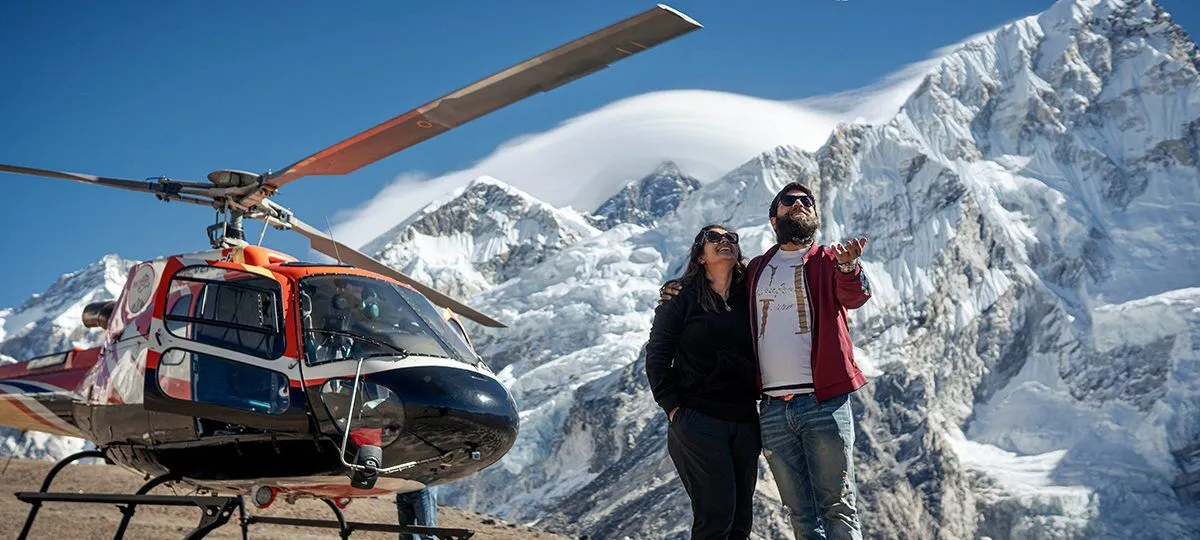
We get this question a few times a season, usually by email, usually a little vague at first: “Can you land somewhere near Everest so I can propose?” Sometimes it’s phrased more directly. Sometimes the person on the other end of the message hasn’t quite decided whether they’re serious about it yet. Either way, we’ve now helped arrange enough of these flights to know what actually works, what tends to go wrong, and what nobody tells you until you’re standing on a ridge at 5,545 meters with your hands shaking for reasons that have nothing to do with romance.
Our site already has a guide for couples doing a wedding photo shoot by helicopter, which is for people who are already married and want professional photos with Everest behind them, and a honeymoon guide, built around our Everest helicopter honeymoon package, for couples flying together after the wedding. Neither of those covers the moment before either of those things happens: the proposal itself. That’s a different occasion with different logistics. You’re not managing a production crew or planning a honeymoon itinerary. You’re trying to keep a secret, carry a ring safely to 5,545 meters, and say something clearly while short of breath in the cold, all without your partner suspecting anything until the moment you want them to.
This guide is written for that specific situation. We don’t sell a packaged “proposal tour” as a separate line item on our trips page, and we’re not going to invent one here just to make this post read cleaner. What we do is arrange a private charter, usually built on our standard Everest Base Camp helicopter tour with Kala Patthar landing, and adjust the details around your specific plan once you tell us what you’re trying to do. Everything below is what we’d actually walk you through on a phone call.
Why Kala Patthar, Specifically
Kala Patthar sits at 5,545 meters, a black rock outcrop above the old Everest Base Camp trail. Climbers on the classic trekking route hike to it for one reason: it’s the closest point most people will ever stand to Everest’s summit without technical climbing experience, and unlike Base Camp itself, you actually see the mountain from there rather than being tucked underneath it. Everest’s southwest face fills the view directly ahead, close enough that you can pick out the black rock bands and the ice fields without a zoom lens. Nuptse sits to the right, a wall of its own. Pumori rises behind you to the west. Below and to the left, if the light is right, you can trace the broken ice of the Khumbu Icefall, the notoriously difficult first stretch of the South Col climbing route.
When you fly there instead of trekking the eight to nine days it normally takes on foot, you get that same vantage point in the space of a morning. It’s genuinely a strange place to stand. There’s no vegetation, no sound beyond wind and your own breathing, and the scale of what’s in front of you doesn’t fully register for the first minute or two. We’ve watched a lot of people go quiet up there, not from any coaching on our part, just because the place does that. It is a legitimately unusual setting for a proposal, not because we’re telling you it is, but because almost nowhere else on earth lets an ordinary traveler stand this close to the world’s highest mountain without a mountaineering expedition behind them.
That said, we want to be direct about something before you get further into planning this, because it changes how you should think about the whole trip.
The Landing Is Never Guaranteed, and That Matters More for a Proposal Than for Anything Else We Fly
Every helicopter tour operator flying to Kala Patthar, us included, is subject to the same constraints on any given morning: wind conditions at altitude, visibility, cloud buildup over the Khumbu (which tends to happen later in the morning, which is why these flights leave Kathmandu so early), current CAAN and Sagarmatha National Park regulations on where and how helicopters may land in the area, and the pilot’s own safety assessment made that specific day. None of that is something any operator controls, and anyone who tells you a landing at Kala Patthar is guaranteed is not being straight with you. We won’t do that here either.
On most clear mornings in good season, the landing happens as planned. But “most” is not “every,” and we’ve had mornings where wind at the ridge made a safe touchdown inadvisable and the pilot made the call to keep the aircraft in the air instead, circling closer to the peaks rather than putting skids down on rock. That’s not a failure on anyone’s part. It’s the pilot doing exactly what we’d want them to do with paying passengers on board at 5,500 meters. It just means the outcome on any single morning is not something we can promise you in an email three months in advance.
For most travelers on the standard tour, a no-landing morning is a disappointment they can shrug off, since the flight itself still gets remarkably close to Everest in the air even without touching down. For someone planning a proposal, it’s a bigger problem, because you’ve built an entire emotional moment around a specific patch of ground. This is the single most important thing we want you to internalize before you book: don’t design a proposal that only works if the landing happens. Design one that works either way, and treat the landing as the best-case version of the plan rather than the only version.
The Backup Plan: Hotel Everest View at Syangboche
This is the part most people planning a proposal haven’t thought about yet, and it’s the part we spend the most time on when someone calls us about this.
Our standard itinerary, and most Everest helicopter tours from Kathmandu that include a landing, also stop at Hotel Everest View near Syangboche, at 3,780 meters, for a breakfast break. It’s a much lower, much less exposed spot than Kala Patthar, and critically, reaching it doesn’t depend on the same tight weather window that a Kala Patthar landing does. The terrace at Hotel Everest View looks directly out at Everest, along with Ama Dablam and a wide sweep of the Khumbu skyline, and you’re sitting down with a hot drink in front of you rather than standing on exposed rock fighting for breath. We’ve written more about that stop on its own in our Hotel Everest View breakfast guide, and it’s worth reading if you haven’t seen it, because it’s genuinely one of the more comfortable, reliable moments on the whole flight.
Here’s what we recommend, and what we’ll walk you through directly if you book with us: decide, before the flight, that Kala Patthar is your first choice for the proposal and Hotel Everest View is your real, fully-formed backup, not an afterthought you improvise in a panic if the landing gets scrubbed. Tell us this in advance. We’ll build the morning so that if the pilot has to skip the Kala Patthar landing, you already know exactly what you’re doing at Syangboche instead, and there’s no scrambling, no visible disappointment in front of your partner, no tell that something didn’t go the way you planned. The couples who’ve handled this best are the ones who treated both scenarios as legitimate versions of the same plan, not a good outcome and a lesser one. Some of them, honestly, told us afterward they were glad to have a calmer, seated moment as the actual proposal, ring hand not shaking from cold and altitude quite as much.
The short version: if a clear-sky Kala Patthar landing happens on your morning, wonderful, that’s the setting we’re all hoping for. If it doesn’t, you still have a legitimate, quietly spectacular moment at 3,780 meters with Everest in front of you and considerably better odds of things going smoothly. Plan for both. Never plan for only one.
| Location | Altitude | Landing reliability | Setting |
|---|---|---|---|
| Kala Patthar | 5,545 m | Weather and regulation dependent, never guaranteed | Exposed rock ridge, standing, brief window, closest possible view of Everest’s face |
| Hotel Everest View, Syangboche | 3,780 m | Reliable stop on nearly every flight | Seated terrace, Everest and Ama Dablam in view, breakfast served |
Private Charter vs. a Shared Group Flight
Our standard Kala Patthar landing tour typically flies as a shared charter, meaning the seats on the aircraft are sold individually and you may be flying alongside other travelers you’ve never met. For most tourism purposes that’s fine, even nice, since Everest is worth sharing regardless of who else is on board. For a proposal, we’d steer you away from it.
Think through what a shared flight actually means on the ground at Kala Patthar. The ground window there is short, five to fifteen minutes depending on conditions, and during that window every passenger from your flight is out on the same small stretch of rock, taking photos, catching their breath, looking at the same view you are. If you propose during that window on a shared flight, you’re doing it with strangers a few meters away, possibly in your photos, possibly asking what just happened. Some couples are fine with that. Most, in our experience, are not, and they don’t realize it until they’re standing there and it’s too late to change the plan.
A private charter solves this outright. You book the whole aircraft, so the only people on the ground at Kala Patthar are you, your partner, the pilot, and possibly a ground crew member depending on the day’s arrangement. Nobody else’s schedule constrains your ground time within the window CAAN and the park allow, and there’s no one you don’t know standing in your photos or overhearing what you say. It costs more than buying two seats on a shared flight, since you’re covering the cost of the aircraft rather than splitting it across a full passenger list, but for this specific purpose we think it’s worth the difference. It’s the one line item in this whole plan we’d genuinely push back on if someone tried to skip it to save money. A private Everest helicopter charter is also the version of this trip that gives us, as the operator, the most flexibility to build the morning around your specific plan rather than a fixed group schedule, which matters for almost everything else in this guide.
On the practical side, the helicopters flying this route are typically five or six seat aircraft, so a private charter for two of you leaves room for a couple of extra passengers if you want family or friends along, or it flies with just the pilot and the two of you if you’d rather keep it that way. Pricing for a private charter is quoted per flight rather than per seat, so the cost doesn’t change much whether two of you fly or four, which is worth knowing if you’re weighing whether to invite someone else along for the ride. We’ll give you an exact figure once we know your dates and passenger count, since seasonal demand and group size both factor into it, but as a general rule, expect a private charter to cost noticeably more than two shared seats would, and budget accordingly if this is the route you want to take.
Keeping It a Secret
If your partner doesn’t know this is coming, the logistics of booking and traveling together create a few obvious leak points, and we’ve seen most of them happen at least once.
The easiest one to manage is the booking itself. When you contact us, you don’t have to explain the proposal in the subject line of an email your partner might glance at, or in a shared document, or over a phone call made from the next room while they’re in the house. Reach out from an account or number they don’t check, and if you’d rather not put “proposal” in writing anywhere they might see it, just tell us it’s a special occasion and give us a way to reach you privately for the actual details. We handle enough of these that we don’t need the word spelled out to understand what’s going on.
The second leak point is paperwork and logistics on travel day. Permits, manifests, and trip vouchers for Everest helicopter tours usually list passenger names, and if your partner is the one handling documents, tickets, or check-in at the hotel desk the morning of the flight, they may see something. If secrecy matters to you, tell us in advance and we’ll route the paperwork and any pre-flight communication through you specifically rather than defaulting to whichever contact happens to reply first. This is a small thing to ask for and it prevents almost all of the accidental reveals we’ve heard about after the fact.
The third is simply pickup morning. Our vehicles collect guests early, often before sunrise, from hotels around Kathmandu or Thamel. If your partner sees a driver ask for “the couple booked for the proposal flight” or something similarly unsubtle, that’s the plan finished before you’ve left the ground. We brief our pickup drivers to use guest names only and to say nothing about the nature of the trip, but it’s worth confirming this with us directly if you’re worried about it, since it costs nothing to double check and it’s the kind of detail that’s easy to assume is handled when it might not be.
None of this is complicated. It just requires telling us, plainly, what you’re trying to keep quiet and from whom, so we can route communication accordingly instead of guessing.
The Ring: How to Actually Carry It to 5,545 Meters
This is the detail people think about least until the morning of the flight, and it’s worth working out properly rather than improvising.
Don’t pack the ring in a daypack or a bag that ends up stowed somewhere other than on your body. Bags get placed in the cabin or cargo area depending on the aircraft configuration, and you don’t want to be the person unzipping compartments mid-flight looking for a small box while everyone else is looking out the window at Everest. An inside jacket pocket, ideally one that zips or buttons closed, is the simplest, most reliable place to carry it. Check it before you leave the hotel, check it again before boarding, and if you’re wearing a bulky insulated jacket over it (you likely will be, since it’s genuinely cold at altitude), make sure you can still get your hand into that pocket without a struggle. We’ve seen people put the ring somewhere sensible in theory and then discover, standing on the ridge with a glove already off, that the zip is jammed or the pocket is buried under three layers.
Gloves are the other practical issue. At 5,545 meters your fingers will be cold quickly, and thick gloves make fine motor tasks, like actually placing a ring on someone’s finger, genuinely difficult. Plan for this rather than hoping it works out. Some couples decide the ring goes on before gloves go back on after landing, meaning you do the actual placement in the first moment or two on the ground, before the cold has fully set into your hands, then get gloves back on for the rest of the short window. Others decide to keep a thin liner glove on the ring hand throughout and only remove it for the ten seconds the moment actually takes. Either approach works. What doesn’t work is deciding this on the spot while also trying to say something meaningful and manage your own breathing, so talk it through with your partner’s ring size and your own plan before you’re on the mountain, not after.
Photography: Who Actually Captures the Moment
We want to be honest about this rather than oversell it, because it’s one of the questions we get most often and the answer disappoints some people.
Our standard Everest helicopter tour includes the pilot and, depending on the flight, a ground crew member, but we don’t have a dedicated photographer built into the flight as a standard inclusion, and we’re not going to imply otherwise. If you want professional, composed photography of a proposal at altitude, with someone whose full job that day is capturing the moment properly, that’s closer to what our separate wedding photo shoot by helicopter guide describes, or the associated wedding photo shoot trip itself, both of which are a different, larger production built around already-married couples doing dedicated portrait and video work. That’s a legitimate option if you decide, after the proposal, that you want a proper shoot in the same region on a separate flight, but it’s not something we’d bolt onto a proposal flight as an afterthought, since the two occasions call for different pacing and different crew.
For the proposal flight itself, your realistic options are your own camera or phone, handed to the pilot or ground crew member for the actual moment, or, if you’re on a shared flight, asking a fellow passenger, which brings us back to why we recommend a private charter. On a private charter there’s no other passenger to ask, which sounds like a downside until you realize it also means there’s no stranger involved in your photos or your privacy at all. Most of our pilots and ground crew are happy to take a phone and get a handful of shots while you have your moment, and we’ll flag this specifically with your crew in advance if you tell us it’s happening, so it isn’t an awkward mid-moment request. If photo quality matters enormously to you, set expectations accordingly: you’ll get real, genuine shots from a crew member using your own device, not professionally lit portrait work. If you want that separately, our photography guide for the Everest helicopter tour is worth reading before you fly regardless, since it covers camera settings, window glare, and which seats give the cleanest shots, useful whether you’re taking the photos or handing your phone to someone else.
Drones, Video, and What You Can’t Bring
A few couples have asked us about flying a drone to film the proposal from outside the aircraft, or having a second small camera rig set up on the ground. Sagarmatha National Park has firm restrictions on drone use, and flying one without the correct permits, which are not something we can arrange on short notice for a single flight, is not something we can support. If aerial footage beyond what you or the crew capture by hand matters a great deal to you, that’s a conversation to have with us well in advance of your trip, not something to plan around assuming it will simply work out on the day. For nearly everyone we’ve flown, a phone or camera in hand on the ground, plus whatever the pilot or ground crew can capture, ends up being plenty.
A Few Words on What to Actually Say
We’re not going to write your speech for you, but we’ll pass along what we’ve noticed works and what doesn’t. The couples who seem happiest afterward tend to have decided on the first sentence or two in advance, word for word, rather than trusting themselves to find the right words cold at 5,545 meters with the wind pulling at their jacket and their lungs working harder than usual. You don’t need a long speech. A short, specific sentence about why this place, why this person, said clearly, carries more weight up there than a longer version would, partly because a longer version is genuinely harder to deliver when you’re short of breath and partly because the setting is already doing a lot of the emotional work for you. If you’re someone who gets tongue tied under pressure at sea level, assume that gets slightly harder, not easier, at altitude, and plan your words accordingly.
Timing Within a Short Ground Window
The ground time at Kala Patthar on a landing tour runs roughly five to fifteen minutes, depending on conditions that morning, weather, wind, and how the pilot is reading the day. That’s not a lot of time, and on a shared flight it gets divided across everyone on board without much room to negotiate. This is another reason we push people toward a private charter for this specific purpose, since it gives you the discretion to use the ground window as you see fit rather than sharing it with a group that has its own photo priorities.
Even with a private charter, though, plan the moment itself to be brief. You will not have twenty unhurried minutes to speak at length, get down on one knee, wait for a response, and then pose for a slow sequence of photos before reboarding. Realistically you have a few minutes where the aircraft is on the ground and the crew is comfortable with you being out and about on the rock. Say what you want to say, but keep it short and decide the core of it in advance rather than trying to compose it in the moment, because at that altitude, composing a long, articulate sentence on the spot is harder than you’d expect, for reasons we’ll get into next. A few honest, direct sentences land better up there than a long speech you can’t quite get through.
The Altitude Itself Is Part of the Moment, for Better and Worse
We should be straightforward about what 5,545 meters actually feels like, because it’s not a garden or a rooftop bar. It’s cold, frequently windy, and the air is thin enough that most people notice some breathlessness and a kind of mental fog within the first minute or two of stepping out of the aircraft. Talking clearly takes more effort than it does at sea level. Getting down on one knee and back up again is more work than it sounds like it should be. None of this is dangerous for a healthy traveler on a short visit with supplemental oxygen available on board, but it is a real physical experience, not a backdrop.
Here’s the part we think is worth mentioning honestly rather than glossing over: a fair number of people find themselves more emotional at altitude than they expected to be, and some of that is the moment itself, but some of it is genuinely the altitude and thin air acting on your body and your head. Mild lightheadedness, a faster heartbeat, a kind of heightened, slightly overwhelmed feeling, these are normal physiological responses to being at 5,545 meters, and they happen to people who aren’t remotely anxious about anything. Combine that with genuine nerves about a proposal and you get a moment that can feel more intense than either factor alone would produce. We mention this not to talk anyone out of it, but because it’s a real and, honestly, kind of charming side effect worth knowing about ahead of time rather than being caught off guard by it. If you find yourself a little more overcome than you expected, that’s the mountain as much as the moment.
When to Go: Season and a Little Flexibility
Nothing here changes the fact that we can’t guarantee a landing on any given morning, but you can meaningfully improve your odds with two decisions made well before you leave home.
First, season. Spring, roughly March through May, and autumn, late September through November, are generally the most stable flying windows in the Everest region, with clearer mornings and more consistent wind conditions than the monsoon months or deep winter. This isn’t a guarantee for any single day within those windows, weather in the high Himalaya can still turn against you on a given morning even in peak season, but statistically, your odds of a clear, landing-suitable morning are noticeably better in spring and autumn than outside them.
Second, and this matters more than most people expect: build a few spare days into your Nepal itinerary around the flight rather than locking in one single fixed date. Weather delays and reschedules are a completely normal part of operating helicopters in this environment, and operators who fly this route regularly, us included, will move your flight to the next viable morning if the first one isn’t safe rather than force a marginal call. If your entire Nepal trip is built around one specific date with no room to shift, a single poor-weather morning can mean the flight doesn’t happen at all during your visit, which is a genuinely disappointing outcome for anyone, and considerably more so if you’d built a proposal around that exact date. Give yourself two or three extra days of flexibility around your planned flight date if you can. It’s the single most effective thing you can do, short of controlling the weather itself, to improve your odds of the whole plan coming together the way you’re hoping.
Questions We Get Asked Directly
A few of these come up often enough that we’d rather answer them here plainly than leave you to wonder.
Does the crew know it’s happening? Only if you tell us, and we’d genuinely encourage you to. Once we know, we brief the pilot and any ground crew so they understand what’s going on, stay discreet around your partner beforehand, and give the two of you a bit of space during the ground window rather than hovering or narrating the landing the way they might on a standard flight. A crew that knows what’s coming handles it far better than one caught by surprise mid-flight.
What if the answer is no, or the moment turns out to be overwhelming, in either direction? We’ll keep this brief because it’s not really our place to say much more than this: our pilots and crew are professional, they’ve seen a full range of reactions over the years, and whatever happens, they give you your moment and let it play out without turning it into a spectacle. The flight continues as planned either way, and nobody on our side treats it as anything other than your business.
Can family or friends be on the same private charter to celebrate right after? Yes, and this is genuinely worth raising with us at the time of booking rather than as an afterthought, because it changes the aircraft configuration, the total weight on board, and the seat count we need to plan for. If you want a small group in the air to celebrate immediately after, or waiting at a specific point in the itinerary, tell us that up front and we’ll build the charter around it rather than trying to retrofit it later.
Do you offer a fixed “proposal package” with a set price? Not as a standalone product on our trips page, no, and we’d rather tell you that plainly than invent one for the sake of a tidy answer. What we do is take the standard Kala Patthar landing tour, or occasionally a private version of the broader Everest Base Camp helicopter tour, and customize it around your specific situation: private charter, timing, crew briefing, backup plan, any extra passengers. Every one of these flights ends up a little different because every couple’s situation is a little different, and that’s really the honest shape of how this gets arranged.
Health and Altitude: What to Check Before You Book
We touched on breathlessness and lightheadedness above as a normal, expected part of a short visit to 5,545 meters, and for the overwhelming majority of healthy travelers, that’s exactly what it stays: normal and short-lived, easing once you’re back in the aircraft and descending. Supplemental oxygen is carried on board for exactly this reason. But we’re not going to pretend altitude is a non-issue for everyone, and if you have a cardiac or respiratory condition, or if altitude has affected you badly on a previous trip, or you’re generally anxious about how your body will handle it, please read our full altitude sickness guide for the Everest helicopter tour before you book, and talk to us directly about your specific situation. This applies a bit more, not less, when a proposal is involved, since adrenaline and nerves on top of altitude can intensify how you feel physically in the moment, and we’d rather you go into it informed than surprised.
How This Actually Gets Arranged
In practice, most of these flights start the same way: someone emails or calls us, tells us roughly what they’re planning, and we talk through dates, whether a private charter makes sense (for a proposal, it almost always does, for the reasons above), how many people if any are joining, and how much flexibility exists in the travel dates. From there we build a private charter around our standard Kala Patthar landing tour, with the Hotel Everest View stop built in as a genuine backup moment rather than just a breakfast stop, and we brief the crew on what’s happening so they can be discreet and give you space.
If you’re still deciding between the Kala Patthar landing tour and our standard Everest Base Camp helicopter tour without a landing, it’s worth reading our companion piece comparing the EBC helicopter tour and the Kala Patthar landing tour, which goes into more depth on exactly how the landing uncertainty works and what each version of the flight actually includes. For a proposal specifically, we’d steer you toward the landing tour as the base product, private-chartered, simply because it’s the version of the flight that gives you a shot at Kala Patthar itself while still including the Everest View Hotel stop as a fallback within the same morning.
A Short Checklist Before You Fly
Once you’ve talked to us and settled on dates, a handful of small tasks make the actual morning go smoothly. We’d rather you have this in front of you a week out than working through it at check-in.
- Confirm with us that you want a private charter, and how many passengers, including anyone joining to celebrate afterward.
- Agree on your backup plan at Hotel Everest View in advance, so nobody improvises on the day if the Kala Patthar landing doesn’t happen.
- Decide where the ring lives on your body during the flight, and practice getting it out with gloves on.
- Tell us explicitly that this is a proposal, and flag anything you need kept quiet from your partner, including how pickup and paperwork should be handled.
- Check our altitude sickness guide if you have any cardiac, respiratory, or anxiety concerns, and mention them to us directly.
- Build a few spare days into your Nepal itinerary around your planned flight date rather than locking to one single morning.
What We’d Actually Tell You If You Called Us Today
Contact us directly and tell us this is for a proposal. That one sentence changes how we plan the morning: which crew we assign, how we handle your paperwork and pickup, how we brief the pilot, and how we set up the backup plan at Hotel Everest View so there’s no improvising if the landing doesn’t happen. Then talk to us about dates. If you can fly during spring or autumn and build in a few spare days around your planned date rather than locking to one single morning, your odds of a clear, landing-suitable window go up meaningfully, though we still won’t promise you a landing, because no honest operator can.
Decide on your backup plan before you leave Kathmandu, not on the ridge. Work out where the ring lives on your body and how you’ll get it onto a cold hand quickly. Think about whether you want family on the charter to celebrate right after, and tell us if so. And when you’re standing up there, or seated on the terrace at Syangboche if that’s how the morning goes, keep in mind that whichever version of the moment you get, you’ll be somewhere very few engaged couples on earth have ever stood, with Everest close enough to actually see the mountain rather than just say you’ve been near it. That part, at least, we can promise you’ll remember clearly, altitude fog or not.