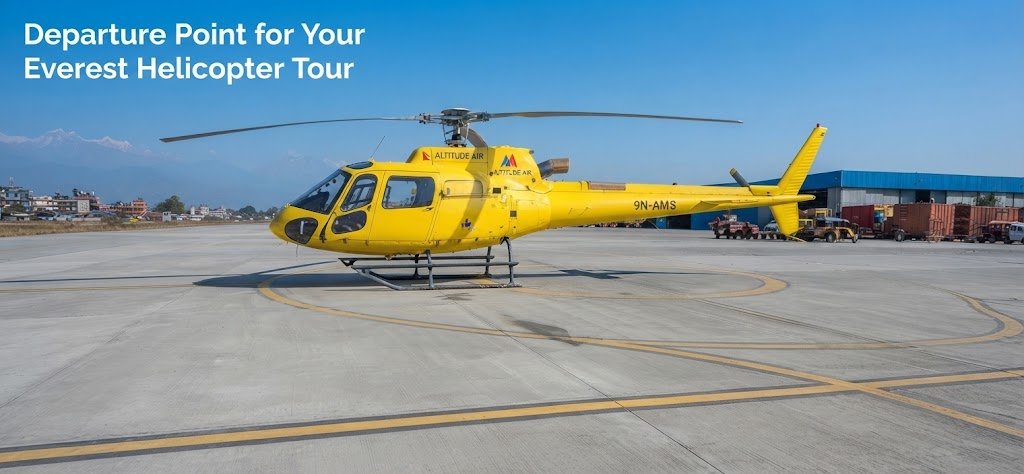
Two departure points exist for Everest helicopter tours: Kathmandu at 1,300 metres, and Lukla at 2,860 metres. Most passengers book from Kathmandu without knowing Lukla is an option, and most who do know about Lukla assume it is simply a cheaper version of the same thing. The reality is more nuanced. The two departure points offer genuinely different experiences, cost structures, and logistical requirements.
The Kathmandu Departure: What It Includes
A Kathmandu departure means the helicopter picks you up in the capital, flies the full route to the Everest region, makes the stops at Syangboche and Everest Base Camp or Kala Patthar, and returns you to Kathmandu. The full return flight covers approximately 280 kilometres and takes 3.5 to 4.5 hours from door to door.
The Kathmandu departure gives you the complete aerial experience of the approach to Everest. You fly over the Kathmandu Valley, cross the middle hill zone of central Nepal, watch the elevation rise as you enter the Solu Khumbu district, and see the landscape transform from agricultural terracing to pine forest to moraine to glacial ice over the course of the outbound flight. By the time you reach base camp, you have an aerial map of the terrain in your head that gives the destination genuine geographical context.
For most first time visitors to Nepal, this approach is the recommended choice. The full flight tells a complete story about where Everest is in relation to the rest of the country.
The Lukla Departure: What It Includes
A Lukla departure requires you to get yourself to Lukla first, either by the 30-minute domestic flight from Kathmandu to Tenzing-Hillary Airport or by trekking. Tenzing-Hillary Airport at Lukla (2,860 metres) is consistently rated among the most challenging commercial airports in the world. The runway is 527 metres long, slopes uphill at a gradient of 11.7 degrees, ends in a sheer drop on one side and a rock face on the other, and sits in a valley that can close with cloud at any time of day.
From Lukla, the Everest helicopter tour covers only the upper portion of the route: Lukla to Namche Bazaar to Syangboche to Everest Base Camp or Kala Patthar and back to Lukla. The helicopter is in the air for roughly 1.5 to 2 hours total. You see the dramatic upper Khumbu, but you miss the approach from Kathmandu.
After the helicopter tour from Lukla, you fly back to Kathmandu on a domestic fixed-wing flight (separate ticket, not included in the helicopter tour cost). The Lukla flights use Twin Otter or similar small aircraft operated by Buddha Air, Tara Air, or Sita Air, and are themselves subject to weather cancellation, sometimes at higher rates than the helicopter tour itself.
Cost Comparison in 2026
A Kathmandu departure Everest helicopter tour in 2026 runs between USD 1,000 and USD 1,200 per person for a shared group tour, and USD 4,000 to USD 5,500 for a private helicopter charter. These prices cover the helicopter, the landing fees, the Sagarmatha National Park permit, and typically tea or refreshments at the stop points.
A Lukla departure tour typically costs USD 600 to USD 800 per person for a shared seat, and USD 2,500 to USD 3,500 for a private charter from Lukla. This is cheaper because the helicopter is in the air for less time and the fuel cost is lower. However, you need to add the cost of your domestic Lukla flight (approximately USD 180 to USD 250 per person each way) and factor in the time cost of the Lukla flight, including potential weather delays at both ends.
Net cost difference: the Lukla departure tour works out roughly USD 300 to USD 500 cheaper per person when all costs are included, but that saving comes with meaningfully higher logistical complexity and weather dependency.
Which Departure Point Has Higher Cancellation Risk?
Kathmandu departures cancel when the Khumbu Valley is fogged in or winds at altitude exceed safe limits. Lukla departures have an additional cancellation risk layer: the Lukla domestic flight from Kathmandu. Lukla airport closes frequently due to cloud, low visibility, or wind, and even when the helicopter weather in the Khumbu is fine, the Lukla flight may not operate. In that scenario, you are grounded in Kathmandu unable to reach your departure point, which counts as a separate problem from helicopter tour cancellation.
For passengers with limited Nepal itinerary flexibility, the added cancellation variable at Lukla is a meaningful consideration. Kathmandu departure tours reduce the number of weather-dependent steps in the itinerary from two (Lukla flight plus helicopter tour) to one (helicopter tour only).
The Tenzing-Hillary Airport Experience
Flying into Lukla is itself an experience that many Nepal travelers specifically want, and for those passengers the domestic flight to Lukla is a feature rather than a logistical step. The approach to Tenzing-Hillary Airport, descending rapidly through the valley, aligning with the steeply pitched runway, and touching down with the rock wall immediately ahead, is genuinely memorable. If you have already trekked to EBC before and are returning specifically for the helicopter, the Lukla flight is worth doing once.
First-time Nepal visitors who are already nervous about the helicopter tour sometimes find the Lukla domestic flight adds anxiety rather than excitement. In those cases, a Kathmandu departure removes the Lukla variable entirely and lets the helicopter tour be the focus of the day.
Who Should Choose Kathmandu Departure
Choose Kathmandu departure if you are visiting Nepal for the first time, if you have limited days in Nepal and cannot absorb a Lukla cancellation, if you want the complete aerial experience of the full approach from the Kathmandu Valley to base camp, or if simplifying the logistics is more important than saving money.
Who Should Choose Lukla Departure
Choose Lukla departure if you are already trekking in the Khumbu and want to add a helicopter tour before flying out, if you are a returning Nepal visitor who has already done the Kathmandu-to-EBC route and wants the different perspective of a Lukla-origin flight, or if budget is a primary consideration and you have enough buffer days to absorb both a potential Lukla flight delay and a helicopter tour cancellation.
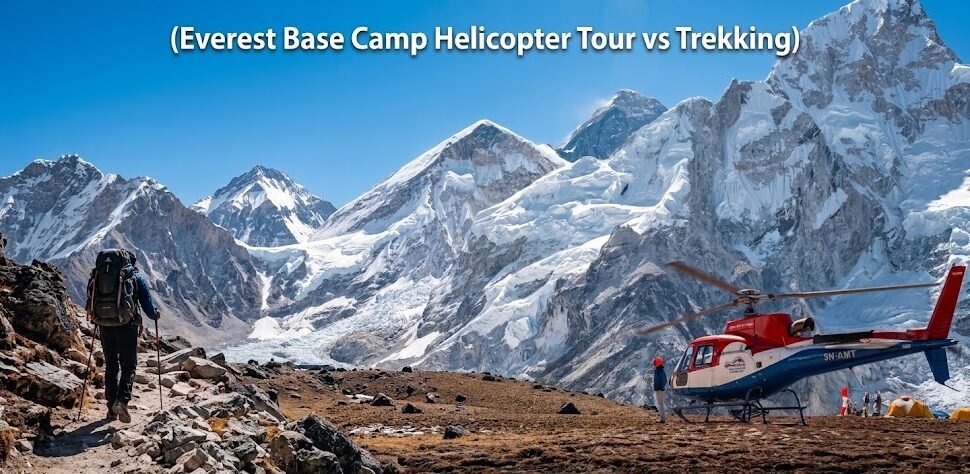
Some trekkers at the end of an Everest Base Camp trek book a Lukla departure tour for the final day, fly up to Kala Patthar by helicopter to see the summit view they may have missed on foot due to cloud, then take the domestic flight back to Kathmandu. This is a legitimate and well established use of the Lukla departure option, and operators handle it regularly.
Combining Both: The Kathmandu Out, Lukla Back Option
A less common but available option is booking a helicopter from Kathmandu to EBC and back to Lukla (rather than back to Kathmandu), then taking the domestic flight to Kathmandu from Lukla on the same day. This gives you the full outbound flight experience and the Lukla airport experience on the return, with one helicopter segment and one domestic flight segment. Some operators offer this as a named route. Ask specifically when booking if this interests you.
Related reading: Everest Base Camp Helicopter Tour | Cost Guide 2026 | How to Book | Helicopter vs Mountain Flight