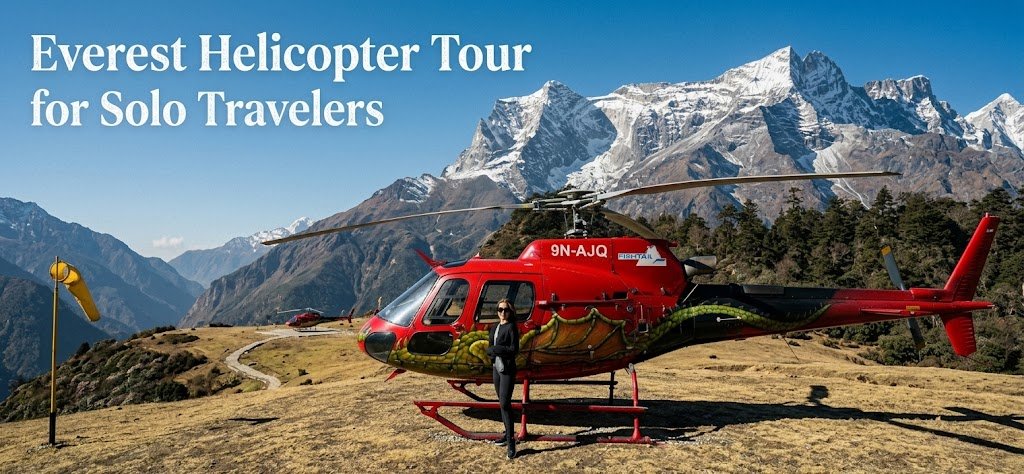
Booking an Everest helicopter tour as a solo traveler involves a set of decisions that group or couple bookings do not. Most operators fill a shared helicopter with passengers who have booked independently, which means solo travelers pay a per-seat rate rather than chartering the entire aircraft. Here is what you need: how shared bookings work, what solo travel on this route actually looks like, and the specific booking considerations that apply when you are traveling alone.
How Shared Helicopter Seats Work
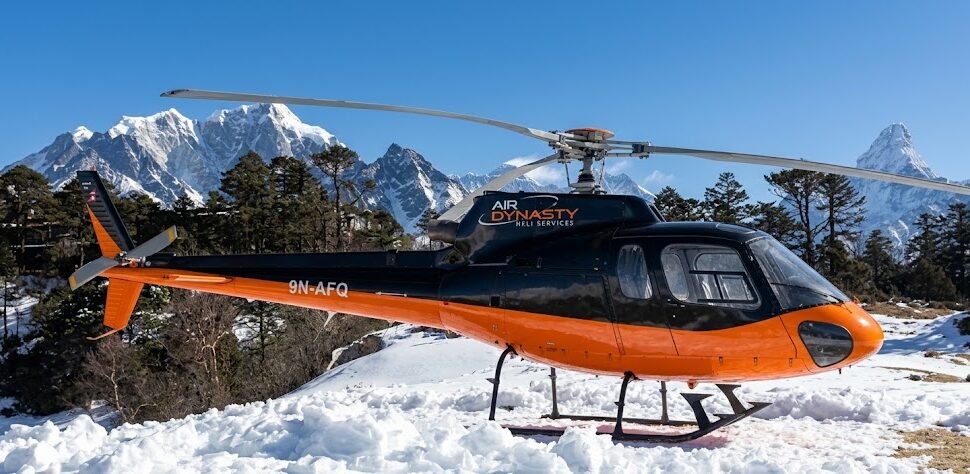
The standard Everest helicopter tour uses aircraft that hold four to five passengers plus the pilot. Most operators sell these seats individually to different bookings, filling the helicopter from multiple reservations made on different dates. A family of three, two friends, and a solo traveler might share the same aircraft on the same morning, each having booked separately at different times.
This is how almost all group-rate helicopter tours operate. The solo traveler is not added as a fifth wheel to an existing group. They are simply one booking among several that happen to be scheduled for the same flight slot. In practice, the passengers on a shared helicopter often have their first conversation while waiting at the helipad and find the shared journey adds rather than subtracts from the experience.
Solo travelers who want guaranteed privacy, freedom to extend landing times, or the ability to choose their route without consensus can book a private charter. A private charter reserves the entire helicopter for one booking. For a solo traveler, this means paying the full charter price (typically USD 4,000 to USD 5,500 for the Kathmandu-to-EBC route in 2026) rather than a per-seat rate (typically USD 1,000 to USD 1,200). Most solo travelers book the shared seat option.
The Single Supplement Question
Unlike hotels or cruise ships, Everest helicopter tours do not typically charge a single supplement. You are buying a seat on a helicopter, not a room with occupancy pricing. Your per-seat cost as a solo traveler is the same as the per-seat cost for anyone else on the same tour. This is a genuine advantage of helicopter tours for solo travelers compared to many other travel products.
The practical implication is that you pay the standard group tour price regardless of how many people are on your specific flight. If the helicopter that morning has only two passengers instead of five, you do not pay extra. If it is full with five passengers, you do not pay less. The seat price is fixed.
Minimum Booking Requirements
Some operators have minimum booking requirements for shared tours. A common policy is that the tour departs when a minimum of two or three paying seats are booked for a given morning. If you are the only person booked for a particular day, the operator may ask you to shift to a different day when other bookings exist, or offer you the option of paying for the minimum seat count to guarantee your departure.
Ask about this policy when booking. Most operators running regular EBC helicopter tours in peak season have enough bookings that solo travelers are rarely the only passenger. In the shoulder months (March, mid-November, early December), the chances of being the sole passenger on a given morning are higher.
What Solo Female Travelers Should Know
Nepal is a generally safe destination for solo female travelers, and the Everest helicopter tour context is professional and structured. You board a helicopter with a licensed pilot, fly to a destination, land, take photographs, return. The setting is public, the activity is supervised, and the other passengers are international tourists.
Practical considerations: confirm your meeting point and pick-up logistics clearly before tour day. Most operators arrange hotel pickup or specify a meeting point at the helipad. Having this confirmed in writing via WhatsApp or email removes ambiguity on the morning of the tour. The pre dawn departure time (typically 5:30 to 6:30 AM) means arriving at the helipad in darkness in some seasons. Know the address, know the operator’s contact number, and have backup transportation arranged.
When communicating with operators by WhatsApp (the standard communication channel in Nepal for this type of booking), maintain all booking details in a single thread so you have a written record. This applies equally for male and female solo travelers but is worth stating explicitly.
Meeting Other Passengers
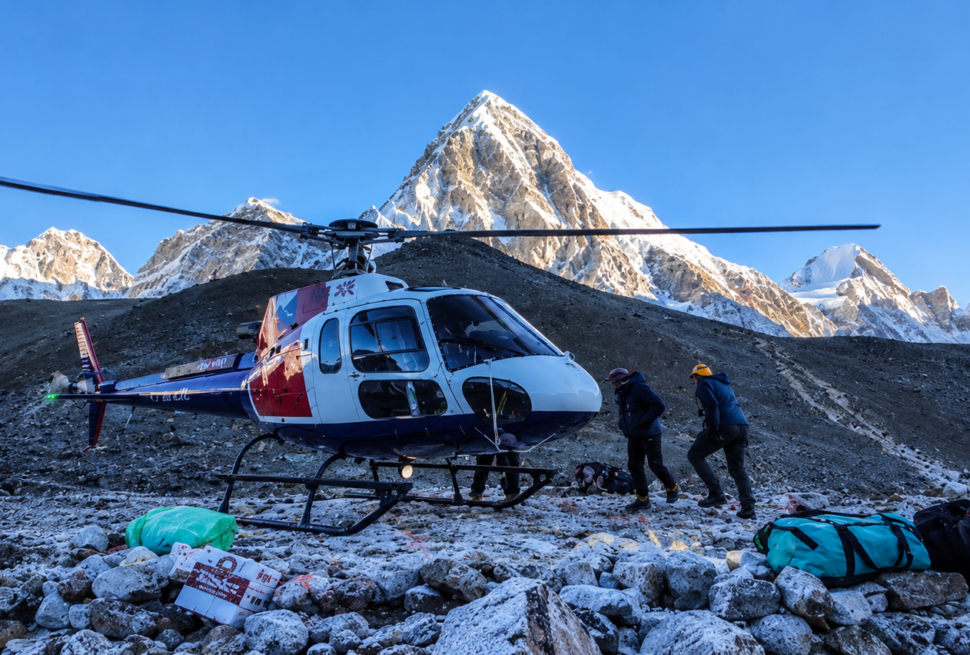
The shared helicopter format naturally produces brief social encounters with other passengers. Most EBC helicopter tour passengers are international visitors, and the shared experience of seeing the same things at the same moment creates an immediate point of connection. The 15-minute landing at Kala Patthar or Everest Base Camp is often when conversations happen, because everyone is standing in the same extraordinary place at the same time and processing it simultaneously.
Solo travelers who prefer minimal social interaction will find that the nature of the tour makes this easy to manage. The helicopter is loud in flight and conversation is limited. The landing stops are short. If you want to photograph or simply stand and look, other passengers are doing the same. The format does not require sociability the way a group trek does.
Combining the Helicopter Tour with a Solo Trek
Many solo travelers book the Everest helicopter tour as one part of a Nepal itinerary that also includes some trekking. A common combination is the Annapurna Base Camp trek (which takes 7 to 10 days from Pokhara) followed by the Everest helicopter tour from Kathmandu at the end of the trip. This gives you ground level Himalayan experience combined with the aerial perspective of Everest.
For solo trekkers finishing the Everest Base Camp trek on foot, the helicopter tour becomes a logical return option: instead of trekking back down to Lukla over 4 to 5 days, book a helicopter from Lukla to Kathmandu with a stop at Kala Patthar, and you have the aerial view of the terrain you just walked through. This Lukla departure option (covered in detail in our separate guide) is widely used by solo trekkers finishing the standard EBC route.
Solo Booking Process: Step by Step
Find an operator, check that they are CAAN-licensed, and contact them by email or WhatsApp with your travel dates. The operator will confirm availability for your dates, provide pricing, and specify what deposit is required to hold a seat. Standard deposits run 20 to 30 percent of the tour cost, payable by bank transfer, card, or in cash at the operator’s Kathmandu office.
You will receive a booking confirmation with a meeting time and point. Save this confirmation and the operator’s WhatsApp number. On the evening before your tour, you will typically receive a weather update confirming whether the tour is running or needs to reschedule. On the morning of the tour, arrive at the specified location at the specified time. The helicopter operator handles everything from that point: briefing, boarding, pilot introduction, and the full route.
For solo travelers carrying camera gear, confirm at booking whether baggage weight limits apply and what the limit is. Most shared helicopter tours allow 5 to 8 kilograms of carry-on equipment per passenger. A camera bag with a body and two lenses, batteries, and memory cards typically weighs 3 to 5 kilograms, well within standard limits.
Travel Insurance for Solo Travelers
Solo travelers should carry travel insurance that covers helicopter medical evacuation. In the Everest region, medical evacuation by helicopter is the only viable emergency transport option, and the cost of an unscheduled evacuation flight from EBC or Kala Patthar to Kathmandu is typically USD 4,000 to USD 8,000 for the aircraft alone, before any hospital costs. This is not hypothetical: altitude sickness affects some helicopter tour passengers even on short-duration flights, and evacuation decisions sometimes need to be made quickly.
Major travel insurance providers that cover Nepal helicopter evacuation include World Nomads, IMG Global, Allianz, and Battleface. Check specifically that high altitude helicopter evacuation is included in your policy, not excluded as a hazardous activity. Some base-tier policies exclude helicopter transport entirely; most mid-tier and above policies include it.
Related reading: Group Helicopter Tour Package | Private vs Group Guide | Cost Guide 2026 | Altitude Sickness Guide