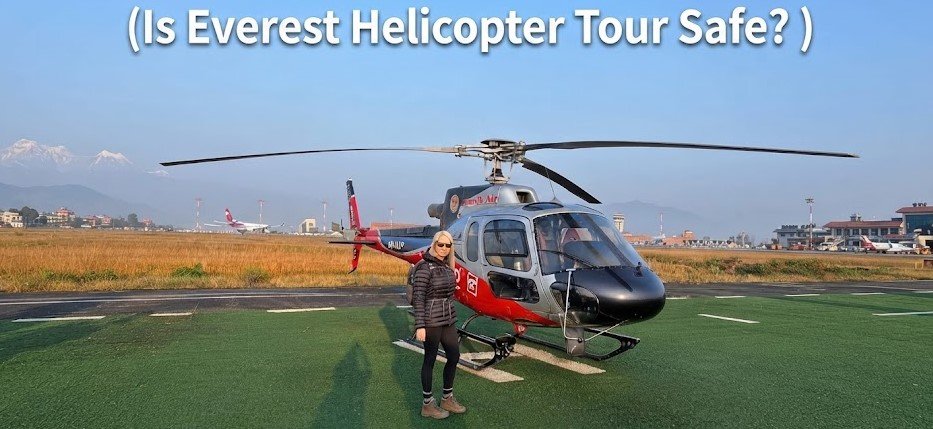
Let us start with the question directly: is an Everest helicopter tour safe? The honest answer, based on the actual safety record, the regulatory framework in Nepal, and the specific mechanics of how these flights work, is yes, provided you book with a legitimate, licensed operator flying modern, properly maintained aircraft. That qualifier matters. Not all operators meet that standard.
Here is the real picture, not a reassuring marketing summary, but the actual data, the known risks, the regulatory situation in Nepal, and what you can do to make sure you are flying with an operator who takes safety as seriously as you do.
The Safety Record of Nepal Helicopter Operations
Nepal’s helicopter industry has a complex safety history. The country operates more high altitude helicopter flights than almost anywhere else on earth, search and rescue operations, mountain expedition support, EBC tours, medical evacuations, and cargo routes to remote villages. The volume of flights is significant, and the terrain and altitude make Nepal’s airspace among the most technically demanding in the world.
The Civil Aviation Authority of Nepal (CAAN) records all aviation incidents and accidents. Looking at the data from the past decade: the majority of serious helicopter incidents in Nepal have involved military or search and rescue aircraft operating in extreme weather, not commercial tourism operators on established routes like the EBC circuit. The EBC tourist route, Kathmandu to Khumbu to Kathmandu, is one of the most frequently flown helicopter routes in Nepal, and it has an excellent safety record among licensed commercial operators.
That said, incidents have occurred. Three things account for almost every serious helicopter accident in Nepal’s tourism sector: weather decisions made too late, aircraft that were inadequately maintained, and pilots with insufficient high altitude experience. All three are factors you can investigate before booking.
What Makes high altitude Helicopter Flying Technically Challenging
To understand the safety profile of an EBC helicopter tour, you need to understand why flying at altitude is different from flying at sea level.
Thin Air and Engine Performance
At 5,500 metres, the altitude of a Kala Patthar landing, the air has roughly half the density of air at sea level. Helicopter engines, which are essentially gas turbines, produce less power in thin air. The rotors, which generate lift through the air they push downward, have less air to work with. The result: a helicopter at 5,500 metres has significantly less performance margin than the same aircraft at sea level. Take-off and landing require precise technique, correct load management, and an aircraft with sufficient power reserve for the conditions.
The AS350 B3e (now marketed as the Airbus H125) is the helicopter most commonly used on the EBC route for precisely this reason, its Arriel 2D engine maintains excellent performance at high altitude and has a single engine safety margin that suits the terrain. Older, less powerful variants of the Ecureuil family, or underpowered alternatives, have materially less margin at these altitudes. Aircraft selection is not a cosmetic concern, it directly affects safety.
Mountain Weather: Predictable Patterns, Unpredictable Changes
The Khumbu has reliable weather patterns: mornings are typically calm and clear; cloud builds through the late morning and afternoon; afternoons can bring strong winds. This pattern is why all EBC helicopter tours depart very early, typically between 6:30 and 7:30 AM, to complete the high altitude landing before conditions deteriorate.
What makes mountain weather challenging is the speed at which conditions can change. A clear morning can become a clouded, windy afternoon in less than an hour. A skilled pilot reads the early signs, building cumulus at the valley heads, changing wind direction at altitude, and makes the call to return before the window closes. Experience in reading Khumbu-specific weather is what separates excellent pilots from merely competent ones.
The Landing Zone at High Altitude
Landing a helicopter at Kala Patthar (5,545 metres) or near EBC (5,364 metres) is technically demanding. There is no flat, prepared helipad, the pilot identifies a suitable patch of rock or snow, assesses wind direction and surface conditions from the air, and commits to a landing. The available power margin is thin. A missed approach at this altitude requires immediate, confident recovery. Pilots who fly this route regularly develop a deep familiarity with the specific landing zones and the approach angles that work under different wind conditions. Pilots flying it for the first time, or rarely, do not have that knowledge base.
Regulatory Framework: CAAN and What It Requires
Nepal’s Civil Aviation Authority (CAAN) licenses helicopter operators, certifies pilots, and mandates maintenance standards. The requirements are substantive:
- All commercial helicopter pilots must hold a valid CAAN Commercial Pilot License (Helicopter) with an instrument rating
- high altitude operations require specific endorsements and minimum flight hours in mountain environments
- Aircraft must have current airworthiness certificates renewed through mandatory periodic inspection
- Engine overhaul intervals are mandated, helicopter turbine engines must be overhauled at specified hour intervals regardless of apparent condition
- Operators must carry aviation insurance as a condition of their Air Operator Certificate
These regulations are real and are enforced, but enforcement quality varies, and the gap between the regulatory standard and actual compliance at some budget operators is a known issue within Nepal’s aviation community. This is why verifying your operator’s specifics matters more than assuming regulation provides a uniform safety floor.
What Separates Safe Operators from Risky Ones
Here is what you should actually look for when evaluating an operator’s safety credentials, beyond the marketing language.
Aircraft Type and Age
Ask specifically: what helicopter model and what registration? Then look up that registration in CAAN’s public aircraft register (available through Nepal’s Department of Civil Aviation). Check the aircraft’s year of manufacture. An AS350 B3e manufactured in 2018 or later, properly maintained, is an excellent choice for this route. An Ecureuil model from the 1990s requires more scrutiny, when was the last engine overhaul? What is the total airframe time?
Pilot Experience
Ask how many hours the pilot flying your tour has in Nepal mountain operations specifically. A total flight time of 3,000 hours means something different if 2,000 of those hours are Kathmandu-to-Khumbu commercial operations versus general utility flying elsewhere. The EBC route is specific, Khumbu weather, specific landing zones, specific approach angles. Experience on this exact route is what matters.
Maintenance Practices
You cannot inspect an aircraft’s maintenance logbooks before your tour, that would be unusual and impractical. But you can ask: who does your aircraft maintenance, where, and on what schedule? Reputable operators use CAAN-certified maintenance organizations and follow manufacturer-specified intervals. If the answer is vague, that is information.
Cancellation Culture
One of the strongest indicators of a safety conscious operator is their willingness to cancel. An operator who cancels or postpones when conditions are marginal, even when passengers are disappointed, is making the right call. An operator who presses on because “most of the flight was fine” or because they do not want to deal with refund requests is prioritising revenue over risk management. The best way to gauge this: read reviews specifically for mentions of weather cancellations and how the operator handled them. Operators who receive complaints for cancelling too readily are, paradoxically, often the safest ones to fly with.
The Actual Risks of an EBC Helicopter Tour, Honestly Stated
No mode of transport is zero risk. Here are the actual risks of this specific tour, stated plainly.
Weather-Related Risk
The primary risk is weather, either a forced turn-back before landing (disappointing but safe) or, in a worst-case scenario, an encounter with rapidly deteriorating conditions during the flight. Reputable operators mitigate this by departing early, monitoring weather in real time, maintaining radio contact with pilots already in the Khumbu airspace, and making conservative go/no-go decisions. The risk is manageable with good judgment. It is not manageable when operators feel commercial pressure to fly in marginal conditions.
Altitude Physiology
A rapid ascent to 5,500 metres without acclimatisation carries altitude risk. The saving factor on a helicopter tour is that the exposure is brief, 10 to 15 minutes, and descent is immediate. Most healthy adults experience no meaningful altitude effects on a brief EBC helicopter stop. People with undiagnosed cardiovascular conditions, recent respiratory illness, or extreme sensitivity to altitude may experience headache, dizziness, or mild breathlessness. Serious acute mountain sickness (AMS) at these oxygen levels is possible but uncommon in a healthy adult on a brief, same-day ascent. Full guidance: Altitude Sickness on an Everest Helicopter Tour.
Mechanical Risk
Helicopter mechanical failures are the least common cause of incidents among established operators on this route, precisely because the operating costs of maintaining these aircraft are high and serious operators invest in maintenance. The risk is materially higher with budget operators using aging aircraft on extended maintenance intervals. This is the clearest argument for paying the premium for a reputable operator, not because cheaper operators are necessarily unsafe, but because the correlation between budget operations and deferred maintenance is real.
Comparing EBC Helicopter Tour Risk to Other Nepal Activities
Context helps. Here is how the EBC helicopter tour compares to other activities that visitors to Nepal commonly undertake.
| Activity | Primary Risk Factors | Relative Risk Level |
|---|---|---|
| EBC Helicopter Tour (reputable operator) | Weather, altitude physiology | Low |
| EBC Trek (experienced guide, good acclimatisation) | Altitude sickness, weather, terrain | Low Moderate |
| EBC Trek (poorly guided, rushed acclimatisation) | Severe AMS, HACE, HAPE | Moderate High |
| Road travel Kathmandu Pokhara by bus | Road conditions, driver fatigue, landslides | Moderate |
| Domestic fixed wing to Lukla | Short runway, mountain approach, weather | Moderate |
| White-water rafting (Class IV V) | Hydraulic forces, remote location | Moderate High |
The comparison with the Lukla flight is instructive. Lukla (Tenzing-Hillary Airport) is notorious for a short runway, a mountain-face approach, and a history of weather related incidents. Most EBC helicopter tours bypass Lukla entirely, they fly directly from Kathmandu, and the approach to the high altitude landing zone is conducted by helicopter pilots who fly the Khumbu dozens or hundreds of times per season. The risk profile of the helicopter tour is, in most respects, more manageable than the Lukla fixed wing approach.
What the Helicopter’s Safety Features Actually Do
Modern tourism helicopters operating in Nepal carry several safety systems worth understanding.
Engine Performance Reserve
The AS350 B3e is certified for single engine operations, meaning if the engine fails (an extremely rare event in a properly maintained turbine), the aircraft can autorotate to a landing. Autorotation uses the stored rotational energy in the rotor blades to provide controlled descent without engine power. It requires a competent pilot and sufficient altitude, but it is a real and functional emergency capability, not a theoretical one.
Emergency Locator Transmitters (ELTs)
All CAAN-registered commercial helicopters must carry ELTs that activate automatically on impact and transmit location to satellite search and rescue networks. In the event of a forced landing in a remote area, emergency services have the means to locate the aircraft.
Supplemental Oxygen
Many operators carry portable supplemental oxygen on board for passengers who experience unexpected altitude effects at the high altitude landing stop. This is worth confirming with your operator before your tour, particularly if any member of your group has cardiovascular or respiratory history.
Radio Communication
Pilots on the Everest route maintain radio contact with the operator’s ground team in Kathmandu and, where available, with other pilots operating in the same airspace. Real-time weather information from multiple aircraft simultaneously in the Khumbu is one of the most practical safety tools available, conditions at the landing zone are reported by pilots who have just flown through, not predicted by a distant weather station.
Questions to Ask Your Operator About Safety
These are the specific safety questions worth asking before you book. A reputable operator answers all of them without defensiveness.
| Question | What to Listen For |
|---|---|
| What helicopter model will be used? | Specific model and registration, AS350 B3e preferred |
| When was the last engine overhaul? | Recent date, specific hours since overhaul |
| How many hours does our pilot have on this specific route? | Hundreds of hours on the Khumbu route specifically |
| What is your go/no-go weather decision process? | Specific criteria, conservative thresholds, morning weather check |
| Is there supplemental oxygen on board? | Yes |
| What is your emergency protocol if a passenger has medical distress at altitude? | Immediate descent, divert to Lukla if necessary, contact details for Kathmandu medical |
| Is your aircraft’s airworthiness certificate current? | Yes, with specific expiry date |
The Role of Your Own Travel Insurance
A legitimate operator’s aircraft carries aviation insurance, this is a CAAN requirement. But that insurance covers the aircraft and third party liability, not your personal medical evacuation if you need emergency care. Before any Nepal travel involving high altitude, buy complete travel insurance that explicitly covers:
- Helicopter rescue and evacuation at high altitude
- Emergency medical treatment in Nepal
- Repatriation if necessary
- Trip cancellation for medical reasons
Helicopter medical evacuation in Nepal without insurance can cost $5,000 to $20,000 depending on the location and complexity of the rescue. With the right insurance policy, it costs you nothing. This is not optional advice, it is the single most important safety preparation you can make for any Nepal mountain travel, helicopter tour or otherwise.
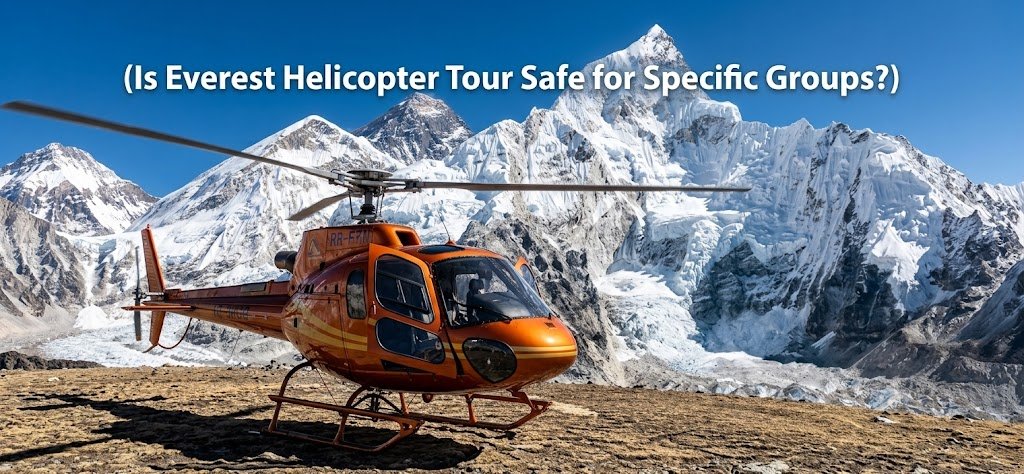
Is Everest Helicopter Tour Safe for Specific Groups?
Elderly Passengers
The brief high altitude stop is the main point of consideration for older passengers. Most healthy elderly people complete the tour without incident. Those with uncontrolled hypertension, recent cardiac events, or serious respiratory conditions should get medical clearance before booking. Discuss your health history with your doctor and with your operator. Full guide: Everest Helicopter Tour for Families.
Children
Children above 5 or 6 who are healthy and can communicate clearly are generally fine. Their bodies acclimatise rapidly, and the brief exposure at altitude is not typically problematic for healthy children. Watch for signs of distress during the high altitude stop and report anything unusual to the pilot immediately.
People with Heart Conditions
A rapid ascent to 5,500 metres transiently reduces blood oxygen saturation, which increases cardiac workload. For people with well-controlled mild cardiac conditions, many doctors give clearance for brief high altitude exposure. For those with recent cardiac events, uncontrolled arrhythmias, or significant heart failure, the standard medical advice is to avoid high altitude exposure. Get individual medical advice, do not rely on general guidance for a specific health situation.
Pregnant Women
high altitude exposure during pregnancy carries poorly characterized risk, particularly in the first and third trimesters. Most operators will not fly pregnant passengers above 3,500 metres. Discuss this with your obstetrician and your operator before booking.
What Happens If Something Goes Wrong
Nepal’s mountain rescue infrastructure is well developed, largely because the Himalayan trekking and expedition industry created the demand for it. The Himalayan Rescue Association (HRA) operates medical facilities in the Khumbu region. Kathmandu has several hospitals with high altitude medicine experience, including CIWEC Hospital, which has treated altitude illness cases from Everest expeditions for decades.
In the specific scenario of a helicopter landing or forced diversion due to weather in the Khumbu, the pilot radios immediately to the operator’s Kathmandu base. If there are injuries, CAAN coordinates search and rescue response. The response times for helicopter rescue from Lukla or Kathmandu to most Khumbu locations are measured in minutes to hours, genuinely one of the best search and rescue situations in the Himalaya given the density of aviation in the area during the tourist season.
The Bottom Line on Everest Helicopter Tour Safety
The Everest helicopter tour is safe when flown by a licensed, experienced operator using modern, properly maintained aircraft with pilots who know the Khumbu route. The route has an excellent safety record among established commercial operators. The risks that exist, primarily weather and altitude physiology, are manageable and well understood.
The safety gap in Nepal’s helicopter tourism sector is not between helicopter tours and other activities. It is between reputable operators and budget operators who cut corners on aircraft maintenance, pilot experience, or weather decision-making. That gap is real. Paying $150 more to fly with an operator who uses an AS350 B3e maintained to manufacturer specifications, flown by a pilot with 500+ hours on the Khumbu route, is not extravagance, it is the most rational safety decision you can make.
We are that kind of operator. Our aircraft are modern, our pilots are experienced on this specific route, and our weather cancellation record reflects a policy of prioritising your safety over completing a flight for commercial reasons. View our tour packages here or book the Kala Patthar landing package, the most dramatic viewpoint on the route.
Frequently Asked Questions About Everest Helicopter Tour Safety
Has anyone ever died on an Everest helicopter tour?
There have been helicopter incidents in Nepal involving tour aircraft over the years, but the EBC commercial tour route has an excellent safety record among established operators. The incidents that have occurred have predominantly involved weather decisions made too late, aged aircraft, or operations in conditions outside normal parameters. Among reputable operators on this specific route, the record is strong.
How do I know if my operator is safe?
Ask for the aircraft registration and check it with CAAN. Ask for the pilot’s specific Khumbu flying hours. Confirm the operator’s CAAN Air Operator Certificate is current. Read reviews for mentions of weather cancellation culture. And check the price, significantly below-market pricing is often correlated with below-standard operations.
What should I do if I feel unwell at high altitude during the landing?
Tell the pilot immediately. Do not try to manage symptoms silently. The helicopter can descend 3,000 metres in 15 minutes, the fastest possible altitude sickness treatment. Pilots on this route are familiar with altitude illness symptoms and will prioritise your safety.
Is the helicopter tour safer than the Lukla flight?
The two are difficult to compare directly, but Lukla’s short runway, mountain-face approach, and weather exposure have earned it a reputation as one of the world’s most challenging commercial airports. Most EBC helicopter tours bypass Lukla entirely. The high altitude helicopter landing carries its own technical demands, but the Khumbu route in a modern helicopter with an experienced pilot is, for many aviation safety analysts, a more controllable risk profile than the Lukla fixed wing approach in marginal conditions.
Do I need supplemental oxygen for the helicopter tour?
No, healthy adults at a 10 15 minute stop at 5,500 metres typically do not require supplemental oxygen. Your blood oxygen saturation will drop temporarily, and you may feel breathless, but the short duration of the stop means you descend before serious altitude effects can develop. Supplemental oxygen is carried on the aircraft for passengers who experience unexpected distress. More detail: Altitude Sickness on the Everest Helicopter Tour.
What a CAAN Helicopter Inspection Actually Covers
Nepal’s Civil Aviation Authority (CAAN) Air Operator Certificate renewal requires helicopter operators to demonstrate the following to inspectors each year:
- Current airworthiness certificates for every aircraft in the fleet, uninterrupted and up to date
- Maintenance records showing engine overhaul compliance with manufacturer-specified intervals
- Pilot licenses current for all operating crew, including high altitude endorsements where applicable for mountain operations
- Pilot aviation medical certificates renewed at the required intervals under CAAN regulations
- Operational manuals covering emergency procedures specific to mountain flying environments
- Insurance documentation covering the aircraft and third party liability
- Helipad agreements and landing zone permissions for all destinations on the operator’s declared routes
The inspection is annual. Operators who fall out of compliance lose their Air Operator Certificate and cannot legally fly passengers. In practice, enforcement quality has varied across the industry over the years, and the gap between the regulatory standard and actual day to day practice at some budget operators is a known issue within Nepal’s aviation community. This is precisely why verifying your specific operator matters more than assuming regulation provides a uniform safety floor.
You can check CAAN registration status for helicopter companies by contacting CAAN directly. The website caan.gov.np lists licensed airlines and operators, though the digital database is not always fully current. A reputable operator will provide their Air Operator Certificate number on request without hesitation.
Nepal Helicopter Safety in Numbers: Context for the EBC Tourist Route
Nepal operates one of the largest proportionate helicopter fleets in Asia relative to its size. During peak season, 40 to 60 commercial helicopters are actively operating tourist, charter, and utility routes. The total number of helicopter operations annually, particularly in the Khumbu and Annapurna corridors during October and April, is substantial.
Reviewing CAAN incident records and publicly reported events over the past decade: the overwhelming majority of serious helicopter incidents in Nepal have occurred outside the EBC tourist route category. Military aircraft, government fleet operations, medevac missions undertaken in deteriorating weather, utility cargo flights to remote settlements without established helipad infrastructure, and search and rescue operations in hazardous conditions account for most of the incidents on record.
The commercial EBC tourist route, operated by licensed companies with established departure windows, scheduled morning flights, and return protocols before afternoon weather builds, has a materially better safety record than any of those other operational categories. The route is flown hundreds of times per season by experienced pilots who know the Khumbu’s specific weather patterns, landing zones, and approach angles in detail that cannot be replicated by generalist pilots encountering the terrain for the first time.
This is the context within which the EBC helicopter tour’s risk profile sits. It is not a reckless activity. Among reputable operators on this specific route, it is a well-managed commercial operation with a strong safety record. The risk gap in this industry is between reputable operators who manage it rigorously and budget operators who do not.
Related reading: How to Book an Everest Helicopter Tour | Everest Helicopter Tour Cost 2026 | Helicopter Tour vs Trekking