Most travelers picture the Everest Base Camp Helicopter Tour as an entire day event: a pre dawn wake up call, a flight past the highest mountain on earth, breakfast at 3,780 meters with Everest framed in the window, then a slow, sleepy return to the hotel to recover. The truth is more useful than that. Door pickup to door drop off, the flight itself runs about 4 to 5 hours, and if your pickup slot is on the earlier side of the morning window, you can be back in your Thamel hotel room by 9, 10, or 11 in the morning with a full Kathmandu day still sitting in front of you.
Compare that to the classic Everest Base Camp trek, which takes 12 to 14 days on the trail before you even reach the viewpoint this helicopter flight covers in about an hour. Most visitors do not have two weeks to spend walking through the Khumbu. What almost every guest does have, once they land back in Kathmandu, is a free afternoon and evening in one of the most historically dense capital cities in Asia, a valley that holds seven separate UNESCO World Heritage listed monument zones within its city limits. Wasting that afternoon asleep in a hotel room is, frankly, a missed opportunity.
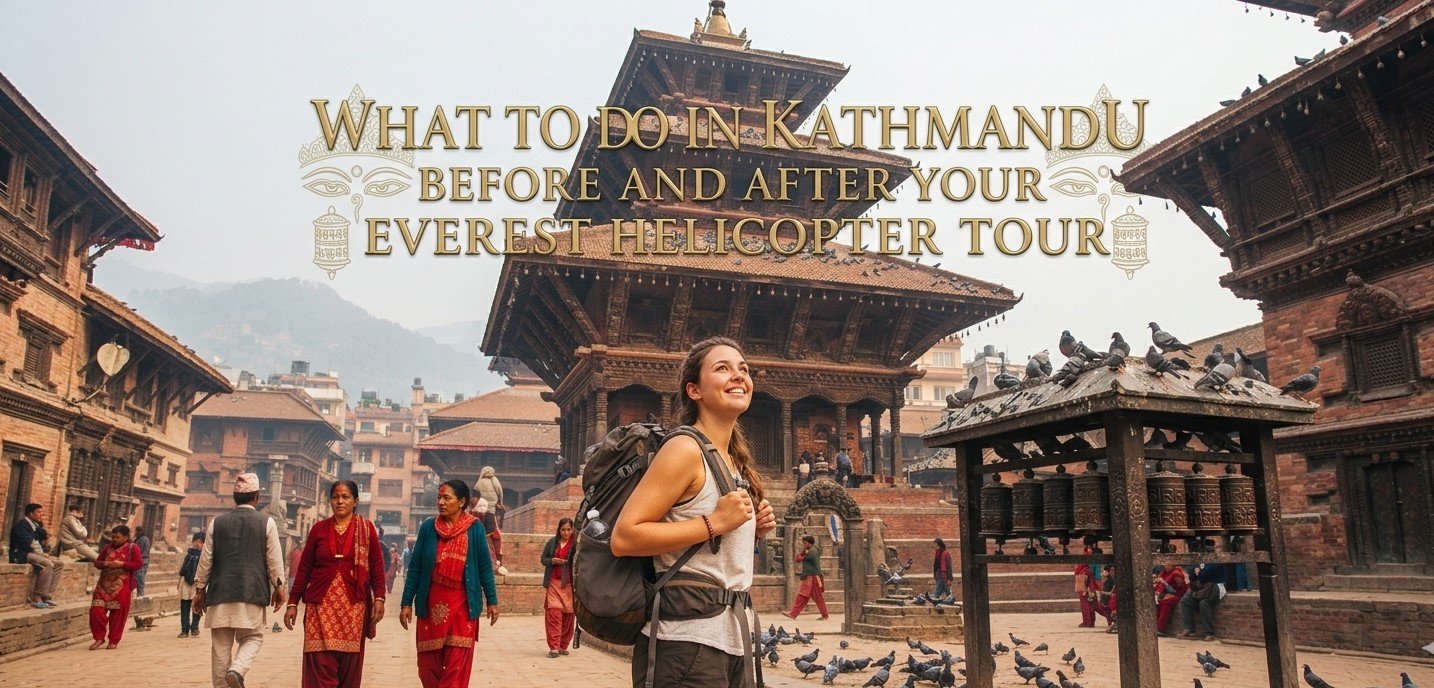
This guide lays out a realistic, hour by hour plan for that same day, from the light breakfast you should eat before pickup to the rooftop dinner that closes the evening. It is built around real travel times between Thamel and Kathmandu Durbar Square, Swayambhunath, Boudhanath, and Pashupatinath, and it is written for someone who just flew past Everest at dawn and is, quite reasonably, a little tired. Every stop below is something a jet lagged traveler can genuinely do the same day as the flight, not a theoretical itinerary that only works on paper.
Why the Everest Helicopter Tour Leaves You a Free Afternoon
The Everest Base Camp Helicopter Tour begins with hotel pickup in Kathmandu, at an elevation of about 1,400 meters, typically around 5 in the morning. There is a specific reason the flight leaves so early, mostly weather. Mountain winds and cloud build up increase through the day in the Khumbu, so mornings offer the clearest air and the calmest flying conditions. Our detailed explanation of the dawn departure window covers exactly why this timing exists and why operators will not push it later in the day.
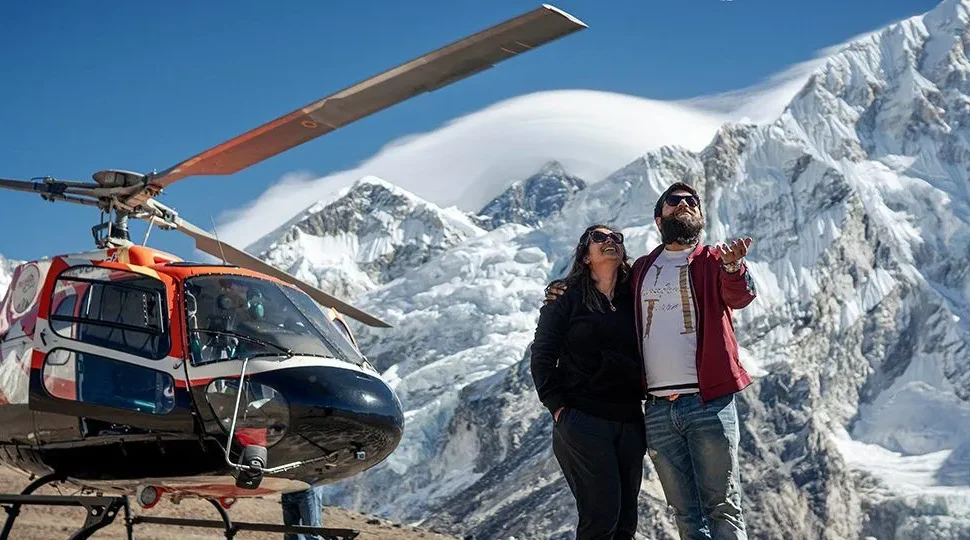
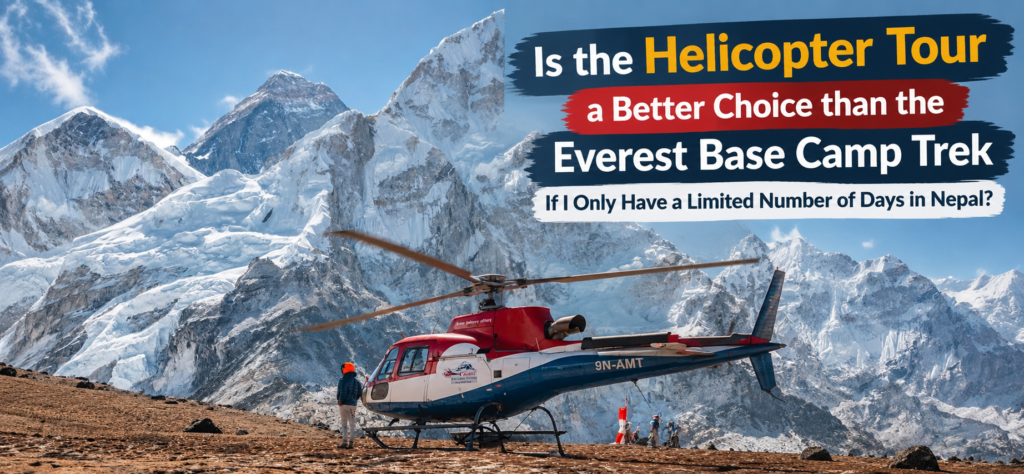
Once airborne, the helicopter, a single engine Airbus H125 (AS350 B3e) chosen for its strong high altitude performance, climbs over the Khumbu Valley, passing near Lukla at 2,860 meters, then continues toward an aerial pass above Everest Base Camp itself at 5,364 meters, tracking over the Khumbu Glacier and the Khumbu Icefall. Along the way you get close views of Everest at 8,849 meters, Lhotse at 8,516 meters, Nuptse at 7,861 meters, Makalu at 8,485 meters, and Ama Dablam at 6,812 meters, a lineup of five of the world’s most recognizable peaks in one flight. The helicopter then lands at Hotel Everest View in Syangboche, 3,780 meters, the Guinness World Record holder for the highest hotel in the world with a direct view of Everest, for a breakfast stop before the return flight to Kathmandu.
Total time from hotel pickup to hotel drop off runs about 4 to 5 hours. That means most guests are back at their hotel somewhere between 9 and 11 in the morning, depending on the exact pickup time and any weather related adjustments. If you want the full minute by minute breakdown of the flight itself, including what happens at each stage, our day by day guide to the Everest helicopter tour walks through the entire sequence from the 5am pickup to the final return. For the purposes of this guide, the important number is simple: by late morning, you are free, and Kathmandu is waiting.
Before Pickup: Making the Most of a Very Early Morning
A 5am pickup means most guests are up somewhere between 4 and 4:15 in the morning, and how you handle those first thirty or forty minutes sets the tone for the rest of the day. Resist the urge to skip food entirely just because it is early and you are nervous or excited. A completely empty stomach combined with a cold cabin, some engine vibration, and the emotional intensity of seeing Everest up close is not a great combination for anyone prone to motion sensitivity.
The better approach is a light early breakfast or simply a coffee or tea with something small: a piece of toast, a banana, a couple of biscuits, or a granola bar. Avoid a large, heavy meal right before flying, both because of the early hour and because turbulence, however mild, is more comfortable to sit through on a light stomach. Many Thamel hotels can arrange an early tea or coffee service or a packed breakfast box if you let the front desk know the night before, since regular breakfast service usually does not start until well after most helicopter pickups.
Dress in warm layers. Even though the helicopter cabin is enclosed and heated to a reasonable degree, temperatures at Syangboche in the early morning can be well below freezing, and you will likely step outside for photos near Hotel Everest View. A fleece or down layer, gloves, and a hat pack down small and make a real difference. If you have not finalized your bag for the flight yet, our guide on what to pack for the Everest helicopter tour covers exactly what to bring and, just as importantly, what to leave at the hotel.
Expect a short check in and safety briefing once you reach the airport or charter facility, generally 15 to 30 minutes, before boarding. Nerves are completely normal at this point. Almost everyone describes a mix of excitement and a slight edge of anxiety in the minutes before boarding, which tends to disappear within the first few minutes of flight once Kathmandu’s city lights give way to terraced hillsides and, soon after, the first real mountains.
What to Expect Physically and Mentally Right After Landing
Guests consistently describe the same two feelings on the ride back to the hotel: exhilaration and tiredness, often at the same time. The exhilaration is straightforward to explain. You have just seen Everest, Lhotse, Nuptse, Makalu, and Ama Dablam from the air, eaten breakfast at one of the highest hotels on earth, and flown directly over the Khumbu Icefall, all before most people have finished their morning coffee. That kind of experience produces a genuine adrenaline response, and many guests spend the drive back to the hotel scrolling through photos, comparing notes with travel companions, or simply sitting quietly and processing what they just saw.
The tiredness is just as real and deserves to be taken seriously when planning the rest of the day. A handful of factors stack up: the early wake up time, the brief but noticeable elevation change up to 5,364 meters during the aerial pass and a landing at 3,780 meters, the cold, dry mountain air, and for many travelers, ongoing jet lag from an international flight into Nepal in the first place. None of this is dangerous, since the time spent at altitude is short and the helicopter descends well before altitude sickness would typically develop, but mild fatigue, a slight headache, or simply feeling worn out is common and completely normal.
The practical takeaway is to build in a genuine buffer before diving into an ambitious afternoon. This is exactly why the itinerary below does not schedule sightseeing the moment you walk back through the hotel doors. Give yourself room to shower, change, and rehydrate first. Cold mountain air is dry, and between that and an early flight, most people arrive back at the hotel more dehydrated than they realize. A liter of water over the next hour or two makes a noticeable difference in how the rest of the day feels.
Late Morning: Shower, a Short Rest, and an Easy Lunch in Thamel
Once you are back at the hotel, generally somewhere between 9 and 11 in the morning, resist any temptation to immediately race out the door to sightsee. Take 45 minutes to an hour to shower, change out of flight layers, and simply sit down. If you genuinely feel like you need sleep, a short nap of 20 to 30 minutes can help, but set an alarm. A longer nap at this point in the day tends to leave people groggier and more disoriented than if they had just pushed through with a light, active afternoon instead.
By late morning, aim for lunch somewhere around 11:30am to 12:30pm. Keep it relaxed and keep it light. This is not the moment for a three course meal, both because your body is still processing an early start and a mild altitude swing, and because you have an active afternoon ahead. Thamel has more than a hundred restaurants and cafes within a compact, walkable grid, so you are never more than a five or ten minute walk from a good option regardless of which hotel you are staying at.
Good choices for this particular lunch lean toward something easy on the stomach and quick to arrive: a bowl of thukpa or momos at a casual Nepali or Tibetan restaurant, a simple dal bhat if you want to try Nepal’s staple meal in a lighter portion, or a sandwich and fresh juice at one of Thamel’s many cafes if you would rather ease back into food gradually. Several restaurants in the area have small garden courtyards or rooftop seating, which is a pleasant, unhurried way to sit in the late morning sun, still slightly buzzing from the flight, without rushing through a formal sit down meal. Budget about an hour to an hour and a half for lunch including the short walk from your hotel, and you will still have most of the afternoon ahead of you.
The Achievable Afternoon: Pairing One or Two UNESCO Sites
Kathmandu Valley holds seven UNESCO World Heritage listed monument zones, and four of them sit within a realistic radius of a typical Thamel hotel: Kathmandu Durbar Square, Swayambhunath, Boudhanath, and Pashupatinath. Trying to see all four in one afternoon, on top of an early morning helicopter flight, is not a good plan for anyone, jet lagged or not. Traffic, entrance queues, and simple fatigue make a four site afternoon feel rushed rather than enjoyable. A far better approach is to pick one pairing based on geography and interest, and see it properly.
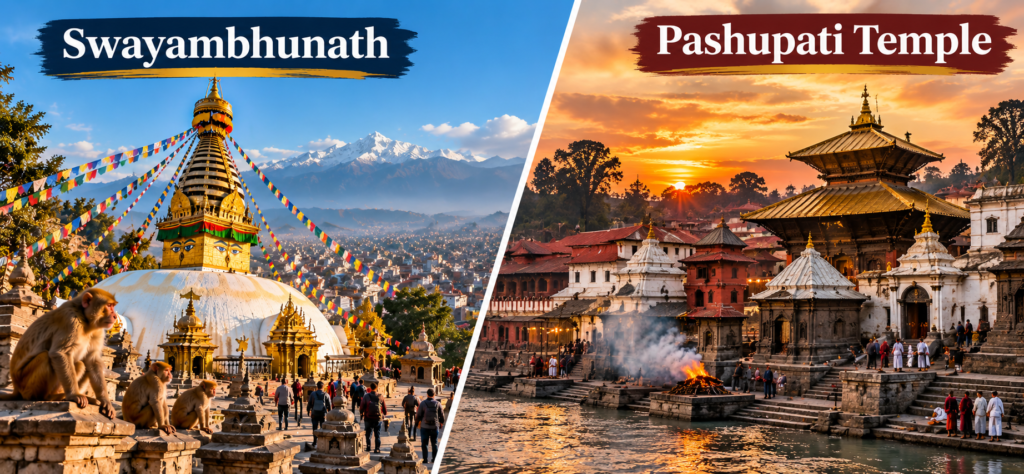
The two natural pairings fall along different sides of the city. Swayambhunath and Kathmandu Durbar Square sit closer to Thamel and pair naturally as a loop focused on Newari architecture and valley views. Pashupatinath and Boudhanath sit further east, close to each other, and pair naturally as a loop focused on living religious practice and Himalayan Buddhist culture. Below is a realistic breakdown of each site, with approximate travel time from Thamel and how long you actually need once you arrive.
The Heritage Loop: Swayambhunath and Kathmandu Durbar Square
Swayambhunath, often called the Monkey Temple by visitors because of the resident macaques living around the hillside, sits roughly 2.5 to 3 kilometers from Thamel. By taxi, that is about 15 to 20 minutes depending on traffic, though you can also walk it in around 30 to 40 minutes if you are feeling energetic, most of it uphill toward the end. The site itself sits on a hilltop with sweeping views across the Kathmandu Valley, and the famous 365 stone steps lead up to the main stupa, whose painted eyes of the Buddha look out in all four directions. Foreigner entrance runs roughly 2,000 Nepali rupees, though fees are periodically revised, so it is worth confirming the current rate at the gate. Plan on 45 minutes to an hour here, enough time to climb up, circle the stupa, take in the view, and head back down.
From Swayambhunath to Kathmandu Durbar Square is about a 15 to 20 minute taxi ride, since the route drops back down toward the older core of the city. Kathmandu Durbar Square, the former royal palace complex of the Malla and early Shah kings, is arguably the single most rewarding UNESCO site to fit into a short visit, since so much is packed into a walkable plaza. Highlights include Kasthamandap, one of the oldest structures in the square, Kumari Ghar, the residence of Kathmandu’s Living Goddess, the multi tiered Hanuman Dhoka Palace complex, and the striking stone relief of Kal Bhairab. Foreigner entrance runs roughly 1,000 to 1,500 Nepali rupees depending on current pricing. A focused visit covering the main highlights takes about 45 minutes to an hour, though history enthusiasts could easily spend two to three hours exploring every courtyard and museum. Given the day you have already had, budget on the shorter end. From here it is about a 15 to 20 minute walk, or a quick taxi, back to Thamel.
The Sacred Circuit: Pashupatinath and Boudhanath
If living religious tradition interests you more than palace architecture, the eastern pairing is the better fit. Pashupatinath, the holiest Hindu temple in Nepal, sits on the banks of the Bagmati River about 5 kilometers from Thamel, roughly 15 to 25 minutes away by taxi depending on traffic. The temple opens early, generally around 4am, and stays active well into the evening, around 9pm. Only Hindus may enter the main sanctum, but visitors who are not Hindu can explore the extensive outer complex and view the cremation ghats along the river from the opposite bank, an intense and genuinely moving glimpse into how Hindu death rites are practiced in Nepal. Entrance for visitors who are not Hindu runs roughly 1,000 Nepali rupees. Allow 45 minutes to an hour.
From Pashupatinath, Boudhanath is only about 10 to 15 minutes away by taxi, making this pairing efficient in terms of travel time. Boudhanath is one of the largest stupas in the world and sits at the center of Kathmandu’s Tibetan Buddhist community, surrounded by monasteries, prayer wheel corridors, and a ring of shops and cafes. Many visitors find it the single most photogenic stop in the valley, particularly in the late afternoon light. A relaxed visit includes walking the kora, the clockwise circuit around the stupa’s base that pilgrims perform, spinning the prayer wheels as you go, and finishing with a coffee or tea at one of the rooftop cafes that overlook the stupa directly. Entrance runs roughly a few hundred Nepali rupees. Budget an hour here, including the rooftop coffee break, and note that this loop puts you further from Thamel at the end, so the taxi ride back, roughly 20 to 30 minutes depending on traffic, should be factored into your evening plans.
Choosing Between the Two
Neither pairing is objectively better, and both are genuinely doable the same afternoon as an early morning helicopter flight. If you are drawn to architecture, royal history, and panoramic hilltop views, take the Heritage Loop. If you are drawn to living religious practice, Tibetan Buddhist culture, and a slower, more contemplative pace, take the Sacred Circuit. If your energy is genuinely low after the flight, it is also completely reasonable to visit only one site rather than two, particularly Boudhanath or Kathmandu Durbar Square, both of which reward a slower, unhurried visit on their own.
Late Afternoon: Shopping in Thamel
By around 4 in the afternoon, most travelers following either loop above are back in or near Thamel, and this is the ideal window for shopping, before the dinner crowds arrive and while there is still good natural light inside the shops. Thamel is Kathmandu’s main tourist district, a dense, largely pedestrian grid of narrow lanes packed with shops selling everything from mountaineering gear to handwoven textiles, and it rewards an hour or two of unhurried browsing more than a rushed dash through.
Pashmina shawls are sold almost everywhere in Thamel, in every color and weight imaginable. It is worth knowing that a genuine 100 percent pashmina, made from the fine undercoat wool of Himalayan mountain goats, is considerably more expensive and softer than the common viscose and silk blends also labeled pashmina throughout the district. If authenticity matters to you, ask specifically for certified pure pashmina and expect to pay a noticeably higher price for it, while the blended versions still make attractive, affordable gifts at a fraction of the cost.
Singing bowls are another Thamel staple, sold in shops throughout the district in sizes ranging from small palm sized bowls to large decorative pieces. Most shopkeepers will happily demonstrate the sound of a bowl before you buy, running a wooden mallet around the rim to produce the sustained resonant tone the bowls are known for. Prices vary with size, metal composition, and craftsmanship, so it is worth comparing a few shops rather than buying at the first one you enter.
Trekking gear is where Thamel genuinely earns its reputation as an outdoor retail hub. Down jackets, fleece layers, hiking boots, backpacks, trekking poles, and cold weather accessories are sold throughout the district, both from established outdoor brand stores and from smaller shops selling well made budget alternatives at a fraction of international retail prices. Even if you are not heading out on a trek yourself, a down jacket or warm layer picked up here is a genuinely useful souvenir for Kathmandu’s own chilly evenings, particularly between November and February.
Handicrafts round out the shopping list: intricately carved wooden statues and window frames, hammered copper and brass ritual items, hand painted thangka scroll paintings depicting Buddhist deities and mandalas, and strings of colorful prayer flags that make lightweight, easy to pack gifts. Bargaining is standard practice throughout Thamel outside of fixed price shops and larger retail outlets, so treat the first quoted price as a starting point rather than a final figure, and shop with cash in Nepali rupees for the smoothest transactions, since many smaller stalls do not accept cards. Two hours is a comfortable amount of time to cover the main shopping streets without feeling rushed, though committed shoppers could easily spend longer.
Evening: Rooftop Dinner, Mountain Views, and Cultural Show Options
By early evening, most guests following this itinerary are back at their hotel by around 6 or 6:30pm to freshen up before dinner. After a day that started before sunrise with an Everest flight and continued through UNESCO sites and shopping, this is the moment to slow down and let the day settle.
Thamel and the surrounding neighborhoods have a genuinely strong rooftop dining scene, and a rooftop restaurant is a fitting way to close a day that began looking down at the Himalayas from a helicopter window. Many rooftop spots in and around Thamel offer views across the city’s rooftops and, on a clear evening, distant silhouettes of the surrounding hills. Menus typically range from Nepali thali sets and Newari specialty dishes to wood fired pizza and international comfort food, so there is something for travelers who want to keep exploring local cuisine and those who would simply like a familiar, easy meal after a long day. Budget 1.5 to 2 hours for a relaxed dinner.
A cultural dinner show is the other strong option for this evening, particularly for first time visitors to Nepal or anyone traveling with family. Several venues around Kathmandu pair a buffet dinner with a live program of traditional dance performances representing different regions and communities of Nepal, from Newari and Tharu dances to Sherpa and Gurung folk performances. It is a low effort, genuinely enjoyable way to get a broader sense of Nepal’s cultural diversity after a day that focused heavily on its Buddhist and Hindu religious sites.
If this trip is a honeymoon or a couples getaway, the evening is also worth building around each other rather than a group setting. Several rooftop restaurants in Thamel can arrange a quieter, more private table for two, and if the helicopter flight itself is part of a honeymoon celebration, our private couple honeymoon helicopter package is built specifically around that kind of trip, with the whole aircraft reserved for two travelers rather than a shared group flight.
Sample Full Day Itinerary
The table below pulls the entire day into one reference timeline. Treat the times as realistic estimates rather than a fixed schedule, since traffic, weather, and your own pace on any given day will shift things slightly earlier or later.
| Time | Activity | Duration and Notes |
|---|---|---|
| 4:00am to 4:45am | Wake up, light tea or coffee and a small snack | Keep it light, avoid a heavy meal before flying |
| 4:45am | Hotel pickup for the airport | Doorstep pickup, generally on schedule |
| 5:00am to 5:30am | Check in, safety briefing, boarding | 15 to 30 minutes at the terminal |
| 5:30am to roughly 9am | Everest Base Camp helicopter flight, including the breakfast landing at Hotel Everest View | Total flight and breakfast time of about 3.5 to 4 hours |
| 9:00am to 10:30am | Hotel drop off | Exact timing depends on your specific pickup slot, generally between 9 and 11am |
| 10:30am to 11:30am | Shower, rest, rehydrate, change | At the hotel, a short nap is fine if needed |
| 11:30am to 12:45pm | Relaxed lunch in Thamel | Short walk plus an easy meal, about an hour to 75 minutes |
| 12:45pm to 1:15pm | Travel to the first UNESCO site | Taxi, about 15 to 25 minutes depending on the loop chosen |
| 1:15pm to 2:15pm | Visit the first site (Swayambhunath or Pashupatinath) | 45 minutes to an hour |
| 2:15pm to 2:35pm | Travel to the second site | Taxi, about 15 to 20 minutes |
| 2:35pm to 3:45pm | Visit the second site (Kathmandu Durbar Square or Boudhanath) | 45 minutes to an hour, longer if you enjoy the architecture or the kora walk |
| 3:45pm to 4:15pm | Return to Thamel | Taxi or walk, 15 to 30 minutes depending on the loop |
| 4:15pm to 6:15pm | Shopping for pashmina, singing bowls, trekking gear, and handicrafts | About two hours, fully walkable within Thamel |
| 6:15pm to 7:00pm | Return to hotel, freshen up | Short walk |
| 7:00pm to 9:00pm | Dinner: rooftop restaurant or a cultural dance show | 1.5 to 2 hours, a relaxed close to the day |
Why This Free Afternoon Makes the Helicopter Tour the Smarter Choice
Set this same day plan against the classic Everest Base Camp trek and the appeal becomes obvious. The trek covers similar terrain over roughly 12 to 14 days on foot, including acclimatization days, long walking stages between teahouses, and real physical strain at altitude. It is a genuinely rewarding experience for people who have the time and the fitness for it, but very few travelers visiting Nepal actually have two free weeks to give to a single trek, and fewer still want to spend that much of a limited vacation on one activity.
The Everest Base Camp Helicopter Tour compresses the visual reward of that trek, the aerial pass above Everest Base Camp itself, close views of Everest, Lhotse, Nuptse, Makalu, and Ama Dablam, and a landing at the highest hotel on earth with a direct Everest view, into a single morning. That leaves the rest of your trip, including the very same day, completely free for exactly the kind of Kathmandu exploration this guide describes. Instead of spending two weeks reaching a single viewpoint, you spend one morning in the air and one afternoon walking through UNESCO World Heritage sites, shopping in Thamel, and enjoying a proper dinner, all before your body has even had time to feel the accumulated fatigue that catches up with trekkers by the second week on the trail.
Pricing reflects the range of ways to do this trip. A shared group tour with five or more travelers per helicopter runs approximately 1,250 dollars per person, while the Everest Helicopter Tour group package comes in at approximately 1,100 dollars per person. Travelers who would rather reserve the entire aircraft can book a private helicopter charter, seating about five passengers, for approximately 4,800 dollars total. Couples celebrating a honeymoon or anniversary often choose the private couple package at approximately 2,800 dollars. For travelers who want to go a step further than the base camp flyby, a landing upgrade at Kala Patthar, 5,545 meters and the highest tourist accessible helicopter landing point in Nepal, is available on a shared seat basis for approximately 1,250 dollars per person.
If your trip extends beyond Kathmandu, the same efficiency applies to the rest of Nepal. Many travelers pair this helicopter tour with a few days in Pokhara for lake and mountain views, or Chitwan National Park for wildlife, rather than committing weeks to trekking. Our guide to multi day Nepal packages combining the Everest helicopter tour with Pokhara and Chitwan lays out how to build a complete Nepal itinerary around this same time efficient approach, seeing more of the country in less time rather than spending it all on one trail.
Practical Tips for a Jet Lagged Traveler Following This Plan
A few practical details make the difference between a smooth version of this day and a stressful one. First, carry Nepali rupees in small denominations for entrance fees, taxis, and smaller shops, since cards are not universally accepted outside larger restaurants and stores. Second, wear comfortable, broken in shoes. Between temple steps at Swayambhunath, cobblestones around Kathmandu Durbar Square, and the walking involved in Thamel shopping, this is not a day for new or uncomfortable footwear.
Third, dress with shoulders and knees covered when visiting Pashupatinath and Swayambhunath, both active religious sites where modest dress is appreciated and, in some areas, expected. A light scarf or shawl, conveniently something you may end up buying in Thamel anyway, works well for this. Fourth, keep hydrating throughout the day. Between the dry mountain air on the flight, a full afternoon of walking, and possible ongoing jet lag, dehydration creeps up quickly and tends to show up as a headache or general low energy rather than obvious thirst.
Fifth, consider arranging a driver or guide for the afternoon rather than hailing individual taxis at each stop. Many hotels can arrange this, and it removes the friction of negotiating fares and finding transport after each site, which matters more than usual on a day when you are already running on an early start. Sixth, and most importantly, build in flexibility. If you are more tired than expected after the flight, it is completely fine to cut the afternoon down to a single UNESCO site rather than two, spend a longer stretch of time shopping in Thamel instead, and still call the day a full success.
If this is your first trip to Nepal and you are still finalizing the broader shape of your visit, our trip planning guide for first time visitors to Nepal covers the wider practical questions, from currency and connectivity to how many days to allow in the country, that sit outside the scope of this single day plan.
Frequently Asked Questions
How early do I actually need to wake up for the Everest helicopter tour?
Most pickups happen around 5am, so plan to be up by about 4 to 4:15am to allow time to dress in warm layers, have a light snack or coffee, and be ready when the vehicle arrives. Exact pickup times vary slightly by season and by which package you book, and your operator will confirm the precise time the day before your flight.
Will I be too tired to sightsee after such an early flight?
Most guests feel a genuine mix of exhilaration and tiredness after landing, which is completely normal given the early start, the brief altitude exposure, and often some lingering jet lag. The itinerary in this guide is built around that reality, with a rest and rehydration window built in after the flight before any sightseeing begins, so a tired but reasonably fit traveler can still comfortably complete it.
Can I really see Kathmandu Durbar Square, Swayambhunath, Boudhanath, and Pashupatinath all in one afternoon?
Not comfortably, and it is not recommended. Pick one pairing based on geography, either Swayambhunath with Kathmandu Durbar Square, or Pashupatinath with Boudhanath, and see it at an unhurried pace. Trying to fit all four into one afternoon after an early morning flight tends to produce a rushed, unenjoyable experience rather than a memorable one.
Do I need to book a guide for the afternoon, or can I get around Thamel on my own?
Both work. Thamel and the nearby UNESCO sites are very manageable independently using taxis or ride hailing apps, and English is widely spoken in the tourist areas. That said, arranging a driver or a half day guide through your hotel removes the hassle of negotiating each taxi fare individually and can be worth it on a day when you are already tired from an early flight.
What should I buy in Thamel, and is bargaining expected?
Pashmina shawls, singing bowls, trekking gear, and handicrafts such as wood carvings, thangka paintings, and prayer flags are the standout categories. Bargaining is standard practice outside of fixed price stores, so treat the first quoted price as a starting point. Carrying cash in Nepali rupees makes transactions smoother, since many smaller shops do not accept cards.
Is the helicopter tour a better choice than the Everest Base Camp trek if I only have a limited number of days in Nepal?
For travelers without two or more weeks to spend on a single trek, yes. The helicopter tour delivers the visual reward, close views of Everest, Lhotse, Nuptse, Makalu, and Ama Dablam, and an aerial pass above Everest Base Camp, in a single morning, leaving the rest of your trip free for the kind of Kathmandu exploration and additional destinations covered in this guide.
What does the Everest Base Camp Helicopter Tour actually cost?
A shared group tour with five or more travelers per helicopter runs approximately 1,250 dollars per person, and the group package option runs approximately 1,100 dollars per person. A private charter of the whole aircraft, about five passengers, runs approximately 4,800 dollars total, while a private couple honeymoon package runs approximately 2,800 dollars. A Kala Patthar landing upgrade, the highest tourist accessible helicopter landing point in Nepal at 5,545 meters, is available on a shared seat basis for approximately 1,250 dollars per person.
Can this day be combined with a longer Nepal trip that includes Pokhara or Chitwan?
Yes, and many travelers do exactly this. The time efficiency of the helicopter tour makes it easy to pair with a few days in Pokhara for lake and mountain scenery, or Chitwan National Park for wildlife, without committing weeks of a trip to trekking. Our guide to combining the Everest helicopter tour with Pokhara and Chitwan lays out realistic multi day itineraries built around this same approach.
A single morning is all it takes to see Everest up close, and a single afternoon is enough to walk through centuries of Kathmandu’s history, shop for pashmina and singing bowls in Thamel, and sit down to a proper dinner with the whole day still fresh in your mind. That combination, one flight and one full, well planned day in the city, is hard to match with any other way of experiencing the Himalayas on a limited schedule. If you are ready to see Everest for yourself and still have the rest of the day ahead of you, you can find full details and current departure dates on the Everest Base Camp Helicopter Tour page, and our step by step booking guide walks through exactly how to reserve your seat.