Kala Patthar is a rocky promontory on the southern shoulder of Pumori mountain in Nepal’s Khumbu region. Its name translates from Nepali as “black rock,” which describes the dark metamorphic rock that makes up its upper slopes. It sits at 5,645m at the true summit, though the viewpoint most visitors reach and most helicopter tours land at is between 5,545m and 5,590m on the ridge. It is not technically a challenging peak. It is, however, one of the most visited high altitude viewpoints on earth, because it offers something that almost no other accessible location provides: a direct, unobstructed close view of the south face of Mount Everest and the entire upper Khumbu from above Everest Base Camp.
Here is everything about Kala Patthar that matters before you go, whether you are planning to reach it by trekking over two weeks or by helicopter in a single morning. The geography, the views, what the landing is actually like, the difference in what you see compared to the trek approach, and why this particular piece of Himalayan rock became famous when so many other equally dramatic viewpoints in Nepal remain essentially unknown.
Where Exactly Is Kala Patthar?
Kala Patthar is on the ridge that runs south from the summit of Pumori (7,161m) toward Gorak Shep, the small settlement at 5,160m that acts as the last stop before Everest Base Camp on the classic trekking route. Geographically, it sits on the western side of the Khumbu Glacier, directly opposite the Khumbu Icefall and looking south toward the Khumbu Valley and north toward the summit of Everest.
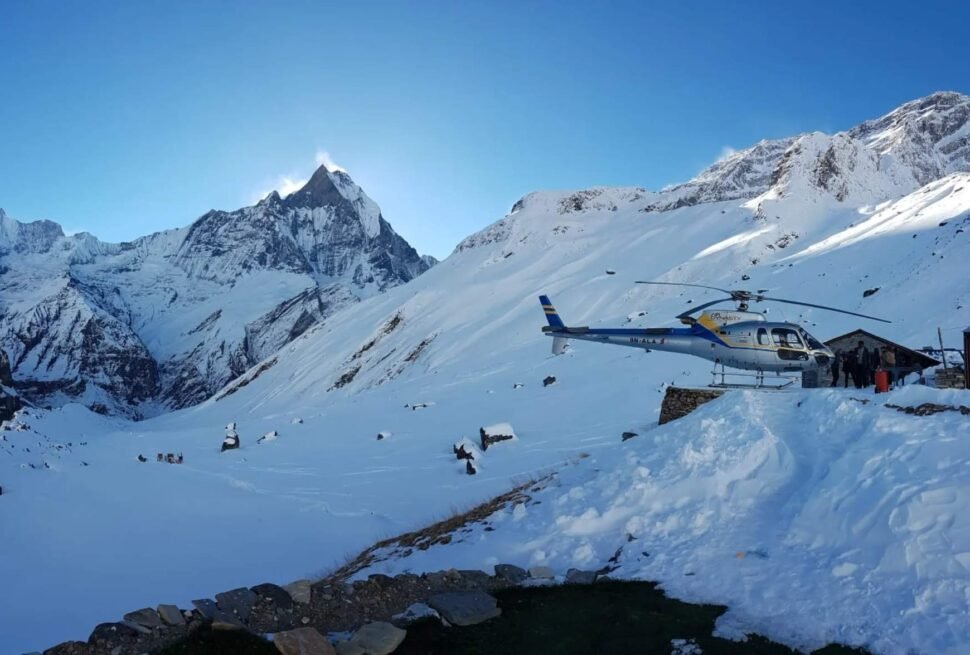
The coordinates of the main Kala Patthar viewpoint are approximately 27.9958°N, 86.8283°E. It lies within Sagarmatha National Park and requires a national park entry permit for all visitors. The helipad used by helicopter tours is on the eastern face of the ridge, at a flatter section that allows the Airbus H125 to set down safely.
The Khumbu Glacier runs east of Kala Patthar. Everest Base Camp, which sits on the lateral moraine of the Khumbu Glacier at roughly 5,364m, is visible from Kala Patthar as a collection of coloured tents and camp structures during climbing season (April to May and September to October). From Kala Patthar you look down at base camp and across at Everest, which gives you a perspective that trekkers at base camp itself do not have. Base camp sits in a valley. Kala Patthar sits above it on the ridge.
What You See from Kala Patthar
The views from Kala Patthar are exceptional in every direction, but the dominant element is always Everest. Here is a specific description of what you see from the main viewpoint on the ridge.
Directly to the northeast, Mount Everest (8,849m) fills the upper right portion of the view. From Kala Patthar you see the southwest face of Everest, with the West Ridge visible to the left and the Southeast Ridge running toward the summit to the right. The South Col, the high altitude camp at 7,906m used by expeditions on the Southeast Ridge route, is visible as a relatively flat section between Everest and Lhotse. During climbing season, you can sometimes see the fixed rope lines on the Lhotse Face with binoculars or a telephoto lens.
Lhotse (8,516m), the world’s fourth highest mountain, sits immediately to the right of Everest from the Kala Patthar perspective, joined to it by the South Col saddle. From almost every other vantage point in the Khumbu, Lhotse’s summit is partially hidden behind Everest. From Kala Patthar, Lhotse’s full south face is visible and its summit stands clearly above the col. It is the most complete view of Lhotse available from any publicly accessible location.
Nuptse (7,861m) stands to the left of Everest, connected to the main Everest massif by the West Ridge. Nuptse’s south face is a 2,000 metre wall of rock and ice that appears dramatically steep from Kala Patthar. The mountain has been climbed by far fewer people than Everest and Lhotse and is considered significantly more technically difficult. Its south face is visible in its full dramatic extent from the Kala Patthar ridge.
Changtse (7,543m), the northern peak of the Everest massif, is visible above the North Col in the background between Everest and Pumori. It sits on the Tibetan side of the border and is only visible from Kala Patthar because of the ridge’s elevation and clear sightline into the upper mountain.
Pumori (7,161m) rises directly above you to the north when you stand on the Kala Patthar ridge. Its south face, directly overhead, is impressive in scale though you are too close to see it properly in photographic terms. The ridge you stand on is Pumori’s own southern shoulder.
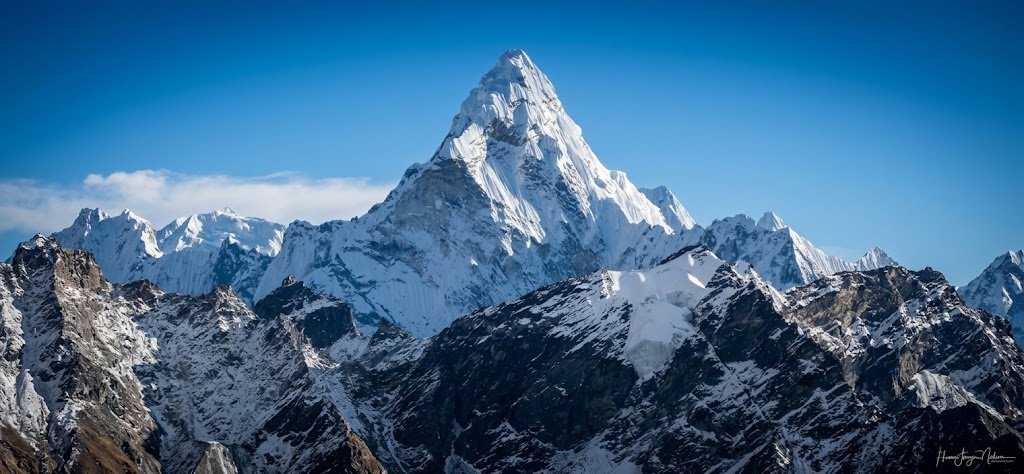
Looking back south down the Khumbu Valley, you can see Ama Dablam (6,812m) rising above the valley walls, Thamserku (6,618m), and Kangtega (6,685m) to the southeast. The Khumbu Glacier stretches below you, its surface broken into a maze of ice towers called seracs. The Khumbu Icefall, where the glacier descends from the Western Cwm, is visible as a chaotic tumble of white ice directly above base camp. During climbing season, the fixed ropes and ladder bridges on the icefall are visible from the ridge with good optics.
Why Kala Patthar Became Nepal’s Most Famous Viewpoint
Hundreds of peaks in Nepal offer extraordinary Himalayan views. Many of them are higher than Kala Patthar, more dramatic in form, and far less visited. What made Kala Patthar specifically into a destination that draws tens of thousands of visitors per year?
The short answer is that it is the closest point to Everest’s summit that can be reached without technical mountaineering skills or expensive permits. The Everest summit itself requires permits costing $11,000 per person from the Nepal side, months of preparation, and serious technical ability. Everest Base Camp (5,364m) is reachable by trekkers and offers proximity to the mountain, but from base camp you look up the Khumbu Icefall at the mountain above and cannot see the south face or the summit clearly. Kala Patthar sits above base camp on the ridge, high enough to clear the obstruction of the icefall and see Everest’s full southwestern profile.
The other reason is photography. Since the earliest expeditions to Everest in the 1950s, the standard dramatic photograph of Everest from below has been taken from the Kala Patthar ridge. The angle, the framing with Nuptse to the left and Lhotse to the right, and the inclusion of the Khumbu Glacier in the foreground is the image that most people associate with Everest from below. That image has been reproduced so many times in books, documentaries, and travel media that Kala Patthar’s specific view of Everest has become the canonical view of the mountain. Travellers come to stand in the place where that photograph was first taken, and often to take their own version of it.
Kala Patthar by Helicopter vs by Trekking
The ridge you stand on is identical whether you arrive by trekking or by helicopter. The views are the same. The altitude is the same. The cold is the same. But the experience of being there is genuinely different depending on how you arrived.
Trekkers who reach Kala Patthar have typically been walking for ten to fourteen days. They started at Lukla at 2,800m, acclimatised gradually over a week, and approached the summit ridge in the dark with headlamps, aiming to arrive at sunrise. Their bodies have adapted substantially to altitude. They are physically tired but physiologically prepared. The experience of standing on the ridge after that approach carries the weight of earned arrival. Many trekkers describe the sunrise from Kala Patthar after the long approach as the single most significant moment of their trekking career.
Helicopter passengers arrive at Kala Patthar having taken about 45 minutes from Kathmandu. Their bodies have had no gradual acclimatisation. The thin air at 5,545m hits them immediately and the supplemental oxygen becomes important quickly. The time available at the viewpoint is limited to 15 to 20 minutes. The experience is concentrated and intense but brief.
Neither approach is superior. They are different relationships with the same place. Trekkers often describe a retrospective appreciation for the helicopter option for friends or family who cannot trek. Helicopter passengers often describe a new respect for what trekkers experience in getting there on foot. The mountain is large enough to accommodate both approaches and remains unchanged by either.
The Helicopter Landing: What Actually Happens
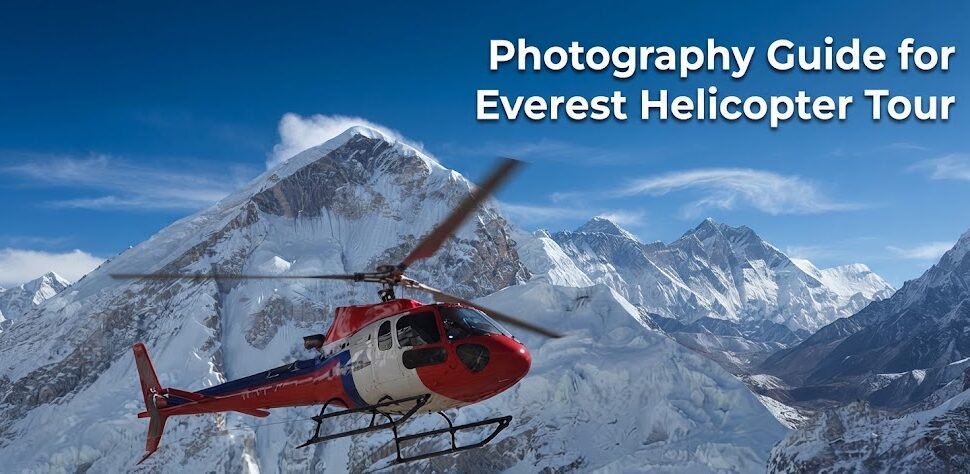
The Kala Patthar helicopter landing is one of the highest altitude helicopter landings conducted commercially anywhere in the world. The Airbus H125 (AS350 B3) used by reputable operators is specifically certified for operations at this altitude, with engine and rotor performance figures that allow it to hold in ground effect and maintain safe operations at 5,545m above sea level.
The approach to the helipad comes from the east, descending from the Khumbu airspace toward the ridge. The helipad itself is a flat section of rocky ground that has been cleared for helicopter operations. It is not a permanent structure. It is simply the most suitable flat area on the ridge, marked by previous use and local knowledge.
The landing at this altitude requires the pilot to account for significantly reduced air density. At 5,545m, the air is approximately half the density of sea level air, which means the rotor has to work much harder to generate lift. Pilots certified for Khumbu operations have specific training in these conditions and extensive logged hours in the valley. Reputable tour operators do not send uncertified pilots to Kala Patthar.
Passengers typically have 15 to 20 minutes on the ground. The pilot monitors weather and air conditions throughout the ground stop and may indicate departure earlier than planned if conditions shift. At altitude, weather changes quickly and the pilot’s judgement is final. This is not something to push back on. An early departure from Kala Patthar due to weather is the right decision, not an inconvenience.
What to Do in Your 20 Minutes on the Ridge
Twenty minutes at 5,545m sounds brief. It is enough time, if you use it well, to have a genuinely complete experience of the place. Here is how to use it.
First two minutes: take the oxygen, breathe slowly, let your system adjust to the sudden altitude. Do not rush immediately to the viewpoint. Stand by the helicopter, breathe, let the cold register, look at your surroundings. This brief settling period makes the rest of the stop more present and less reactive.
Minutes three to eight: walk to the main viewpoint area on the ridge. The terrain is rocky and uneven. Walk carefully. Look around at all 360 degrees, not just at Everest. Pumori above you. The Khumbu Glacier below. The valley falling away toward Namche. The Tibetan plateau in the distance through the passes between the peaks. This panoramic context matters for understanding where you are.
Minutes eight to fourteen: face Everest. Take photographs. Identify the peaks from left to right: Nuptse, then the upper SW face of Everest with the South Col saddle connecting it to Lhotse on the right. Find the Khumbu Icefall below the Western Cwm. Look for the coloured dots of base camp tents on the moraine. If you brought binoculars, use them now.
Minutes fourteen to twenty: put the camera down. Stand facing the mountain for at least two minutes without photographing or filming. Let the visual experience land without mediation. This is the part of the visit that most people later describe as the most significant, and it is also the most commonly skipped because the photography instinct fills all available time.
The Prayer Flags of Kala Patthar
The Kala Patthar ridge is strung with Tibetan Buddhist prayer flags that have been placed by trekkers, expedition teams, and locals over many years. The flags, in the traditional five colours of blue (sky), white (air), red (fire), green (water), and yellow (earth), flutter continuously in the wind that runs along the ridge. The sound and motion of prayer flags at altitude has a specific quality that is hard to separate from the emotional experience of the place.
In Tibetan Buddhist tradition, prayer flags carry prayers into the wind, which spreads them across the landscape. The flags are not decorative. They are a form of active prayer, refreshed by the movement of air. The density of flags on Kala Patthar reflects the number of people who have felt the need to mark having been in that place in a way that persists after they leave. Many visitors bring a flag to add to the strings. If this matters to you, a small set of prayer flags can be purchased in Thamel or Namche Bazaar.
Sunrise from Kala Patthar: The Classic Trekking Experience
Trekkers who reach Kala Patthar typically do so before dawn, leaving Gorak Shep at 4:00 to 5:00am by headlamp to reach the ridge in time for sunrise. The pre dawn approach in darkness on rocky terrain at altitude is demanding but the reward justifies it completely.
The sunrise sequence from Kala Patthar is one of the most reliably extraordinary natural events that can be witnessed from a publicly accessible location on earth. The sequence begins with the sky behind the Kangshung Face (east face) of Everest beginning to lighten from black to deep blue. Then the summit catches the first sunlight while the valley below remains in darkness. The summit glow at this moment, a single point of gold against the dark blue sky with stars still visible above it, is what drives tens of thousands of trekkers to leave their sleeping bags at 4am in sub zero temperatures every year. It is not just beautiful. It is one of those moments that changes a person’s sense of what the natural world can produce.
Helicopter tours depart from Kathmandu at sunrise and arrive at Kala Patthar roughly an hour after the summit glow has passed. The full sunrise sequence itself is typically not available to helicopter passengers. What they see instead is the mountain in full morning light, which is exceptional but different from the pre dawn first light sequence. Trekkers and helicopter passengers see different versions of the same place at different moments of the morning.
Book Your Kala Patthar Helicopter Visit
The most direct way to reach Kala Patthar without trekking is the Kala Patthar Landing Tour operated from Kathmandu. The tour includes the return flight, the Kala Patthar landing at 5,545m, supplemental oxygen, Sagarmatha National Park permit, and hotel transfers in Kathmandu. The full experience takes approximately four hours from hotel pickup to return.
For the widest aerial view of the upper Khumbu including Gokyo Lakes, the EBC and Gokyo combined tour extends the flight into the Gokyo Valley for a second landing. For couples wanting a private aircraft experience, the honeymoon package provides the Kala Patthar landing with exclusive use of the aircraft.
Book the Kala Patthar Helicopter Tour
Ready to land at 5,545m — the highest helicopter touchdown point for tourists in Nepal? The Kala Patthar helicopter tour departs Kathmandu at sunrise and returns by mid-morning. No advance payment required to hold your date. Check availability and book here →