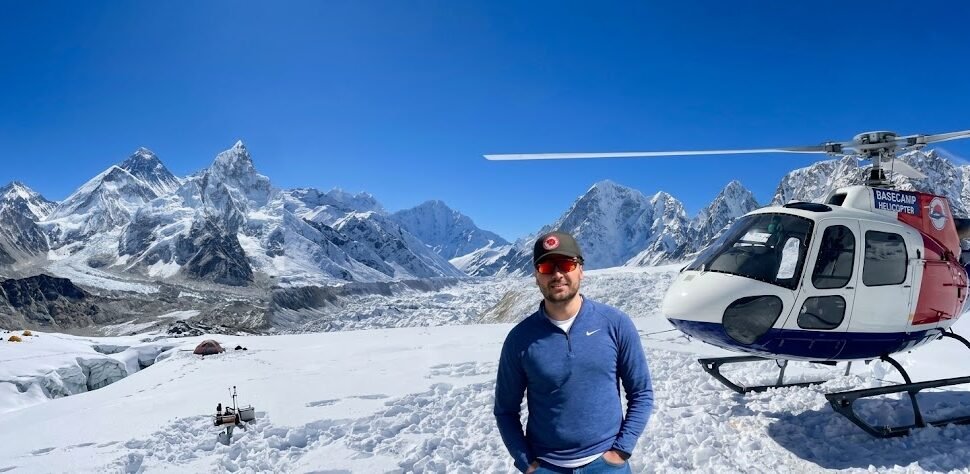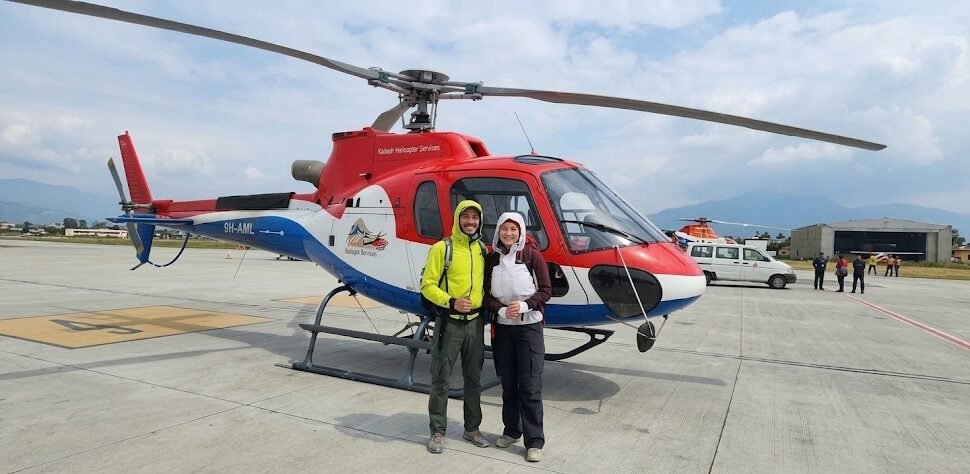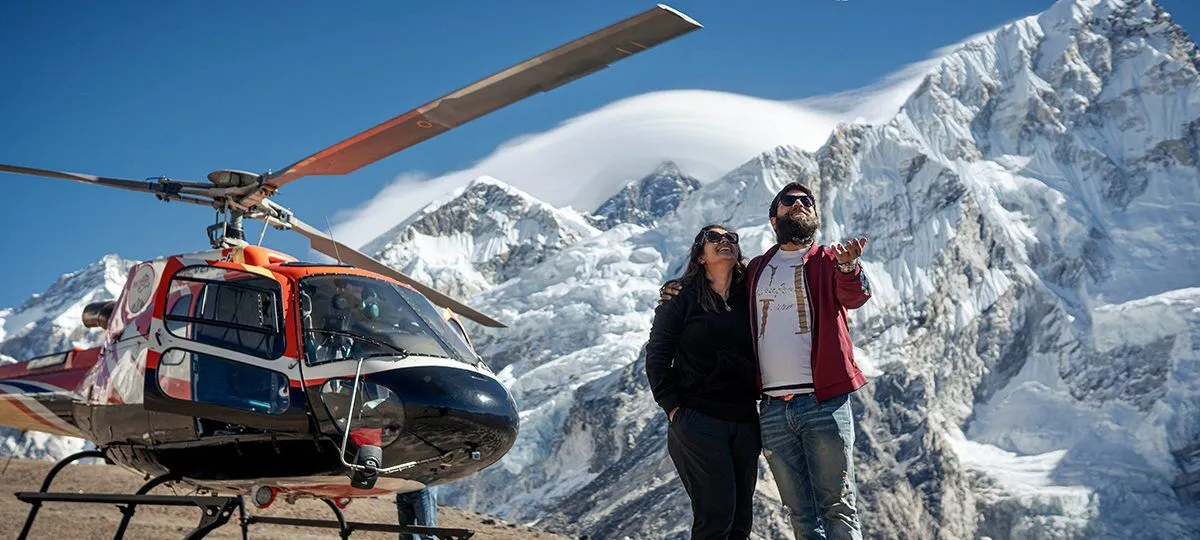
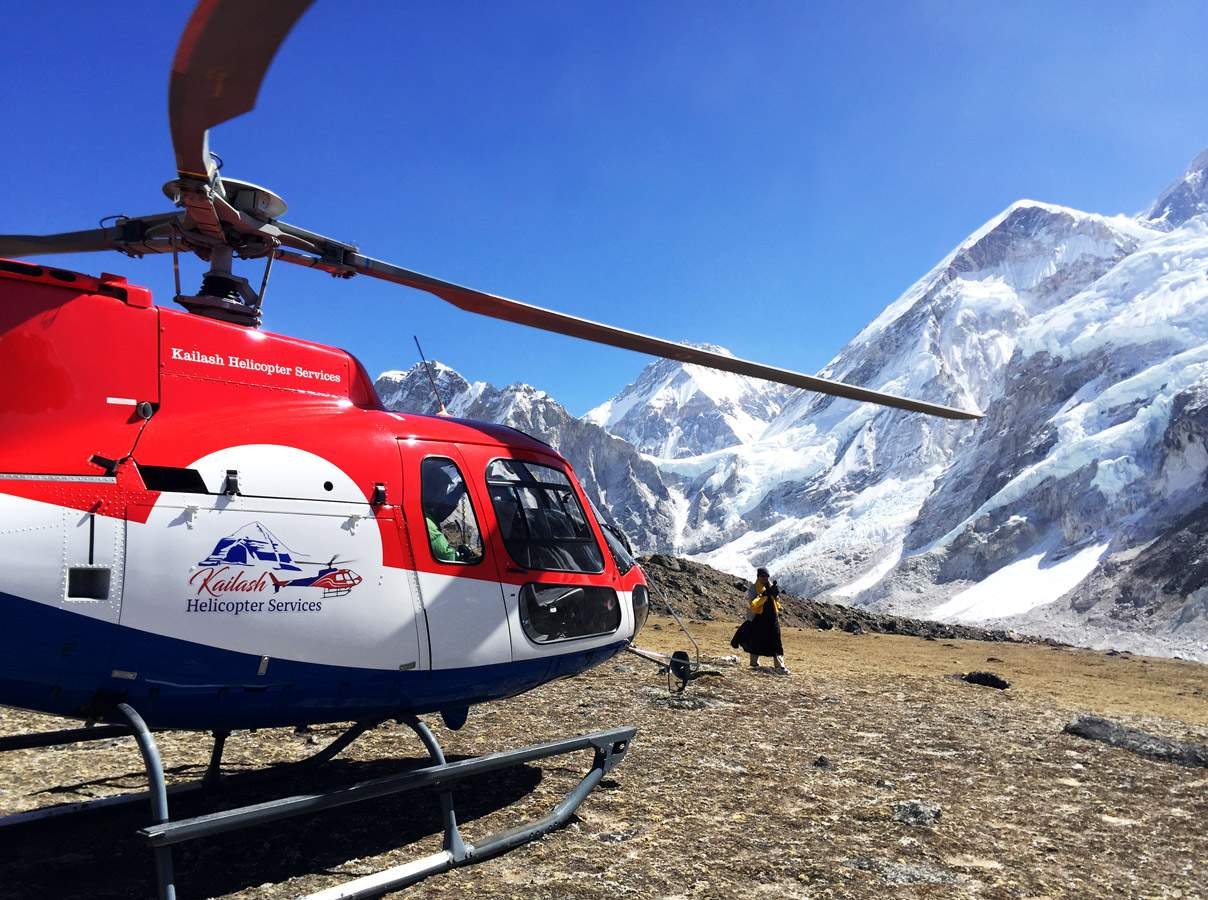
Most Everest helicopter tour passengers know they will land at Everest Base Camp and Kala Patthar. Few know that almost every tour includes a third stop at Syangboche, a high altitude airstrip and settlement at 3,780 metres in the Khumbu Valley, roughly 25 minutes by helicopter from Kathmandu. The stop is brief, typically 15 to 20 minutes, but it is not incidental. Syangboche exists in the tour for specific physiological and logistical reasons, and the location has its own character worth understanding before you arrive.
Where Syangboche Is
Syangboche sits on a ridge 300 metres above Namche Bazaar, the main trading town and acclimatization hub of the Khumbu region. The airstrip at Syangboche was constructed in 1973 and was for many years the highest commercial airstrip in the world at 3,780 metres. It is a grass and gravel strip approximately 530 metres long, suitable for small aircraft and helicopters. The airstrip is still technically operational but sees minimal fixed-wing traffic in 2026, primarily serving the Hotel Everest View, which sits at approximately 3,880 metres on the ridge 300 metres above the strip.
Namche Bazaar, 300 metres below, is the Sherpa capital of the Khumbu, a market town of perhaps 1,500 permanent residents that swells during trekking season with guides, porters, teahouse owners, and the international trekking community. From Syangboche, looking south you can see the river junction where the Bhote Koshi and Dudh Koshi rivers meet, and the deep gorge that marks the entrance to the Khumbu from the lower Solu region. Looking north, the first high peaks of the Khumbu appear: Kongde Ri, Thamserku, Kangtega, and the distant silhouette of Ama Dablam.
Why Every Everest Helicopter Tour Stops at Syangboche
The Syangboche stop is a controlled acclimatization step. The standard Everest helicopter tour takes passengers from Kathmandu at 1,300 metres to either Everest Base Camp at 5,364 metres or Kala Patthar at 5,644 metres. This represents a gain of 4,064 to 4,344 metres in altitude within a single flight of roughly 45 to 60 minutes. For comparison, altitude medicine guidelines for trekking recommend gaining no more than 300 to 500 metres per day above 3,000 metres.
Helicopter flights do not cause altitude sickness in the same way that sustained physical exertion at altitude does. You are not working aerobically as you would be trekking. But the rapid ascent does expose your physiology to reduced oxygen partial pressure very quickly, and some passengers experience lightheadedness, shortness of breath, or early altitude sickness symptoms even on a 15-minute helicopter landing at 5,000 metres.
The Syangboche stop at 3,780 metres allows the body to begin adjusting to reduced oxygen levels before the ascent to 5,000 metres and above. A 15 to 20 minute stop at this elevation, where passengers get out of the helicopter, walk around briefly, and drink tea, gives the circulatory system a first encounter with high altitude oxygen levels in a controlled setting. It is not a complete acclimatization break, but it is meaningfully better than flying directly from 1,300 to 5,364 metres with no intermediate stop.
Hotel Everest View: The World’s Highest Hotel
The Hotel Everest View, sitting 100 metres above the Syangboche airstrip at 3,880 metres, holds the Guinness World Record as the world’s highest hotel reachable without trekking for days. It was built by Japanese investors in the early 1970s and originally planned as a luxury resort accessed by the Syangboche airstrip. The concept ran into the predictable problem that altitude sickness affected guests so severely that the hotel struggled commercially for years before finding its current niche as a destination tea stop and acclimatization lodge.
The hotel has 12 guest rooms and a dining area with large south-facing windows looking directly at Ama Dablam, Thamserku, and, on clear days, the Everest massif in the distance. Guests can stay overnight (booking required well in advance) or visit for a meal or tea without a room reservation. On Everest helicopter tours that include the Hotel Everest View stop, passengers walk up the 300-metre path from Syangboche airstrip to the hotel, take tea and breakfast at the hotel’s dining room with the mountain views, and then return to the helicopter. This is the “breakfast at Hotel Everest View” experience offered as a specific package variant.
The honeymoon package offered by Mt Everest Helicopter Tour includes a private breakfast at Hotel Everest View as the Syangboche stop, making it a romantic morning at the world’s highest hotel rather than a simple acclimatization break. The detail that differentiates this from a standard tour stop is the privacy of a reserved table and a prepared meal rather than tea from the communal pot.
What You Can See from Syangboche
The view from Syangboche airstrip itself is excellent. Ama Dablam (6,812 metres) dominates the northeastern horizon with its distinctive profile. Below to the southwest, Namche Bazaar’s semi-circular arrangement of lodges, shops, and houses is visible in the bowl of the valley. The Sagarmatha National Park entrance gate is visible further down the trail from Namche. The Tengboche ridge with its monastery is visible across the valley to the east on clear mornings.
On the 300-metre walk from the airstrip to Hotel Everest View, the panorama expands progressively. By the time you reach the hotel’s terrace, you are looking at a straight-line view of Everest (partially obscured by Nuptse at this angle), Lhotse, Ama Dablam, Thamserku, and Kangtega simultaneously. The hotel’s terrace is one of the most widely photographed viewpoints in the Khumbu outside of Kala Patthar itself.
Altitude Considerations at Syangboche
At 3,780 metres, Syangboche is at an elevation where most healthy, unacclimatized adults will feel some degree of increased breathing effort or mild headache on exertion. Do not run up the path to Hotel Everest View. Walk at a relaxed pace. This is not a precaution unique to older or less-fit passengers: the physiology of altitude works regardless of fitness level, and the first encounter with 3,780 metres requires the same care from a marathon runner as from a sedentary office worker.
Drink water during the Syangboche stop if you feel any mild symptoms. Avoid alcohol at the hotel. Light snacks are fine. If you feel significantly unwell at Syangboche (severe headache, nausea, loss of coordination, or confusion), inform the pilot immediately. These symptoms at 3,780 metres should be taken seriously and may indicate that continuing to 5,000 metres is not appropriate for you on that day.
The Syangboche Stop in Context of the Full Tour Day
A typical Kathmandu departure Everest helicopter tour runs as follows: helipad departure from Kathmandu at approximately 6:00 to 7:00 AM, 45 to 55 minute flight to Syangboche, 15 to 30 minute stop (longer for the Hotel Everest View breakfast variant), 15 to 20 minute flight from Syangboche to Everest Base Camp or Kala Patthar, 10 to 15 minute landing and photography at the high altitude stop, 50 to 60 minute return flight to Kathmandu. Total time from Kathmandu to Kathmandu is 3.5 to 4.5 hours.
The Syangboche stop is not time wasted in transit. It is the moment in the tour where most passengers first understand that they have genuinely arrived in the Himalaya. The views from Syangboche are better than most people see on a standard Nepal holiday. The tea, usually Nepali masala chai or plain black tea, is served hot in the high altitude chill of a Khumbu morning. The walk to Hotel Everest View, if you are on the breakfast variant, is a short but genuinely beautiful piece of high altitude terrain with improving views at every step.
Many passengers who expected Syangboche to be a logistics stop arrive back at the helicopter saying it was one of the highlights of the morning. The three-stop structure of the Everest helicopter tour, Syangboche, then EBC or Kala Patthar, then back, is not padding. It is the experience designed by people who have done the flight hundreds of times and understand that arriving cold and breathless at 5,000 metres without context or preparation produces a worse experience than arriving with the Syangboche acclimatization step behind you.
Related reading: Everest Base Camp Helicopter Tour | Honeymoon Package with Hotel Everest View | Altitude Sickness Guide | Breakfast at Hotel Everest View