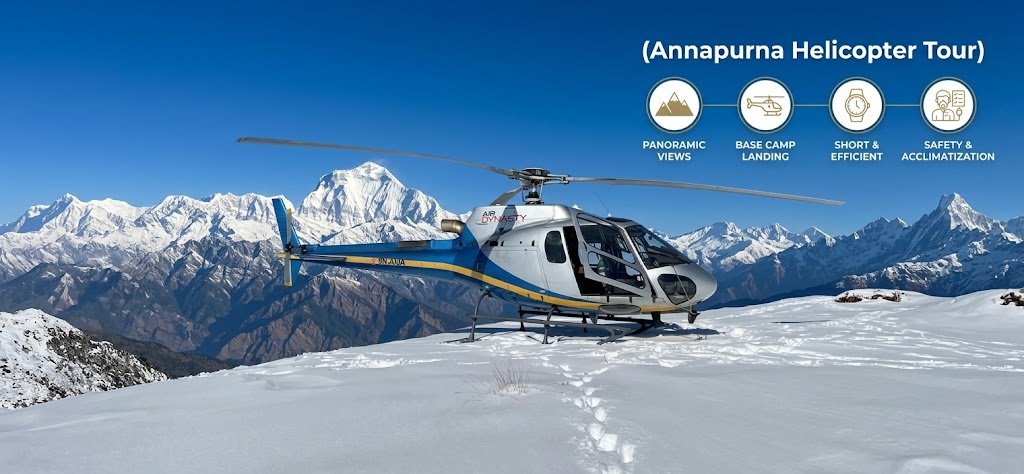
Most people who come to Nepal for a helicopter tour have one name on their mind: Everest. And that makes complete sense, Everest is the world’s highest peak, the most recognizable mountain on earth, and the symbol of Himalayan ambition. But there is another helicopter tour in Nepal that, for sheer mountain spectacle per kilometre of flying, may actually surpass it. The Annapurna Base Camp helicopter tour, flying deep into the Annapurna Sanctuary to land at 4,130 metres beneath the 8,091-metre south face of Annapurna I, is extraordinary, relatively unknown to casual visitors, and available as a day trip from either Pokhara or Kathmandu.
This is the complete guide to the Annapurna helicopter tour: where it goes, what it costs, what time of year to go, how it compares to the Annapurna Base Camp trek, and everything you need to book with confidence.
What Is the Annapurna Helicopter Tour?
The Annapurna helicopter tour most commonly refers to a flight from Pokhara (or directly from Kathmandu) to Annapurna Base Camp (ABC) at 4,130 metres. ABC sits within the Annapurna Sanctuary, a dramatic natural amphitheatre ringed by 13 peaks above 7,000 metres, including Annapurna I (8,091m), Annapurna South (7,219m), Machapuchare (6,993m), Hiunchuli (6,441m), and Gangapurna (7,455m).
The sanctuary is extraordinary to fly into. The approach passes through the Modi Khola gorge, a narrow valley flanked by walls of ice and rock, and suddenly opens into the circular bowl of the sanctuary, ringed 360 degrees by some of the most dramatic mountain terrain in the world. The landing at ABC gives you ground level access to a scene that usually requires 7 to 10 days of trekking to reach.
Some operators also offer an Annapurna Circuit helicopter tour, flying the broader Annapurna Massif and the Mustang Valley, but ABC is the most popular and most accessible variant.
The Route: What You See and Where You Land
A standard Annapurna Base Camp helicopter tour from Pokhara works roughly like this:
Departure is from Pokhara Airport (820 metres) or, for tours originating in Kathmandu, from Kathmandu’s domestic terminal with a transit stop at Pokhara. The first part of the flight follows the Pokhara Valley heading north, crossing the Phewa Tal (Phewa Lake) area and entering the Modi Khola drainage. The approach becomes increasingly dramatic as the valley walls steepen and the peaks close in around you.
The narrow gorge section before ABC, roughly 2 kilometres of flight between walls that rise almost vertically, is one of the most dramatic sections of any helicopter tour in Nepal. The contrast between the enclosed gorge and the sudden opening of the Annapurna Sanctuary is a moment passengers consistently describe as striking.
At ABC (4,130 metres), the landing zone is near the teahouse settlement at the base. You have 15 to 20 minutes on the ground. The scene surrounding you: Machapuchare (the “Fishtail Mountain”) to the south, Annapurna I’s south face dominating the northern skyline, glaciers descending on three sides, and an almost total silence broken only by the sound of the helicopter cooling on its skids.
The return typically follows the same route through the gorge, or in some tours, the pilot makes an additional pass over Annapurna South’s ridgeline for photography before returning to Pokhara.
Annapurna Helicopter Tour: Cost and Pricing (2026)
| Tour Type | Departure Point | Price Per Person (Shared) | Private Charter | Duration |
|---|---|---|---|---|
| Standard ABC Tour | Pokhara | $400, $550 | $1,800, $2,500 total | 2 3 hours total |
| ABC Tour from Kathmandu | Kathmandu | $650, $850 | $2,800, $3,800 total | 4 5 hours total |
| ABC + Mustang Extension | Pokhara | $700, $900 | $3,500, $5,000 total | 5 6 hours total |
| Annapurna Circuit Overview | Pokhara | $500, $700 | $2,200, $3,200 total | 3 4 hours total |
Pricing is for 2026. Annapurna helicopter tours are typically less expensive than Everest tours due to shorter distances from Pokhara and lower operating costs on this route. Flights from Kathmandu cost more because they include the Kathmandu Pokhara transit leg.
For price comparison with Everest tours: Everest Helicopter Tour Cost 2026.
Best Time for an Annapurna Helicopter Tour
The Annapurna region has a similar seasonal pattern to the Everest region, with some nuances driven by the different geography of the western Himalaya.
Autumn, October and November (Best)
post monsoon clarity is exceptional in the Annapurna region. October brings crisp air, freshly snow-dusted peaks, and the most reliable visibility of the year. November is slightly colder but equally clear. The ABC landing at this time of year shows you the sanctuary in its most dramatic, high-contrast form, brilliant white peaks against deep blue sky. This is the peak booking window; reserve at least three to four weeks ahead.
Spring, March, April, and May (Excellent)
pre monsoon spring is the second-best window. The distinctive feature of spring in the Annapurna foothills, not visible from a helicopter flying to ABC, but worth knowing, is the rhododendron bloom that colours the hillsides pink, red, and white below 4,000 metres. At ABC altitude, conditions are similar to autumn: stable mornings, building cloud in the afternoon. Fly early. Book ahead.
Winter, December to February
December and January bring cold temperatures and potential wind issues in the sanctuary. The approach gorge can experience channelled winds that make the low level flight more demanding. February is the most acceptable winter month, the worst cold has passed, and conditions begin to stabilise. Prices are lower in winter, and on a clear February morning, the sanctuary is remarkably beautiful. But cancellation rates are higher, and you should budget an extra day or two in Pokhara for rescheduling.
Monsoon, June to September (Not Recommended)
The Annapurna region receives heavier monsoon rainfall than the Everest region due to its more westerly position and the way weather systems track across the subcontinent. The Modi Khola gorge approach to ABC can be completely clouded out for weeks at a time during monsoon. If you visit Nepal in July or August, the Annapurna helicopter tour is a gamble that will more often than not require rescheduling.
Annapurna Base Camp by Helicopter vs Trekking: How They Compare
The Annapurna Base Camp trek is one of Nepal’s classic routes, approximately 7 to 10 days from the road at Nayapul (or starting from Pokhara), ascending through the Modi Khola valley, through Chhomrong and Deurali, to the sanctuary at 4,130 metres. It is a genuinely beautiful trek with excellent teahouse accommodation and some of the best mountain scenery in the lower Himalaya. Trekkers who walk the route have an experience that is fundamentally different from the helicopter version, the gradual revelation of the sanctuary, the progression through rhododendron forest and alpine meadow, the nightly teahouse conversations.
The helicopter tour is for visitors who want the destination, ABC, the sanctuary, the circle of peaks, in a morning, without the week it takes to walk there. For those with limited time in Nepal, the helicopter tour is not a lesser version of the trek. It is a different thing that delivers the same extraordinary visual destination through a radically different and genuinely exciting means.
| Factor | ABC Helicopter Tour | ABC Trek |
|---|---|---|
| Time required | Half a day | 7 10 days |
| Physical fitness required | Minimal | Moderate Good |
| Cost | $400 $850 per person | $500 $1,500 per person (guide, permits, accommodation) |
| Time at ABC | 15 20 minutes | 1 2 nights |
| Journey experience | Flight through gorge, dramatic | Village, forest, alpine, rewarding |
| Altitude risk | Brief exposure, low risk | Multi-day, AMS risk managed through acclimatisation |
| Best for | Limited time, elderly, families, high altitude non-trekkers | People who want the full mountain journey experience |
Annapurna Helicopter Tour from Pokhara: The Logistics
Most Annapurna helicopter tours operate out of Pokhara, Nepal’s second city, approximately 200 km west of Kathmandu and itself a striking destination with the Annapurna Range visible above the Phewa Lake from nearly every point in the city.
If you are visiting Nepal primarily for the Annapurna helicopter tour, flying to Pokhara first (30-minute domestic flight from Kathmandu) and doing the tour from there is significantly cheaper and more efficient than an Annapurna tour originating from Kathmandu. The Kathmandu-origin tours make sense if you are already combining the tour with an Everest visit and want to cover both from one base.
Getting to Pokhara: Yeti Airlines, Buddha Air, and Shree Airlines run frequent 30-minute domestic flights from Kathmandu to Pokhara for $100 to $180 per person. Alternatively, the Kathmandu to Pokhara tourist bus takes 6 to 7 hours on a scenic but winding road, comfortable enough but significantly slower. For a trip centred on the helicopter tour, flying to Pokhara is the efficient choice.
What to Expect at Annapurna Base Camp
ABC at 4,130 metres is lower than the Everest Base Camp landing (5,364 metres) and lower than Kala Patthar (5,545 metres). This has practical implications: altitude effects at ABC are generally milder than at EBC, and most healthy adults feel little more than mild breathlessness at this elevation. The landing zone is near the teahouse settlement that acts as a base camp for Annapurna expeditions, you are standing at the same spot where some of history’s most significant Himalayan climbing expeditions have staged.
The 360-degree panorama from ABC is arguably the most enclosed and dramatic mountain amphitheatre accessible by helicopter anywhere in the Himalaya. The walls of the sanctuary are higher relative to the landing zone than the EBC view, you are surrounded, not just looking toward, the mountains. Annapurna I’s south face rises 4,000 metres above you in a near vertical sweep of ice, rock, and avalanche debris. Machapuchare, which remains unclimbed (it is sacred to Hindus and closed to climbing), stands at the entrance to the sanctuary like a guardian. The combination is genuinely unlike anything else accessible in a morning flight.
Annapurna Helicopter Tour and Machapuchare: The View You Will Remember
Of all the visual elements of the Annapurna helicopter tour, Machapuchare (6,993 metres) tends to be the one passengers remember most vividly. The name means “Fishtail Mountain” in Nepali, referring to the twin summits visible from certain angles. From Pokhara, Machapuchare is the dominant peak visible above the lake. From inside the Annapurna Sanctuary, seen at close range from ABC, it is revealed as something extraordinary, a near-perfect pyramid of ice and rock, its summit frequently in cloud, its flanks striped by couloirs and rockfall tracks. No helicopter is going to fly you to the top of Machapuchare, the entire peak is closed to climbing. But the views of it from the sanctuary floor are among the most remarkable available to any visitor to Nepal.
Combining Annapurna and Everest Helicopter Tours
For visitors to Nepal with sufficient time and budget, combining an Annapurna helicopter tour with an Everest helicopter tour is possible, and gives you a genuinely complete view of Nepal’s two dominant mountain regions. The logistics typically work like this:
Day 1: Arrive Kathmandu. Everest helicopter tour from Kathmandu, fly to Kala Patthar, return to Kathmandu by midday. Afternoon at leisure or evening flight to Pokhara. Day 2: Annapurna helicopter tour from Pokhara, fly to ABC, return by midday. Afternoon in Pokhara, boat on Phewa Lake, Lakeside restaurants, sunset view of Annapurna from the shore. Day 3: Return to Kathmandu or continue to other Nepal destinations.
This two-tour combination covers both of Nepal’s great 8,000-metre regions in 48 hours and is genuinely achievable as a standalone Nepal mountain experience for visitors with limited time. Ask your operator about combined booking discounts.
EBC tour options to combine with: Standard EBC Tour | EBC with Kala Patthar Landing.
What to Bring for the Annapurna Helicopter Tour
The packing requirements for the Annapurna tour are similar to those for the Everest tour, with a few nuances due to the lower altitude and different season characteristics. At 4,130 metres versus 5,500 metres, the temperature differential is less extreme, but the Annapurna Sanctuary is enclosed and the cold can feel more intense due to the lack of direct sunlight on the north-facing landing area in the morning. Full packing guide: What to Pack for an Everest Helicopter Tour.
Key differences for Annapurna specifically:
- You may not need as many layers as for EBC, but warm base and mid-layers are still essential in October November and in winter
- UV protection is essential even at 4,130 metres, snow reflection amplifies UV significantly
- The landing area at ABC can be wet or muddy in spring, good waterproof footwear matters more here than at the typically drier Kala Patthar landing
Safety: Is the Annapurna Helicopter Tour Safe?
The Annapurna helicopter tour has a comparable safety profile to the EBC tour. The Modi Khola gorge approach is technically demanding, the narrow valley and high walls require precise low level flying and good weather judgment, but experienced Pokhara-based helicopter pilots fly this route hundreds of times per season and know every aspect of its approach behaviour under different weather conditions.
The altitude at ABC (4,130 metres) is meaningfully lower than Kala Patthar or EBC, which reduces altitude related risk compared to the Everest tour. The main weather risk is cloud building in the gorge, a completely opaque cloud layer in the Modi Khola below ABC makes the return impossible without visual reference. Experienced pilots monitor this actively and make the decision to return before the gorge closes. For complete safety guidance: Is Everest Helicopter Tour Safe?
Annapurna Helicopter Tour: Frequently Asked Questions
Is the Annapurna helicopter tour better than the Everest tour?
Better is the wrong word, they are different. The Everest tour gives you the world’s highest peak and the stark, high altitude terrain of the Khumbu. The Annapurna tour gives you a 360-degree enclosed mountain amphitheatre with arguably more intimate visual impact. Many visitors who have done both say the Annapurna sanctuary is the more visually overwhelming of the two experiences, even if Everest carries more name recognition. If you can do both, do both.
Can I do the Annapurna helicopter tour from Kathmandu?
Yes, operators run Annapurna tours from Kathmandu with a transit stop at Pokhara. These tours are more expensive (you are paying for the Kathmandu Pokhara transit leg) and take more time. If Pokhara is part of your Nepal itinerary anyway, book the ABC tour locally in Pokhara and save the cost premium.
How long does the Annapurna helicopter tour take?
From Pokhara: departure around 6:00 7:00 AM, landing at ABC around 7:00 8:00 AM (30 40 minute flight), 15 20 minutes on the ground, return to Pokhara by 9:00 10:00 AM. Total time from Pokhara hotel pickup to return: 3 to 4 hours. From Kathmandu: add the Kathmandu Pokhara leg, total time 5 to 6 hours.
Is altitude sickness a concern on the Annapurna tour?
At 4,130 metres, altitude effects are milder than at the Everest tour’s 5,300 5,545 metres. Most healthy adults feel mild breathlessness and nothing more at ABC for a brief stop. The same principles apply: move slowly, breathe deeply, communicate with the pilot if you feel unwell, and the helicopter descends immediately. Full altitude guide: Altitude Sickness on the Everest Helicopter Tour.
What is the landing surface like at ABC?
It varies by season. In dry autumn conditions: rocky, firm ground near the teahouse settlement. In spring or after recent snowfall: snow covered. In both cases, the ground is uneven and the light can be intense. Wear hiking boots and sunglasses.
Can I book an Annapurna helicopter tour through the same operator as my Everest tour?
Many Kathmandu-based operators arrange both Everest and Annapurna helicopter tours, either directly or through partnerships with Pokhara-based operators. Contact us directly to discuss combining both tours and any combined booking arrangements.
The Bottom Line on Annapurna Helicopter Tours
The Annapurna Base Camp helicopter tour is one of the most rewarding half day experiences in Nepal, arguably in all of South Asia. The approach through the Modi Khola gorge, the sudden opening of the sanctuary, and the 360-degree mountain amphitheatre at ABC combine to create something that consistently surprises people who have already seen the Everest tour and thought nothing could match it. Some find it does.
If you are planning a Nepal trip and have one morning for Everest and one for Annapurna, take both. If you have only one morning and are choosing between them, let your priorities guide you: Everest for the name, the highest point, and the iconic recognition; Annapurna for the enclosed sanctuary, the fishtail of Machapuchare, and a mountain experience that most Western travellers have never heard of and will never forget.
To book our Everest tours, and to inquire about Annapurna arrangements, start here:
Machapuchare: The Sacred Mountain That Has Never Been Summited
At 6,993 metres, Machapuchare is within the technical reach of experienced climbers and yet it is the only significant Himalayan peak in the 7,000-metre range that has never been officially stood on. The reason is religious, not technical.
Machapuchare is sacred in Hindu tradition. It is believed to be the abode of Shiva, and climbing to the actual summit is prohibited by the Government of Nepal. A permit was issued only once, in 1957, to a British expedition led by Wilfrid Noyce and David Cox. They reached approximately 50 metres below the summit and turned back, having agreed as a condition of their permit not to set foot on the actual summit point. No permit has been issued since. The peak is expected to remain closed to climbing indefinitely.
From the Annapurna Sanctuary, with Machapuchare’s twin-pointed summit filling the southern entrance to the bowl, the knowledge that this mountain has never had a human footprint on its highest point gives the view a dimension you do not find anywhere else in the Himalaya. The helicopter tour brings you close enough on the approach to feel the vertical scale of the peak, and the fact that it remains untouched makes the encounter genuinely different from flying past any other mountain on the route.
Flying the Modi Khola Gorge: What to Expect on the Approach
The approach to Annapurna Base Camp requires flying through the Modi Khola gorge, a section of the valley where the walls narrow sharply and rise steeply on both sides. This passage lasts approximately 3 to 5 minutes of flight time and is unlike anything in the approach to Everest Base Camp or Gokyo.
In the gorge, the helicopter flies at a relatively low altitude compared to the surrounding terrain. The walls are close enough to see individual rock strata, vegetation hanging from ledges, and waterfalls cutting through the cliff faces. Engine noise increases as the aircraft navigates the air currents that form in enclosed valleys. Then, in a matter of seconds, the gorge opens into the Annapurna Sanctuary and the entire 360-degree ring of peaks appears simultaneously.
Most passengers describe the gorge-to-sanctuary transition as the single most dramatic moment of the Annapurna helicopter tour. The contrast between the enclosed rock channel and the sudden open mountain bowl is something that photographs cannot adequately prepare you for. Knowing it is coming means you will have your camera ready at the right moment, not fumbling with it after the opening has already revealed itself.
Annapurna Base Camp at Ground Level: The Teahouses and What You Will Find
At ABC, the landing zone sits near the cluster of teahouses that serve as support accommodation for Annapurna expedition teams and trekkers who have walked the route. Several teahouse operators maintain year round or near-year round operations here, serving hot drinks, basic meals, and the kind of reception that surprises visitors expecting only desolate rock and ice.
The Annapurna Base Camp Hotel and several smaller teahouses are open through the main trekking seasons. If your tour includes a Gokyo-length ground stop (some private charters allow more time on request), a hot tea or soup at the teahouse at 4,130 metres is worth the additional minutes. The teahouse owners see far fewer helicopter visitors than trek visitors and tend to offer a warm, genuine welcome rather than the commercial bustle of busier stops on the trek circuit.
The ground at ABC is rocky and uneven. Walk carefully and slowly. The 4,130-metre altitude is lower than the EBC landing and most healthy adults adapt quickly, but moving too fast immediately after exiting the helicopter accelerates breathlessness unnecessarily. Give yourself 60 to 90 seconds to orient after stepping off the aircraft before moving toward the views you want to photograph.
Related reading: Everest Helicopter Tour Cost | Best Time to Visit | How to Book