You will leave Kathmandu at around 6:00 AM in a vehicle. The temperature at that hour in October will feel cool, maybe 14 or 15 degrees Celsius. By the time your helicopter lands at Kala Patthar two hours later, the temperature will be somewhere between -5 and -15 degrees Celsius with wind chill that can push it lower. You will have 10 to 15 minutes on the ground. What you are wearing and carrying in those 10 minutes determines whether this is one of the most memorable mornings of your life or a cold, miserable one spent wishing you had read a packing guide first.
This is that guide. We have been running Everest helicopter tours for years and have watched passengers arrive perfectly prepared and passengers arrive in summer clothes shivering on the helipad. Here is everything you need, why you need it, and what you can leave behind.
The Core Principle: Layer for Two Completely Different Climates in One Morning
The single most important thing to understand about packing for an Everest helicopter tour is that you will experience two dramatically different climates in the span of two hours. Kathmandu in the morning is cool to mild. The high altitude landing at 5,300 to 5,545 metres is arctic, cold, windy, and intensely bright. Your clothing system needs to handle both without you having to unpack and repack mid-flight.
The answer is layering. Three layers, worn together at altitude, removed progressively as you descend back into Kathmandu warmth. Here is how that layering system works in practice.
Clothing: What to Wear (Not What to Pack)
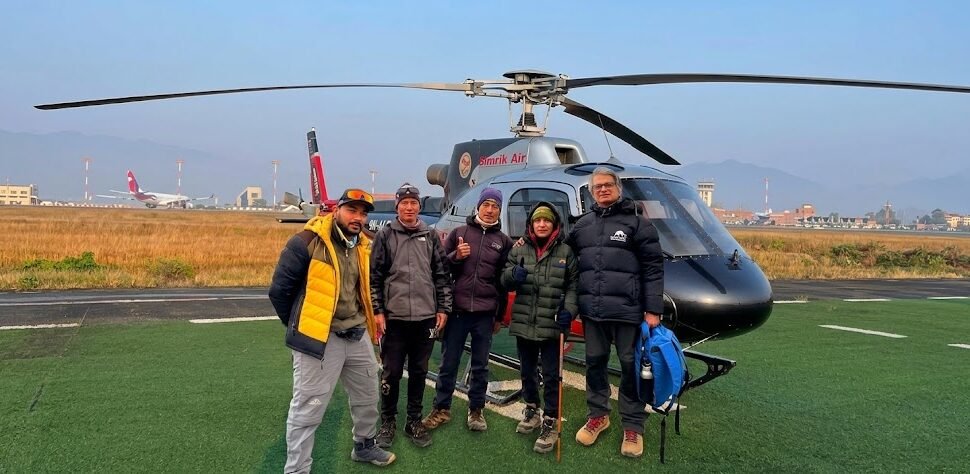
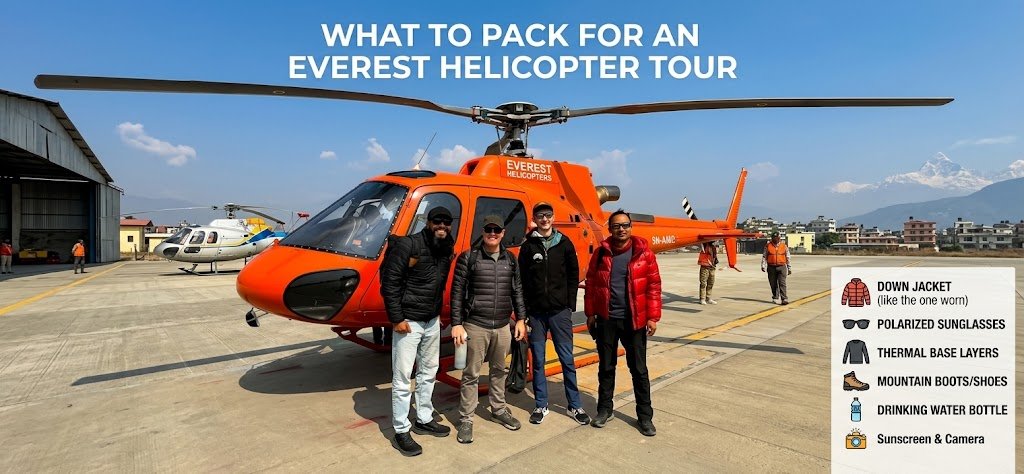
Wear all of this on the day of the tour. Do not pack it, wear it. The helicopter cabin has limited space, and you do not want to be extracting layers from a bag in a cramped aircraft.
Layer 1, Thermal Base Layer
A merino wool or synthetic thermal top and bottom worn against your skin. This is the layer that manages moisture, when you exert yourself getting in and out of the helicopter, you will generate some body heat. Merino wool is particularly good because it stays warm even when slightly damp, does not develop odour rapidly, and is comfortable against skin for hours. Synthetic options (Patagonia Capilene, Icebreaker Tech Lite equivalents) work equally well for moisture management.
Do not use cotton as your base layer. Cotton absorbs moisture and stays wet, which means it chills you at altitude. This is not a theoretical concern, it is the reason experienced mountaineers do not use cotton next to their skin in cold environments.
Layer 2, Insulating mid layer
A down jacket or high-loft fleece worn over the thermal base. Down is warmer by weight than fleece and compresses easily. A 600 to 800 fill power down jacket in the -10 to -20°C range provides genuine warmth at the altitude you will be visiting. Fleece is a good alternative if you do not own a down jacket, a 300-weight fleece provides similar warmth with more breathability.
If you are travelling light and need to rent or borrow gear in Kathmandu, down jackets are available to rent in the Thamel district for around $3 to $8 per day. The quality varies, inspect what you are renting for torn baffles (gaps in the down fill that create cold spots) and working zip pulls before taking it.
Layer 3, Windproof and Waterproof Shell
A hardshell or softshell jacket worn over everything else. At 5,500 metres, even a calm-looking day can produce significant wind on the exposed ridgeline. Wind penetrates insulating layers and strips body heat rapidly. A windproof outer layer is non-negotiable.
Waterproofing matters less in the Himalayan dry season (October November, March May), you are unlikely to encounter rain at the landing zone, but wind resistance is critical. If you have a jacket that is windproof but not fully waterproof (a softshell, for example), that is fine for the standard EBC tour timing.
Insulating Trousers or Salopettes
Your legs are often the first thing to get cold at altitude and the last thing people remember to insulate. Regular jeans or chinos are not appropriate for a 5,500 metre landing. Wear thermal tights or long johns as a base layer under fleece-lined trousers, hiking pants, or ski salopettes. If you do not own appropriate trousers, waterproof ski pants over thermal long johns are entirely suitable and can be rented in Thamel.
Warm Hat
A close fitting merino wool or fleece beanie that covers your ears. A significant portion of body heat is lost through the head. This is one of the smallest items you can carry and has a disproportionate effect on how warm you feel at altitude.
Neck Gaiter or Balaclava
Wind on the face and neck at high altitude is relentless and immediately uncomfortable without protection. A neck gaiter (tube scarf) can be pulled up over the lower face and nose. A balaclava covers everything including the top of the head. Either works, many experienced high altitude visitors prefer the balaclava because it can be pulled down to a collar position during the flight and pulled up quickly on landing.
Insulated Gloves or Mittens
Your hands need to be functional at the high altitude stop, you will want to use your camera. Thick mittens are warmer but reduce dexterity. The practical solution: wear thin liner gloves that allow you to operate your camera touchscreen or buttons, with a warmer overmitt or shell glove available if the wind picks up. Remove the outer layer for the shots you need, replace it quickly.
Warm Socks
Merino wool hiking socks, two thin pairs or one thick pair. Your feet are enclosed in the helicopter cabin during most of the flight, which is warm enough. The issue is the 10 to 15 minutes standing on snow or frozen ground at the landing zone. Cold feet can become acutely uncomfortable quickly and are distracting from what should be an extraordinary experience.
Sturdy Boots or Hiking Shoes
The landing zone at Kala Patthar or near EBC is not flat, smooth ground. It is rocky, sometimes icy, sometimes snow covered. Solid ankle supporting hiking shoes or boots with some grip are appropriate. Heavy mountaineering boots are not necessary, the terrain is manageable in good hiking shoes. Trainers or sneakers are borderline, functional on a clear, dry day at EBC but inadequate if there is snow or ice, and definitely insufficient for the cold.
The Essential Kit: Everything Beyond Clothing
UV 400 Sunglasses, Non-Negotiable
This is not a comfort item. At 5,500 metres, UV radiation intensity is approximately 50 percent higher than at sea level, and if there is snow on the ground, likely, the reflected UV compounds this dramatically. Snow blindness (photokeratitis) is a real condition that causes temporary but extremely painful loss of vision. It can develop in as little as 15 minutes of unprotected exposure on a bright, snowy day at altitude.
Your sunglasses must carry a UV 400 rating or equivalent CE EN ISO 12312-1 standard certification. This means they block 99 100 percent of UVA and UVB radiation. Polarised lenses are a useful addition for snow, they eliminate glare from reflected light. Fashion sunglasses without UV rating are not adequate regardless of how dark the lens appears. Lens darkness is not a reliable indicator of UV protection.
Your Camera System, Fully Prepared
You are flying to one of the most photographed places on earth, in conditions that offer extraordinary light. Prepare accordingly.
Battery: Cold temperatures reduce battery capacity significantly. A battery that read 80 percent in your warm hotel room may read 40 percent after 20 minutes at -10°C. Carry your camera inside your jacket during the flight to keep it warm. Carry a fully charged spare battery in an inner pocket, also kept warm.
Memory card: Empty before departure. The light on Everest at 7:30 or 8:00 AM, alpenglow pink transitioning to golden hour as the sun clears the ridgeline, is extraordinary. You do not want to be deleting old photos to make room.
Lens cleaning cloth: Altitude + wind + your breath = condensation on a cold lens as you exit the aircraft. A microfibre cloth in an accessible pocket solves this in 10 seconds.
Smartphone shooters: Modern phone cameras perform well in these conditions, better than many compact cameras because of computational photography. The limitation is touchscreen operation with cold fingers. Fingerprint recognition often fails in the cold. Set your phone to PIN unlock before departure, and consider a pair of thin touchscreen compatible gloves for phone operation.
Drone: Note, drones are prohibited in Sagarmatha National Park and in the Khumbu region without specific permits from CAAN and the park authority. These permits are expensive, time consuming to obtain, and almost never granted to individual tourists. Do not bring a drone expecting to fly it.
Sunscreen, SPF50+
UV radiation at altitude, combined with reflection from snow, requires sunscreen even if it is cold enough to feel like winter. Apply SPF50 or higher to all exposed skin, face, neck, backs of hands, before you leave the helicopter. The landing stop is short, but sunburn at 5,500 metres is rapid and significantly more intense than sunburn at sea level.
Lip Balm with SPF
Lips crack and burn at high altitude due to dry air and UV exposure. A quality lip balm with SPF 30 or higher, applied before the high altitude stop, prevents the discomfort of chapped lips for the rest of your Nepal trip. Small item. Easy win.
Small Daypack, Under 15 Litres
The helicopter cabin is tight. A standard 30-litre trekking pack wedged between your legs is awkward for you and your fellow passengers. A small 10 to 15 litre daypack, worn on your back during the high altitude stop, keeps your hands free for photography and keeps all your small items accessible. This is not the tour for a large rolling suitcase, leave luggage at your hotel.
Water Bottle, Insulated
Hydration at altitude reduces altitude related discomfort. An insulated water bottle keeps liquids from freezing solid during the high altitude stop. Drink water before departure and during the flight, airplane-style dry air in a helicopter cabin dehydrates you subtly but consistently over a 45-minute flight.
Small Snack
Not strictly necessary for a five-hour tour, but useful if you are prone to low blood sugar or if you have a Hotel Everest View breakfast stop (in which case you will be glad of something light beforehand). An energy bar or a handful of nuts in a jacket pocket takes no space and provides a useful energy buffer.
Altitude Medicine, Discuss With Your Doctor First
Acetazolamide (Diamox) is sometimes prescribed for altitude sickness prevention. For a brief helicopter tour, where you are at high altitude for 10 to 15 minutes and then descending, its use is rarely justified or recommended. The medication has side effects including increased urination and tingling in the extremities, and it is a prescription drug in most countries. Discuss with your doctor whether it is appropriate for your specific situation. Most tour participants do not need it. For full altitude guidance: Altitude Sickness on the Everest Helicopter Tour.
Documents and Identification
| Item | Why You Need It |
|---|---|
| Passport | Required for check-in at the helipad and park permit verification |
| Booking confirmation | Printed or on your phone, confirm before leaving hotel that it is accessible |
| Travel insurance documents | Emergency contact numbers, policy number, coverage summary |
| Emergency contacts | Your hotel in Kathmandu, local emergency numbers, your operator’s phone |
What to Leave Behind
This is as important as what to bring. The helicopter has limited space. Your fellow passengers, and the pilot, whose job involves managing load carefully at high altitude, will appreciate you travelling light.
- Large luggage: Your main bag stays at the hotel. This is a day tour, not an overnight trip.
- Unnecessary electronics: Your laptop, tablet, full camera rig with multiple lenses. Choose your camera or phone, not both and all accessories.
- Trekking poles: Not useful in the helicopter cabin or at the high altitude landing stop.
- Drone: As noted, prohibited without permits in the national park.
- Heavy mountaineering equipment: You are landing for 15 minutes, not climbing. Ice axes and crampons are theatre, not necessity.
Packing Checklist by Season
| Item | Oct Nov | Mar May | Feb | Dec Jan |
|---|---|---|---|---|
| Thermal base layer (top + bottom) | Essential | Essential | Essential | Essential |
| Down jacket / heavy fleece | Essential | Essential | Essential | Critical |
| Windproof shell | Essential | Essential | Critical | Critical |
| Warm trousers over thermal base | Essential | Essential | Essential | Critical |
| Warm hat and neck gaiter | Essential | Recommended | Critical | Critical |
| Gloves (liner + shell) | Essential | Essential | Critical | Critical |
| UV 400 sunglasses | Critical | Critical | Critical | Critical |
| SPF50 sunscreen | Essential | Essential | Essential | Essential |
| Hiking shoes/boots | Essential | Essential | Essential | Essential |
| Camera with spare battery | Essential | Essential | Essential | Essential |
| Insulated water bottle | Recommended | Recommended | Essential | Essential |
What to Wear in the Helicopter Cabin
The cabin of an AS350 B3e or Bell 407 is small. You are seated close to other passengers with limited movement. Wearing all three clothing layers during the flight is warm in the cabin, you may want to unzip or remove your shell layer for the 45-minute flight to Khumbu and put it back on just before landing. Helmets and in-ear communication systems are standard in the cabin, so your beanie goes on over those systems or is placed in your lap during the flight and put on just before landing.
Tips for Getting the Best Photographs
Since photography is one of the primary reasons people take this tour, here are the practical tips that make the difference between good shots and exceptional ones.
Shoot through the window during the flight: The helicopter windows are large and clean. Turn off your flash completely (it will just reflect off the glass). Use the window as a rest for your camera to reduce motion blur. Shoot in RAW if your camera supports it, the dynamic range of snow covered mountains in morning light requires post-processing headroom.
Golden hour timing: Departures around 6:30 7:00 AM mean you arrive at the high altitude landing zone in the middle of morning golden hour. Everest’s summit pyramid in early morning alpenglow, pink to gold, is the most iconic Himalayan photograph. The timing of a standard EBC helicopter tour is almost perfectly calibrated to catch this light.
Move slowly and shoot frequently: At 5,500 metres you will feel the altitude. Move calmly, breathe steadily, do not sprint around the landing zone for different angles. Shoot frequently rather than waiting for the perfect composed shot, the ground time goes quickly, and conditions change fast.
Composition tips: Include something human-scale (a fellow passenger, your own boots) in at least some shots to give Everest’s scale context. Pure mountain shots are beautiful but lack the sense of vertical scale that makes the Himalaya viscerally impressive. A person standing small against the face of Everest tells the story more powerfully than the mountain alone.
Frequently Asked Questions About Packing
What if I don’t have a down jacket, can I rent one in Kathmandu?
Yes, easily. Thamel has dozens of outdoor gear shops and rental outlets. A down jacket rental costs $3 to $8 per day. Quality varies, inspect it carefully. Purchasing a light down jacket in Kathmandu before the tour (from reputable brands at local market prices) is also an option if you are spending time in Nepal and will use it for other activities.
Can I wear my hotel bathrobe and call it a day?
We are not going to pretend people have not tried to approximate warmth with hotel robes and blankets. They have. They were cold. Don’t be that person.
Is there a weight limit for what I carry on board?
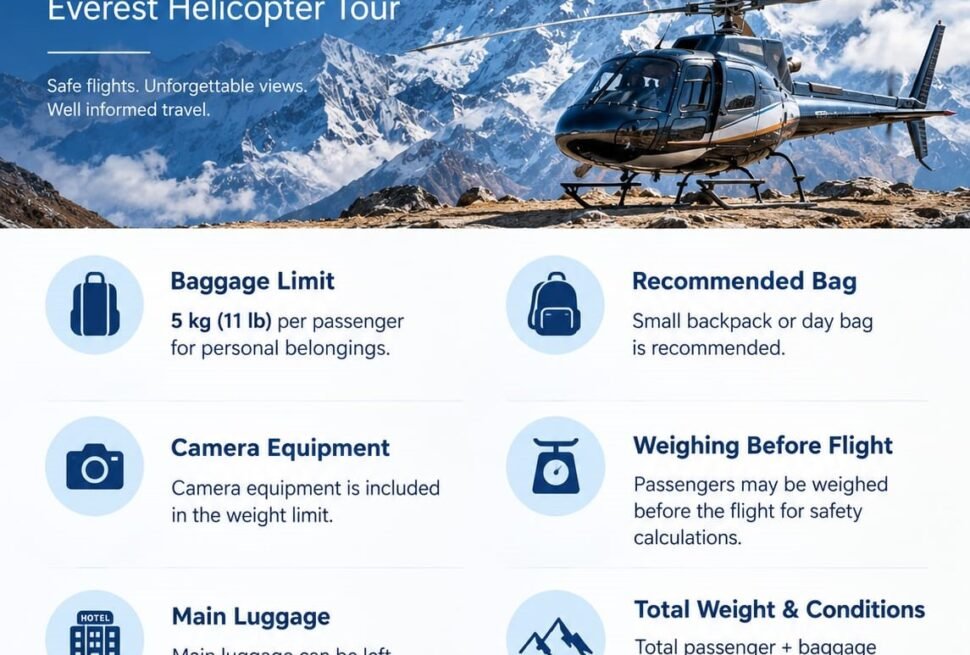
The weight limit applies to your total body weight plus hand luggage, typically 100 to 110 kg combined. What you wear counts toward this. If you are close to the limit and wearing heavy gear, account for that in your calculation. Your operator will weigh you at check-in.
Should I bring motion sickness medication?
The Everest helicopter tour involves mountain flying with some lateral movement during ridge crossings and the approach to landing zones. If you are susceptible to motion sickness, a standard over the counter antihistamine (cinnarizine or dimenhydrinate) taken 30 minutes before departure is effective. Avoid scopalamine patches for a short flight, the dosage is calibrated for longer sea voyages and may cause excessive drowsiness.
What about altitude sickness medication?
As noted above, discuss with your doctor. For a 10-15 minute high altitude stop, the evidence for prophylactic acetazolamide is weak. Your best “medication” is adequate hydration and moving slowly on the ground. Full guide: Altitude Sickness on the Everest Helicopter Tour.
Ready to Go?
Once you have sorted your layers and charged your camera battery, the rest takes care of itself. The Everest helicopter tour is a morning, a very early morning that ends with views most people never get to see in their lifetimes. The preparation is minimal. The return is extraordinary.
Book your tour here:
- Standard EBC Helicopter Tour
- EBC with Kala Patthar Landing
- EBC with Gokyo Lakes Tour
- Honeymoon Helicopter Package
Renting vs Buying Gear in Kathmandu
If you do not own appropriate cold-weather gear and do not want to travel with heavy clothing, Kathmandu is genuinely excellent for rental and purchase. Thamel, the tourist district, has dozens of outdoor gear shops ranging from genuine international brands (North Face, Mammut, Arc’teryx) sold at authorised retail to good-quality local alternatives that perform adequately for a single day tour. Here are the practical costs in 2026.
| Item | Rental Per Day | Purchase Approximate | Recommendation |
|---|---|---|---|
| Down jacket (medium weight) | NPR 300 to 600 ($2 to $4) | NPR 2,500 to 8,000 ($19 to $60) | Rent for one tour; buy if trekking also planned |
| Fleece jacket (300 weight) | NPR 200 to 400 ($1.50 to $3) | NPR 1,500 to 5,000 ($11 to $38) | Rent for one tour |
| Windproof shell jacket | NPR 400 to 700 ($3 to $5) | NPR 3,000 to 12,000 ($23 to $90) | Rent; buying only worthwhile if you have more Nepal plans |
| Thermal base layer set | Not commonly rented | NPR 2,000 to 6,000 ($15 to $45) | Buy; inexpensive and useful at home in winter |
| Hiking boots (ankle support) | NPR 500 to 900 ($4 to $7) | NPR 4,000 to 18,000 ($30 to $135) | Rent if your current shoes are borderline; buy if trekking |
| Wool gloves | Not commonly rented | NPR 300 to 1,500 ($2 to $11) | Buy; cheap and compact |
| Wool beanie | Not commonly rented | NPR 200 to 800 ($1.50 to $6) | Buy; you will use it beyond Nepal |
| Neck gaiter | Not commonly rented | NPR 200 to 600 ($1.50 to $4.50) | Buy; essential at altitude |
Before renting any item in Thamel: inspect zips to confirm they pull smoothly, check for torn baffles on down jackets (cold spots where the fill is missing), check sole grip on boots by pressing your thumb across the tread. Budget 20 to 30 minutes in Thamel the day before your tour to select and inspect rentals. Do not leave gear sourcing to the morning of the tour.
Your Main Luggage During the Tour: What to Do With It
The Everest helicopter tour is a morning out, not an overnight trip. Your main bags stay at your hotel. Most Kathmandu hotels offer luggage storage as a standard service, either in your locked room or in a secure storage area for guests who have checked out that morning.
If you are checking out of your hotel on the same day as your helicopter tour, confirm with reception that they will store your main bags until you return. Most hotels accommodate this without charge or for a small fee. Arrange this the evening before so there is no confusion at 5:00 AM when your vehicle arrives.
What you bring to the helipad: a small daypack (10 to 15 litres maximum), your camera, the layers you are wearing on your body, and your documents in an inner jacket pocket. Everything else stays at the hotel. Do not bring large rolling luggage to the helipad. There is no storage there, and it will be in the way during weight check and boarding.
The Weight Check at the Helipad: What Actually Happens
Every passenger is weighed at helipad check-in before boarding. This is not a formality and it is not negotiable. At 5,500 metres, the helicopter operates with reduced power margin, and total load directly affects performance and safety. The pilot reviews the load calculation before every high altitude flight.
The process is straightforward: you stand on a digital scale wearing your cold-weather layers and holding your daypack. The ground crew records your total weight. This is combined with the weights of all other passengers and the fuel load to calculate whether the aircraft is within safe operating parameters for the altitude of the planned landing.
Most operators work with a practical limit of 100 to 110 kg total per passenger position including hand luggage. If your total weight is close to or above this limit, the operator will speak with you privately about options. These conversations are handled with discretion. Knowing about this process in advance means you will not be surprised or embarrassed by it on the morning of your tour. If you think weight may be a consideration, contact your operator before your arrival date to discuss options quietly.
Related reading: Is Everest Helicopter Tour Safe? | Altitude Sickness Guide | How to Book | Tour Cost Guide 2026