Introduction: Two Ways to Reach the Roof of the World
Everest Base Camp is one of the most iconic destinations on earth. Sitting at 5,364 metres in Nepal’s Khumbu region, at the foot of the world’s highest mountain, it draws tens of thousands of visitors every year, adventurers, trekkers, mountaineers, and travellers who simply want to witness the raw scale of the Himalayas at close range. Until relatively recently, reaching Everest Base Camp meant committing to a 12 to 16-day round trip trek on foot. Today, a growing number of visitors are choosing an entirely different path: the Everest Base Camp helicopter tour, which covers the same iconic ground in a single morning.
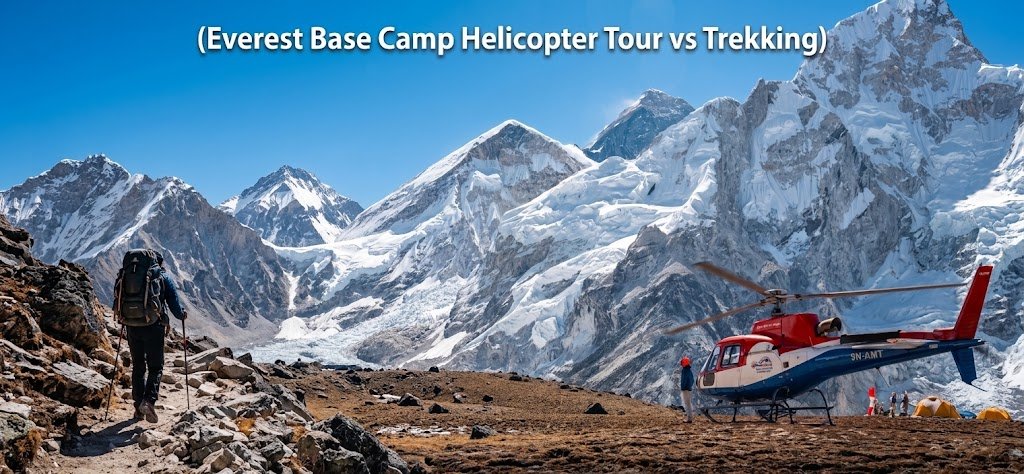
The choice between trekking and flying is not simply a question of time or fitness. It is a question of what kind of experience you are looking for, what your body can handle, what your schedule allows, and what memories you want to bring home. Both the trek and the helicopter tour offer genuinely extraordinary experiences of the Khumbu region, but they are radically different in character, pace, physical demand, cost, and what they reveal about this extraordinary corner of Nepal.
Here is an honest, thorough comparison of both options across every dimension that matters: scenery, cost, fitness requirements, time, cultural immersion, safety, and overall value for money. Whether you are a solo adventurer with two weeks to spare, a family with elderly members, a couple on a honeymoon, or a business traveller with three days in Kathmandu, you will find clear guidance here on which option is right for you, and how to book the experience that best matches your situation.
The Classic EBC Trek: What You Are Actually Signing Up For
The Everest Base Camp trek is one of the world’s most celebrated long distance hiking routes. It follows the same trail used by mountaineering expeditions heading for the South Col route on Everest, passing through ancient Sherpa villages, Buddhist monasteries, dense rhododendron forests, and increasingly barren high altitude terrain before arriving at the grey moraine of the Khumbu Glacier where Base Camp sits. The trail passes through Lukla, Phakding, Namche Bazaar, Tengboche, Dingboche, Lobuche, Gorak Shep, and finally Everest Base Camp itself, a succession of names that have become legendary in the adventure travel world.
The standard itinerary takes 12 to 16 days round trip from Kathmandu, with the return journey either on foot all the way back to Lukla or, increasingly commonly, by helicopter from Gorak Shep or Lukla to speed up the descent. Daily walking distances range from five to ten kilometres on average, with significant elevation gain and loss each day. The critical physiological challenge is not the distance or the steepness but the altitude: trekkers spend multiple consecutive nights at progressively higher elevations, carefully acclimatising to allow their bodies to adjust to decreasing oxygen availability. Altitude sickness is the most significant health risk on the trek, and proper acclimatisation scheduling, including rest days at Namche Bazaar (3,440m) and Dingboche (4,410m), is essential for safety.
The trek requires a reasonable base level of fitness. You do not need to be an athlete or a mountaineer, but you must be able to walk for five to seven hours per day for up to two weeks, often on uneven, rocky terrain, at altitudes where breathing is noticeably harder than at sea level. Most trekkers are surprised not by the steepness but by the cumulative fatigue of consecutive high altitude walking days. Knees, ankles, and hips take significant load, particularly on the descent.
The costs of the EBC trek add up quickly. Beyond international flights to Nepal, you need to budget for a Sagarmatha National Park entry permit, a TIMS trekking card, a guide (highly recommended and sometimes mandatory depending on updated regulations), a porter, accommodation in teahouses along the trail, three meals per day, travel insurance covering high altitude trekking and helicopter evacuation, gear (including warm layers, trekking poles, a sleeping bag rated to -20C, and appropriate boots), and the flight between Kathmandu and Lukla or a bus/jeep to Salleri. A realistic budget for the full EBC trek, including all permits, guide, porter, accommodation, and food, is between $1,500 and $3,500 depending on the level of service and how you travel.
What the EBC Helicopter Tour Actually Involves
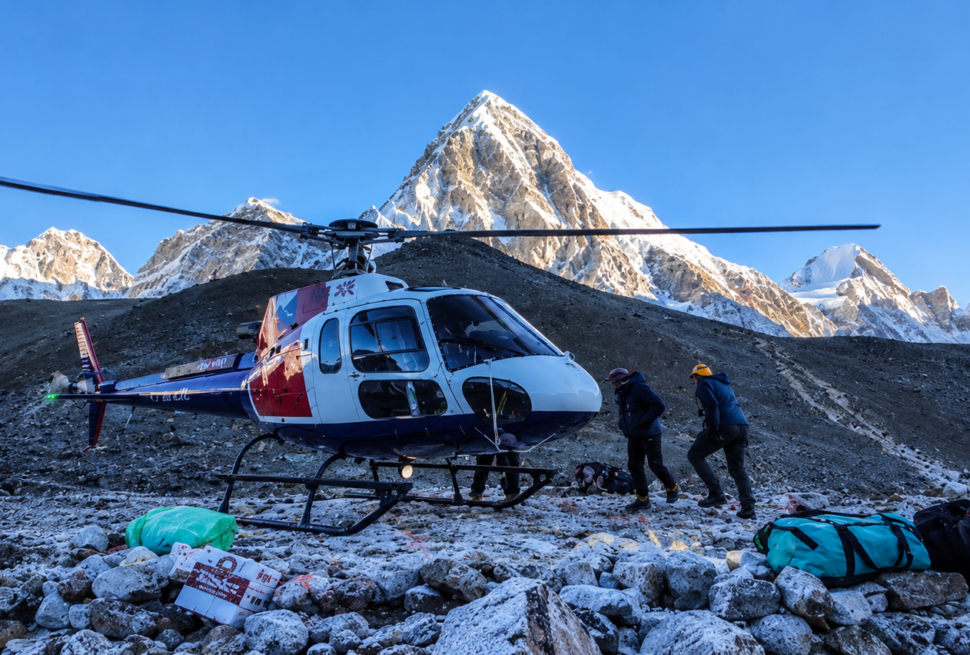
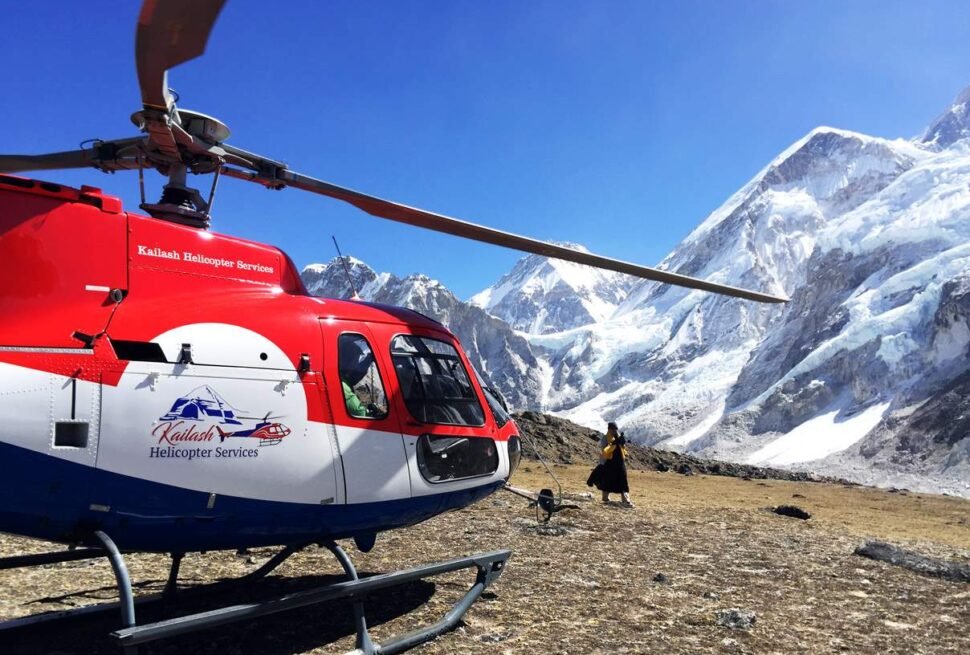
The Everest Base Camp helicopter tour is a completely different kind of experience. Instead of walking for two weeks, you board a helicopter in Kathmandu in the early morning and fly directly into the Khumbu region, landing at high altitude viewpoints and returning to the city by mid morning or early afternoon. The entire experience from hotel pickup to hotel drop-off takes four to five hours, including the flight, landings, and transfers. During that time you see virtually everything that long distance trekkers see from the air, the Khumbu Glacier, the Khumbu Icefall, Everest Base Camp, and the surrounding ring of Himalayan peaks, and land at viewpoints including Kala Patthar (5,545m), the famous black ridge that provides the single most celebrated close range view of the Everest South Face available to non mountaineers.
The helicopter tour requires no physical preparation, no multiday commitment, no altitude acclimatisation beyond what your body naturally manages during the brief high altitude stops, and no specialised gear beyond warm clothing for the Kala Patthar landing. It is accessible to virtually any healthy adult, including older travellers, people with physical limitations that preclude multiday trekking, families with young children, and first time Nepal visitors who want the Everest experience without the two week commitment. The cost of the group sharing helicopter tour starts from around $1,250 per person, while private charters start from $4,800 for the whole aircraft. Group tours and honeymoon packages are also available at competitive rates.
Scenery and Views: What Each Experience Shows You
This is arguably the most important comparison for most travellers. Both the trek and the helicopter tour offer extraordinary views of the Khumbu region and its surrounding peaks, but they show you very different aspects of that landscape.
The trek reveals the landscape at ground level and at a walking pace. You walk through Sherpa villages where daily life continues around you, past mani stones and prayer wheels, through forests of pine and rhododendron, across suspension bridges festooned with prayer flags, and up open ridgelines where the high peaks gradually come into view. The scenery builds slowly, revealing itself over days rather than minutes. The moment when Everest first appears above the Lhotse-Nuptse wall, usually around the Namche Bazaar area, is genuinely moving for most trekkers, a mountain that has dominated global imagination suddenly visible in physical reality. As you ascend further, the landscape becomes more austere and dramatic: the vegetation thins, the valleys become more barren, and the glacial moraines and ice formations of the upper Khumbu create a stark, otherworldly environment that feels genuinely remote.
From the ridge at Kala Patthar, reached on the penultimate day of the trek after 12 to 14 days of walking, trekkers get the same ground level view of the Everest South Face that helicopter passengers get at the Kala Patthar helicopter landing. The difference is context: trekkers who have walked for two weeks to reach this point experience the view with an intensity of earned achievement that is profound and deeply personal. The panorama includes Everest (8,849m), Lhotse (8,516m), Nuptse (7,861m), Changtse (7,543m), Pumori (7,161m), and many other significant Khumbu peaks.
The helicopter tour, by contrast, offers something trekkers simply cannot get: aerial views. Flying low over the Khumbu Icefall, the helicopter reveals the full scale of this extraordinary feature, thousands of tonnes of moving ice, seracs, crevasses, and collapse zones, from directly above, at close range. The glacier system visible from the air has a completeness and scale that is impossible to appreciate from any ground level trail. The transition from the green Kathmandu Valley to the high Himalayan terrain takes just over an hour of flying, during which the landscape changes so dramatically and continuously that the aerial perspective becomes its own distinct and extraordinary form of mountain appreciation.
Time Commitment: Two Weeks vs One Morning
The time difference between the two options is the single most striking practical difference. The EBC trek requires a minimum of 12 days of walking, with most itineraries running 14 to 16 days to include proper acclimatisation rest days. Add two or three days in Kathmandu before and after, and the full trip takes at least 16 to 20 days. This is a major commitment that requires significant vacation time, not something most working adults can arrange easily, particularly in Asian or American work cultures where two week vacations are uncommon.
The helicopter tour, by contrast, takes a single morning. Passengers are collected from their Kathmandu hotel before sunrise, fly to the Khumbu and back, and are returned to their hotel before lunch. This means the helicopter tour is genuinely accessible to travellers on short trips to Nepal, those with a three or four-day layover in Kathmandu, business travellers with a free day, or visitors who have other itinerary commitments in Nepal and can spare only one morning for the Everest experience.
For many travellers, particularly those over 50 who dream of Everest but cannot commit to a multi-week high altitude trek, or families travelling with children who cannot sustain two weeks of demanding hiking, the helicopter tour is not a compromise, it is the only realistic option. And given the extraordinary aerial perspective and the Kala Patthar landing at 5,545 metres, it is an experience that stands completely on its own merits rather than simply being a lesser substitute for the trek.
Physical Requirements: Fit vs Everyone
The EBC trek demands genuine physical preparation. Most guides recommend three to six months of aerobic fitness training before attempting the trek, including regular hiking at elevation if possible, strength training for the legs and core, and cardiovascular conditioning. This is not to say that you need to be an ultra-runner, many people of modest fitness complete the trek successfully, but arriving unprepared significantly increases the risk of altitude sickness, injury from cumulative fatigue, and having to cut the trek short.
The helicopter tour has effectively no physical requirements beyond being healthy enough to fly. Passengers sit in the aircraft during transit and stand or walk slowly on the ground at landing sites. Even at Kala Patthar (5,545m), passengers typically walk no more than 50 to 100 metres from the landing area. The brief altitude exposure can cause mild symptoms in some people, and supplemental oxygen is available on board and at the landing site, but the risk is orders of magnitude lower than for trekkers who spend multiple consecutive nights at high altitude.
This makes the helicopter tour genuinely inclusive in a way that the trek is not. Senior travellers in their 60s, 70s, and even 80s regularly complete the tour without difficulty. People with mobility limitations, chronic conditions that would exclude them from high altitude trekking, or who are recovering from injury can participate. Parents can bring young children. The helicopter tour opens the Khumbu region to a vastly wider range of visitors than the trek can accommodate.
Cost Comparison: Trekking vs Flying
Cost is one area where the comparison is more nuanced than it first appears. The helicopter tour has an upfront cost that looks higher than a basic trek budget, but when you factor in the full cost of a well-organised trekking experience, the gap narrows considerably.
| Cost Item | EBC Trek (14 days) | Helicopter Tour |
|---|---|---|
| Main experience cost | $1,500, $3,500 | $1,100, $4,800 |
| Permits (park + TIMS) | $60, $80 | Included |
| Guide fee | $300, $600 | Not required |
| Porter fee | $200, $400 | Not required |
| Accommodation (14 nights) | $200, $600 | Not required |
| Food on trail (14 days) | $300, $500 | Not required |
| Lukla flight | $200, $350 | Included in tour |
| Travel insurance (14+ days) | $100, $300 | $30, $80 (day trip) |
| Gear purchase or rental | $200, $800 | Warm clothing only |
| Total realistic budget | $2,860, $6,530 | $1,160, $4,930 |
When you add up the true cost of a well-organised trek, guides, porters, permits, Lukla flights, teahouse accommodation, three meals per day for two weeks, gear, and insurance, the budget is often higher than the helicopter tour cost for the mid-range group sharing option. The private charter is more expensive than a basic budget trek, but less expensive than a fully guided private trekking experience with high quality accommodation. The group helicopter tour at $1,100 per person is one of the most cost effective ways to see the Khumbu region.
Cultural Immersion: Deep vs Panoramic
One area where the trek offers something the helicopter tour cannot replicate is cultural depth. The EBC trek passes through a series of Sherpa villages, Phakding, Namche Bazaar, Khumjung, Tengboche, Pangboche, Dingboche, Lobuche, Gorak Shep, each with its own character, its own monastery or gompa, its own community of Sherpa families who have lived in the Khumbu for generations. Spending two weeks walking through these villages gives trekkers a genuine, if modest, glimpse into Sherpa culture: the yak caravans on the trail, the juniper incense at monastery doorways, the prayer flags strung between ridges, the remarkably welcoming teahouse hosts who make even long, exhausting days end warmly. Many trekkers describe the cultural experience of the Khumbu as the unexpected highlight of their trip, something they valued even more than the mountain views.
The helicopter tour does not provide this cultural immersion. In four to five hours, there is no time to walk through a Sherpa village, sit in a monastery, or have a meal with a local family. The cultural exposure is aerial, you see the villages and monasteries from the air, you land briefly in the landscape, and then you return to Kathmandu. For some travellers this is an acceptable trade-off given the time saved. For others, the cultural dimension is central to why they want to visit the Khumbu and makes the trek the clearly correct choice.
Safety: Which Option Is Safer?
Both activities carry risk, but the nature of the risk is very different.
The EBC trek’s primary risk is altitude sickness in its various forms: Acute Mountain Sickness (AMS), High Altitude Pulmonary Oedema (HAPE), and High Altitude Cerebral Oedema (HACE). AMS affects a majority of trekkers to some degree, with symptoms ranging from mild headache and nausea to severe incapacitation. HAPE and HACE are rare but life-threatening. The standard protocol, ascend slowly, rest on acclimatisation days, never ascend when symptomatic, reduces the risk significantly, but altitude sickness remains the reason that helicopter evacuations from the Khumbu region are common, and travel insurance covering emergency evacuation is considered mandatory for all trekkers. Other trekking risks include trail injuries from uneven terrain, hypothermia in cold weather, and general fatigue-related incidents.
The helicopter tour has a very different safety profile. Commercial helicopter operations in Nepal are subject to CAAN (Civil Aviation Authority of Nepal) safety regulations, and flights are cancelled whenever conditions are outside the safe operating envelope. The biggest safety consideration for passengers is the brief altitude exposure at Kala Patthar (5,545m), which can produce mild altitude symptoms. However, the exposure time is short, typically 20 to 30 minutes on the ground, and supplemental oxygen is available. Helicopter flying in mountain terrain carries its own risks, as evidenced by a historical record of helicopter incidents in Nepal, but licensed commercial tour operators with experienced mountain pilots have a strong safety record. The overall risk to a healthy helicopter tour passenger is considerably lower than the risk to a trekker spending 12 days at high altitude.
Best of Both Worlds: Trek In, Fly Out
One increasingly popular option that falls between the two choices is the combination itinerary: trek to Everest Base Camp on foot and return by helicopter from Gorak Shep or Lukla. This approach gives you the full cultural immersion, the physical achievement, and the ground level experience of the upward journey, while saving several days on the descent, which many trekkers find less rewarding than the ascent as the novelty of the landscape diminishes. The helicopter descent from Gorak Shep to Kathmandu takes under two hours and dramatically reduces the total trip duration, allowing a 16-day trek experience to be compressed to 10 to 12 days.
Many serious trekkers who have previously completed the full round trip trek on foot opt for the helicopter on their second visit, having already experienced the cultural and physical journey of the ascent, they choose the aerial perspective of the return. This is a testament to the genuinely different value that the helicopter tour adds even to experienced Himalayan trekkers.
Who Should Trek and Who Should Fly: Honest Recommendations
Based on everything above, here is a straightforward guide to which option is likely right for you:
Choose the EBC Trek if: You have 14 to 16 days available and can take that time off work without difficulty. You are reasonably fit and enjoy multiday hiking. You want deep cultural immersion in Sherpa communities and the journey itself is as important as the destination. You want the profound sense of physical achievement that comes from reaching Base Camp on foot. You are in your 20s, 30s, or 40s with no significant health conditions. This is a bucket list experience you want to fully inhabit rather than efficiently tick off.
Choose the EBC Helicopter Tour if: You have limited time, a week or less in Nepal. You are over 60, have reduced mobility, or have health conditions that make multiday high altitude trekking inadvisable. You are travelling with young children, elderly family members, or a mixed group with varied physical abilities. You want to see Everest and the Khumbu region and the aerial perspective genuinely excites you. You are on a honeymoon or special occasion and want a dramatic, memorable experience without the camping and teahouse roughing-it of the trek. You have already trekked to Base Camp and want to experience the region from a completely different perspective. Consider our honeymoon helicopter package, our group tour, or our Kala Patthar landing tour depending on what suits your group.
The Gokyo Option: Beyond EBC
For travellers who want maximum Khumbu coverage in minimum time, our EBC with Gokyo Helicopter Tour extends the aerial journey to include the dramatic Gokyo Lakes and the Ngozumpa Glacier, Nepal’s longest glacier, beyond Everest Base Camp and the Khumbu region. This extended tour takes you deep into the western Khumbu valleys that many trekkers never reach even on a standard EBC trek, covering terrain that would take an additional four to six days on foot.
Conclusion: There Is No Wrong Answer
The Everest Base Camp trek and the EBC helicopter tour are not competing products, they are fundamentally different experiences of the same extraordinary landscape. The trek is a two week physical and cultural immersion that tests your body, rewards your patience, and builds lasting memories through cumulative effort. The helicopter tour is a concentrated, aerial, one-morning encounter with the Himalayas that offers perspectives and accessibility unavailable to trekkers and compresses the visual grandeur of the Khumbu into a single memorable flight.
The right choice depends entirely on who you are, what you have, and what you want. If you have the time, the fitness, and the desire for immersion, trek. If you have a morning, a budget, and a hunger for the kind of Himalayan panorama that no ground trail can provide, fly. And if you have both the ambition and the resources, do both, on separate trips, and discover that the Khumbu rewards you differently every time.
Ready to book your Everest helicopter tour? Explore our Everest Base Camp Helicopter Tour, our Kala Patthar Landing Tour, or our EBC with Gokyo Heli Tour and experience Nepal’s most extraordinary landscape on your terms.
The Psychology of the Two Experiences: What Each Leaves You With
One dimension that travel guides rarely discuss is the psychological aftermath, what each experience leaves behind in memory and emotion long after you return home. Understanding this dimension matters because it shapes the meaning of the journey and whether you feel, a year later, that it was the right choice.
Trekkers who complete the EBC route almost universally describe it as one of the most significant physical experiences of their lives. The combination of sustained physical challenge, progressive altitude, daily rhythm of walking and rest, communal teahouse evenings, and the building anticipation across days of approach creates an emotional arc that mirrors a narrative, it has a beginning, a middle, a climax at Base Camp or Kala Patthar, and a denouement on the descent. This narrative structure means the trek feels like an achievement in a deep sense. You earned this view. Your body carried you to this place. The struggle is inseparable from the reward, and most trekkers say the most emotional moment is not the arrival at Base Camp but a quiet moment somewhere on the trail when they understand viscerally what they are doing and where they are.
Helicopter tour passengers report a different but equally genuine emotional experience. For many, the helicopter flight produces what can only be described as awe, the sudden, overwhelming encounter with scale and beauty that has no preparation period. Unlike the trek, where Everest appears gradually on the horizon over several days, the helicopter delivers you directly into the heart of the Himalayan scenery in under an hour. The psychological impact of going from the streets of Kathmandu to the foot of Everest in 60 minutes is profound in its own way, a disorienting leap across spatial and experiential distance that creates a vivid, lasting memory precisely because of its brevity and intensity. Many helicopter tour passengers describe the experience as “unreal”, a word that captures how difficult it is to process the sensory intensity of the Khumbu at speed.
Neither emotional experience is superior to the other. They are simply different, and understanding which type resonates more with your own psychology will help guide your choice.
Environmental Impact: Which Is More Sustainable?
Responsible travel in the Himalayas requires considering environmental impact, and both the trek and the helicopter tour have distinct sustainability profiles that are worth examining honestly.
The EBC trek’s environmental footprint is multifaceted. The Khumbu region’s rapid growth as a trekking destination has created well documented environmental pressures: waste accumulation on popular trails and at Base Camp itself, deforestation in the lower valleys historically driven by the demand for firewood from teahouses (now largely replaced by alternative fuels), and the strain that thousands of daily trekkers place on the limited water and waste infrastructure of remote mountain villages. Responsible trekking, using established teahouses that have adopted sustainable practices, carrying out rubbish, staying on designated trails, and supporting community-run lodges, significantly reduces this impact, but even the most conscientious trekker occupies the trail for two weeks and generates food waste, packaging waste, and plastic waste throughout.
The helicopter tour’s primary environmental impact is aviation fuel consumption and associated emissions. A helicopter flight burns considerably more fuel per kilometre than ground transportation, and aviation emissions have a disproportionate warming effect at altitude. This is a real environmental cost that should not be dismissed. However, the helicopter tour generates essentially no trail-based waste and places no pressure on the teahouse and trail infrastructure of the Khumbu region. For operators who are careful about landing site management and passenger conduct at high altitude stops, the on-the-ground environmental impact is minimal. From a purely local ecosystem perspective, the brief helicopter visit leaves a significantly lighter footprint than a two week trekking party.
The most environmentally sustainable choice in absolute terms is probably to visit the Khumbu via helicopter on a single trip rather than multiple trekking expeditions, but the most valuable long term relationship between visitors and the Himalayan environment is one built on genuine understanding of and attachment to the landscape, which the trek does more to foster than the aerial visit. Responsible visitors to the Khumbu, whether by foot or by air, should look for operators who contribute to conservation funds, employ local guides and crew, and follow waste management protocols at all stops.
Seasonal Considerations: When Each Option Works Best
The EBC trek and the helicopter tour have different seasonal windows, and understanding these differences matters for trip planning.
The EBC trek operates in two main seasons: spring (March to May) and autumn (September to November). Spring is the busiest season due to the overlap with Everest climbing season, when expeditions attempting the South Col route are active on the mountain. The trail is at its most crowded in April and May, teahouses require advance booking, and the approach to Base Camp has the added drama of seeing expedition tents dotting the Khumbu Glacier. Autumn is often considered the best trekking season for the EBC route: the post monsoon atmosphere creates crystal clear visibility, the trail is marginally less crowded than spring, and the Khumbu landscape takes on the golden tones of Himalayan autumn. Winter trekking (December to February) is possible for experienced trekkers but requires proper cold-weather gear and acceptance of colder temperatures and potentially closed high passes. Monsoon season (June to August) is not recommended for the EBC trek due to heavy rainfall, leeches in the lower valleys, poor visibility, and trail conditions.
The helicopter tour operates year round but has its own weather dependencies. Flights depend on clear visibility and acceptable wind conditions, which are most reliable in spring and autumn, the same peak trekking seasons. In winter, the helicopter tour is actually excellent: the air is exceptionally clear, visibility of the peaks is often at its very best, and the Khumbu landscape in snow looks dramatic. The cold at the Kala Patthar landing is more intense in winter, requiring proper warm clothing, but the photographic conditions and clarity of the mountain views make December to February an underrated time for the helicopter tour. Monsoon season (June to August) is the most difficult for helicopter operations due to cloud cover, but morning flights when weather windows exist can still operate. The team monitors conditions daily and reschedules on weather-cancelled days at no charge.
Group Dynamics: Solo, Couple, Family, or Corporate Group
The social dynamic of your group significantly affects which option is better suited.
Solo travellers thrive on the EBC trek, where the teahouse social scene creates an organic community of fellow trekkers from around the world. Many solo trekkers find the trail’s social infrastructure, shared meals, shared experiences, chance conversations with other walkers, to be one of the most rewarding aspects of the trip. The helicopter tour is equally accessible for solo travellers, particularly on group sharing flights where you are joined by other passengers, though the very brief duration limits the social dimension.
Couples, particularly on special occasions, find the helicopter tour particularly well suited to the intensity and intimacy of shared wonder. Our Everest Helicopter Tour Honeymoon Package is specifically designed for couples who want to mark their journey with the extraordinary visual drama of the Khumbu. A two-person private helicopter experience over Everest is genuinely among the most romantic adventures available anywhere in the world, the combination of aerial solitude, mountain grandeur, and once in a lifetime intensity creates an experience that couples describe as one of the defining memories of their relationship.
Families with children have a clear preference for the helicopter tour, which provides all the visual drama of the Khumbu without requiring children to walk for two weeks at altitude. Children as young as five or six regularly take the helicopter tour with their parents, returning to Kathmandu in time for lunch. The experience sparks genuine wonder in young visitors who see the world’s highest mountain from close range at an age when such impressions are particularly formative.
Corporate and incentive groups choose the helicopter tour almost exclusively, as the trek’s duration and physical demands make it impractical as a group activity for mixed-fitness professional teams. Our group helicopter tour can accommodate multiple passengers simultaneously and creates a shared extraordinary experience that builds team memory and bonds in a way that conventional corporate events cannot replicate.
What Travellers Actually Say: Comparing Reviews
Looking at what experienced travellers report from both experiences reveals consistent patterns that are worth highlighting.
Trekkers who complete the EBC route consistently rate the cultural experience and personal achievement as the highlights, often mentioning specific teahouse hosts by name, describing conversations with Sherpa guides, and pointing to a particular moment on the trail as transformative. The scenery is always mentioned, but rarely as the primary reason the experience was meaningful. Many experienced EBC trekkers say they would do it again, but also say they appreciate the helicopter tour when they return to Nepal with less time or with family members who cannot trek.
Helicopter tour passengers consistently highlight the aerial perspective, the Kala Patthar landing, and the surprise at how emotionally powerful the experience is in such a short time. The most common phrase in helicopter tour reviews is some variant of “I didn’t expect it to feel this way”, expressing genuine surprise at the depth of emotion generated by the brief but intense encounter with the Khumbu landscape. Travellers who were unsure whether the helicopter tour would “count” as a real Everest experience consistently report that the experience was far more powerful than they anticipated.
The pattern that emerges clearly is this: both experiences deliver what they promise, and the rare dissatisfied customer is almost always someone who chose the wrong option for their situation, a trekker who committed to two weeks without adequate fitness preparation, or a helicopter tour passenger who wanted more cultural depth than a single morning flight can provide. The key is honest self-assessment before you book.
Practical Tips: Preparing for Each Option
Regardless of which option you choose, preparation makes the difference between a good experience and a great one. For the EBC trek, the single most important preparation is cardiovascular fitness training over three to six months before your trip. Long-distance hiking with elevation gain, stair climbing, cycling, or any sustained aerobic activity will build the base fitness needed. Equally important is gear preparation: appropriate layering, broken-in trekking boots, trekking poles, a quality sleeping bag, and a down jacket for the upper elevations are all essential. Studying the acclimatisation schedule and committing to it even when you feel well is the single most important safety decision you will make on the trek.
For the helicopter tour, the practical preparation is minimal by comparison. The most important items are: warm clothing (a down jacket, gloves, and warm hat for the Kala Patthar landing regardless of season), sunglasses for the intense Himalayan UV, a camera with a fully charged battery, and arrival at the collection point in time for the early morning departure. We recommend arriving in Kathmandu at least one day before your tour date to allow for any flight delays or jetlag recovery, and building an extra day of flexibility in your Nepal itinerary in case of weather rescheduling on your chosen tour date.
For either option, full travel insurance covering medical evacuation is strongly recommended. In the Khumbu region, emergency helicopter evacuation is the only practical means of reaching hospital care quickly, and the cost of an uninsured evacuation from high altitude can be very high. Most standard travel insurance policies do not cover high altitude activities by default, make sure your policy explicitly covers trekking above 4,000 metres or helicopter tours to extreme altitude before purchasing.
Final Verdict: The Decision Framework
Here is a simple decision framework for choosing between the EBC trek and the helicopter tour. Answer these three questions:
1. How much time do you have? If you have fewer than 10 days in Nepal, the helicopter tour is your clear choice. If you have 14 or more days and want to spend them in the Khumbu, the trek is viable.
2. What is your fitness level and health situation? If you are over 65, have any cardiovascular or respiratory conditions, or are not regularly physically active, the helicopter tour is the appropriate and safe choice. If you are in good aerobic health and enjoy physical challenges, the trek is achievable with preparation.
3. What kind of experience are you looking for? If you want immersion, cultural depth, the journey as the destination, and the deep satisfaction of physical achievement, trek. If you want concentrated visual intensity, an aerial perspective unavailable from any trail, accessibility for all members of your group, and a morning-length encounter with the world’s highest peaks, fly.
Whatever you decide, the Khumbu region will reward you. There is no experience in the world quite like encountering the scale and majesty of the Everest region, whether your legs carry you there over two weeks or a helicopter brings you in an hour. Both are extraordinary. Both are real. Both are deeply, unforgettably Nepal.
Explore all our Everest helicopter tour options at Mt Everest Helicopter Tour and find the experience that is right for you.