Muktinath is one of Nepal’s most sacred pilgrimage sites, venerated simultaneously by Hindus and Buddhists for different but overlapping theological reasons. It sits at 3,710 metres in the Mustang district of northwestern Nepal, in the upper Gandaki River valley at the base of the Thorong La pass. For most of Nepal’s history, reaching Muktinath required a multiday walk from the nearest road head. The helicopter tour from Pokhara changed this, making it accessible as a single-day experience from Nepal’s second-largest city.
What Muktinath Is
The Muktinath Temple complex sits within a walled enclosure at 3,710 metres. The main Hindu temple, dedicated to Vishnu in his form as Muktinath (the Lord of Liberation), is a pagoda-style structure that draws pilgrims from across Nepal and India. The name Muktinath means liberation lord or lord who gives liberation in Sanskrit, reflecting the theological significance of the site as a place where Hindu devotees can achieve moksha, liberation from the cycle of rebirth.
Within the same temple complex, a Buddhist monastery called Jwala Mai Temple (fire temple) sits adjacent to the Hindu structures. The monastery contains a natural flame fed by natural gas seeping through a spring, where water and fire emerge from the same source. This phenomenon, water and fire coexisting in the same place, is considered miraculous in both Hindu and Buddhist traditions and is one of the primary reasons for Muktinath’s dual-faith significance. The 108 water spouts arranged in a semicircle that surround the main temple, through which ice-cold spring water flows continuously, are used by pilgrims for ritual bathing as an act of purification.
For Tibetan Buddhists, Muktinath is called Chumig Gyatsa, meaning a hundred waters in Tibetan. It is one of the 24 Tantric sites described in ancient Buddhist texts and is associated with the Dakinis, female spirit figures in Vajrayana Buddhism. Tibetan pilgrims have walked the Mustang route to Muktinath for centuries.
The Helicopter Route from Pokhara
Pokhara sits at 822 metres in the Gandaki Zone of western Nepal, roughly 200 kilometres west of Kathmandu. It is the main gateway to the Annapurna region and the operational base for helicopter tours in the western Himalaya. The Muktinath helicopter tour departs from Pokhara airport, flies northeast up the Gandaki Valley and Kali Gandaki Gorge, and reaches Muktinath after approximately 40 to 50 minutes of flying time.
The Kali Gandaki Gorge, which the helicopter traverses for a significant portion of the route, is the world’s deepest gorge by one common definition: the vertical distance between the gorge floor and the flanking summits of Annapurna I (8,091 metres) and Dhaulagiri (8,167 metres) exceeds 5,500 metres, more than the vertical drop of the Grand Canyon. From the helicopter, this measurement becomes physical reality. The gorge walls rise steeply on both sides, the river below appears as a thread of white water thousands of metres below, and the summits of the two 8,000-metre peaks are visible in the upper frame of the view.
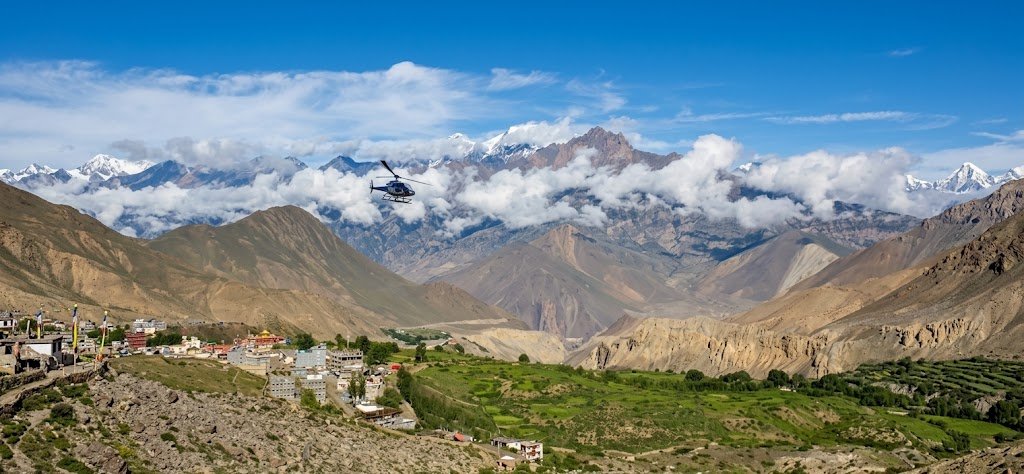
The cultural landscape changes visibly during the flight as you move from the lush, green Pokhara valley into the rain shadow of the Himalaya. Above the gorge, the Mustang district is semi-arid, with brown and ochre terrain, flat-roofed white-painted villages, and a landscape that resembles Tibet far more than the southern Nepal lowlands you departed from. The transition happens within minutes and is one of the most striking visual sequences of any Nepal helicopter tour.
What to Do at Muktinath
Standard Muktinath helicopter tours from Pokhara allow 1 to 2 hours on the ground at the temple complex. This is enough time to walk through the main temple, observe or participate in the ritual bathing at the 108 spouts, visit the Buddhist monastery and its natural flame, and walk the perimeter of the walled complex with the view of the upper Mustang valley and the Thorong La ridge behind.
The ritual bathing at the 108 spouts deserves specific mention. The water is fed by glacial springs and is extremely cold, between 4 and 8 degrees Celsius year round. Pilgrims, particularly Hindu pilgrims who have walked from India over multiple weeks, pass under each of the 108 spouts as an act of purification. Visitors who are not Hindu pilgrims can observe this without participating, or can participate if they choose. The cultural protocol is to dress modestly, remove shoes before entering the temple inner area, and observe quietly rather than photograph at close range without permission from the people being photographed.
The local market below the temple sells items typical of the Mustang district: thangka paintings (Tibetan Buddhist scroll paintings), prayer wheels, turquoise and coral jewelry, yak wool textiles, and Mustang apple products. The Mustang district is known for its apple cultivation, and during harvest season (September to November) fresh apples, dried apples, apple brandy, and apple jam are available in the shops below the temple.
Muktinath Helicopter Tour Cost in 2026
A shared group helicopter tour from Pokhara to Muktinath and back in 2026 costs approximately USD 400 to USD 550 per person. A private charter for the same route runs approximately USD 2,000 to USD 2,800 for the full helicopter, accommodating 4 to 5 passengers.
These prices include the helicopter, the landing fee at Muktinath, and fuel. They do not include the temple entry fee (approximately NPR 500 or roughly USD 4), camera fees if applicable, or any purchases at the local market. Most operators also require a Nepal government protected area permit for the Mustang district, which costs approximately USD 500 for the first 10 days as of 2026 for the restricted Upper Mustang zone. Note that standard Muktinath is in Lower Mustang (not the restricted zone), so the basic Annapurna Conservation Area Permit (ACAP, approximately NPR 3,000 or USD 22) is sufficient for the standard helicopter tour.
When to Go: Best Season for Muktinath Helicopter Tour
The Mustang district sits in the rain shadow of the Annapurna range, which means it receives significantly less monsoon rainfall than the rest of Nepal. While the Pokhara and Kathmandu regions are fully monsoon-affected from June to September, Mustang remains drier during these months. This makes the Muktinath helicopter tour one of the few Himalayan activities in Nepal that continues to operate during what is normally the monsoon off-season.
Spring (March to May) and autumn (October to November) are the most reliable seasons for the Pokhara-to-Muktinath route, with clear skies and good mountain visibility for the gorge transit. Summer (June to September) is flyable in Mustang on many days but requires checking conditions each morning, as monsoon cloud can affect the Pokhara departure even when Mustang itself is clear. Winter (December to February) is cold at 3,710 metres but technically flyable, with excellent clarity and minimal tourist crowds.
Combining Muktinath with Annapurna Base Camp Helicopter Tour
Some operators offer combined helicopter tours from Pokhara that cover both Annapurna Base Camp (4,130 metres) and Muktinath (3,710 metres) in a single day, with the ABC stop in the morning and the Muktinath cultural visit afterward. This combination covers two very different experiences: the glaciated high altitude bowl of Annapurna Base Camp with its wall of Annapurna summits, followed by the semi-arid, culturally rich landscape of Mustang.
The combined tour makes for a long morning (departures at 6:00 AM, return by 11:00 to 12:00 AM) but is logistically sound when weather cooperates. Ask specifically whether the combined tour maintains the Muktinath ground time you want, as some operators reduce it to 30 to 45 minutes when combining routes, which is not enough for a full temple visit.
Reaching Pokhara from Kathmandu
Pokhara is approximately 200 kilometres west of Kathmandu and is reachable by domestic flight (25 to 30 minutes, multiple daily departures from Tribhuvan International Airport), tourist bus (6 to 7 hours along the Prithvi Highway), or private vehicle. The domestic flight option is strongly recommended if you are combining the Muktinath helicopter tour with other Pokhara activities and have limited Nepal travel time. Buddha Air, Yeti Airlines, and Tara Air operate regular Kathmandu to Pokhara routes with morning departures that fit a schedule of arriving in Pokhara and joining a helicopter tour the following morning.
Related reading: Everest Base Camp Helicopter Tour | Annapurna Helicopter Tour Guide | Helicopter vs Mountain Flight | How to Book a Nepal Helicopter Tour